airbag off PONTIAC G8 2009 User Guide
[x] Cancel search | Manufacturer: PONTIAC, Model Year: 2009, Model line: G8, Model: PONTIAC G8 2009Pages: 356, PDF Size: 1.83 MB
Page 54 of 356
Securing Child Restraints
(Right Front Seat)
This vehicle has airbags. A rear
seat is a safer place to secure
a forward-facing child restraint.
SeeWhere to Put the Restraint
on page 1-40.
In addition, the vehicle has a
passenger sensing system which
is designed to turn off the right front
passenger frontal airbag under
certain conditions. SeePassenger
Sensing System on page 1-27
andPassenger Airbag Status
Indicator on page 4-14for more
information, including important
safety information.A label on the sun visor says,
“Never put a rear-facing child seat
in the front.” This is because the risk
to the rear-facing child is so great,
if the airbag deploys.
{CAUTION
A child in a rear-facing child
restraint can be seriously injured or
killed if the right front passenger
airbag inates. This is because
the back of the rear-facing child
restraint would be very close to
the inating airbag. A child in a
forward-facing child restraint can
be seriously injured or killed if the
right front passenger airbag
inates and the passenger seat
is in a forward position.
(Continued)
CAUTION (Continued)
Even if the passenger sensing
system has turned off the right
front passenger frontal airbag, no
system is fail-safe. No one can
guarantee that an airbag will not
deploy under some unusual
circumstance, even though it is
turned off.
Secure rear-facing child restraints
in a rear seat, even if the airbag is
off. If you secure a forward-facing
child restraint in the right front seat,
always move the front passenger
seat as far back as it will go. It is
better to secure the child restraint
in a rear seat.
SeePassenger Sensing System
on page 1-27for additional
information.
1-50 Seats and Restraints
Page 55 of 356
If the child restraint has the LATCH
system, seeLower Anchors and
Tethers for Children (LATCH)
on page 1-42for how and where to
install the child restraint using
LATCH. If a child restraint is secured
using a safety belt and it uses a
top tether, seeLower Anchors and
Tethers for Children (LATCH)
on page 1-42for top tether anchor
locations.
Do not secure a child seat in a
position without a top tether anchor
if a national or local law requires
that the top tether be anchored, or if
the instructions that come with
the child restraint say that the top
strap must be anchored.
In Canada, the law requires that
forward-facing child restraints have a
top tether, and that the tether be
attached.You will be using the lap-shoulder
belt to secure the child restraint in
this position. Follow the instructions
that came with the child restraint.
1. Move the seat as far back as it
will go before securing the
forward-facing child restraint.
When the passenger sensing
system has turned off the
right front passenger frontal
airbag, the off indicator on
the passenger airbag status
indicator should light and stay lit
when the vehicle is started.
SeePassenger Airbag Status
Indicator on page 4-14.
2. Put the child restraint on the seat.3. Pick up the latch plate, and run
the lap and shoulder portions
of the vehicle’s safety belt
through or around the restraint.
The child restraint instructions
will show you how.
4. Push the latch plate into the
buckle until it clicks.
Position the release button, on
the buckle so that the safety belt,
could be quickly unbuckled if
necessary.
Seats and Restraints 1-51
Page 56 of 356
5. Pull the rest of the shoulder belt
all the way out of the retractor to
set the lock.6. To tighten the belt, push down
on the child restraint, pull the
shoulder portion of the belt to
tighten the lap portion of the belt
and feed the shoulder belt back
into the retractor. When installing
a forward-facing child restraint, it
may be helpful to use your knee
to push down on the child
restraint as you tighten the belt.
7. Push and pull the child restraint
in different directions to be sure
it is secure.If the airbag is off, the off indicator
in the passenger airbag status
indicator will come on and stay on
when the vehicle is started.
If a child restraint has been installed
and the on indicator is lit, see
“If the On Indicator is Lit for a
Child Restraint” underPassenger
Sensing System on page 1-27
for more information.
To remove the child restraint,
unbuckle the vehicle safety belt and
let it return to the stowed position.
1-52 Seats and Restraints
Page 90 of 356
Passenger Airbag Status
Indicator
The vehicle has a passenger
sensing system. SeePassenger
Sensing System on page 1-27
for important safety information.
The rearview mirror has a
passenger airbag status indicator.
When the vehicle is started, the
passenger airbag status indicator
will light ON and OFF, or the symbol
for on and off, for several secondsas a system check. If you are using
remote start to start your vehicle
from a distance, if equipped,
you may not see the system check.
Then, after several more seconds,
the status indicator will light
either ON or OFF, or either the on
or off symbol to let you know
the status of the right front
passenger frontal airbag.
If the word ON or the on symbol is
lit on the passenger airbag status
indicator, it means that the right front
passenger frontal airbag is enabled
(may inate).
If the word OFF or the off symbol is
lit on the passenger airbag status
indicator, it means that the
passenger sensing system has
turned off the right front passenger
frontal airbag.If, after several seconds, both status
indicator lights remain on, or if
there are no lights at all, there may
be a problem with the lights or
the passenger sensing system.
See your dealer/retailer for service.
{CAUTION
If the airbag readiness light ever
comes on and stays on, it means
that something may be wrong with
the airbag system. To help avoid
injury to yourself or others, have
the vehicle serviced right away.
SeeAirbag Readiness Light on
page 4-13for more information,
including important safety
information. United States
Canada
4-14 Instruments and Controls
Page 103 of 356
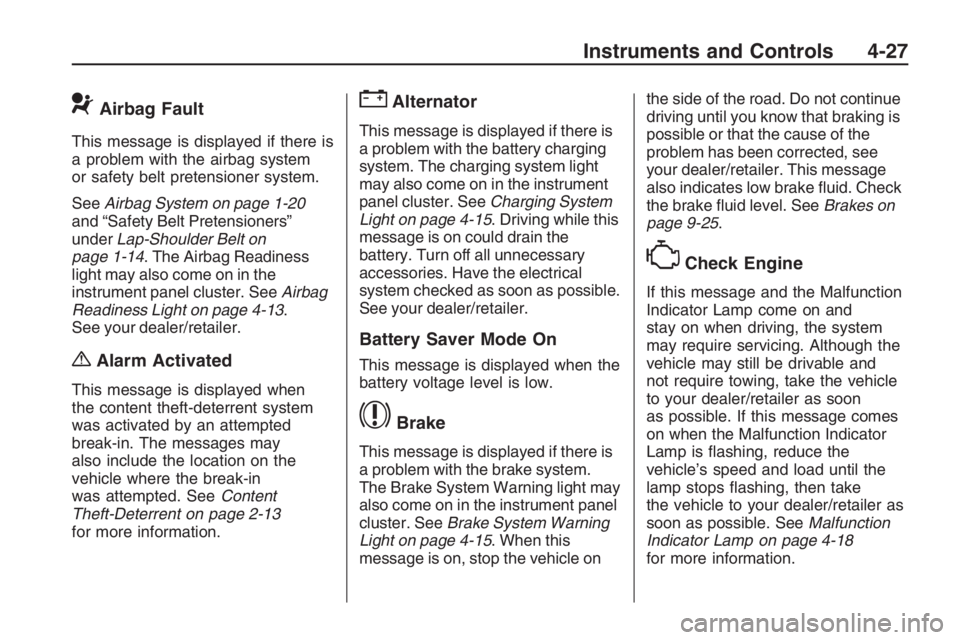
9Airbag Fault
This message is displayed if there is
a problem with the airbag system
or safety belt pretensioner system.
SeeAirbag System on page 1-20
and “Safety Belt Pretensioners”
underLap-Shoulder Belt on
page 1-14. The Airbag Readiness
light may also come on in the
instrument panel cluster. SeeAirbag
Readiness Light on page 4-13.
See your dealer/retailer.
{Alarm Activated
This message is displayed when
the content theft-deterrent system
was activated by an attempted
break-in. The messages may
also include the location on the
vehicle where the break-in
was attempted. SeeContent
Theft-Deterrent on page 2-13
for more information.
"Alternator
This message is displayed if there is
a problem with the battery charging
system. The charging system light
may also come on in the instrument
panel cluster. SeeCharging System
Light on page 4-15. Driving while this
message is on could drain the
battery. Turn off all unnecessary
accessories. Have the electrical
system checked as soon as possible.
See your dealer/retailer.
Battery Saver Mode On
This message is displayed when the
battery voltage level is low.
$Brake
This message is displayed if there is
a problem with the brake system.
The Brake System Warning light may
also come on in the instrument panel
cluster. SeeBrake System Warning
Light on page 4-15. When this
message is on, stop the vehicle onthe side of the road. Do not continue
driving until you know that braking is
possible or that the cause of the
problem has been corrected, see
your dealer/retailer. This message
also indicates low brake uid. Check
the brake uid level. SeeBrakes on
page 9-25.
*Check Engine
If this message and the Malfunction
Indicator Lamp come on and
stay on when driving, the system
may require servicing. Although the
vehicle may still be drivable and
not require towing, take the vehicle
to your dealer/retailer as soon
as possible. If this message comes
on when the Malfunction Indicator
Lamp is ashing, reduce the
vehicle’s speed and load until the
lamp stops ashing, then take
the vehicle to your dealer/retailer as
soon as possible. SeeMalfunction
Indicator Lamp on page 4-18
for more information.
Instruments and Controls 4-27
Page 208 of 356
Doing Your Own
Service Work
{CAUTION
You can be injured and the vehicle
could be damaged if you try to do
service work on a vehicle without
knowing enough about it.
Be sure you have sufficient
knowledge, experience, the
proper replacement parts, and
tools before attempting any
vehicle maintenance task.
Be sure to use the proper
nuts, bolts, and other
fasteners. English and metric
fasteners can be easily
confused. If the wrong
fasteners are used, parts
can later break or fall off.
You could be hurt.If doing some of your own service
work, use the proper service
manual. It tells you much more
about how to service the vehicle
than this manual can. To order the
proper service manual, see
Service Publications Ordering
Information on page 12-15.
This vehicle has an airbag system.
Before attempting to do your
own service work, seeAirbag
System Check on page 1-33.
Keep a record with all parts receipts
and list the mileage and the date
of any service work performed.
SeeMaintenance Record on
page 11-15.
Adding Equipment to the
Outside of the Vehicle
Things added to the outside of the
vehicle can affect the airow
around it. This can cause wind
noise and can affect fuel economy
and windshield washer performance.
Check with your dealer/retailer
before adding equipment to
the outside of the vehicle.
9-4 Vehicle Service and Care
Page 240 of 356
Electrical System
Add-On Electrical
Equipment
Notice:Do not add anything
electrical to the vehicle unless you
check with your dealer/retailer
rst. Some electrical equipment
can damage the vehicle and the
damage would not be covered by
the vehicle’s warranty. Some
add-on electrical equipment can
keep other components from
working as they should.
Add-on equipment can drain the
vehicle battery, even if the vehicle
is not operating.
The vehicle has an airbag system.
Before attempting to add anything
electrical to the vehicle, see
Servicing Your Airbag-Equipped
Vehicle on page 1-31.
Headlamp Wiring
The headlamp wiring is protected by
fuses in the fuse block. An electrical
overload will cause the lamps to
turn off. If this happens, have the
headlamp wiring checked right away.
Windshield Wiper Fuses
The windshield wiper motor is
protected by a circuit breaker and a
fuse. If the motor overheats due
to heavy snow, etc., the wiper will
stop until the motor cools. If the
overload is caused by some
electrical problem, have it xed.
Power Windows and
Other Power Options
Circuit breakers in the fuse block
protect the power windows and
other power accessories. When the
current load is too heavy, the
circuit breaker opens and closes,
protecting the circuit until the
problem is xed or goes away.
Instrument Panel Fuse
Block
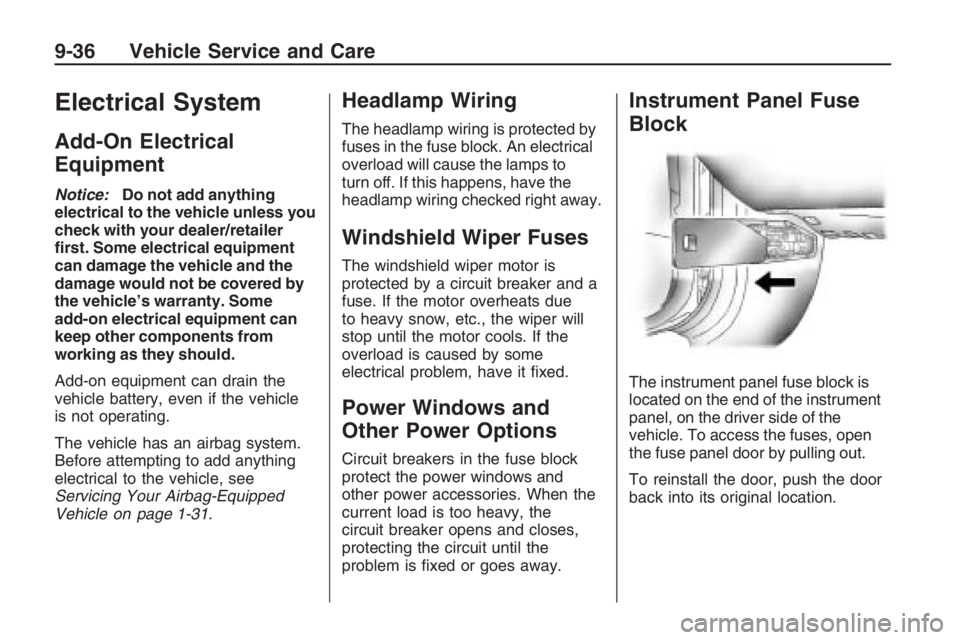
The instrument panel fuse block is
located on the end of the instrument
panel, on the driver side of the
vehicle. To access the fuses, open
the fuse panel door by pulling out.
To reinstall the door, push the door
back into its original location.
9-36 Vehicle Service and Care
Page 352 of 356
Light (cont.)
Brake System Warning......4-15
Charging System..............4-15
Daytime Running Lamps
Indicator.......................4-21
Door Ajar.........................4-21
Fog Lamp ........................4-20
Highbeam On...................4-20
Passenger Airbag Status
Indicator.......................4-14
Safety Belt Reminders.......4-12
Security...........................4-20
Tire Pressure...................4-17
Lighting
Perimeter.......................... 5-4
Lights
Exterior Lamps................... 5-1
High/Low Beam Changer..... 4-7
Loading Your Vehicle............8-30
Locks
Door ................................. 2-8
Power Door ....................... 2-9
Rear Door Security Locks.... 2-9
Loss of Control....................8-23
Lower Anchors and Tethers
for Children......................1-42
Lumbar Seat Adjustment......... 1-2M
Maintenance Schedule
Additional Required
Services.......................11-6
At Each Fuel Fill..............11-9
At Least Once a Month.....11-9
At Least Once a Year......11-10
Introduction......................11-1
Maintenance Footnotes......11-7
Maintenance Record........11-15
Maintenance
Requirements...............11-2
Normal Maintenance
Replacement Parts.......11-13
Owner Checks and
Services.......................11-9
Recommended Fluids and
Lubricants...................11-12
Scheduled Maintenance.....11-4
Using..............................11-2
Your Vehicle and the
Environment.................11-2
Malfunction Indicator Lamp....4-18
Manual Seats........................ 1-2
Manual Transmission
Operation........................8-10Message
DIC Warnings and
Messages....................4-26
Mirrors
Manual Rearview Mirror.....2-16
Outside Convex Mirror.......2-18
Outside Power Mirrors.......2-17
MP3 ...................................6-20
MyGMLink.com....................12-3
N
Navigation System,
Privacy..........................12-17
New Vehicle Break-In............. 8-2
Normal Maintenance
Replacement Parts..........11-13
Notices and Cautions............... iii
O
Off-Road Recovery...............8-23
Oil
Engine.............................. 9-8
Pressure Gage.................4-21
Oil, Engine Oil Life System....9-10
Older Children, Restraints......1-34
i-6 INDEX