seats PONTIAC G8 2009 Workshop Manual
[x] Cancel search | Manufacturer: PONTIAC, Model Year: 2009, Model line: G8, Model: PONTIAC G8 2009Pages: 356, PDF Size: 1.83 MB
Page 54 of 356
Securing Child Restraints
(Right Front Seat)
This vehicle has airbags. A rear
seat is a safer place to secure
a forward-facing child restraint.
SeeWhere to Put the Restraint
on page 1-40.
In addition, the vehicle has a
passenger sensing system which
is designed to turn off the right front
passenger frontal airbag under
certain conditions. SeePassenger
Sensing System on page 1-27
andPassenger Airbag Status
Indicator on page 4-14for more
information, including important
safety information.A label on the sun visor says,
“Never put a rear-facing child seat
in the front.” This is because the risk
to the rear-facing child is so great,
if the airbag deploys.
{CAUTION
A child in a rear-facing child
restraint can be seriously injured or
killed if the right front passenger
airbag inates. This is because
the back of the rear-facing child
restraint would be very close to
the inating airbag. A child in a
forward-facing child restraint can
be seriously injured or killed if the
right front passenger airbag
inates and the passenger seat
is in a forward position.
(Continued)
CAUTION (Continued)
Even if the passenger sensing
system has turned off the right
front passenger frontal airbag, no
system is fail-safe. No one can
guarantee that an airbag will not
deploy under some unusual
circumstance, even though it is
turned off.
Secure rear-facing child restraints
in a rear seat, even if the airbag is
off. If you secure a forward-facing
child restraint in the right front seat,
always move the front passenger
seat as far back as it will go. It is
better to secure the child restraint
in a rear seat.
SeePassenger Sensing System
on page 1-27for additional
information.
1-50 Seats and Restraints
Page 55 of 356
If the child restraint has the LATCH
system, seeLower Anchors and
Tethers for Children (LATCH)
on page 1-42for how and where to
install the child restraint using
LATCH. If a child restraint is secured
using a safety belt and it uses a
top tether, seeLower Anchors and
Tethers for Children (LATCH)
on page 1-42for top tether anchor
locations.
Do not secure a child seat in a
position without a top tether anchor
if a national or local law requires
that the top tether be anchored, or if
the instructions that come with
the child restraint say that the top
strap must be anchored.
In Canada, the law requires that
forward-facing child restraints have a
top tether, and that the tether be
attached.You will be using the lap-shoulder
belt to secure the child restraint in
this position. Follow the instructions
that came with the child restraint.
1. Move the seat as far back as it
will go before securing the
forward-facing child restraint.
When the passenger sensing
system has turned off the
right front passenger frontal
airbag, the off indicator on
the passenger airbag status
indicator should light and stay lit
when the vehicle is started.
SeePassenger Airbag Status
Indicator on page 4-14.
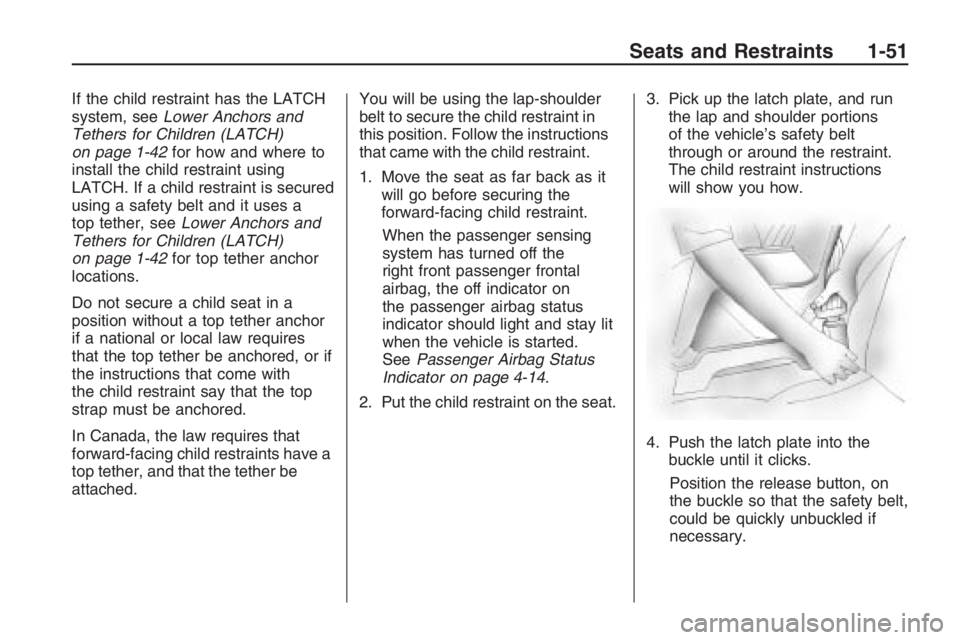
2. Put the child restraint on the seat.3. Pick up the latch plate, and run
the lap and shoulder portions
of the vehicle’s safety belt
through or around the restraint.
The child restraint instructions
will show you how.
4. Push the latch plate into the
buckle until it clicks.
Position the release button, on
the buckle so that the safety belt,
could be quickly unbuckled if
necessary.
Seats and Restraints 1-51
Page 56 of 356
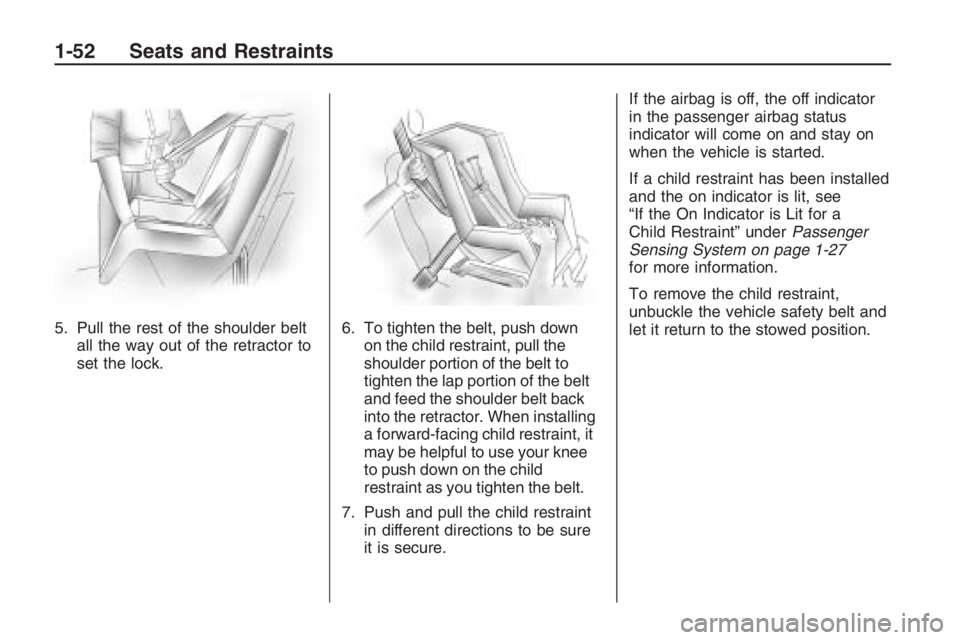
5. Pull the rest of the shoulder belt
all the way out of the retractor to
set the lock.6. To tighten the belt, push down
on the child restraint, pull the
shoulder portion of the belt to
tighten the lap portion of the belt
and feed the shoulder belt back
into the retractor. When installing
a forward-facing child restraint, it
may be helpful to use your knee
to push down on the child
restraint as you tighten the belt.
7. Push and pull the child restraint
in different directions to be sure
it is secure.If the airbag is off, the off indicator
in the passenger airbag status
indicator will come on and stay on
when the vehicle is started.
If a child restraint has been installed
and the on indicator is lit, see
“If the On Indicator is Lit for a
Child Restraint” underPassenger
Sensing System on page 1-27
for more information.
To remove the child restraint,
unbuckle the vehicle safety belt and
let it return to the stowed position.
1-52 Seats and Restraints
Page 79 of 356
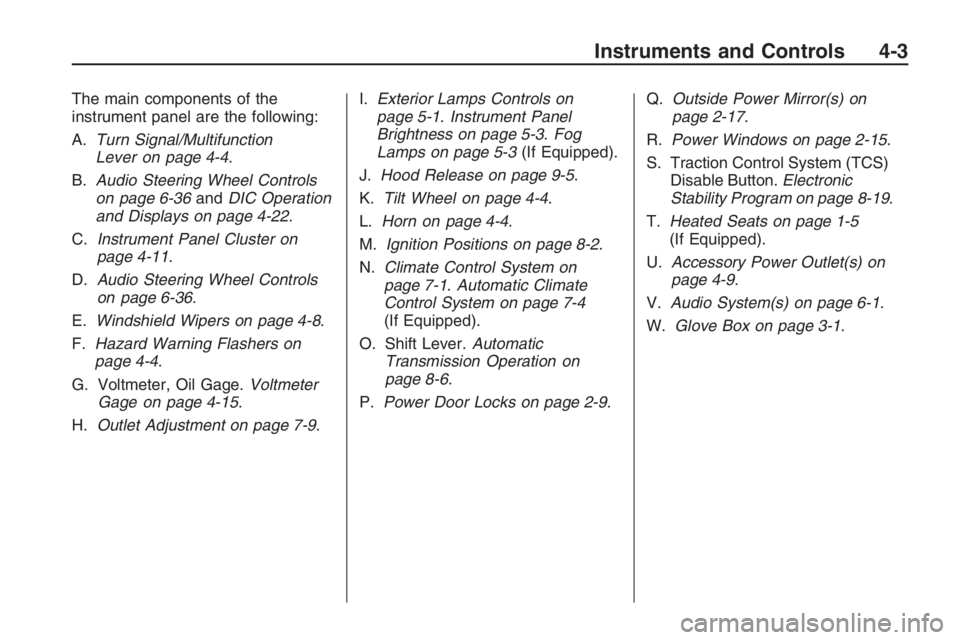
The main components of the
instrument panel are the following:
A.Turn Signal/Multifunction
Lever on page 4-4.
B.Audio Steering Wheel Controls
on page 6-36andDIC Operation
and Displays on page 4-22.
C.Instrument Panel Cluster on
page 4-11.
D.Audio Steering Wheel Controls
on page 6-36.
E.Windshield Wipers on page 4-8.
F.Hazard Warning Flashers on
page 4-4.
G. Voltmeter, Oil Gage.Voltmeter
Gage on page 4-15.
H.Outlet Adjustment on page 7-9.I.Exterior Lamps Controls on
page 5-1.Instrument Panel
Brightness on page 5-3.Fog
Lamps on page 5-3(If Equipped).
J.Hood Release on page 9-5.
K.Tilt Wheel on page 4-4.
L.Horn on page 4-4.
M.Ignition Positions on page 8-2.
N.Climate Control System on
page 7-1.Automatic Climate
Control System on page 7-4
(If Equipped).
O. Shift Lever.Automatic
Transmission Operation on
page 8-6.
P.Power Door Locks on page 2-9.Q.Outside Power Mirror(s) on
page 2-17.
R.Power Windows on page 2-15.
S. Traction Control System (TCS)
Disable Button.Electronic
Stability Program on page 8-19.
T.Heated Seats on page 1-5
(If Equipped).
U.Accessory Power Outlet(s) on
page 4-9.
V.Audio System(s) on page 6-1.
W.Glove Box on page 3-1.
Instruments and Controls 4-3
Page 165 of 356
Personal Identity Keys
For vehicles with the Personal
Identity Key Locking System,
the system remembers the last
climate control settings used with
different keys.
When the unlock button is pressed,
the system remembers the key
and sets the climate control system
to the last settings used with that
key. SeeRemote Keyless Entry
(RKE) System Operation on
page 2-4.
Passenger Compartment
Air Filter
The vehicle has a passenger
compartment air lter that lters the
outside air entering the vehicle.
The lter removes contaminants,
such as pollen and dust. See
your dealer/retailer for more
information.
Outlet Adjustment
The air outlets have adjustable
vanes to move up or down and left or
right to change the direction of the
airow. Use the thumbwheels
located near the air outlets on the
instrument panel, to shut off the
airow.
Operation Tips
Clear away any ice, snow or
leaves from the air inlets at
the base of the windshield that
may block the ow of air into
the vehicle.
Use of non-GM approved hood
deectors may adversely affect
performance of the system.
Keep the path under the front
seats clear of objects to help
circulate the air inside of
the vehicle more effectively.
Outside air is drawn into the
vehicle, unless recirculation
mode is selected.
Climate Controls 7-9
Page 172 of 356
The length of time the heater should
remain plugged in depends on
several factors. Ask a dealer/retailer
in the area where you will be
parking the vehicle for the best
advice on this.
Automatic Transmission
Operation
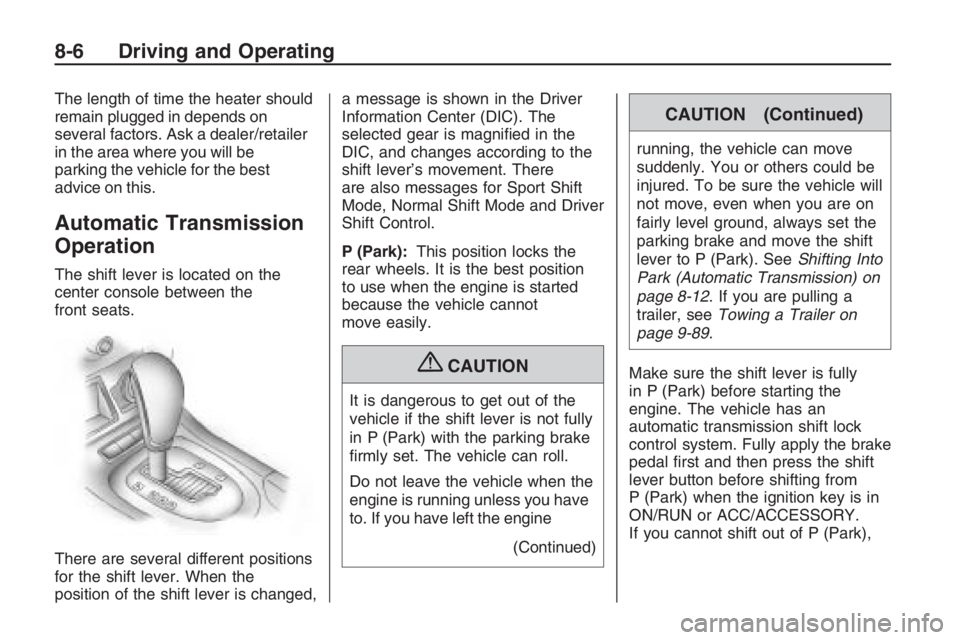
The shift lever is located on the
center console between the
front seats.
There are several different positions
for the shift lever. When the
position of the shift lever is changed,a message is shown in the Driver
Information Center (DIC). The
selected gear is magnied in the
DIC, and changes according to the
shift lever’s movement. There
are also messages for Sport Shift
Mode, Normal Shift Mode and Driver
Shift Control.
P (Park):This position locks the
rear wheels. It is the best position
to use when the engine is started
because the vehicle cannot
move easily.
{CAUTION
It is dangerous to get out of the
vehicle if the shift lever is not fully
in P (Park) with the parking brake
rmly set. The vehicle can roll.
Do not leave the vehicle when the
engine is running unless you have
to. If you have left the engine
(Continued)
CAUTION (Continued)
running, the vehicle can move
suddenly. You or others could be
injured. To be sure the vehicle will
not move, even when you are on
fairly level ground, always set the
parking brake and move the shift
lever to P (Park). SeeShifting Into
Park (Automatic Transmission) on
page 8-12. If you are pulling a
trailer, seeTowing a Trailer on
page 9-89.
Make sure the shift lever is fully
in P (Park) before starting the
engine. The vehicle has an
automatic transmission shift lock
control system. Fully apply the brake
pedal rst and then press the shift
lever button before shifting from
P (Park) when the ignition key is in
ON/RUN or ACC/ACCESSORY.
If you cannot shift out of P (Park),
8-6 Driving and Operating
Page 200 of 356
If you put things inside the
vehicle — like suitcases,
tools, packages, or anything
else — they will go as fast as
the vehicle goes. If you have
to stop or turn quickly, or if there
is a crash, they will keep going.
{CAUTION
Things you put inside the
vehicle can strike and injure
people in a sudden stop or
turn, or in a crash.
Put things in the trunk of
your vehicle. In a trunk,
put them as far forward as
you can. Try to spread the
weight evenly.
(Continued)
CAUTION (Continued)
Never stack heavier
things, like suitcases,
inside the vehicle so that
some of them are above
the tops of the seats.
Do not leave an unsecured
child restraint in the
vehicle.
When you carry something
inside the vehicle, secure it
whenever you can.
Do not leave a seat folded
down unless you need to.
Fuel
Use of the recommended fuel is
an important part of the proper
maintenance of this vehicle.
To help keep the engine clean and
maintain optimum vehicle
performance, we recommend the
use of gasoline advertised as
TOP TIER Detergent Gasoline.
The 8th digit of the Vehicle
Identication Number (VIN) shows
the code letter or number that
identies the vehicle’s engine.
The VIN is at the top left of the
instrument panel. SeeVehicle
Identification Number (VIN) on
page 10-1.
8-34 Driving and Operating
Page 242 of 356
Fuses Usage
F14 Auxiliary Power
F15Outside Rearview
Mirrors
F16Sunroof/Automatic
Transmission
Shift Lock
F17 Sunroof
F18Automatic Occupant
Sensor
F19Driver Side Heated
Seat
F20Passenger Side
Heated Seat
F21Daytime Running
Lamps
F22Front Cigarette
Lighter
F23Steering Wheel
Controls Backlighting
F24 Power Window
FUSE
PULLERFuse PullerCircuit
BreakersUsage
B1 Spare
B2 Power Windows
B3 Power Seats
B4 Spare
Relays Usage
R1Retain Accessory
Power 1
R2 Door Locks
R3Passenger Side
Door Lock
R4 Spare
R5 Trunk Release
R6 Driver Side Lock
R7Retain Accessory
Power 2
R8 Accessory
R9 Blower
R10 Spare
R11Daytime Running
Lamps
R12 Fuel Pump
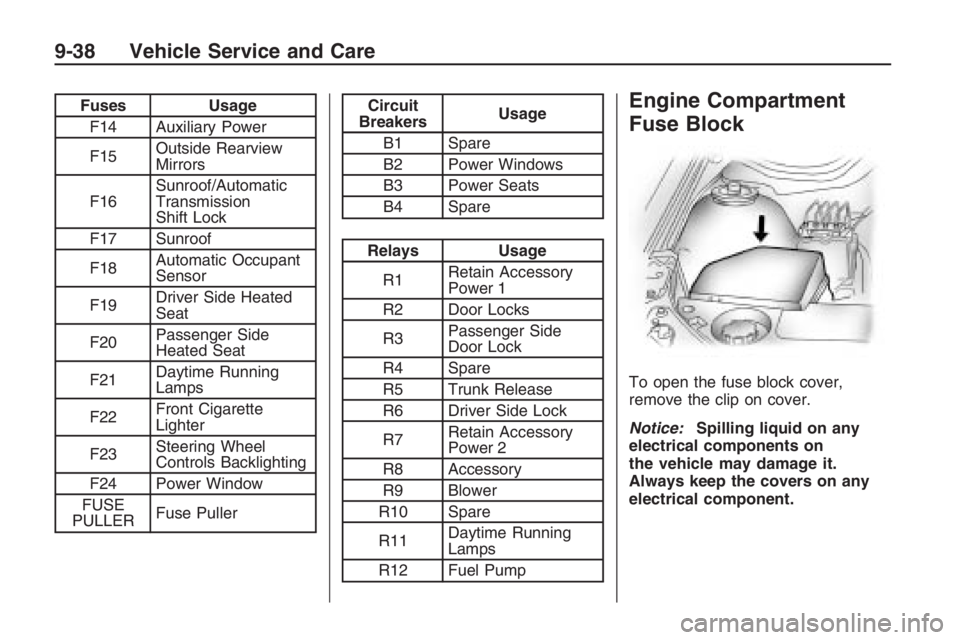
Engine Compartment
Fuse Block
To open the fuse block cover,
remove the clip on cover.
Notice:Spilling liquid on any
electrical components on
the vehicle may damage it.
Always keep the covers on any
electrical component.
9-38 Vehicle Service and Care
Page 244 of 356
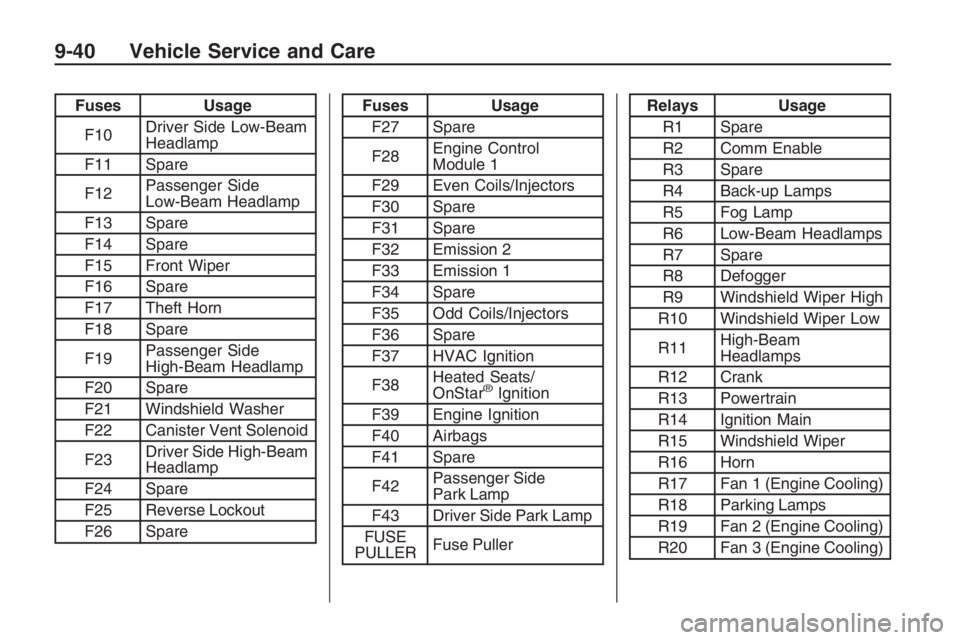
Fuses Usage
F10Driver Side Low-Beam
Headlamp
F11 Spare
F12Passenger Side
Low-Beam Headlamp
F13 Spare
F14 Spare
F15 Front Wiper
F16 Spare
F17 Theft Horn
F18 Spare
F19Passenger Side
High-Beam Headlamp
F20 Spare
F21 Windshield Washer
F22 Canister Vent Solenoid
F23Driver Side High-Beam
Headlamp
F24 Spare
F25 Reverse Lockout
F26 SpareFuses Usage
F27 Spare
F28Engine Control
Module 1
F29 Even Coils/Injectors
F30 Spare
F31 Spare
F32 Emission 2
F33 Emission 1
F34 Spare
F35 Odd Coils/Injectors
F36 Spare
F37 HVAC Ignition
F38Heated Seats/
OnStar
®Ignition
F39 Engine Ignition
F40 Airbags
F41 Spare
F42Passenger Side
Park Lamp
F43 Driver Side Park Lamp
FUSE
PULLERFuse Puller
Relays Usage
R1 Spare
R2 Comm Enable
R3 Spare
R4 Back-up Lamps
R5 Fog Lamp
R6 Low-Beam Headlamps
R7 Spare
R8 Defogger
R9 Windshield Wiper High
R10 Windshield Wiper Low
R11High-Beam
Headlamps
R12 Crank
R13 Powertrain
R14 Ignition Main
R15 Windshield Wiper
R16 Horn
R17 Fan 1 (Engine Cooling)
R18 Parking Lamps
R19 Fan 2 (Engine Cooling)
R20 Fan 3 (Engine Cooling)
9-40 Vehicle Service and Care
Page 250 of 356
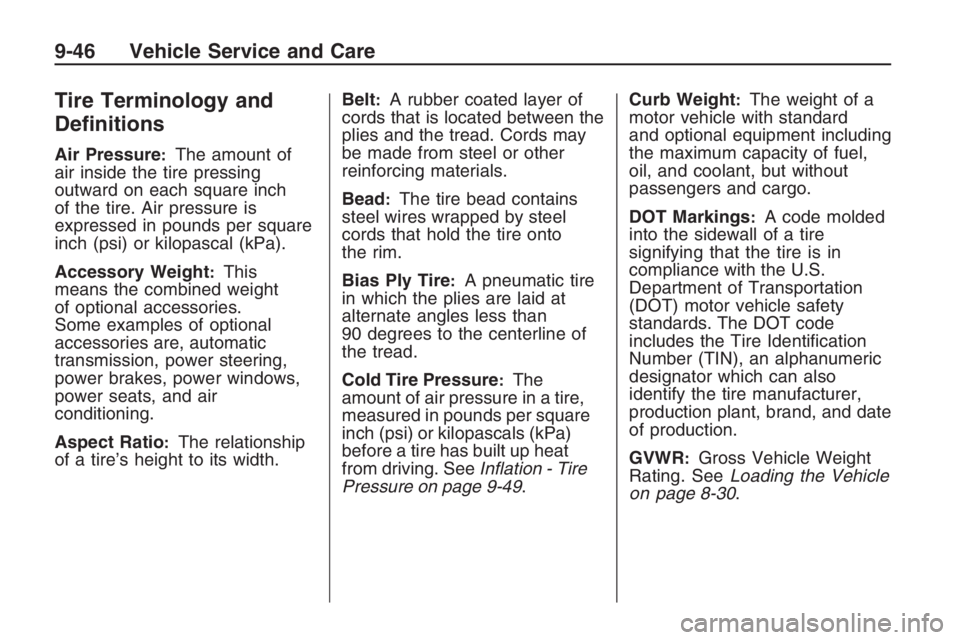
Tire Terminology and
Denitions
Air Pressure:The amount of
air inside the tire pressing
outward on each square inch
of the tire. Air pressure is
expressed in pounds per square
inch (psi) or kilopascal (kPa).
Accessory Weight
:This
means the combined weight
of optional accessories.
Some examples of optional
accessories are, automatic
transmission, power steering,
power brakes, power windows,
power seats, and air
conditioning.
Aspect Ratio
:The relationship
of a tire’s height to its width.Belt
:A rubber coated layer of
cords that is located between the
plies and the tread. Cords may
be made from steel or other
reinforcing materials.
Bead
:The tire bead contains
steel wires wrapped by steel
cords that hold the tire onto
the rim.
Bias Ply Tire
:A pneumatic tire
in which the plies are laid at
alternate angles less than
90 degrees to the centerline of
the tread.
Cold Tire Pressure
:The
amount of air pressure in a tire,
measured in pounds per square
inch (psi) or kilopascals (kPa)
before a tire has built up heat
from driving. SeeInflation - Tire
Pressure on page 9-49.Curb Weight
:The weight of a
motor vehicle with standard
and optional equipment including
the maximum capacity of fuel,
oil, and coolant, but without
passengers and cargo.
DOT Markings
:A code molded
into the sidewall of a tire
signifying that the tire is in
compliance with the U.S.
Department of Transportation
(DOT) motor vehicle safety
standards. The DOT code
includes the Tire Identication
Number (TIN), an alphanumeric
designator which can also
identify the tire manufacturer,
production plant, brand, and date
of production.
GVWR
:Gross Vehicle Weight
Rating. SeeLoading the Vehicle
on page 8-30.
9-46 Vehicle Service and Care