heating PONTIAC GRAND-AM 1993 User Guide
[x] Cancel search | Manufacturer: PONTIAC, Model Year: 1993, Model line: GRAND-AM, Model: PONTIAC GRAND-AM 1993Pages: 306, PDF Size: 15.39 MB
Page 182 of 306
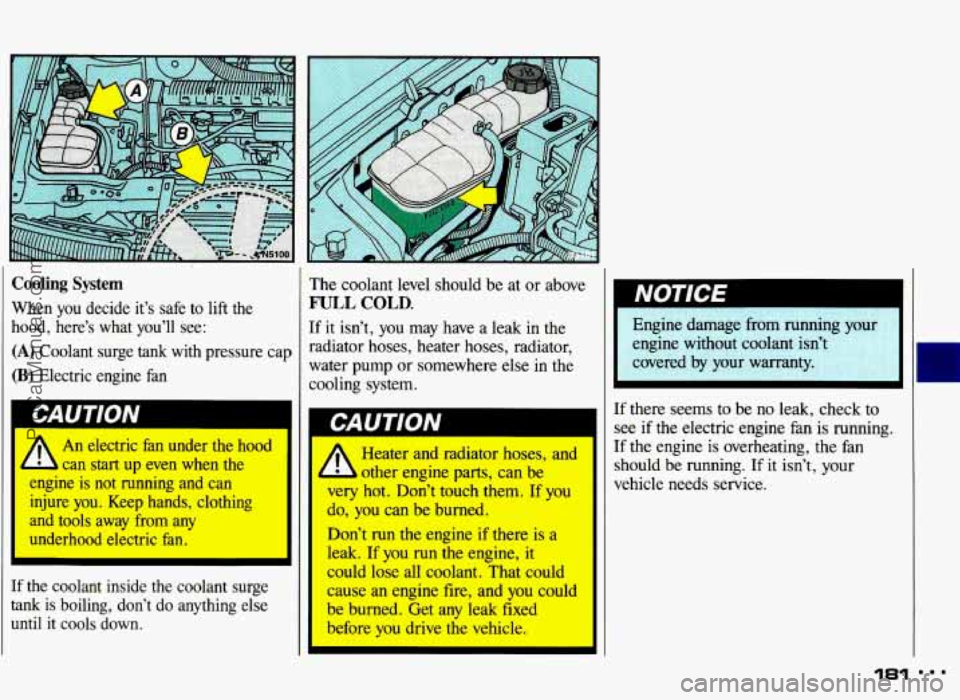
Cooling System
When you decide it’s safe to lift the
hood, here’s what you’ll see:
(A) Coolant surge tank with pressure cap
(B) Electric engine fan
bAU I IVIV
1 /r An electric fan under the hood
- b can start up even when the
engine is not running and can injure you. Keep hands, clothing
and tools away from any
underhood electric fan.
[f the coolant inside the coolant surge
tank is boiling, don’t do anything else
until
it cools down.
’he coolant level should be at or above
TJLL COLD.
f it isn’t, you may have a leak in the
adiator hoses, heater hoses, radiator,
dater pump or somewhere else
in the
ooling system.
A
Heater and radiator hoses, and
other engine parts, can be
very hot. Don’t touch them.
If you
do, you can be burned.
Don’t run the engine if there is a
leak. If
you run the engine, it
could lose all coolant. That could
cause an engine fire, and you could
be burned. Get any leak fixed
before
you drive the vehicle. Engine damage
from
runni
engine without coolant isn’
covered by your warranty.
there seems to be no leak, check
to
x if the electric engine fan is running.
C the engine is overheating, the fan
hould be running.
If it isn’t, your
chicle needs service.
181
ProCarManuals.com
Page 183 of 306
Problems on the Road
Engine Overheating (CONTJ
How to Add Coolant to the Coolant
Surge Tank:
If you haven’t found a problem yet, but
the coolant level isn’t at or above
FULL
COLD, add a 50/50 mixture of clean
water
(preferably distilled) and a proper
antifreeze at the coolant surge
tank, but
be sure the cooling system, including
the coolant surge
tank pressure cap, is
cool before
you do it. (See the Index
under Engine Coolant for more
information about the proper coolant
mix.)
182
L Steam and scalding liquids
L from a hot cooling system can
blow out and burn you badly. They
are under pressure, and if you turn
cap-evm a little-they can come
out at high speed. Never turn the
pressure cap when the cooliag
tank pressure cap, is hot. Wait for
the cooling system and coolant
you ever have to turn the pmsure
MP.
the coolant surge tank pressure
system, including the COoIant surge
surge tank pressure cap to cool if
Adding only plain water to
dangerous. Plain water, or some
other liquid like alcohol, can boil
before the proper coolant mix will.
Your vehicle’s coolant warning
system is set for the proper coolant
mix. With plain water or the
wrong mix, your engine could get
too hot but you wouldn’t get the overheat warning. Your engine
could catch fire and you or others
could be burned. Use a
50/50 mix
of
clean water and a proper
antifreeze.
k your cooling system can be I
ProCarManuals.com
Page 185 of 306
Problems on the Road
,
Engine Overheating (CONT.)
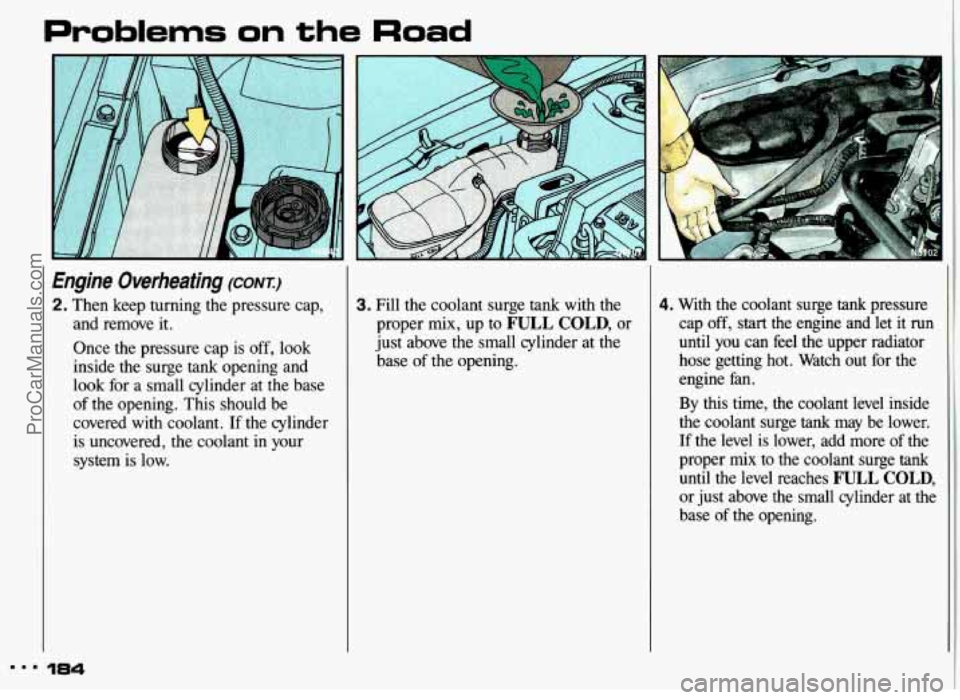
2. Then keep turning the pressure cap, and remove it.
Once the pressure cap is
off, look
inside the surge
tank opening and
look for a small cylinder at the base
of the opening. This should be
covered with coolant. If the cylinder
is uncovered, the coolant in your
system is low.
184
3. Fill the coolant surge tank with the
proper mix, up to
FULL COLD, or
just above the small cylinder at the
base of the opening.
4. With the coolant surge tank pressure
cap off,
start the engine and let it run
until you can feel the upper radiator
hose getting hot. Watch out for the
engine fan.
By this time, the coolant level inside
the coolant surge
tank may be lower.
If the level is lower, add more
of the
proper mix to
the coolant surge tank
until the level reaches F'ULL COLD,
or just above the small cylinder at the
base
of the opening.
ProCarManuals.com
Page 222 of 306
Engine Coolant
The following explains your cooling system and how to add coolant when it
is low. If you have a problem with
engine overheating, see the
Index under
Engine Overheating.
The proper coolant for your Pontiac
will:
Give freezing protection down to
Give boiling protection up to 262°F
Protect against rust and corrosion.
Help keep the proper engine
-34°F (-37°C).
(128°C).
temperature.
Let the warning
should. lights work as they
What to Use:
Use
a mixture of one-half clean water
(preferably distilled) and one-half
antifreeze that meets
“GM Specification
1825-M,” which won’t damage
aluminum parts. You can
also use a
recycled coolant conforming to GM
Specification 1825-M with a complete
coolant flush and refill. If you use this
mixture, you don’t need to add anything
else.
CAUTION I
A Adding only plain water ta
L pur cooling system can be
dangerous. Plain water, or some
other liquid like alcohol, can boil
bebe the proper coolant mix will.
system is set for the proper coolant
mix. With plain water or the
wrong mix, your engine could get
too hot but you wouldn’t get the
overheat warning, Your engine
could catch fire and you or others
could be burned. Use a 50/50 mix
of clean water and a proper
antifreeze.
Your v&hicle’s coolant warning
221 .
ProCarManuals.com
Page 233 of 306

Service & Appearance Care
nres
We don’t make tires. Your new vehicle comes with high quality tires made by a
leading tire manufacturer. These tires are warranted by the tire manufacturers and
their warranties are delivered with every new Fbntiac. If your spare tire is a
different brand than your road tires, you will have a tire warranty folder from each
of these manufacturers.
Poorly maintained and improperly used tires dangerous.
a Overloading your tires can causy overheating as a result of too much
friction. You could have
an air-out and a serious accident. See the Index
under Loading Your Ehicle.
Underinflated tires pose the same danger as overloaded tires. The resulting
accident could
cause serious injury. Check all tires fiquently to maintain
the recommended presswe. Tire pressure should be checked when your
tires are cold.
Overinflated tires are more likely to be cut, punctured, or broken by a
sudden impacts such as when you hit a pothole. Keep tires at the
recommended pressure.
tires have been damaged, replace them.
m Worn, old tires can cause accidents. If your tread is badly worn, or if your
I I
lnflation-Tire Pressure
The Tire-Loading Information label
which is on the rear edge of the driver’t.
door shows the correct inflation
pressures for your tires, when they’re cold. “Cold” means your vehicle has
been sitting for at least three hours or
driven no more than a mile.
ProCarManuals.com
Page 296 of 306
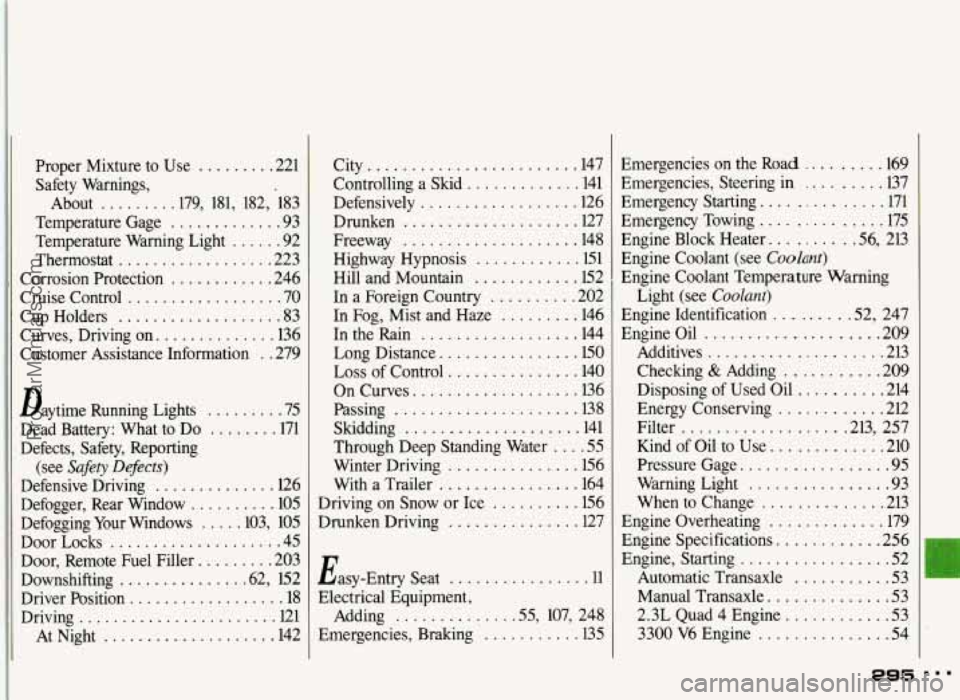
Proper Mixture to Use ......... 221
Safety Warnings. About
........ .179. 181. 182. 183
Temperature Gage
............. 93
Temperature Warning Light ...... 92
Thermostat
.................. 223
Corrosion Protection
............ 246
Cruise Control
.................. 70
Cup Holders
................... 83
Curves. Driving
on .............. 136
Customer Assistance Information
. . 279
Daytime Running Lights
......... 75
Defects. Safety. Reporting Dead Battery: What to Do
........ 171
Defensive Driving
.............. 126
(see
Safety Defects)
Defogger. Rear Window .......... 105
Defogging Your Windows
.... .103. 105
Door Locks
.................... 45
Door. Remote Fuel Filler
......... 203
Downshifting
.............. .62. 152
Driver Position
.................. 18
Driving
....................... 121
AtNight
.............. ... 142 City
........................ 147
Controlling a Skid
............. 141
Defensively
.................. 126
Drunken
.................... 127
Freeway
.................... 148
Highway Hypnosis
............ 151
Hill and Mountain
............ 152
In a Foreign Country
.......... 202
In Fog, Mist and Haze ......... 146
In the Rain
.................. 144
Long Distance ................ 150
Loss of Control
............... 140
On Curves ................... 136
Passing
..................... 138
Skidding
.................... 141
Through Deep Standing Water
.... 55
Winter Driving
............... 156
With a Trailer
................ 164
Driving on
Snow or Ice .......... 156
Drunken Driving
............... 127
Easy-Entry Seat
................ 11
Electrical Equipment, Adding
............. .55, 107, 248
Emergencies, Braking
........... 135 Emergencies
on the
Road ......... 169
Emergencies. Steering in
......... 137
Emergency Starting
.............. 171
Emergency Towing
.............. 175
Engine Block Heater
......... .56, 213
Engine Coolant (see
CooZant)
Engine Coolant Temperature Warning
Engine Identification
........ .52. 247
Engine Oil
.................... 209
Additives
.................... 213
Checking
& Adding ........... 209
Disposing of Used Oil
.......... 214
Energy Conserving
............ 212
Filter
.................. .213. 257
Kind of Oil to Use ............. 210
Pressure Gage
................. 95
Warning Light
................ 93
When to Change .............. 213
Engine Overheating
............. 179
Engine Specifications
............ 256
Engine. Starting
................. 52
Automatic Transaxle
........... 53
Manual Transaxle
.............. 53
2.3L Quad 4 Engine
............ 53
3300
V6 Engine ............... 54
295
Light (see Coolant)
ProCarManuals.com
Page 300 of 306
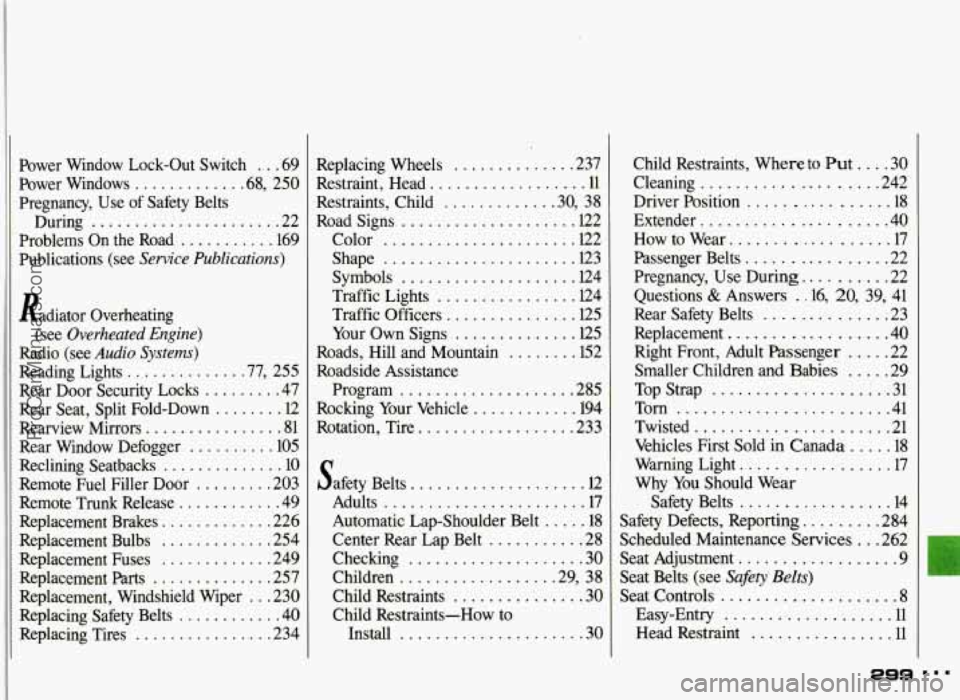
Power Window Lock-Out Switch ... 69
Power Windows
............ .68. 250
Pregnancy. Use of Safety Belts During
...................... 22
Problems On the Road
........... 169
Publications (see
Service Publications)
Radiator Overheating
(see
Overheated Engine)
Radio (see Audio Systems)
Reading Lights ............. .77. 255
Rear Door Security
Locks ......... 47
Rear Seat. Split Fold-Down
........ 12
Rearview Mirrors ................ 81
Rear Window Defogger
.......... 105
Reclining Seatbacks
.............. 10
Remote Fuel Filler Door
......... 203
Remote Trunk Release
............ 49
Replacement Brakes
............. 226
Replacement Bulbs
............. 254
Replacement Fuses
............. 249
Replacement
Parts .............. 257
Replacement, Windshield Wiper
... 230
Replacing Safety Belts
............ 40
Replacing Tires ................ 234 Replacing Wheels
.............. 237
Restraint. Head
.................. 11
Restraints. Child
............ .30. 38
Road Signs
.................... 122
Color
...................... 122
Shape
...................... 123
Symbols
.................... 124
Traffic Lights
................ 124
Traffic Officers
............... 125
Your Own Signs
.............. 125
Roads. Hill and Mountain ........ 152
Roadside Assistance
Program
.................... 285
Rocking Your Vehicle ............ 194
Rotation, Tire
.................. 233
S afety Belts .................... 12
Adults ....................... 17
Center Rear Lap Belt
........... 28
Checking
.................... 30
Children
................. .29, 38
Child Restraints ............... 30
Child Restraints-How to Install
..................... 30
Automatic Lap-Shoulder Belt
..... 18
Child Restraints.
Where to Put .... 30
Cleaning
.................... 242
Driver Position
................ 18
Extender
..................... 40
How to Wear .................. 17
Passenger Belts
................ 22
Pregnancy, Use During
.......... 22
Questions
& Answers . .16, 20, 39, 41
Rear Safety Belts
.............. 23
Replacement
.................. 40
Right Front. Adult Passenger
..... 22
Smaller Children and Babies
..... 29
Top Strap
.................... 31
Torn
........................ 41
Twisted
...................... 21
Vehicles First Sold in Canada
..... 18
Warning Light
................. 17
Why
You Should Wear
Safety Belts
................. 14
Safety Defects. Reporting
......... 284
Scheduled Maintenance Services
... 262
Seat Adjustment
.................. 9
Seat Belts (see
Safety' Belts)
Seat Controls .................... 8
Easy-Entry ................... 11
Head Restraint
................ 11
299 ...
ProCarManuals.com