heating PONTIAC GRAND-AM 1993 Owners Manual
[x] Cancel search | Manufacturer: PONTIAC, Model Year: 1993, Model line: GRAND-AM, Model: PONTIAC GRAND-AM 1993Pages: 306, PDF Size: 15.39 MB
Page 4 of 306
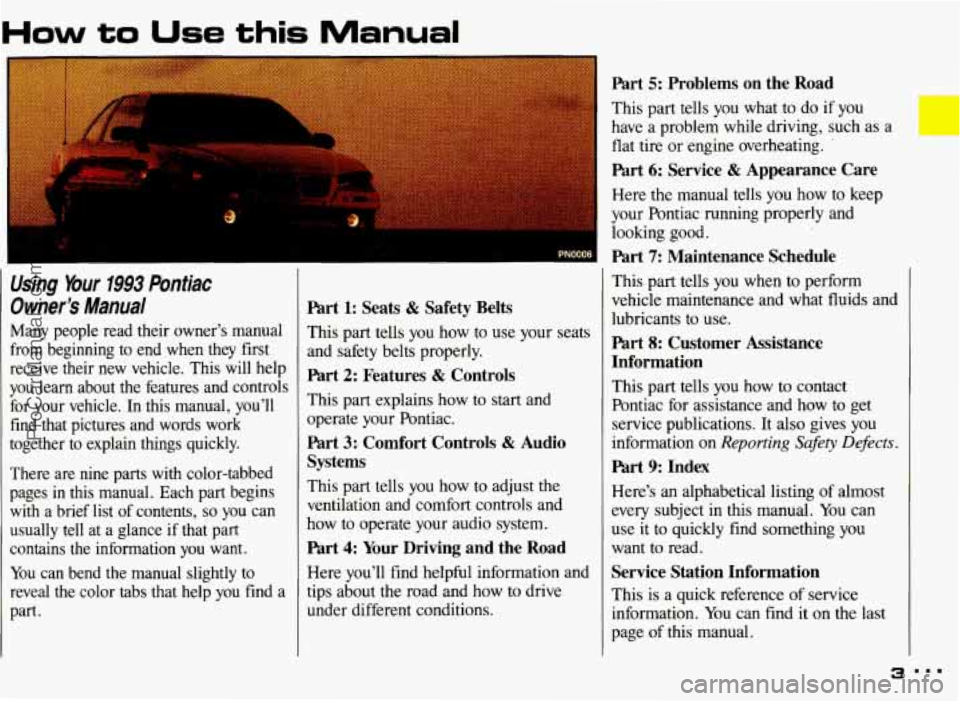
How to Use this Manual
Using Your 1993 Pontiac
Owner’s Manual
Many people read their owner’s manual
from beginning to end when they first
receive their new vehicle. This will help
you learn about the features and controls
for your vehicle. In this manual, you’ll
find that pictures and words work
together to explain things quickly.
There are nine parts with color-tabbed
pages
in this manual. Each part begins
with a brief list of contents,
so you can
usually tell at a glance if that part
contains the information you want.
You can bend the manual slightly to
reveal the color tabs that help you find a
part.
Part 1: Seats & Safety Belts
This part tells you how to use your seats
and safety belts properly.
Part 2: Features & Controls
This part explains how to start and
operate your Pontiac.
Part 3: Comfort Controls & Audio
Systems
This part tells you how to adjust the
ventilation and comfort controls and
how to operate your audio system.
Part 4: Your Driving and the Road
Here you’ll find helpful information and
tips about the road and how to drive
under different conditions.
Part 5: Problems on the Road
This part tells you what to do if you
have a problem while driving, such as
a
flat tire or engine overheating. ’
Part 6: Service & Appearance Care
Here the manual tells you how to keep
your Pontiac running properly and
looking good.
Part 7: Maintenance Schedule
This part tells you when to perform
vehicle maintenance and what fluids and
lubricants
to use.
Part 8: Customer Assistance
Information
This part tells you how to contact
Pontiac for assistance and how to get
service publications. It also gives you
information on
Reporting Safety Defects.
Part 9: Index
Here’s an alphabetical listing of almost
every subject in this manual. You can
use
it to quickly find something you
want to read.
Service Station Information
This is a quick reference of service
information. You can find it
on the last
page
of this manual.
3
ProCarManuals.com
Page 86 of 306
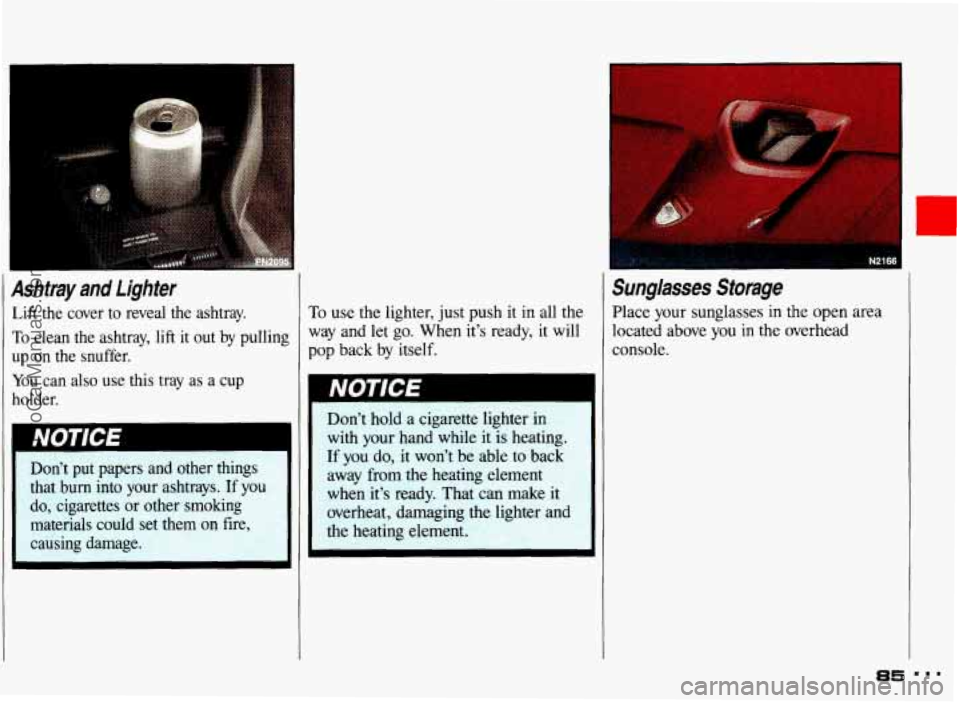
Ashtray and Lighter
Lift the cover to reveal the ashtray.
To clean the ashtray, lift it out by pulling
up on the snuffer.
You can also use this tray as a cup
holder.
Don’t put papers and other things
that burn into your ashtrays.
If you
do, cigarettes or other smoking
materials could set them on fire,
causing damage.
To use the lighter, just push it in all the
way and let go. When it’s ready, it will
pop back by itself.
Don’t hold a cigarette lighter in
with your hand while it is heating.
If you do, it won’t be able to back
away from the heating element
when it’s ready. That can make it
overheat, damaging the lighter and
the heating element.
Sunglasses Stonge
Place your sunglasses in the open area
located above you
in the overhead
console.
85 ..I
ProCarManuals.com
Page 93 of 306
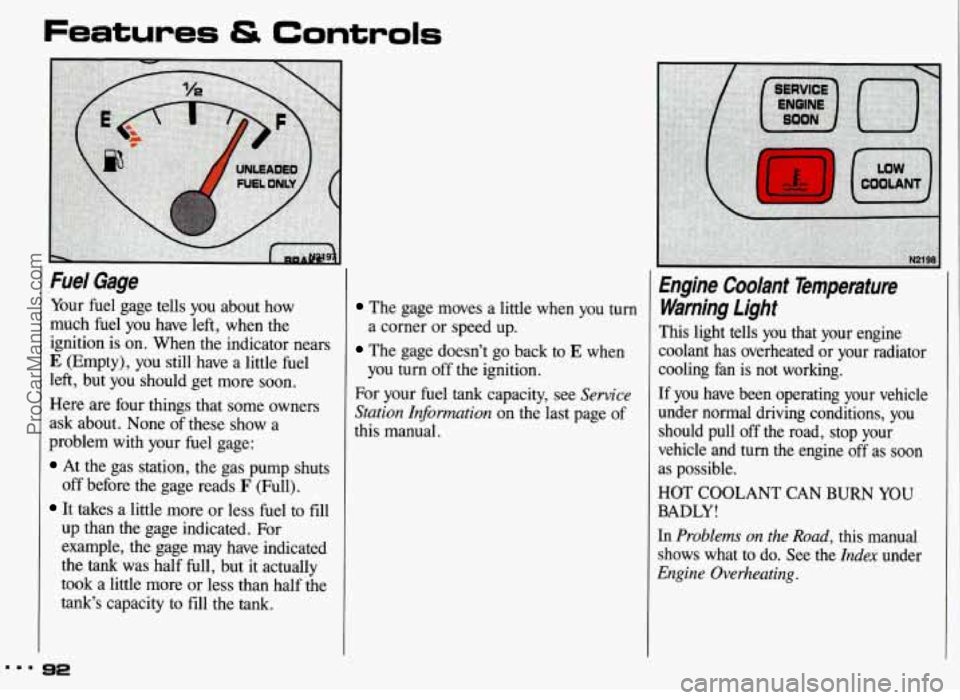
Fuel Gage
Your fuel gage tells you about how
much fuel you have left, when the
ignition is on. When the indicator nears
E (Empty), you still have a little fuel
left, but you should get more soon.
Here are four things that some owners
ask about. None
of these show a
problem with
your fuel gage:
At the gas station, the gas pump shuts
off before the gage reads
F (Full).
It takes a little more or less fuel to fill
up than the gage indicated. For
example, the gage may have indicated
the
tank was half full, but it actually
took a little more or less than half the
tank’s capacity to fill the tank.
The gage moves a little when you turn
The gage doesn’t go back to E when
For your fuel tank capacity, see
Service
Station Information
on the last page of
this manual. a
corner or speed up.
you turn off the ignition.
Engine Coolant Temperature
Warning Light
This light tells you that your engine
coolant has overheated or your radiator
cooling fan is not working.
If you have been operating your vehicle
under normal driving conditions, you
should pull off the road, stop your
vehicle and turn the engine
off as soon
as possible.
HOT
COOLANT CAN BURN YOU
BADLY!
In Problems on the Road, this manual
shows what to do. See the
Index under
Engine Overheating.
ProCarManuals.com
Page 94 of 306
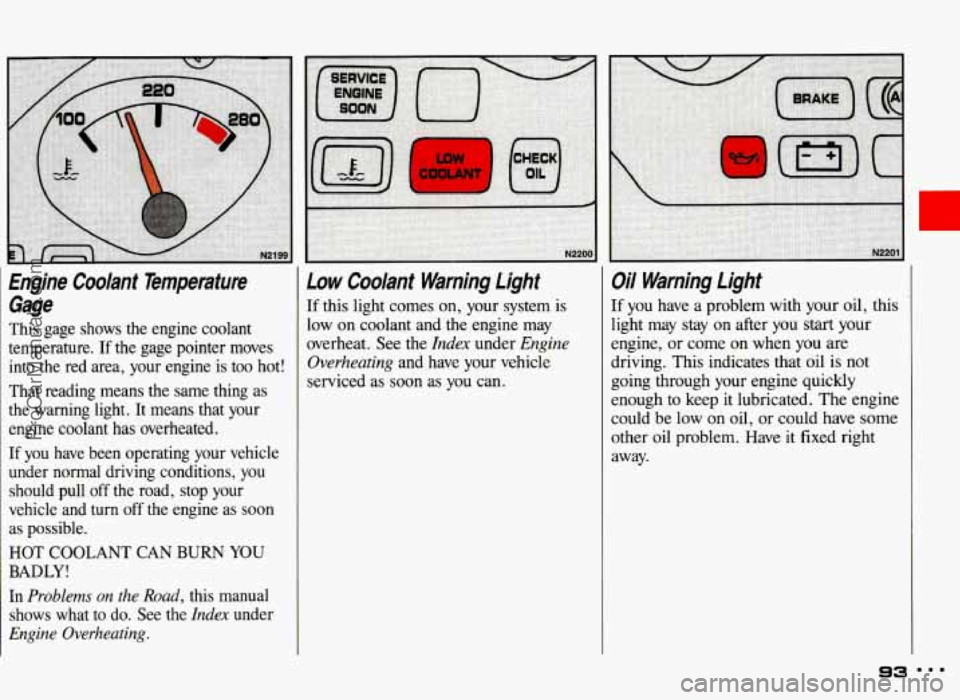
Engine Coolant Temperature Gage
This gage shows the engine coolant
temperature. If the gage pointer moves
into the red area, your engine is too hot!
That reading means the same thing as
the warning light. It means that your
engine coolant has overheated.
If you have been operating your vehicle
under normal driving conditions, you
should pull
off the road, stop your
vehicle and
turn off the engine as soon
as possible.
HOT
COOLANT CAN BURN YOU
BADLY!
In Problems on the Road, this manual
shows what to do. See the
Index under
Engine Overheating.
Low Coolant Warning light
If this light comes on, your system is
low on coolant and the engine may
overheat. See the
Index under Engine
Overheating
and have your vehicle
serviced as
soon as you can.
Oil Warning Llght
If you have a problem with your oil, this
light may stay on after you
start your
engine, or come
on when you are
driving. This indicates that
oil is not
going through your engine quickly
enough to keep it lubricated. The engine
could be low on oil, or could have some
other
oil problem. Have it fixed right
away.
93
ProCarManuals.com
Page 103 of 306
Comfort Controls & Audio Systems
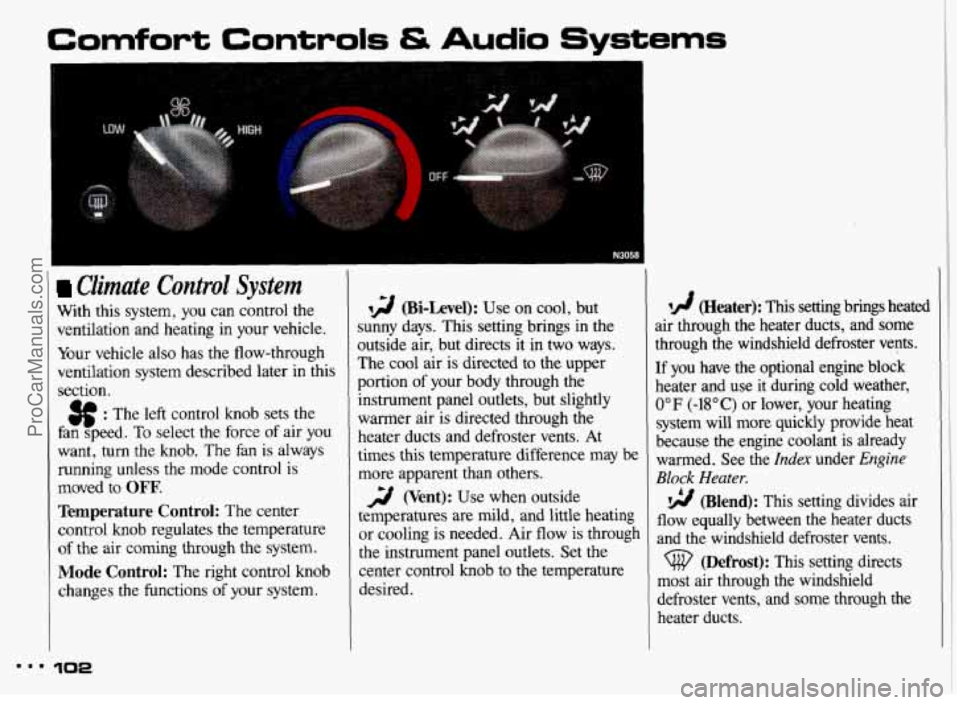
Climate Control System
With this system, you can control the
ventilation and heating in your vehicle.
Your vehicle also has the flow-through
ventilation system described later in this
section.
$$ : The left control knob sets the
fan speed.
To select the force of air you
want, turn the knob. The fan
is always
running unless the mode control
is
moved to OFF’.
Temperature Control: The center
control knob regulates the temperature
of the air coming through the system.
Mode Control: The right control knob
changes the functions
of your system.
N3058
12 (Bi-Level): Use on cool, but
;unny days. This setting brings in the
3utside air, but directs it in two ways.
rhe cool air is directed to the upper
2ortion
of your body through the
instrument panel outlets, but slightly
warmer air
is directed through the
heater ducts and defroster vents. At
times this temperature difference may be
more apparent than others.
temperatures are mild, and little heating
or cooling is needed. Air flow is through
the instrument panel outlets. Set the
center control
knob to the temperature
desired.
2 (Vent): Use when outside
lA (Heater): This setting brings heated
air through the heater ducts, and some
through the windshield defroster vents.
[f you have the optional engine block
heater and use it during cold weather,
0°F (-18°C) or lower, your heating
system will more quickly provide heat
because the engine coolant is already
warmed. See the
Index under Engine
Block Heater.
flow equally between the heater ducts
and the windshield defroster vents.
most air through the windshield
defroster vents, and some through the
heater ducts.
(Blend): This setting divides air
(Defrost): This setting directs
m.. 102
ProCarManuals.com
Page 105 of 306
Comfort Controls & Audio Systems
Air Conditionina (CONI) -.
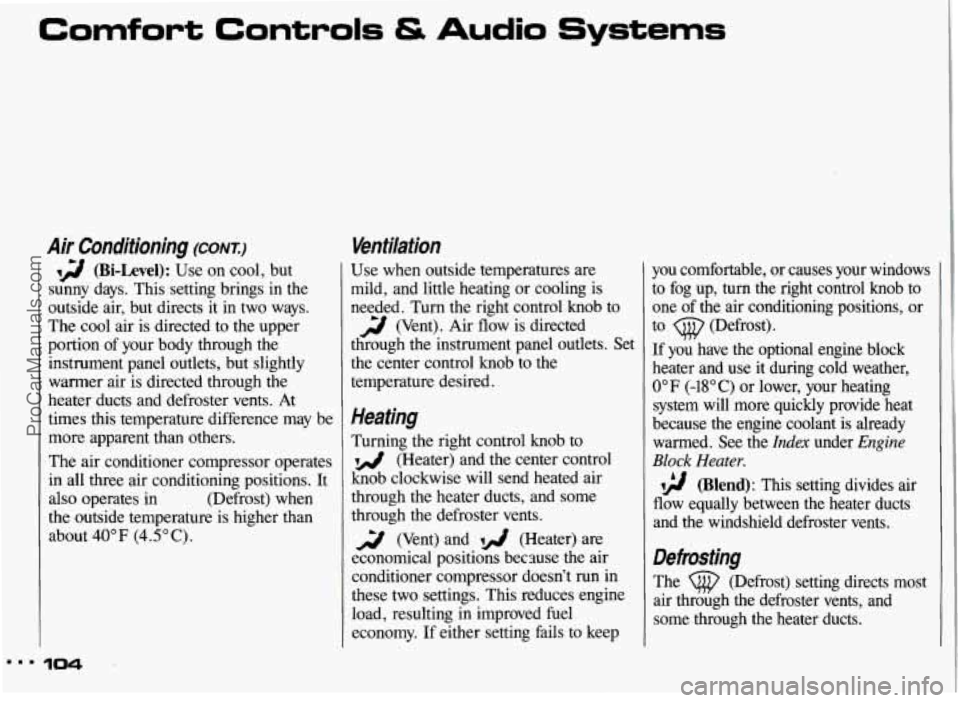
qg (Bi-Level): Use on cool, but
sunny days. This setting brings in the
outside air, but directs it in two ways.
The cool air is directed to the upper
portion of your body through the
instrument panel outlets, but slightly
warmer air is directed through the
heater ducts and defroster vents. At
times this temperature difference may be
more apparent than others.
The air conditioner compressor operates
in all three air conditioning positions. It
also operates in (Defrost) when
the outside temperature is higher than
about
40°F (4.5"C).
Ventilation
Use when outside temperatures are
mild, and little heating or cooling is
needed. Turn the right control knob to
2 (Vent). Air flow is directed
through the instrument panel outlets. Set
the center control knob to the
temperature desired.
Heating
Turning the right control knob to
72 (Heater) and the center control
knob clockwise will send heated air
through the heater ducts, and some
through the defroster vents.
3 (Vent) and (Heater) are
economical positions because the air
conditioner compressor doesn't run in
these two settings. This reduces engine
load, resulting in improved fuel
economy. If either setting fails to keep you
comfortable, or causes your windows
to fog up, turn the right control knob to
one of the air conditioning positions, or
to
(j@ (Defrost).
If you have the optional engine block
heater and use it during cold weather,
0°F (-18°C) or lower, your heating
system will more quickly provide heat
because the engine coolant is already
warmed. See the
Index under Engine
Block Heater.
flow equally between the heater ducts
and the windshield defroster vents.
vg (Blend): This setting divides air
Defrosting
The (@ (Defrost) setting directs most
air through the defroster vents, and
some through the heater ducts.
8.8 104
ProCarManuals.com
Page 166 of 306
Turn Signals When Towing a ’Railer
When you tow a trailer, your vehicle has
to have a different turn signal flasher
and extra wiring. The green arrows on
your instrument panel will flash
whenever you signal a
turn or lane
change. Properly hooked up, the trailer
lights will also flash, telling other drivers you’re about to turn, change
lanes or stop.
When towing a trailer, the green arrows
on your instrument panel will flash for
turns even if the bulbs on the trailer are
burned out. Thus, you may think drivers
behind you are seeing your signal when
they are not. It’s important to check occasionally to be sure the trailer bulbs
are still working.
Driving On Grades
Reduce speed and shift to a lower gear
before you start down a long or steep
downgrade. If you don’t shift down, you
might have to use your brakes
so much
that they would get hot and no longer work well.
On a long uphill grade, use the highest
gear possible. If you cannot maintain
posted speeds, driving at a lower speed
may help avoid overheating your engine
and transaxle.
If you have a manual transaxle with
fifth
gear, it’s better not to use fifth gear. Just
drive in fourth gear (or, as you need to,
a lower gear).
Parking on Hills
You really should not park your vehicle,
with a trailer attached,
on a hill. If
something goes wrong, your rig could
start to move. People can be injured,
and both your vehicle and the trailer can
be damaged.
But if you ever have to park your rig on
a hill, here’s how to do it:
1. Apply your regular brakes, but don’t
shift into
P (Park) yet, or into gear
for a manual transaxle.
2. Have someone place chocks under
the trailer wheels.
3. When the wheel chocks are in place,
release the regular brakes until the chocks absorb the load.
165 DDD
ProCarManuals.com
Page 170 of 306
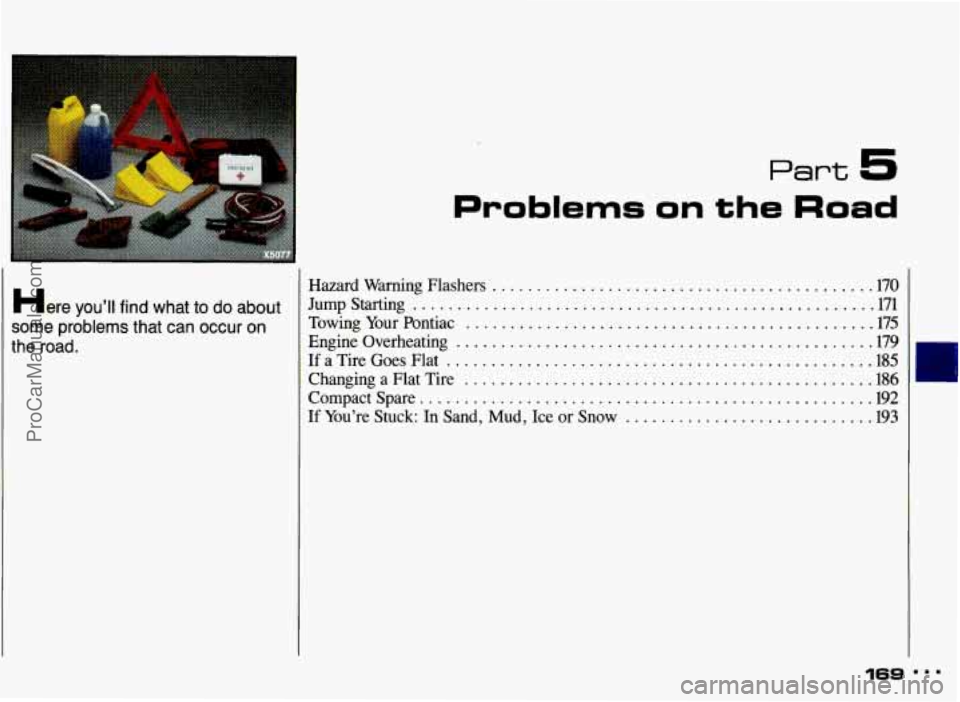
Here you’ll find what to do about
some problems that can occur on
the road.
Problems on the Road
Hazard Warning Flashers .......................................... .170
Jumpstarting
.................................................... 17 1
TowingYourPontiac .............................................. 175
Engine Overheating
.............................................. .179
If a Tire Goes Flat ............................................... -185
Changing a Flat Tire
............................................. .186
CompactSpare
................................................... 192
If You’re Stuck: In Sand, Mud, Ice or Snow ........ ............ .193
169 ...
ProCarManuals.com
Page 180 of 306
Engine Overheating
You will find a coolant temperature gage
or the warning light about
a hot engine
on your Pontiac’s instrument panel. See
the
Index under Coolant Temperature
Gage
and Coolant Temperature Warning
Light.
You will also find a low coolant warning
light on your Pontiac’s instrument panel.
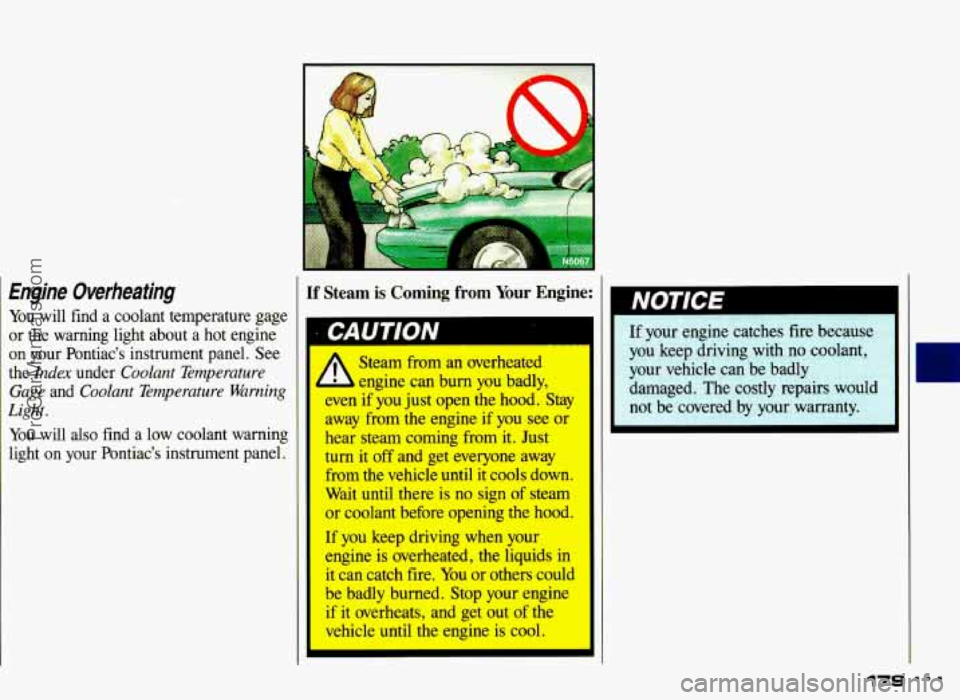
If Steam is Coming from Your Engine:
/1 Steam from an overheated
L L engine can burn you badly,
even
if you just open the hood. Stay
away from the engine if you see or
hear steam coming from
it. Just
turn it off and get everyone away
from the vehicle
until it cools down.
Wait until there is no sign of steam
or coolant before opening the hood.
If you keep driving when your
engine
is overheated, the liquids in
it can catch fire. You or others could
be badly burned. Stop your engine
if it overheats, and get out of the
vehicle until the engine is cool.
179
ProCarManuals.com
Page 181 of 306
Problems on the Road
Engine Overheating (CONT)
If No Steam is Coming from Your
Engine:
If you get the overheat warning but see
or hear no steam, the problem may not
be
too serious. Sometimes the engine
can get a little too hot when you:
Climb a long hill on a hot day.
Stop after high speed driving.
Idle for long periods in traffic.
Tow a trailer.
180
If you get the overheat warning with no
sign of steam, try this for a minute or so:
1 . If you have an air conditioner, turn it
off.
2. Turn your heater to full hot at the
highest fan speed and open the window as necessary.
3. Try to keep your engine under load
(in a drive gear where the engine
runs slower).
If you no longer have the overheat
warning,
you can drive. Just to be safe,
drive slower for about ten minutes.
If
the warning doesn’t come back on, you
can drive normally.
If the warning continues, pull over, stop,
and park your vehicle right away. If there’s
still no sign of steam, you can
idle the engine for two or three minutes
while you’re parked, to
see if the
warning stops.
But then, if you still have the warning,
TURN
OFF THE ENGINE AND GET
EVERYONE OUT
OF THE VEHICLE
until it cools down.
You may decide not to lift the hood but
to get service help right away.
ProCarManuals.com