lock PONTIAC GRAND-AM 1993 Owner's Manual
[x] Cancel search | Manufacturer: PONTIAC, Model Year: 1993, Model line: GRAND-AM, Model: PONTIAC GRAND-AM 1993Pages: 306, PDF Size: 15.39 MB
Page 53 of 306

Features & Controls
On manual transaxle vehicles,
lock the steering column
and result
in a loss of ability to steer the
vehicle. This could cause a
collision.
If you need to turn the
engine
off while the vehicle is
moving,
turn the key only to Off.
Don’t press the key release button
while the vehicle is moving.
L turning the key to Lock will
... 52
NOTICE Starting Your Engine
Engines start differently. The 8th digit of
your Vehicle Identification Number
(VIN) shows the code letter or number
for your engine. You will find the
VIN
at the top left of your instrument panel.
(See the Index under @hide
IdentiJication Number.
) Follow the
proper steps to
start the engine.
ProCarManuals.com
Page 57 of 306

Features & Controls
Engine Block Heater (oPnoN)
In very cold weather, 0" F (-18" C) or
colder, the engine block heater can help.
You'll get easier starting and better fuel
economy during engine warm-up.
To Use the Block Heater:
1. Turn off the engine.
2. Open the hood and unwrap the
3. Plug it into a normal, grounded
electrical
cord.
110-volt outlet. Plugging the cord into an
ungrounded outlet could cause
an electrical shock. Also, the
wrong kind of extension cord
could overheat and cause a fire.
You could be seriously injured.
1
Plug the cord into a properly
grounded three-prong 110-volt
outlet.
If the cord won't reach, use
a heavy-duty three-prong extension
cord rated for at least
15 amps.
I NOTICE
After you've used the block heater, , ;
be sure to store the cord as it was., ,(
moving engine parts. If you don't,
.. before, to keep it away from ,~
it could be damaged, ~".',:; ,"::,:;s ':,:';:::':;
How long should you keep the block
heater plugged in? The answer depends
on the weather, the kind
of oil you have,
and some other things. Instead of trying
to list everything here, we ask that you contact a Pontiac dealer in the area
where you'll be parking your vehicle.
The dealer can give you the best advice
for that particular area.
mmm 56
ProCarManuals.com
Page 58 of 306

Shifting the Automatic Transaxle
Your automatic transaxle has a shift
lever located on the console between the
seats.
There are several different positions for
your shift lever. In this manual, these
are referred
to by the commonly used
symbols in the right column below:
Park P
Reverse R
Neutral N
Drive D
Second 2
First 1
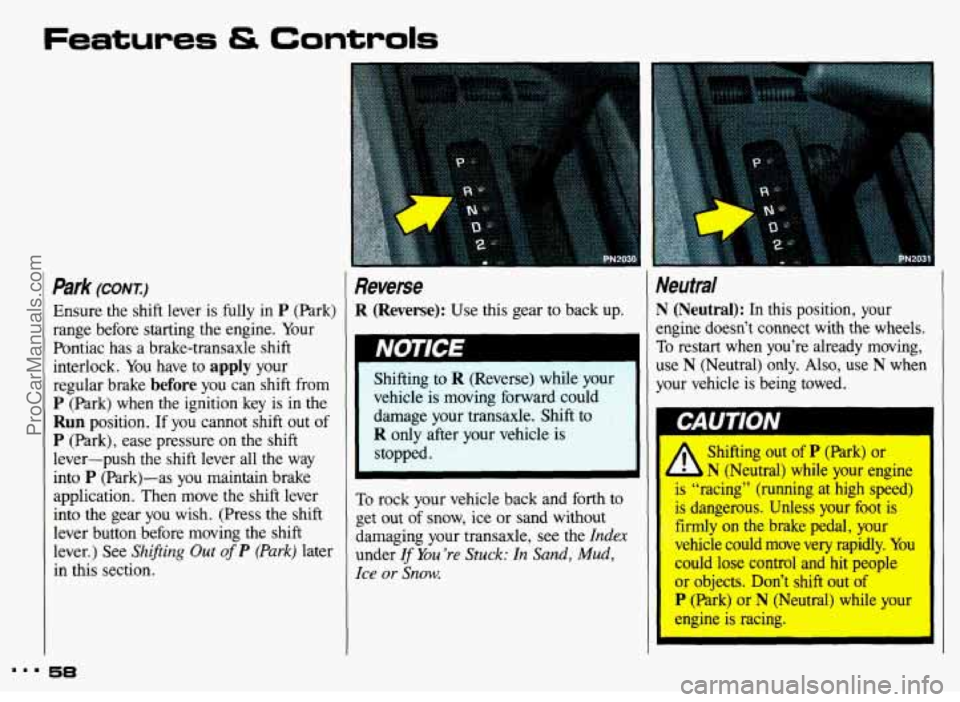
Park
P (hrk): This locks your front wheels.
It’s the best position to use when you
start your engine because your vehicle
can’t move easily.
I I
It can be dangerous to get out
b of your vehicle if the shift
hever is not fully in
P (Park) with
the parking brake firmly
set v-*7
vehicle can roll
Don’t leave your venue
WI I me
engine is running unless you llavr
to. If you have left the engine
running, the vehicle can move
suddenly. You or others could be
injured. To be sure your vehicle
won’t move, when you’re on fair1
level ground, always set your
parking brake and move the shift
lever to
P (Park). See the Index
under Shifting into P (Park). If you
are parking
on a hill, or if you’re
pulling a trailer, also see the
Index
under Parking on Hills or %wing a
Trailer.
ProCarManuals.com
Page 59 of 306
Features & Controls
Park (CONT.)
Ensure the shift lever is fully in P (Park)
range before starting the engine. Your
Pontiac has a brake-transaxle shift
interlock. You have
to apply your
regular brake
before you can shift from
P (Park) when the ignition key is in the
Run position. If you cannot shift out of
P (Park), ease pressure on the shift
lever-push the shift lever all the way
into
P (Park)-as you maintain brake
application. Then move the shift lever
into the gear you wish. (Press the shift
lever button before moving the shift
lever,) See
Shifting Out of P (Park) later
in this section.
Reverse
R (Reverse): Use this gear to back up.
Shifting to
R (Reverse) while your
vehicle
is moving forward could
damage your transaxle. Shift
to
R only after your vehicle is
stopped.
To rock your vehicle back and forth to
get out of
snow, ice or sand without
damaging your transaxle,
see the Index
under If You ’re Stuck: In Sand, Mud,
Ice or Snow.
Neutral
N (Neutral): In this position, your
engine doesn’t connect with the wheels.
To restart when you’re already moving,
use
N (Neutral) only. Also, use N when
your vehicle is being towed.
A Shifting out of P (Park) or
1 N (Neutral) while your engine I
‘racing” (running at high speed)
is dangerous. Unless your foot is
firmly on the brake pedal, your
vehicle could move very rapidly. You
could lose control and hit people
or objects. Don’t shift out
of
P (Park) or N (Neutral) while your
engine is racing.
I.. 58
ProCarManuals.com
Page 65 of 306
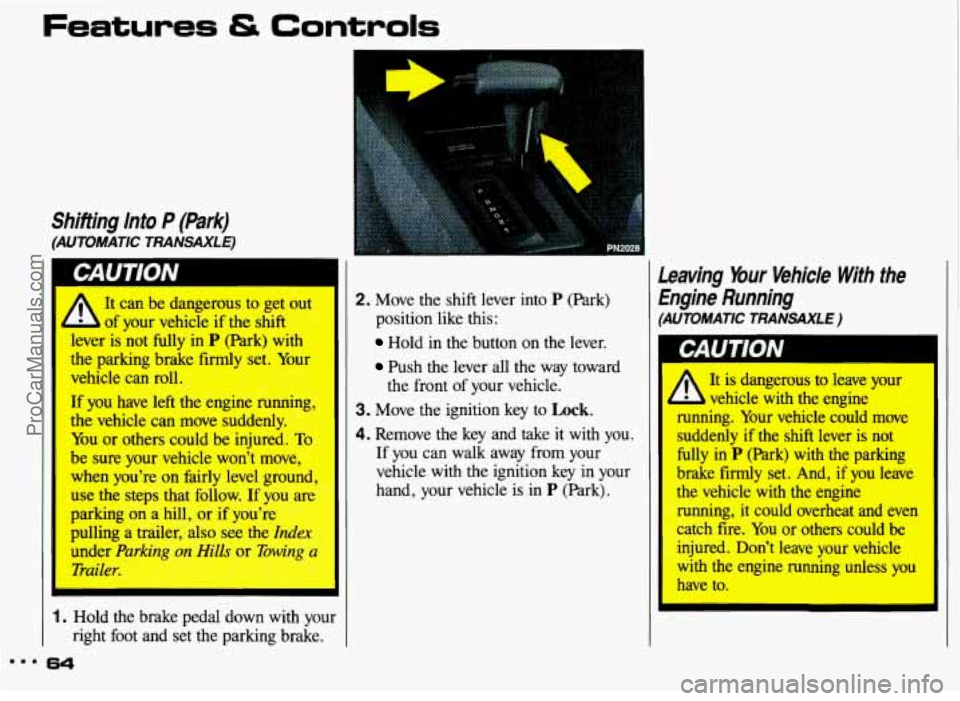
Shifting Into P (Park)
(AUTOMATIC TRANSAXLE)
A
It can be dangerous to get out
of your vehicle if the shift
I
lever is not fully in P (Park) with
the parking brake firmly set. Your
vehicle can roll.
If you have left the engine running
the vehicle can move suddenly.
You or others could be injured.
Tc
be sure your vehicle won’t move,
when you’re on fairly level ground,
use the steps that follow. If you arc
parking on a hill, or if you’re
I
pulling a trailer, also see the Inden
under ParkinP 01 lills or %wing .
“rail
I
1. Hold the brake pedal down with your
right foot and set the parking brake.
8.. 64
2. Move the shift lever into P (Park)
position like this:
Hold in the button on the lever.
Push the lever all the way toward
the front of your vehicle.
3. Move the ignition key to Lock.
4. Remove the key and take it with you.
If you can walk away from your
vehicle
with the ignition key in your
hand, your vehicle is in
P (Park).
Leaving Your Vehicle With the
Engine Running
(AUTOMATIC TRANSAXLE)
It is dangerous to leave your
running. Your vehicle could move
suddenly
if the shift lever is not
fully
in P (Park) with the parking
brake firmly set. And,
if you leave
the vehicle
with the engine
running,
it could overheat and even
catch fire. You or others could be
injured. Don’t leave your vehicle
with the engine
rumins unless you,
have to.
h- *2-- ;,a,&#:+h .u ’ -. :.
L vehicle with the engine
i- ’-
ProCarManuals.com
Page 66 of 306

If you have to leave your vehicle with
the engine running, be sure your vehicle
is in
P (Park) and your parking brake is
firmly set before you leave it. After
you’ve moved the
shift lever into the
P (Park) position, hold the regular brake
pedal down. Then, see if you can move
the shift lever away from
P (Park)
without first pushing the button.
If you can, it means that the shift lever
wasn’t fully locked into
P (Park).
Shifting Out of P (Park)
(AUTOMATIC TRANSAXLE)
Your Pontiac has a brake-transaxle shift
interlock. You have to
apply your
regular brake
before you can shift from
P (Park) when the ignition is in the Run
position. See the Index under Automatic
Transaxle.
If you cannot shift out of P (Park), ease
pressure on the shift lever-push the
shift lever all the way into
P (hrk)- as
you maintain brake application. Then
move the shift lever into the gear you
wish. (Press the shift lever button before
moving the shift lever.) If you ever hold the
brake pedal down
but still can’t shift out
of P (Park), try
this:
1. Turn the key to Off.
2. Apply and hold the brake until the
3. Shift to N (Neutral).
4. Start the vehicle and then shift to the
drive gear you want.
5. Have the vehicle fixed as soon as you
can. end of Step
4.
65
ProCarManuals.com
Page 69 of 306

...
Features & Controls
Ti/t Steering Wheel (opTIoN)
A tilt steering wheel allows you to
adjust the steering wheel before you
drive.
You can also raise it to the highest level
to give your legs more room when
you
exit and enter the vehicle.
To tilt the wheel, hold the steering
wheel and pull the lever.
Move the steering wheel to a comfort-
able level, then release the lever to lock
the wheel in place.
38
Windows
On a vehicle with manual windows, use
the window crank to open and close
each window.
I N21
Power Windows (opTIoN)
With power windows, switches on the
center console control each of the
windows when the ignition is
on. In
addition, each passenger door has a
control switch for its own window.
The driver’s window switch has an Auto
Down feature. The driver’s window can
be opened to any position by pushing
the rear of the switch to the first detent.
When the switch is fully depressed, the
window will go down all the way.
To stop the window while it
is lowering,
press the switch, then release.
To raise the window, press and hold the
switch forward.
ProCarManuals.com
Page 70 of 306
I
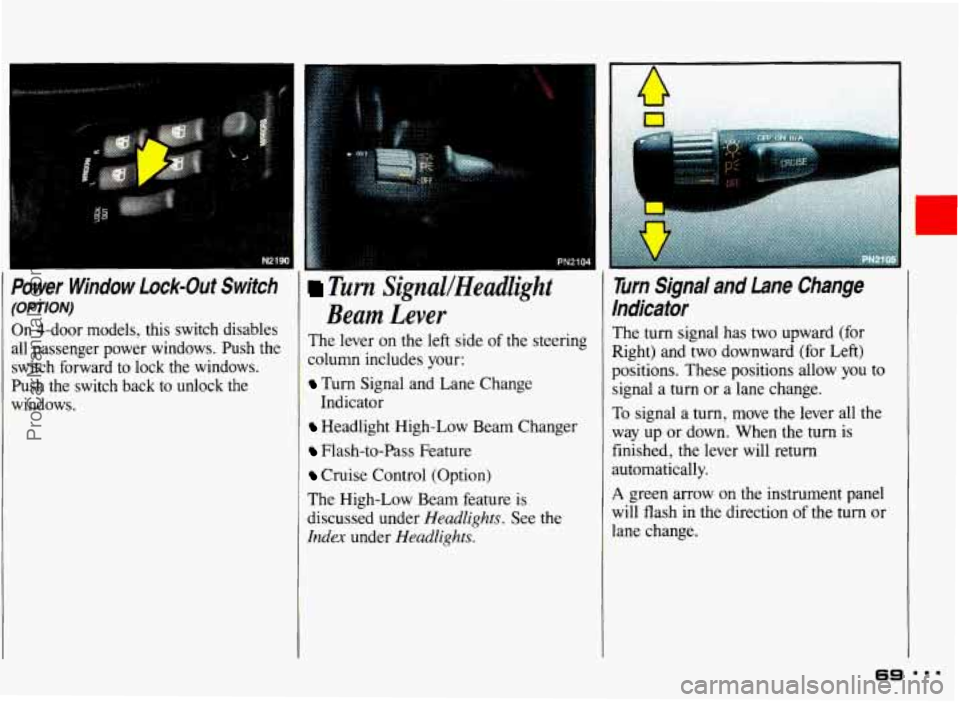
Power Window Lock-Out Switch
(OPT/Off)
On 4-door models, this switch disables
all passenger power windows. Push the
switch forward to lock the windows.
Push the switch back to unlock the
windows.
Turn SignallHeadlight
Beam
Lever
The lever on the left side of the steering
column includes your:
Turn Signal and Lane Change
Headlight High-Low Beam Changer
Flash-to-Pass Feature
Cruise Control (Option)
The High-Low Beam feature is
discussed under
Headlights. See the
Index under Headlights.
Indicator
Turn Signa/ and Lane Change
lndicator
The turn signal has two upward (for
Right) and two downward (for Left)
positions. These positions allow you to
signal a turn or a lane change.
To signal a turn, move the lever all the
way up or down. When the turn is
finished, the lever will return
automatically.
A green arrow on the instrument panel
will flash in the direction of the turn
or
lane change.
ProCarManuals.com
Page 76 of 306
lights On Reminder
If you open the driver’s door while
leaving the lights on, you will hear a
warning chime.
Daytime Running lights
(CANADA ONLY)
The Canadian federal government has
decided that Daytime Running Lights
(DRL) are a useful feature, in that DRL
can make your vehicle more visible to
pedestrians and other drivers during
daylight hours. DRL are required on
new vehicles sold in Canada.
Your DRL work with a light sensor
on
top of the instrument panel. Don’t cover
it up.
The high beam headlights will come on
at reduced brightness in daylight when:
The ignition is on
The headlight switch is off, and
The parking brake is released on a
manual transaxle; or
The shift lever is shifted out of
P (Park) or N (Neutral) on an
automatic transaxle. At
dusk, the exterior lights and
headlights will come on automatically.
At dawn, the exterior lights will go out
and the high beams will change to the
reduced brightness
of DRL again (if the
headlight switch is
off).
Of course, you may still turn on the
headlights any time you need to.
To idle your vehicle with the DRL
off,
set the parking brake on a manual
transaxle or put the vehicle in
P (Park)
or
N (Neutral) on an automatic
transaxle, while the ignition is in the
Off or Lock position. Then start the
vehicle. The DRL will
stay off until you
release the parking brake on a manual
transaxle or shift out
of P (Park) or
N (Neutral) on an automatic transaxle.
75
ProCarManuals.com
Page 79 of 306
Features & Controls
Trunk Light
This light comes on when you open
your trunk. It also comes on when you
open the doors or turn on the courtesy
lights.
78
Battery Rundown Protection
Your Pontiac is equipped with a Battery
Rundown Protection feature designed to
protect your vehicle’s battery.
When any interior light (trunk, reading,
footwell or glove box) is left on when
the ignition is turned off, the Battery
Rundown Protection system will
automatically shut the light off after
20
minutes. This will avoid draining the
battery.
To reactivate the interior lights, either:
The ignition must be turned on
The activated light switch must be
turned off and then on, OR
A front door must be opened. The Battery Rundown Protection feature
will
also be activated when any door of
your vehicle is left open.
Also,
if your vehicle is left with the
ignition turned
off for over 24 days,
battery power to your clock and audio
system will be turned off to reduce
battery drain. When the ignition is
turned on again, battery power will
be
resupplied. However, under these
conditions, it will be necessary to reset
the clock and audio system settings.
ProCarManuals.com