lock PONTIAC GRAND-AM 1993 Repair Manual
[x] Cancel search | Manufacturer: PONTIAC, Model Year: 1993, Model line: GRAND-AM, Model: PONTIAC GRAND-AM 1993Pages: 306, PDF Size: 15.39 MB
Page 193 of 306
Changing a Flat Tire (corvr)
14. Store the flat tire in the compact
spare
tire compartment, and secure
with the
wing bolt and extension.
Store the jack and wheel wrench in
their compartment, also.
I A Storing a jack, a tire, or other
- equipment in the passenger
ompartment
of the vehicle could I
cause injury. In a sudden stop or
collision, loose equipment could strike someone. Store all these in
the proper place.
i
Compact Spare Tire
Although the compact spare was fully
inflated when your vehicle was new, it can lose air after a time. Check the
inflation pressure regularly. It should be
60 psi (420 Wa). The compact spare is
made to go up to
3,000 miles (5 O00 km),
so you can finish your trip and have
your full-size tire repaired or replaced
where you want.
Of course, it’s best to
replace your spare with a full-size tire as
soon
as you can. Your spare will last
longer and be in good shape
in case you
need it again.
Your anti-lock brake system warning
light may come on when you are driving
with a compact spare. See the
Idex
under Anti-Lock Brake System Warning
Light.
192
Don’t take your compact spare
through
an automatic vehicle wash I
with guide rails. The compact spare can get caught on the rails.
That can damage the tire and
wheel, and maybe other parts
of
your vehicle.
)on? use your compact spare on some
)ther vehicle.
ind don’t
mix your compact spare or
vheel with other wheels or tires. They
von’t
fit. Keep your spare and its wheel
ogether.
ProCarManuals.com
Page 204 of 306
To check on fuel availability, ask an auto
club, or contact a major oil company
that does business in the country where
you’ll be driving.
You can also write us at the following
address for advice. Just tell us where
you’re going and give your Vehicle Identification Number (VIN)
.
General Motors of Canada Ltd.
International Export Sales
P.O. Box 828
Oshawa, Ontario L1H 7N1, Canada
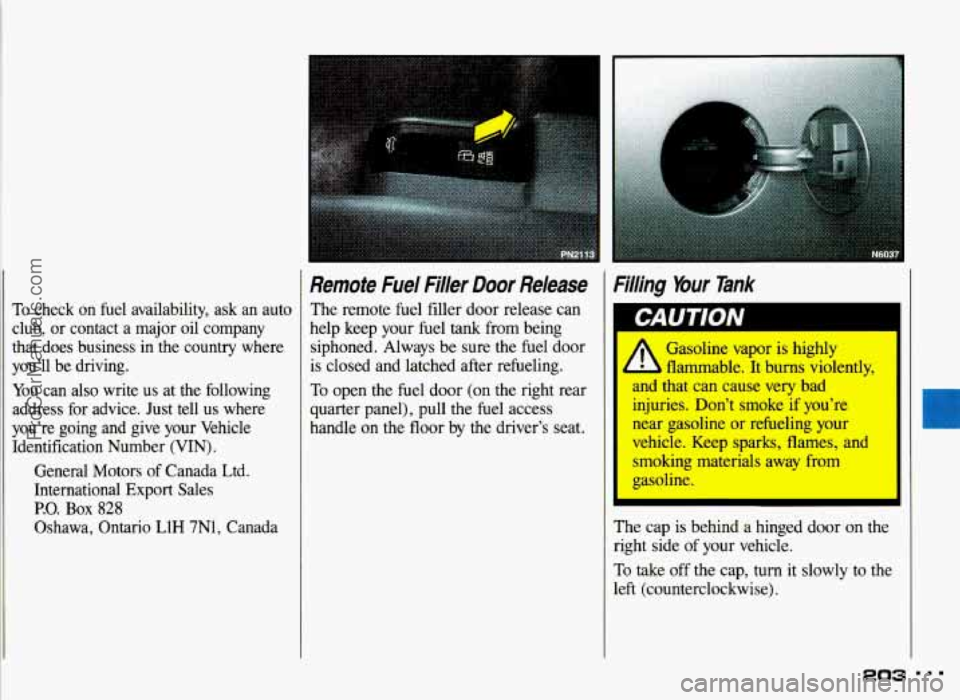
Remote Fuel Filler Door Release
The remote fuel filler door release can
help keep your
fuel tank from being
siphoned. Always be sure the fuel door
is closed and latched after refueling.
To open the fuel door (on the right rear
quarter panel), pull the fuel access
handle on the floor by the driver’s seat.
Wing Your Tank
A Gasoline vapor is highly
and that can cause very bad
injuries. Don’t smoke
if you’re
near gasoline or refueling your
vehicle. Keep sparks, flames, and
smoking materials away from
gasoline.
L flammable. It burns violently,
I
‘he cap is behind a hinged door on the
ight side
of your vehicle.
o take off the cap, turn it slowly to the
:ft (counterclockwise).
203
ProCarManuals.com
Page 214 of 306
I
Engine Oil Additives
Don't add anything to your oil. Your
Pontiac dealer is ready to advise
if you
think something should be added.
When to Change Engine Oil
See if any one of these is true for you:
Most trips are less than 4 miles (6 km).
It's below freezing outside and most
trips are less than
10 miles (16 km).
The engine is at low speed most of the
time
(as in door-to-door delivery, or in
stop-and-go traffic).
You tow a trailer often.
Most trips are through dusty places.
If any one of these is true for your
vehicle, then you need to change your
oil and fdter every 3,000 miles
(5 0oO km) or 3 months-whichever
comes first. (See the
Index under Check
Oil Light.)
If none of them is true, change the oil
every
7,500 miles (12 500 km) or 12
months-whichever comes first. Change
the filter at the first oil change and at
every other
oil change after that.
Engine Block Heater
An engine block heater can be a big
help if you have to park outside
in very
cold weather,
0" F (-18°C) or colder. If
your vehicle has this option, see the
Index under Engine Block Heater.
213 I..
ProCarManuals.com
Page 221 of 306
Service & Appearance Care
Manual Transaxle Fluid (CONI)
How to Add Fluid:
Here’s how to add fluid. Refer to the
Maintenance Schedule to determine
what kind
of fluid to use. See the Index
under Fluids & Lubricants.
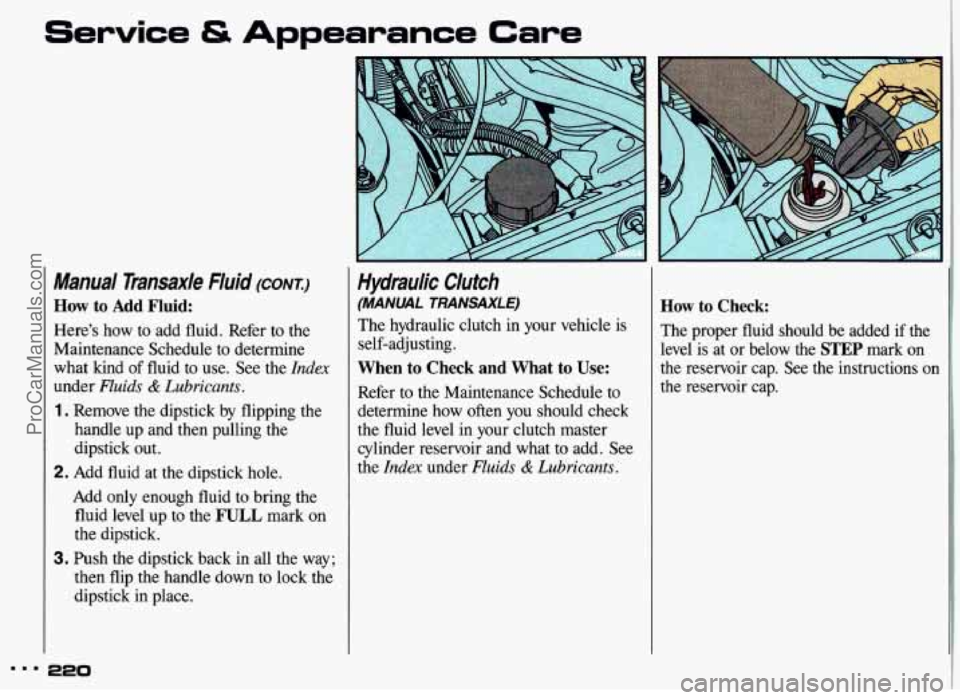
1. Remove the dipstick by flipping the
handle up and then pulling the
dipstick out.
2. Add fluid at the dipstick hole.
Add
only enough fluid to bring the
fluid level up to the
FULL mark on
the dipstick.
3. Push the dipstick back in all the way;
then flip the handle down to lock the
dipstick in place.
220
Hydraulic Clutch
(MANUAL TRANSAXLE)
The hydraulic clutch in your vehicle is
self-adjusting.
When to Check and What to Use:
Refer to the Maintenance Schedule to
determine how often you should check
the fluid level in your clutch master cylinder reservoir and what to add. See
the
Index under Fluids & Lubricants.
How to Check:
The proper fluid should be added if the
level is at or below the
STEP mark on
the reservoir cap. See the instructions on
the reservoir cap.
ProCarManuals.com
Page 229 of 306
Service & Appearance Care
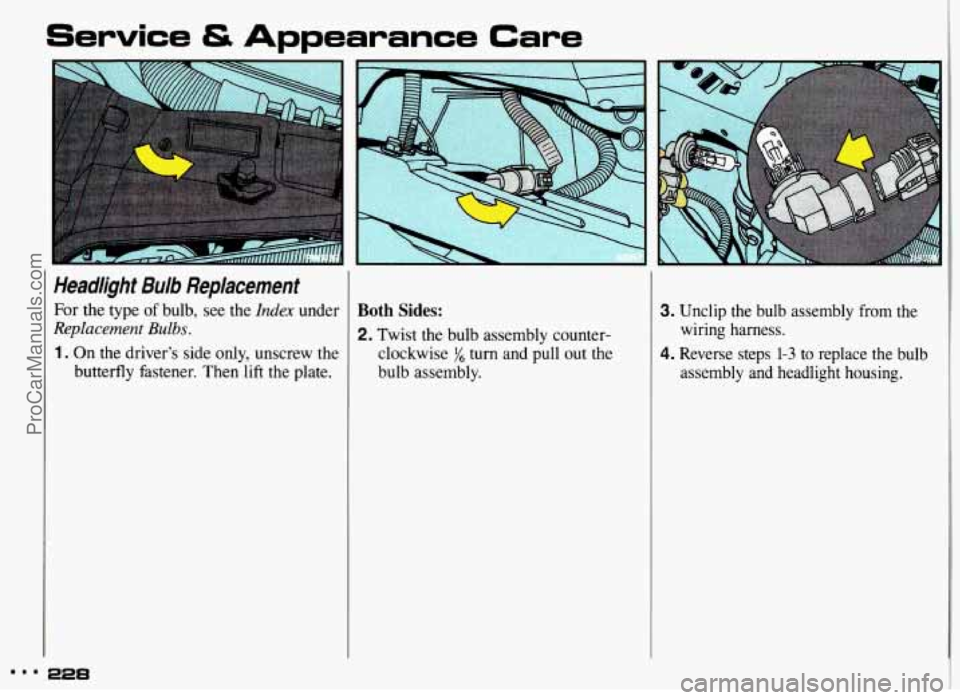
Headlight Bulb Replacement
For the type of bulb, see the Index under
Replacement Bulbs.
1. On the driver’s side only, unscrew the
butterfly fastener. Then lift the plate.
228
Both Sides:
2. Twist the bulb assembly counter-
clockwise
)/6 turn and pull out the
bulb assembly.
3. Unclip the bulb assembly from the wiring harness.
4. Reverse steps 1-3 to replace the bulb ,
assembly and headlight housing. I
ProCarManuals.com
Page 250 of 306
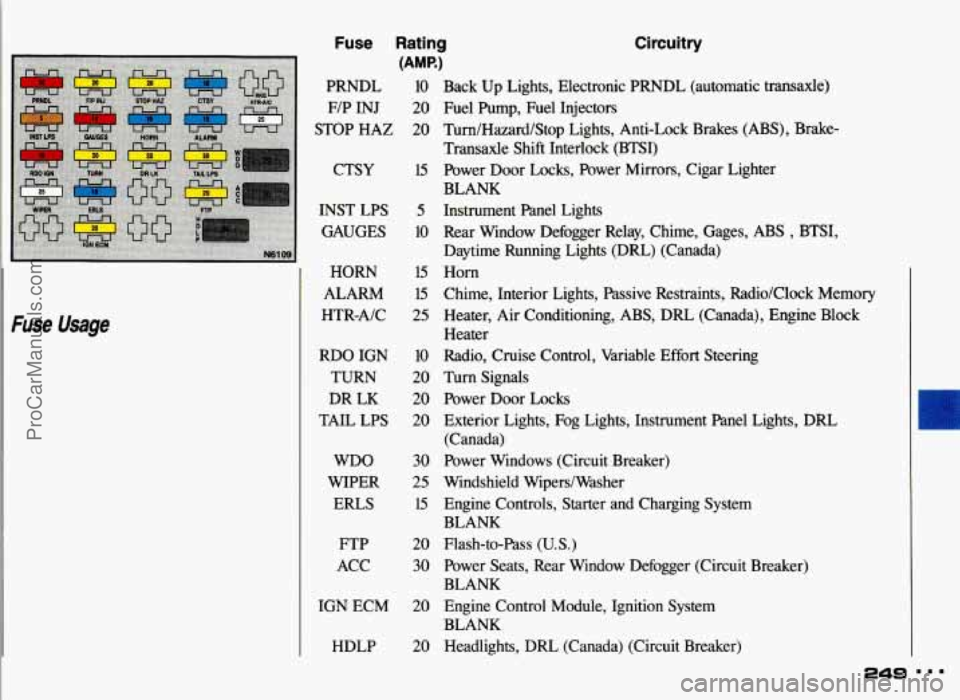
Fuse Rating Circuitry
Fuse Usage
HORN
ALARM
HTR-A/C
RDO IGN
TURN
DR LK
TAIL LPS
WDO
WIPER ERLS
FTP
ACC
IGN ECM
HDLP
15
15
25
10
20
20
20
30
25
15
20
30
20
20
Back Up Lights, Electronic PRNDL (automatic transaxle)
Fuel Pump, Fuel Injectors
Turn/Hazard/Stop Lights, Anti-Lock Brakes
(ABS), Brake-
Transaxle Shift Interlock
(BTSI)
Power Door Locks, Power Mirrors, Cigar Lighter
BLANK
Instrument Panel Lights
Rear Window Defogger Relay, Chime, Gages,
ABS , BTSI,
Daytime
Running Lights (Dm) (Canada)
Horn
Chime, Interior Lights, Passive Restraints, Radio/Clock Memory
Heater, Air Conditioning, ABS, DRL (Canada), Engine Block
Heater
Radio, Cruise Control, Variable
Effort Steering
Turn Signals
Power Door Locks
Exterior Lights, Fog Lights, Instrument Panel Lights, DRL
(Canada)
Power Windows (Circuit Breaker)
Windshield WipedWasher
Engine Controls, Starter and Charging System
BLANK
Flash-to-Pass
(US.)
Power Seats, Rear Window Defogger (Circuit Breaker)
BLANK
Engine Control Module, Ignition System
BLANK
Headlights, DRL (Canada) (Circuit Breaker)
ProCarManuals.com
Page 251 of 306
Headlight Wiring
The headlight wiring is protected by a
circuit breaker in the fuse block. An
electrical overload will cause the lights
to go on and off or, in some cases, to
remain
off. If this happens, have your
headlight system checked right away.
Windshield Wipers
The windshield wiper motor is protected
by a circuit breaker and a fuse.
If the
motor overheats due to heavy snow, etc.,
the wiper will stop until the motor cools.
If the overload is caused by some
electrical problem, have it fixed.
Power Windows and Other
Power Options
Circuit breakers in the fuse panel protect
the power windows and other power accessories. When the current load is
too heavy, the circuit breaker opens and
closes, protecting the circuit until the
problem is
fixed.
mm. 250
ProCarManuals.com
Page 273 of 306
![PONTIAC GRAND-AM 1993 Repair Manual Maintenance Schedule
Section 6: Owner Checks & Services [corn.]
At Least Once a %ar
CHECK
OR SERVICE WHAT TO DO
Key Lock Cylinders Lubricate the key lock cylinders with the lubricant sp](/img/50/58387/w960_58387-272.png "PONTIAC GRAND-AM 1993 Repair Manual Maintenance Schedule
Section 6: Owner Checks & Services [corn.]
At Least Once a %ar
CHECK
OR SERVICE WHAT TO DO
Key Lock Cylinders Lubricate the key lock cylinders with the lubricant sp")
Maintenance Schedule
Section 6: Owner Checks & Services [corn.]
At Least Once a %ar
CHECK
OR SERVICE WHAT TO DO
Key Lock Cylinders Lubricate the key lock cylinders with the lubricant specified in Section D.
Body Lubrication Lubricate all body door hinges. Also lubricate all hinges and latches, including those \
for the
hood, trunk, glove box door, console door, and any folding seat hardware. S\
ection
D tells you
I
t
what to use.
CAUTION I
When you are doing this check, the vehicle could move suddenly. If it does, you or others
a could be injured. Follow the steps below.
1. Before you start, be sure you have enough room around the vehicle.
2. Firmly apply both the parking brake (see the Ida under Parking Brake if necessary) and the
NOTE:
Do not use the accelerator pedal, and be ready to turn off the engine immediately if it
Starts.
3. On automatic transaxle vehicles, try to start the engine in ea\
ch gear. The starter should work
only
in P (Park) or N (Neutral). If the starter works in any other position, your vehicle needs
service.
On manual transaxle vehicles, put the
shift lever in N (Neutral), push the clutch down halfway
and try to start the engine. The starter should work only when the clutch is pushed down all
the way
to the floor. If the starter works when the clutch isn't pushed all the way down, your
vehicle needs service. regular brake.
ProCarManuals.com
Page 274 of 306
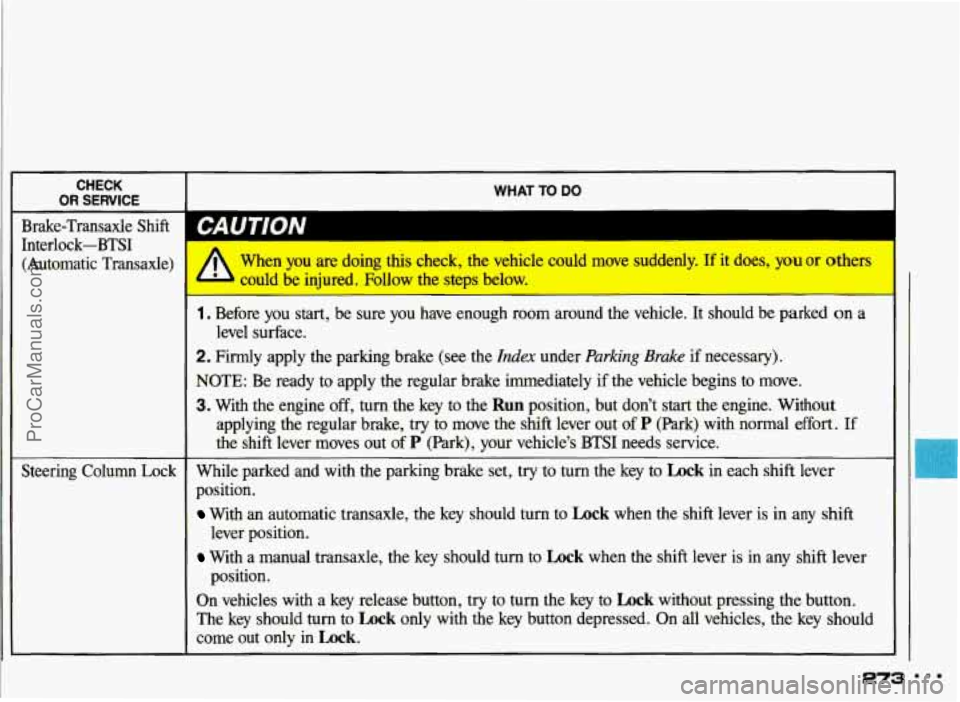
Interlock-BTSI (Automatic Transaxle)
Steering Column Lock When you
are doing this check, the vehicle could move suddenly.
If it does, you or others
could be injured. Foll
- -teps below.
. Before you start, be sure yo^ --we enough room around the vehicle. It snould be parKea on a
level surface.
2. Firmly apply the parking brake (see the Index under Parking Brake if necessary).
NOTE: Be ready to apply the regular brake immediately if the vehicle be\
gins to move.
3. With the engine off, turn the key to the Run position, but don’t start the engine. Without
applying the regular brake, try to move the shift lever out of
P (Park) with normal effort. If
the shift lever moves out of P (Park), your vehicle’s BTSI needs service.
While parked and with the parking brake set, try to turn the key to Lock in each shift lever I
position.
With an automatic transaxle, the key should turn to Lock when the shift lever is in any shift
lever position.
With a manual transaxle, the key should turn to Lock when the shift lever is in any shift lever
On vehicles with a key release button, try to turn the key to
Lock without pressing the button.
The key should turn to
Lock only with the key button depressed. On all vehicles, the key should
come out
only in Lock.
position.
E73
ProCarManuals.com
Page 276 of 306
.
You")
Section C: Periodic Maintenance Inspections
Listed below are inspections and services which should be perfo\
rmed at least twice a year (for instance, each spring and fall).
You should let your GM dealer’s service department or other qualified service center do these jobs: Make sure any necessary
repairs are completed at once.
L
INSPECTION
OR SERVICE
Steering, Suspension
and Front-Wheel-Drive
Axle Boot and Seal
Inspection
Exhaust System
Inspection
Throttle Linkage
Inspection
Brake System
Inspection
WHAT SHOULD BE DONE I
Inspect the front and rear suspension and steering system for \
damaged, loose or missing parts,
signs
of wear, or lack of lubrication. Inspect the power steering lines and hoses for proper
hookup, binding, leaks, cracks, chafing, etc. Clean and then in\
spect the drive axle boot seals for damage, tears or leakage. Replace seals if necessary.
Inspect the complete exhaust system. Inspect the body near the \
exhaust system. Look for broken,
damaged, missing or out-of-position parts
as well as open seams, holes, loose connections, or
other conditions which could cause a heat build-up in the floor pan or could let exhaust fumes
into the vehicle. See the
Idex under EnRine Exhaust.
Inspect the throttle linkage for interference or binding, and for damaged or missing parts.
Replace parts as needed.
Inspect the complete system. Inspect brake lines and hoses for \
proper hookup, binding, leaks,
cracks, chafing, etc. Inspect disc brake pads for wear and rot\
ors for surface condition. Also
inspect drum brake linings for wear and cracks. Inspect other brake parts, including drums,
wheel cylinders, calipers, parking brake, etc. The parking brake is self-adjusting and no manual
adjustment is required,
You may need to have your brakes inspected more often if your driving
habits or conditions result in frequent braking.
NOTE:
A low brake fluid level can indicate worn disc brake pads which \
may need to be
serviced. Also, if the brake system warning light stays on or comes on, something may be wrong
with the brake system. See the
Index under Brake System Warning Light. If your anti-lock brake
system warning light stays on, comes on or flashes, something may be wrong with the anti-lock
brake system. See the
Index under Anti-Lock Brake System Warning Light.
275
ProCarManuals.com