esp PONTIAC GRAND-AM 1993 Owners Manual
[x] Cancel search | Manufacturer: PONTIAC, Model Year: 1993, Model line: GRAND-AM, Model: PONTIAC GRAND-AM 1993Pages: 306, PDF Size: 15.39 MB
Page 17 of 306

Seats & Safety 6elts
Here Are Questions Many People
Ask About Safety Belts-
and the Answers
Q: Won’t I be trapped in the vehicle
after
an accident if I’m wearing a
safety belt?
wearing a safety belt or not. But you
can easily unbuckle a safety belt,
even if you’re upside down. And
your chance of being conscious
during and after an accident,
so you
can unbuckle and get out, is much
greater if you are belted.
A: You could be-whether you’re
16
Q: Why don’t they just put in air
bags
so people won’t have to wear
safety belts?
Inflatable Restraint systems, are in
some vehicles today and will be in
more of them in the future. But they
are supplemental systems only-so
they work
with safety belts, not
instead of them. Every “air bag” system ever offered for sale has
required the use of safety belts. Even
if you’re in a vehicle that has “air
bags,” you still have to buckle up to
get the most protection. That’s true
not only in frontal collisions, but
especially in side and other
collisions.
A: ‘Air bags,” or Supplemental
Q: If I’m a good driver, and I never
drive far from home, why should
I
wear safety belts?
if you’re in an accident-even one
that isn’t your fault-you and your
passengers can be hurt. Being a good
driver doesn’t protect you from
things beyond your control, such as
bad drivers.
Most accidents occur within
25 miles
(40 km) of home. And the greatest
number of serious injuries and deaths
occur at speeds of less than
40 mph
(65 km/h).
Safety belts are for everyone.
A: You may be an excellent driver, but
ProCarManuals.com
Page 46 of 306
Door locks I
1 CAUTION
* Unlocked doors can be
- dangerous.
Passengers-especially children-
can easily open the doors and fall
out. When a door is locked, the
inside handle won’t open
it.
Outsiders can easily enter through
an unlocked door when you slow
down or stop your vehicle.
This may not be
so obvious: You
increase the chance of being
thrown out of the vehicle in a crash
if the doors aren’t locked. Wear
safety belts properly, lock your
doors, and you will be far better
off whenever you drive your
vehicle.
..
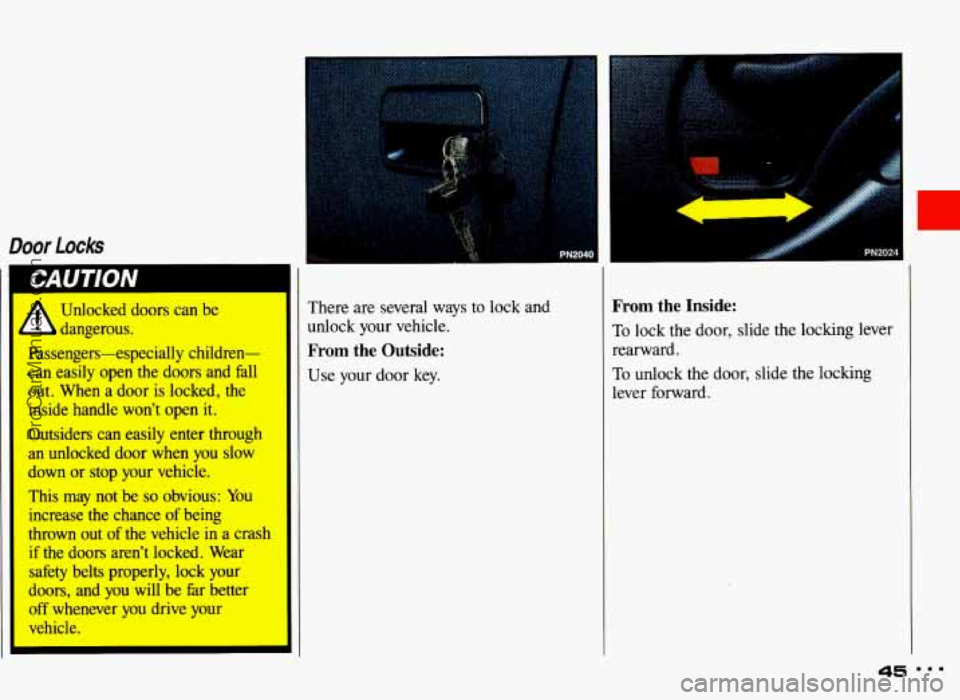
There are several ways to lock and
unlock
your vehicle.
From the Outside:
Use your door key.
From the Inside:
To lock the door, slide the locking lever
rearward.
To unlock the door, slide the locking
lever forward.
45 =.=
ProCarManuals.com
Page 49 of 306
Features & Controls
‘1
Rear Door Security Locks (CONT.)
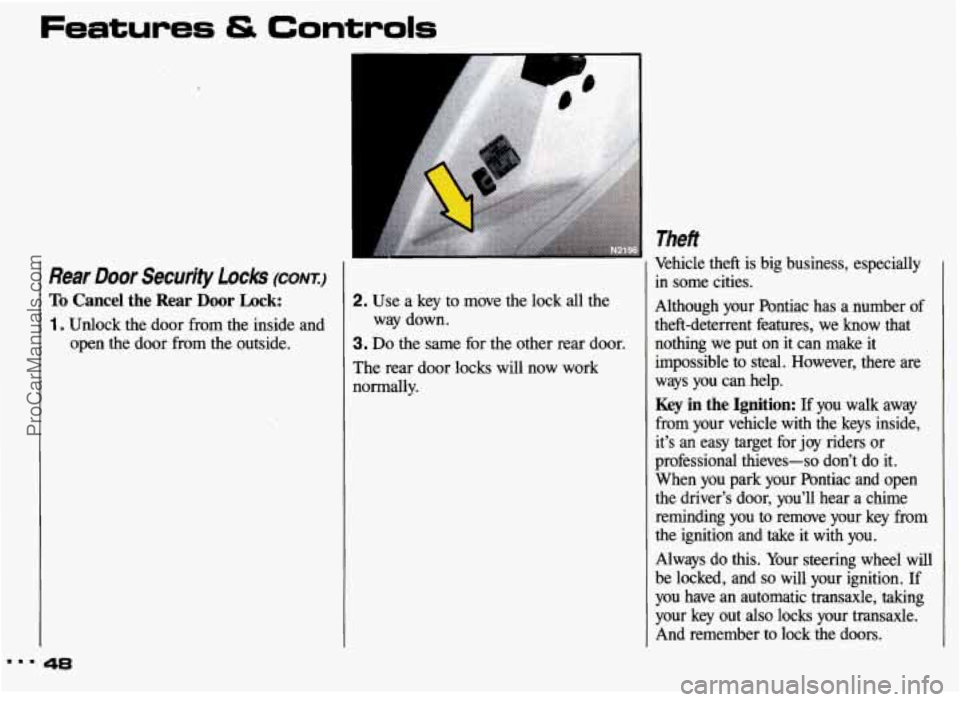
To Cancel the Rear Door Lock:
1 . Unlock the door from the inside and open the door from the outside.
48
2. Use a key to move the lock all the
3. Do the same for the other rear door.
The rear door locks will now work
normally. way
down.
Theft
Vehicle theft is big business, especially
in some cities.
Although your Pontiac has a number of
theft-deterrent features, we know that nothing we put on it can make it
impossible
to steal. However, there are
ways you can help.
Key in the Ignition: If you walk away
from your vehicle with the keys inside,
it’s an easy target for
joy riders or
professional thieves-so don’t do it.
When you park your Pontiac and open
the driver’s door, you’ll hear a chime
reminding you to remove your key from
the ignition and take it with you.
Always do
this. Your steering wheel will
be locked, and
so will your ignition. If
you have an automatic transaxle, taking
your key out
also locks your transaxle.
And remember to lock the doors.
ProCarManuals.com
Page 75 of 306
Features & Controls
I
I'
To Get Out of Cruise Control
There are two ways to turn off the cruise
control:
Step lightly on the brake pedal or push
the clutch pedal, if you have
a manual
transaxle; OR
Move the cruise switch to OFF.
To Erase Cruise Speed Memory
When you turn off the cruise control or
the ignition, your cruise control set
speed memory is erased.
74
. .. .. .. . , .. PN210!
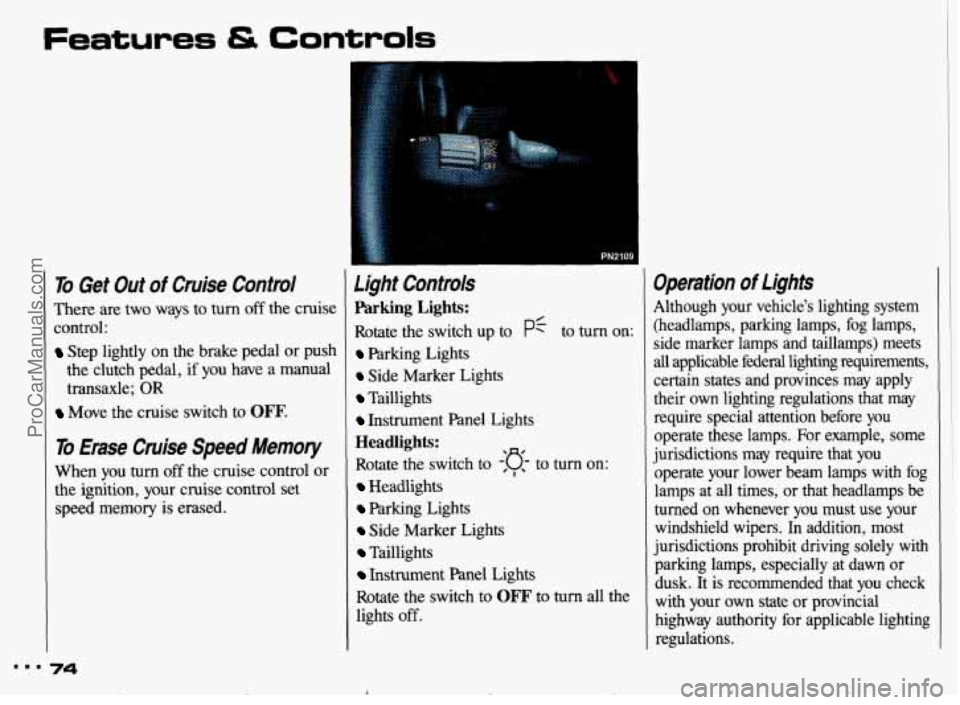
Light Controls
Parking Lights:
Rotate the switch up to pf to turn on
Parking Lights
Side Marker Lights
Taillights
Instrument Panel Lights
Headlights:
Rotate the switch to , , ,- to turn on:
Headlights
Parking Lights
Side Marker Lights
Taillights
Instrument Panel Lights
Rotate the switch
to OF" to turn all the
lights off.
-'D
Operation of Lights
Although your vehicle's lighting system
(headlamps, parking lamps, fog lamps,
side marker lamps and taillamps) meets
all applicable federal lighting requirements,
certain states and provinces may apply
their own lighting regulations that may
require special attention before you
operate these lamps. For example, some
jurisdictions may require that you
operate your lower beam lamps with fog
lamps at all times, or that headlamps be
turned
on whenever you must use your
windshield wipers.
In addition, most
jurisdictions prohibit driving solely with
parking lamps, especially at dawn
or
dusk. It is recommended that you check
with your own state
or provincial
highway authority for applicable lighting
regulations.
c ProCarManuals.com
Page 118 of 306
6. Press the lower knob (000 will
appear again on the display).
7. Press the SEEK, button until the
fourth digit of your code appears.
8. Rotate the lower knob right or left
until the fifth and sixth digits
of your
code appear.
9. Press the lower knob. If the display
shows
"---", the disabling sequence
was successful (the numbers matched
the user-selected code or
the factory
back-up code) and the audio system is in the
UNSECURED mode. If the
display shows
SEC, the disabling
sequence was unsuccessful and the
numbers did not match either
of the
codes. In this case, the audio system
will remain in the
SECURED mode.
To Unlock the System After a Power
Loss:
When battery power is reapplied to a
secured audio system after a loss of
power, the audio system will not turn on
and
LOC will appear on the digital
display. You will need to unlock the
Delco LOC
II@ system.
1 . Turn the ignition to the Accessory or
Run position, and turn the radio off.
2. Press SET, and 000 will appear on
the display.
3. Follow steps 4-8 for disabling your
anti-theft system.
4. Press the lower knob. The time will
appear on the digital display if you
are successful. If
SEC appears,
however, the numbers did not match
and your audio system is still locked.
Understanding Radio Reception
FM Stereo
FM stereo will give you the best sound,
but FM signals will reach only about
10 to 40 miles (16 to 65 km). Tall
buildings or hills can interfere with FM
signals, causing the sound to come and
go.
AM
The range for most AM stations is
greater than for FM, especially at night.
The longer range, however, can cause
stations to interfere with each other. AM
can also pick up noise from things like
storms and power lines.
To lower this
noise, try reducing the treble level.
AM Stereo
Your Delco@ system may be able to
receive C-Quam@ stereo broadcasts.
Many AM stations around the country
use C-Quam@ to produce stereo, though
some do not. C-Quam@ is a registered
trademark of Motorola, Inc. If your
Delco@ system can get C-Quam@
signals, your stereo indicator light will
come on when you are receiving it.
117 I..
ProCarManuals.com
Page 130 of 306
“I’ll be careful” isn’t the right answer.
What if there’s an emergency, a need to take sudden action, as when a child
darts into the street?
A person with a
higher
BAC might not be able to react
quickly enough to avoid the collision.
There’s something else about drinking
and driving that many people don’t
know. Medical research shows that
alcohol in a person’s system can make
crash injuries worse. That’s especially
true for brain, spinal cord and heart
injuries. That means that if anyone who
has been drinking-driver or
passenger-is in a crash, the chance of
being killed or permanently disabled is
higher than
if that person had not been
drinking. And we’ve already seen that the
chance of a crash itself is higher for
drinking drivers.
I
i Drinking and then driving is L b very dangerous. Your reflexes,
perceptions, and judgment will be
affected by even a small amount
of
alcohol. You could have a
serious-or even fatal-accident if
you drive after drinking. Please
don’t drink and drive or ride with a
driver who has been drinking.
Ride home in a cab; or if you’re
with a group, designate a driver
who will not drink.
I
rn Control of a Vehicle
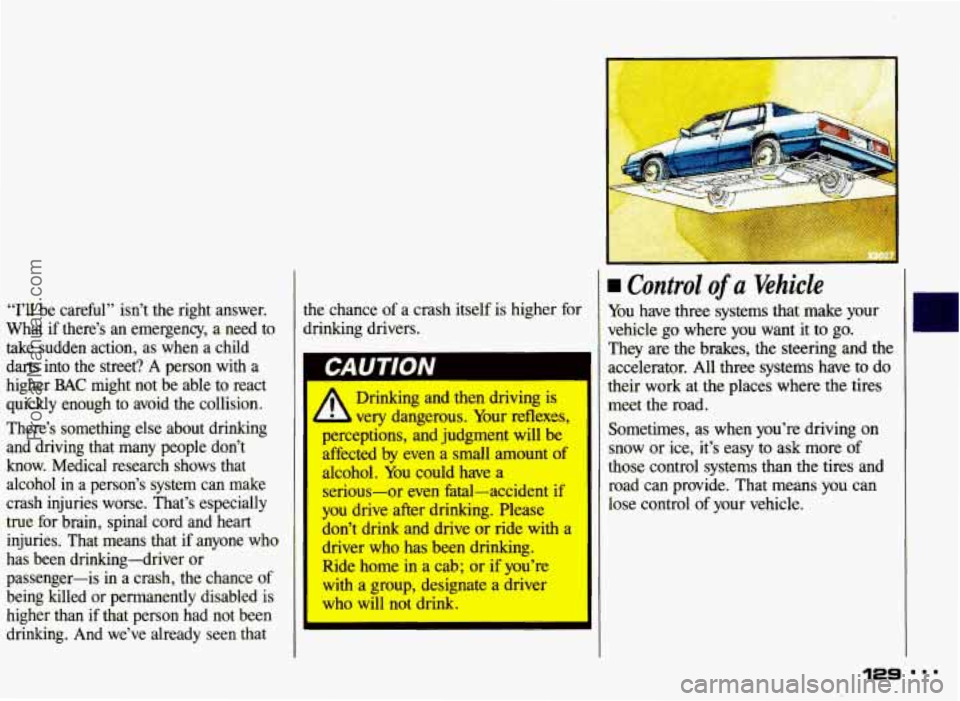
You have three systems that make your
vehicle
go where you want it to go.
They are the brakes, the steering and the
accelerator. All three systems
have to do
their work at the places where the tires
meet the road.
Sometimes, as when you’re driving on
snow or ice, it’s easy to ask more of
those control systems than the tires and
road can provide. That means
you can
lose control of your vehicle.
ProCarManuals.com
Page 140 of 306
So here are some tips for passing:
“Drive ahead.” Look down the road,
to the sides, and to crossroads for situations that might affect your
passing patterns. If you have any doubt
whatsoever about making a successful
pass, wait for a better time.
markings, and lines.
If you can see a
sign up ahead that might indicate a
turn or an intersection, delay your
pass.
A broken center line usually
indicates it’s all right to pass (providing
the road ahead is clear). Never cross
a
solid line on your side of the lane or a
double solid line, even if the road
seems empty of approaching traffic.
0 Watch for traffic signs, pavement
If you suspect that the driver of the
vehicle you want to pass isn’t aware of
your presence, tap the horn a couple
of times before passing. Or, you can
use flash-to-pass. See the
Index under
Flash-to-Pass.
Do not get too close to the vehicle you
want to pass while you’re awaiting
an
opportunity. For one thing, following
too closely reduces. your area of
vision, especially if you’re following a
larger vehicle.
Also, you won’t have
adequate space if the vehicle ahead
suddenly slows or stops. Keep back a
reasonable distance.
When it looks like a chance to pass is
coming up,
start to accelerate but stay
in the right lane and don’t get too
close. Time your move
so you will be
increasing speed
as the time comes to
move into the other lane.
If the way is
clear to pass, you will have
a “running
start” that more than makes up for the
distance you would lose by dropping
back. And if something happens
to
cause you to cancel your pass, you
need only slow down and drop back
again and wait for another opportunity.
slow vehicle, wait your
turn. But take
care that someone isn’t trying to pass
you as you pull out
to pass the slow
vehicle. Remember to glance over your
shoulder and check the blind spot.
If other cars are lined up to pass a
ProCarManuals.com
Page 142 of 306
Skidding
In a skid, a driver can lose control of
the vehicle. Defensive drivers avoid
most skids by taking reasonable care
suited to existing conditions, and by not
“overdriving” those conditions. But
skids are always possible.
The three types of skids correspond to
your Pontiac’s three control systems.
In
the braking skid your wheels aren’t
rolling.
In the steering or cornering
skid, too much speed or steering in a
curve causes tires to slip and lose cornering force. And in the acceleration
skid too much throttle causes the driving
wheels to spin. A
cornering skid and an acceleration
skid are best handled by easing your
foot
off the accelerator pedal. If your
vehicle starts to slide (as when you turn
a corner on a wet, snow- or ice-covered
road), ease your foot off the accelerator
pedal as soon as you feel the vehicle
start to slide. Quickly steer the way you
want the vehicle to go.
If you start
steering quickly enough, your vehicle
will straighten out. As it does, straighten
the front wheels.
Of course, traction is reduced when
water, snow, ice, gravel, or other
material is on the road. For safety, you’ll
want to slow down and adjust your
driving to these conditions. It is
important to slow down on slippery surfaces because stopping distance will
be longer and vehicle control more
limited. While driving on
a surface with reduced
traction, try your best to avoid sudden
steering, acceleration, or braking
(including engine braking by shifting to
a lower gear). Any sudden change could
cause the tires to slide.
You may not
realize the surface is slippery until your
vehicle is skidding. Learn to recognize
warning clues-such as enough water,
ice or packed snow
on the road to make
a “mirrored surface”-and slow down
when you have any doubt.
Remember: Any anti-lock braking
system
(ABS) helps avoid only the
braking skid.
141
ProCarManuals.com
Page 143 of 306
Your Driving and the Road
Driving at Night
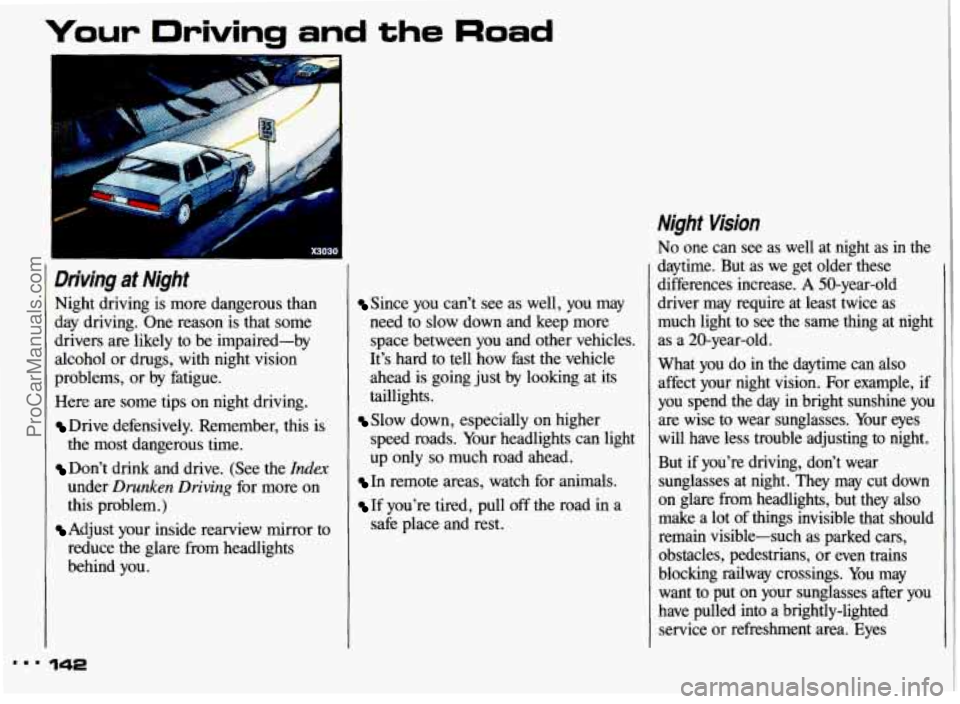
Night driving is more dangerous than
day driving. One reason is that some
drivers are likely to be impaired-by
alcohol or drugs, with night vision
problems, or by fatigue.
Here are some tips on night driving.
Drive defensively. Remember, this is
the most dangerous time.
Don’t drink and drive. (See the Index
under Drunken Driving for more on
this problem.)
Adjust your inside rearview mirror to
reduce the glare from headlights
behind you.
142
Since you can’t see as well, you may
need to slow down and keep more
space between you and other vehicles.
It’s hard to tell how fast the vehicle
ahead is going just by looking at its
taillights.
speed roads. Your headlights can light
up only
so much road ahead.
Slow down, especially on higher
In remote areas, watch for animals.
If you’re tired, pull off the road in a
safe place and rest.
Night Vision
No one can see as well at night as in the
daytime. But as we get older these
differences increase.
A 50-year-old
driver may require at least twice as
much light to see the same thing at night
as a 20-year-old.
What you do
in the daytime can also
affect your night vision. For example, if
you spend the day in bright sunshine you
are wise to wear sunglasses. Your eyes
will have less trouble adjusting to night.
But if you’re driving, don’t wear
sunglasses at night. They may cut down
on glare from headlights, but they also
make a lot of things invisible that should
remain visible-such as parked cars,
obstacles, pedestrians, or even trains
blocking railway crossings. You may
want to
put on your sunglasses after you
have pulled into a brightly-lighted
service or refreshment area. Eyes
ProCarManuals.com
Page 145 of 306
Your Driving and the Road
A &w More Night Driving
Suggestions
(CONTJ
Remember that your headlights light up
far
less of a roadway when you are in a
turn or curve.
Keep your eyes moving; that way,
it’s
easier to pick out dimly lighted objects.
Just as your headlights should be
checked regularly for proper aim,
so
should your eyes be examined regularly.
Some drivers suffer from night
blindness-the inability to see
in dim
light-and aren’t even aware
of it.
144
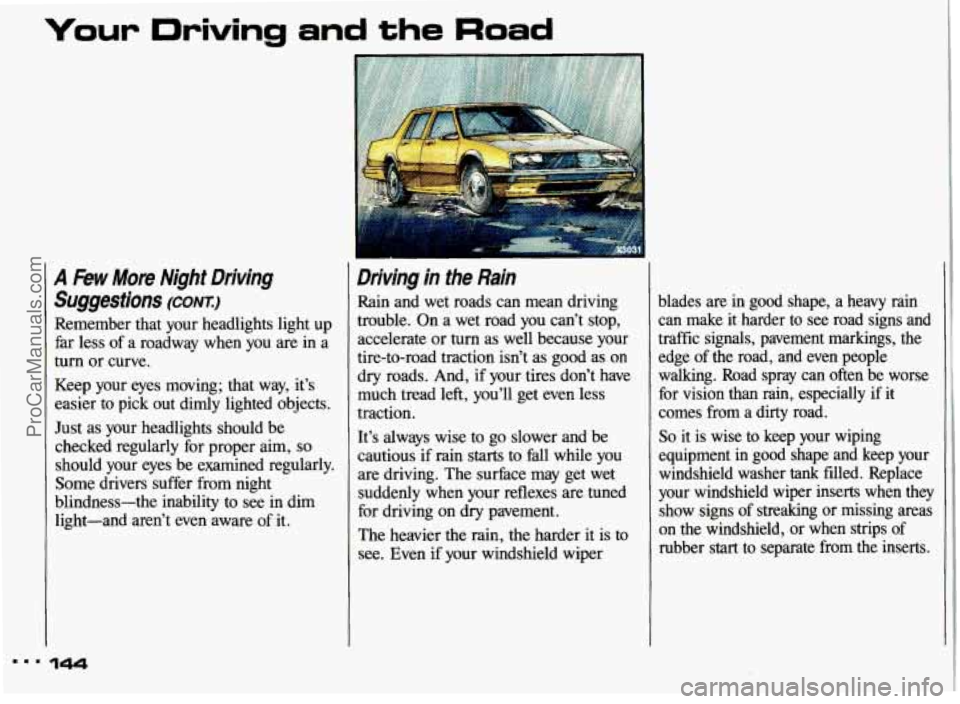
Driving in the Rain
Rain and wet roads can mean driving
trouble. On a wet road you can’t stop,
accelerate or
turn as well because your
tire-to-road traction isn’t as good
as on
dry roads.
And, if your tires don’t have
much tread left, you’ll get even less
traction.
It’s always wise to go slower and be
cautious
if rain starts to fall while you
are driving. The surface may get wet
suddenly when your reflexes are tuned
for driving on
dry pavement.
The heavier the
rain, the harder it is to
see. Even if your windshield wiper blades are in good shape, a heavy rain
can make it harder to see road signs and
traffic signals, pavement markings, the edge of the road, and even people
walking. Road spray can often be worse for vision than rain, especially
if it
comes from
a dirty road.
So it is wise to keep your wiping
equipment in
good shape and keep your
windshield washer
tank fdled. Replace
your windshield wiper inserts when they show signs of streaking or missing areas
on the windshield, or when strips of
rubber
start to separate from the inserts.
ProCarManuals.com