check PONTIAC GRAND-AM 1994 User Guide
[x] Cancel search | Manufacturer: PONTIAC, Model Year: 1994, Model line: GRAND-AM, Model: PONTIAC GRAND-AM 1994Pages: 274, PDF Size: 15.01 MB
Page 96 of 274
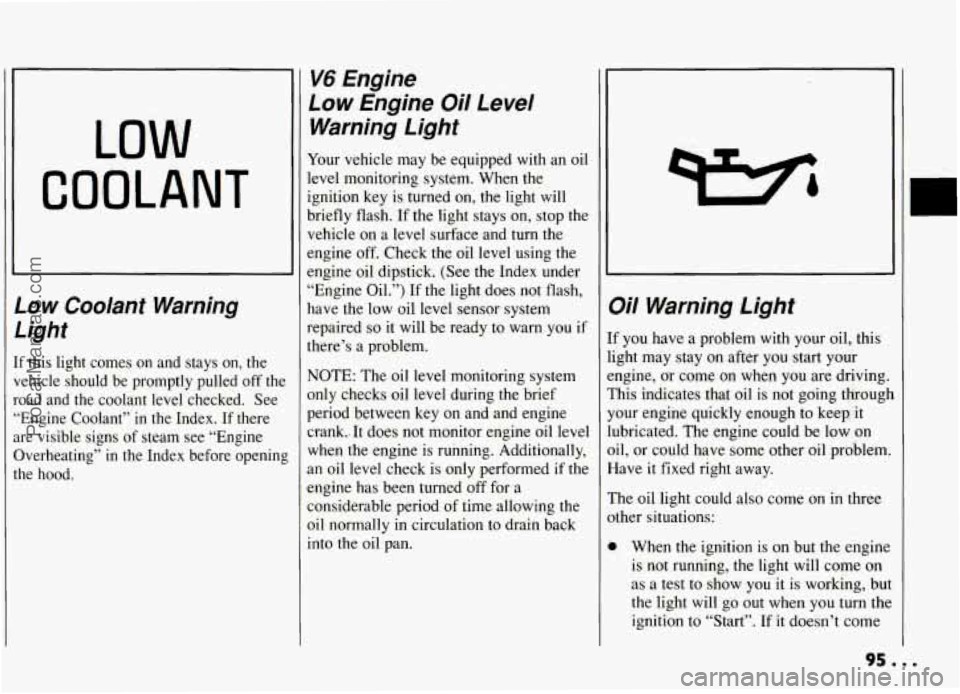
LOW
COOLANT
Low Coolant Warning
Light
F this light comes on and stays on, the
ehicle should be promptly pulled off the
Dad and the coolant level checked. See
Engine Coolant” in the Index. If there
re visible signs of steam see “Engine
herheating” in the Index before opening
le hood.
V6 Engine
Low Engine
Oil Level
Warning Light
Your vehicle may be equipped with an oil
level monitoring system. When the
ignition key is turned on, the light will
briefly flash. If the light stays on, stop the
vehicle on a level surface and turn the
engine off. Check the oil level using the
engine oil dipstick. (See the Index under
“Engine Oil.”) If the light does not flash,
have the low oil level sensor system
repaired
so it will be ready to warn you if
there’s a problem.
NOTE: The oil level monitoring system
only checks oil level during the brief
period between key on and and engine
crank.. It does not monitor engine ail level
when the engine
is running. Additionally,
an oil level check is only performed if the
engine has been turned off for a
considerable period of time allowing the
oil normally in circulation to drain back
into the oil pan.
Oiil Warning Light
If you have a problem with your oil, this
light may stay on after you start your
engine, or come on when you are driving.
This indicates that oil is not going through
your engine quickly enough to
keep it
lubricated. The engine could be low on
oil, or could have some other oil problem.
Have
it fixed right away.
The oil light could also come on in three
other situations:
0 When the ignition is on but the engine
is not running, the light will come on
as a test to show you it is working, but
the light will go out when you turn the
ignition to “Start”. If it doesn’t come
ProCarManuals.com
Page 97 of 274
Features & Controls
Oil Warning Light (CONT.)
on with the ignition on, you may have
a problem with the fuse or bulb. Have
it fixed right away.
0 Sometimes when the engine is idling
at a stop, the light may blink
on and
off. This is normal.
0 If you make a hard stop; the light may
come
on for a moment. This is normal.
NOTICE:
Damage to your engine from
neglected oil problems can be costly
and is
not covered by your warranty.
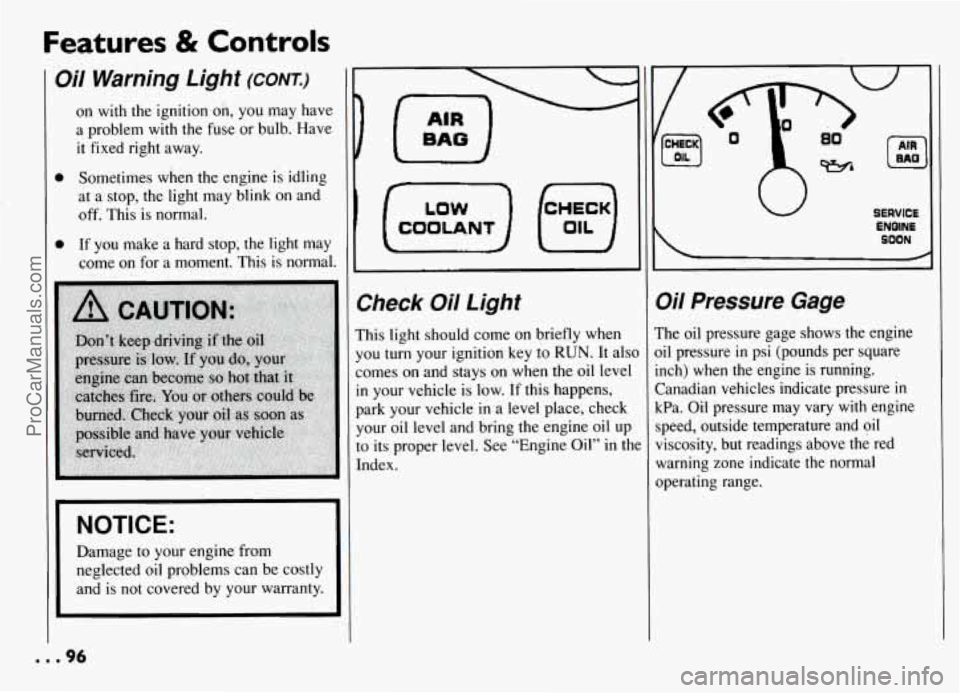
?heck Oil Light
’his light should come on briefly when
‘ou turn your ignition key to
RUN. It alsi
omes
on and stays on when the oil level
n your vehicle is low. If this happens,
ark your vehicle
in a level place, check
our oil level and bring the engine oil up
its proper level. See “Engine Oil” in th
Idex.
ENQINE
SOON
Oil Pressure Gage
The oil pressure gage shows the engine
oil pressure
in psi (pounds per square
inch) when the engine is running.
Canadian vehicles indicate pressure in
kPa. Oil pressure may vary with engine
speed, outside temperature and oil
viscosity, but readings above the red
warning zone indicate the normal
operating range.
... 96
ProCarManuals.com
Page 98 of 274
A reading in the red zone may be caused
by a dangerously low oil level or other
problem causing low oil pressure. Have
your vehicle serviced immediately.
NOTICE:
Damage to your engine from
neglected oil problems can be costly
and is not covered
by your warranty.
-
-
(
T
b
tt
SI
0
rl
dl
el
ir
dl
H
th
If
li;
ac
C(
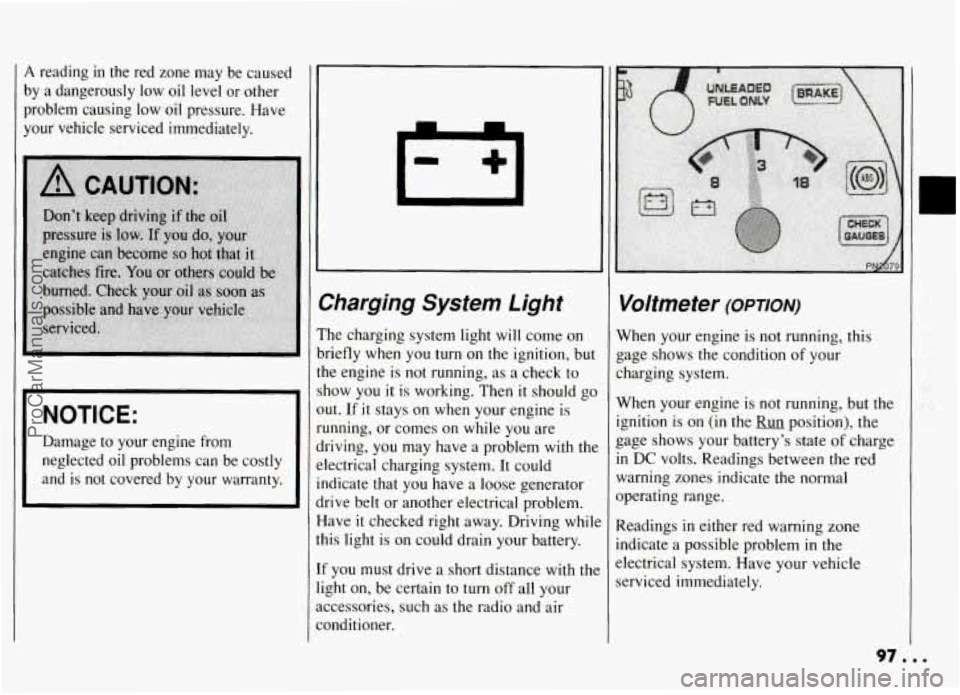
3harging System Light
'he charging system light will come on
riefly when you turn on
the ignition, but
le engine is not running, as a check to
low you
it is working. Then it should gc
ut. If it stays on when your engine is
Inning, or comes on while you are
riving, you may have a problem
with thc
lectrical charging system. It could
tdicate that you have a loose generator
rive belt or another electrical problem.
ave
it checked right away. Driving whih
lis light is on could drain your battery.
'you must drive a short distance with thc
ght on, be certain to turn off all your
xessories, such as the radio and air
mditioner.
Voltmeter (OPTION)
When your engine is not running, this
gage shows the condition
of your
charging system.
When your engine is not running, but the
ignition is on (in the Run position), the
gage shows your battery's state
of charge
in DC volts. Readings between the red
warning zones indicate the normal
operating range.
Readings in either red warning zone
indicate a possible problem in the
electrical system. Have your vehicle
serviced immediately.
970..
ProCarManuals.com
Page 101 of 274
Features & Controls
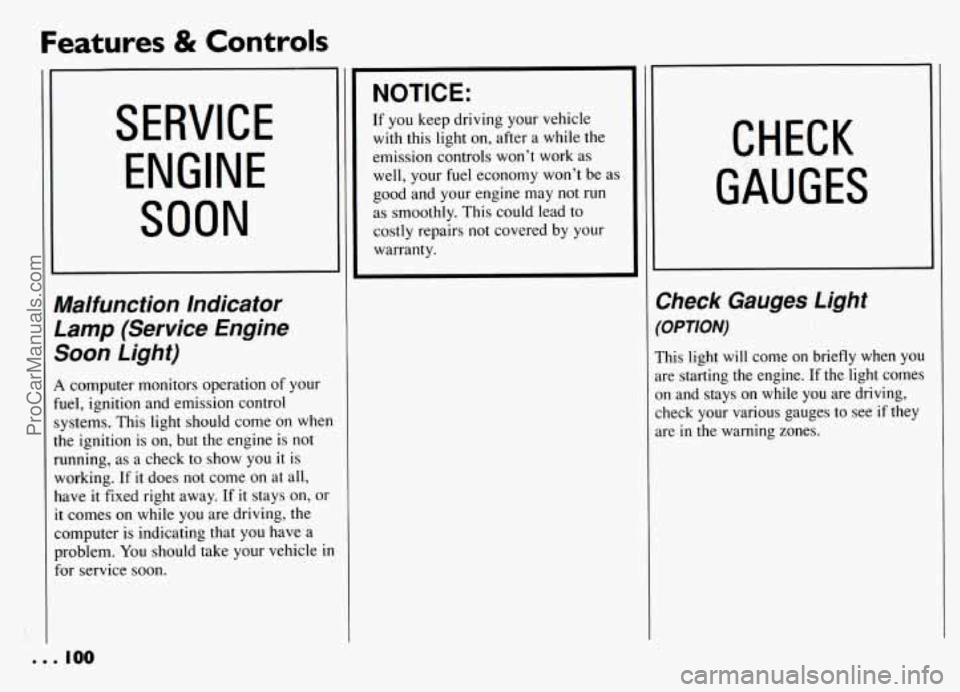
SERVICE
ENGINE
SOON
‘Malfunction Indicator
Lamp (Service Engine
Soon Light)
1 computer monitors operation of your
uel, ignition and emission control
,ystems. This light should come on when
he ignition is
on, but the engine is not
,unning, as a check to show you it is
working. If
it does not come on at all,
lave
it fixed right away. If it stays on, or
t comes on while you are driving, the
:omputer is indicating that you have a
aoblem.
You should take your vehicle in
or service soon.
NOTICE:
If you keep driving your vehicle
with
this light on, after a while the
emission controls won’t work as
well, your fuel economy won’t be as
good and your engine may not
run
as smoothly. This could lead to
costly repairs not covered by your
warranty.
CHECK
GAUGES
Check Gauges Light
(OPTION)
This light will come on briefly when you
are starting the engine. If the
light comes
on and stays
on while you are driving,
check your various gauges to see
if they
are
in the warning zones.
e.. 100
ProCarManuals.com
Page 108 of 274
Hearing damage from loud noise is
almost undetectable until
it is too late.
Your hearing can adapt to higher volumes
of sound. Sound that seems normal can be
loud and harmful to your hearing. Take
precautions by adjusting the volume control on your radio to a safe sound level
before your hearing adapts to
it.
To help avoid hearing loss or damage:
a
a
Adjust the volume control to the
lowest setting.
Increase volume slowly
until you hear
comfortably and clearly.
NOTICE:
Before you add any sound
equipment to your vehicle
-- like a
tape player,
CB radio, mobile
telephone or two-way radio
-- be
sure
you can add what you want. If
you can, it’s very important to do
it
properly. Added sound equipment
may interfere with
the operation of
your vehicle’s engine,
DelcoB radio
or other systems, and even damage
them. And, your vehicle’s systems
may interfere with the operation of
sound equipment that has been
added improperly.
For the best performance, an
external cellular telephone antenna
is recommended for cellular
telephone applications.
So, before adding sound equipment,
check
with your dealer and be sure
to check Federal rules covering
mobile radio and telephone units.
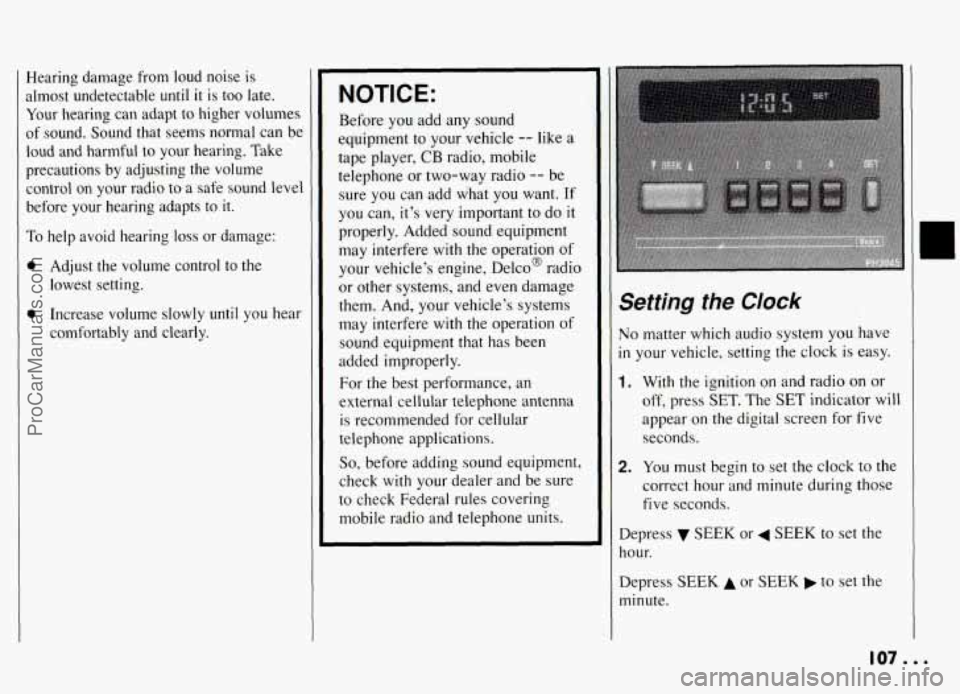
Setting the CIock
No matter which audio system you have
in your vehicle, setting the clock is easy.
1. With the ignition on and radio on or
off, press
SET. The SET indicator will
appear on the digital screen
for five
seconds.
2. You must begin to set the clock to the
correct hour and minute during those
five seconds.
Depress SEEK or 4 SEEK to set the
hour.
Depress
SEEK A or SEEK to set the
minute.
107...
ProCarManuals.com
Page 119 of 274
Comfort Controls & Audio Systems
Care of Your Cassette
Tape Player
(CONT.)
You may also choose a non-scrubbing
action, wet-type cleaner which uses
a
cassette with a fabric belt to clean the tape
head. This type of cleaning cassette will
not eject. It may not clean as thoroughly
as the scrubbing type cleaner.
Cassettes are subject to wear, and the
sound quality
may degrade over time.
Always make surepthat the cassette tape is
in good condition before you have your
tape player serviced. Care of Your Compact
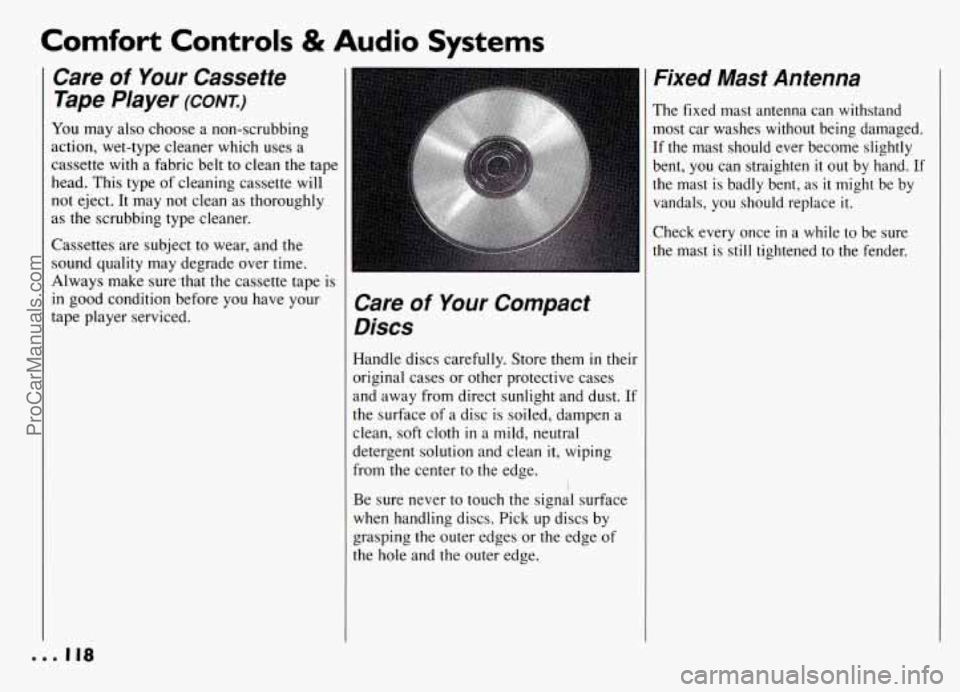
Discs
Handle discs carefully. Store them in thei
original cases or other protective cases
and away from direct sunlight and dust.
I
the surface of a disc is soiled, dampen a
clean, soft cloth
in a mild, neutral
detergent solution and clean
it, wiping
from the center to the edge.
Be sure never to touch the signal surface
when handling discs. Pick up discs by
grasping the outer edges or the edge
of
the hole and the outer edge.
I
Fixed Mast Antenna
The fixed mast antenna can withstand
most car washes without being damaged.
If the mast should ever become slightly
bent, you can straighten
it out by hand. If
the mast is badly bent, as it might be by
vandals, you should replace it.
Check every once in a while to be sure
the mast is still tightened to the fender.
... 118
ProCarManuals.com
Page 129 of 274
Your Driving and the Road
I
0
Passing (CONT.)
distance you would lose by dropping
back. And if something happens to
cause you to cancel your pass, you
need only slow down and drop back
again and wait for another opportunity.
If other cars are lined up to pass a
slow vehicle, wait your turn. But take
care that someone isn’t trying to pass
you as you pull out to pass the slow
vehicle. Remember to glance over
your shoulder and check the blind
spot.
Check your mirrors, glance over your
shoulder, and start your left lane
change signal before moving out of
the right lane to pass. When you are
far enough ahead of the passed vehicle
to see its front
in your inside mirror,
activate your right lane change signal
and move back into the right lane.
(Remember that your right outside
mirror is convex. The vehicle you just
passed may seem to be farther away
from you than
it really is.)
B Try not to pass more than one vehicle
at a time on two-lane roads.
Reconsider before passing the next
vehicle.
B Don’t overtake a slowly moving
vehicle too rapidly. Even though the
brake lights are not flashing, it may be
slowing down or starting to
turn.
If you’re being passed, make it easy
for the following driver to get ahead
of you. Perhaps you can ease a
little to
the right.
Loss of Control
Let’s review what driving experts say
about what happens when the three
control systems (brakes, steering and
acceleration) don’t have enough friction
where the tires meet
the road to do what
the driver has asked.
In any emergency, don’t give up. Keep
trying to steer and constantly seek an
escape route or area of less danger.
Skidding
[n a skid, a driver can lose control of the
vehicle. Defensive drivers avoid most
skids by taking reasonable care suited to
:xisting conditions, and by not
,‘overdriving” those conditions. But skids
we always possible.
The three types of skids correspond to
your Pontiac’s three control systems. In
the braking skid your wheels aren’t
rolling. In the steering or cornering skid,
too much speed or steering in a curve
causes’tires to slip and lose cornering
force. And in the acceleration skid too
much throttle causes the driving wheels to
spin.
A cornering skid and an acceleration skid
are best handled by easing your foot off
the accelerator pedal.
If your vehicle starts to slide, ease your
foot off the accelerator pedal and quickly
steer the way you want the vehicle to go.
If you start steering quickly enough, your
vehicle may straighten out. Always be
ready for a second skid if
it occurs.
... 128
ProCarManuals.com
Page 131 of 274
Your Driving ,and the Road ’
Night Vision (CONT.)
You can be temporarily blinded by
approaching lights. It can take a second or
two, or even several seconds, for your
eyes to readjust to the dark. When you are
faced with severe glare (as from a driver
who doesn’t lower the high beams, or a
vehicle with misaimed headlights), slow
down a little. Avoid staring directly into
the approaching lights.
Keep your windshield and all the glass on
your vehicle clean
-- inside and out.
Glare at night is made much worse by dirt
on
the glass. Even the inside of the glass
can build up a film caused by dust. Dirty
glass makes lights dazzle and flash more
than clean glass would, making the pupils
of your eyes contract repeatedly.
Remember that your headlights light up
far less of a roadway when you are in a
turn or curve. Keep your eyes moving;
that way, it’s easier to pick out dimly
lighted objects. Just as your headlights
should be checked regularly for proper
aim,
so should your eyes be examined
regularly. Some drivers suffer from night
blindness
-- the inability to see in dim
light
-- and aren’t even aware of it.
130
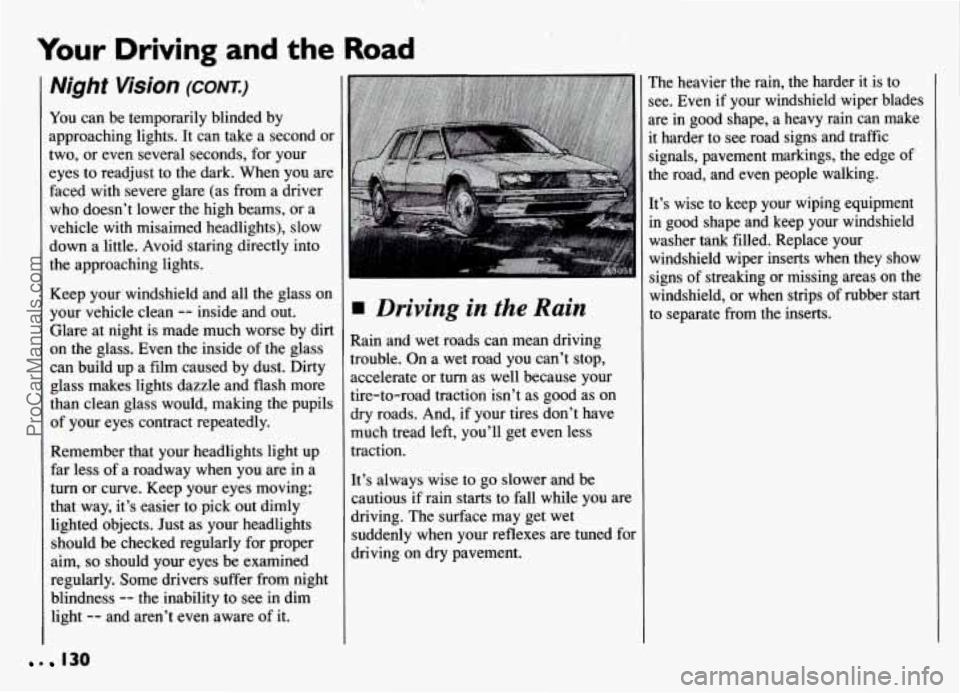
Driving in the Rain
Rain and wet roads can mean driving
trouble. On a wet road
you can’t stop,
accelerate or turn as well because your
tire-to-road traction isn’t as good as on
dry roads. And, if your tires don’t have
much tread left, you’ll get even less
traction.
It’s always wise to go slower and be
cautious if rain starts to fall while you are
driving, The surface may get wet
suddenly when your reflexes are tuned
fo
driving on dry pavement.
The heavier the rain, the harder it is to
see. Even if your windshield wiper blades
xre
in good shape, a heavy rain can make
it harder to see road signs and traffic
signals, pavement markings, the edge of
the road, and even people walking.
It’s wise to keep your wiping equipment
in good shape and keep your windshield
washer tank filled. Replace your
windshield wiper inserts when they show
signs of streaking or
missing areas on the
windshield, or when strips of rubber start
to separate from the inserts.
ProCarManuals.com
Page 133 of 274
Your Driving and the Road
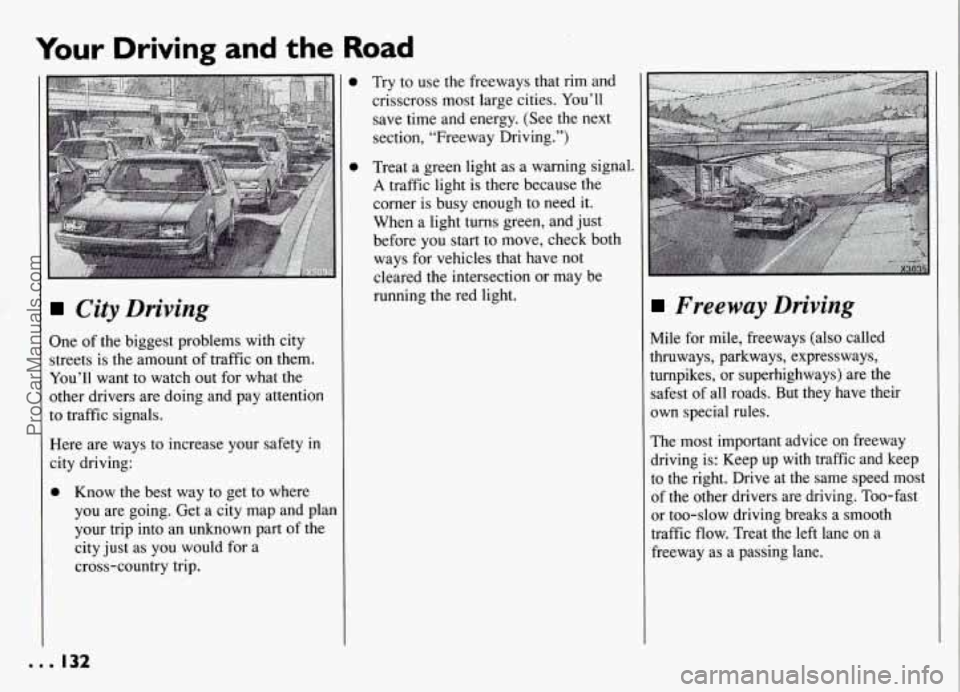
City Driving
One of the biggest problems with city
streets is the amount of traffic on them.
You’ll want to watch out for what the
other drivers are doing and pay attention
to traffic signals.
Here are ways to increase your safety in
city driving:
0 Know the best way to get to where
you are going. Get a city map and plan
your trip into an unknown part of the
city
just as you would for a
cross-country trip.
0
Try to use the freeways that rim and
crisscross most large cities. You’ll
save time and energy. (See
the next
section, “Freeway Driving.”)
Treat a green light as a warning signal.
A traffic light is there because the
corner is busy enough to need it.
When a light turns green, and just
before you start to move, check both
ways for vehicles that have not
cleared the intersection or may be
running the red light.
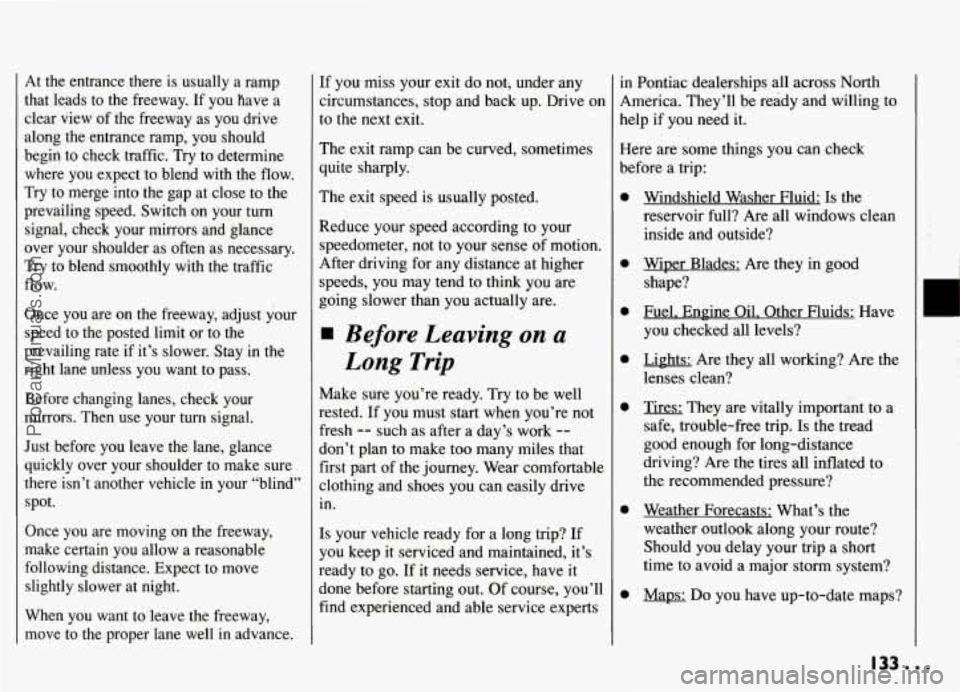
Freeway Driving
Mile for mile, freeways (also called
thruways, parkways, expressways,
turnpikes, or superhighways) are the
safest of all roads. But they have their
own special rules.
The most important advice on freeway
driving is: Keep up with traffic and keep
to the right. Drive at the same speed most of the other drivers are driving. Too-fast
or too-slow driving breaks a smooth
traffic flow. Treat the left lane on
a
freeway as a passing lane.
. . . 132
ProCarManuals.com
Page 134 of 274
At the entrance there is usually a ramp
that leads to the freeway. If you have a
clear view of the freeway as you drive
along
the entrance ramp, you should
begin to check traffic. Try to determine
where you expect
to blend with the flow.
Try to merge into the gap at close
to the
prevailing speed. Switch on your turn signal, check your mirrors and glance
over your shoulder as often as necessary.
Try to blend smoothly with the traffic
flow.
Once you are on the freeway, adjust your
speed to the posted limit or to the
prevailing rate if it’s slower. Stay in the
right lane unless you want to pass.
Before changing lanes, check your
mirrors. Then use your turn signal.
Just before you leave the lane, glance
quickly over your shoulder to make sure
there isn’t another vehicle in your “blind”
spot.
Once you are moving on the freeway,
make certain you allow a reasonable following distance. Expect to move
slightly slower at night.
When you want to leave the freeway,
move to the proper lane well
in advance.
If you-miss your exit do not; under any
circumstances, stop and back
up. Drive on
to the next exit.
The exit ramp can be curved, sometimes
quite sharply.
The exit speed is usually posted.
Reduce your speed according to your
speedometer, not to your sense of motion.
After driving for any distance at higher
speeds, you may tend to think you are
going slower than you actually are.
Before Leaving on a
Long Trip
Make sure you’re ready. Try to be well
rested. If
you must start when you’re not
fresh
-- such as after a day’s work --
don’t plan to make too many miles that
first part of the journey. Wear comfortable
clothing and shoes you can easily drive
in.
Is your vehicle ready for a long trip? If
you keep it serviced and maintained, it’s
ready to go. If it needs service, have it
done before starting out. .Of course, you’ll
find experienced and able service experts
in Pontiac dealerships all across North
America. They’ll be ready and willing to
help if you need it.
Here are some things you can check
before a trip:
0
0
0
0
0
0
0
Windshield Washer Fluid: Is the
reservoir full? Are all windows clean
inside and outside?
Wiper Blades: Are they in good
shape?
Fuel, Engine Oil. Other Fluids: Have
you checked all levels?
Lights:’
Are they all working? Are the
lenses clean?
Tires: They are vitally important to a
safe, trouble-free trip. Is the tread
good enough for long-distance
driving?
Are the tires all inflated to
the recommended pressure?
Weather Forecasts: What’s the
weather outlook along your route?
Should you delay your trip a short
time to avoid a major storm system?
Maps: Do you have up-to-date maps?
133...
ProCarManuals.com