warning light PONTIAC GRAND-AM 1994 User Guide
[x] Cancel search | Manufacturer: PONTIAC, Model Year: 1994, Model line: GRAND-AM, Model: PONTIAC GRAND-AM 1994Pages: 274, PDF Size: 15.01 MB
Page 95 of 274
Features & Controls
Fuel Gage (CONT.)
0 It takes a little more or less fuel to fill
up than the gage indicated. For
example, the gage may have indicated
the tank was half full, but it actually
took a little more or less than half the
tank’s capacity to fill the tank.
0 The gage moves a little when you turn
a corner or speed up.
0 The gage doesn’t go back to “E” when
you turn off the ignition.
For your fuel tank capacity, see “Service
Station Information”
on the last page of
this manual.
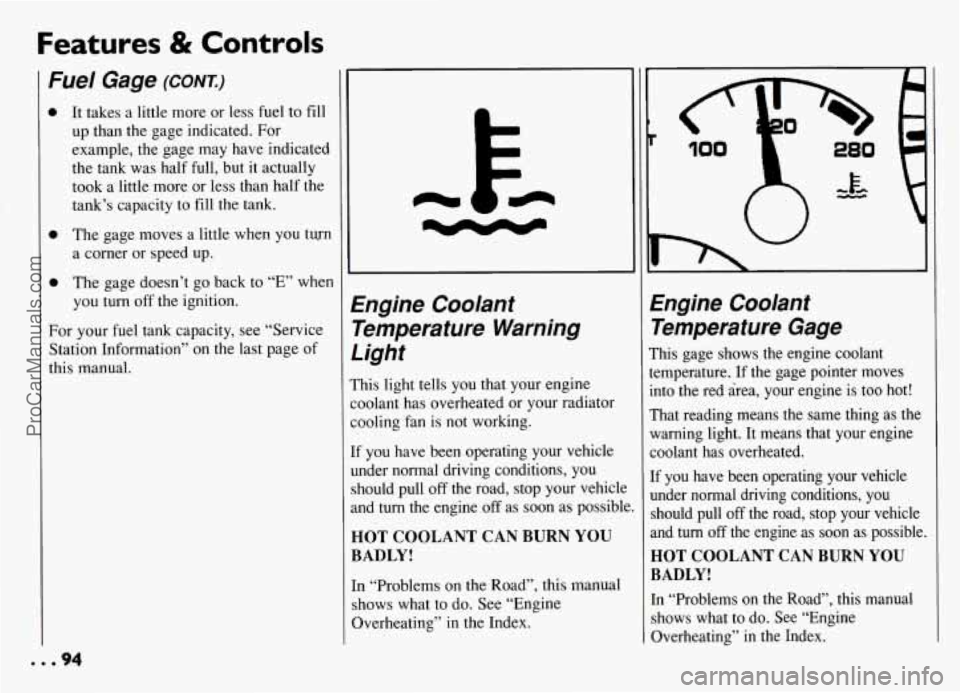
Engine Coolant Temperature Warning
Light
This light tells you that your engine
coolant has overheated or your radiator
cooling fan is not working.
If you have been operating your vehicle
under normal driving conditions, you should pull
off the road, stop your vehicle
and
turn the engine off as soon as possible
HOT COOLANT CAN BURN YOU
BADLY!
In “Problems on the Road”, this manual
shows what to do. See “Engine
Overheating” in the Index.
Engine Coolant
Temperature Gage
This gage shows the engine coolant
temperature. If the gage pointer moves
into the red area, your engine is too hot!
That reading means the same thing as the
warning light. It means that your engine
coolant has overheated.
If you have been operating your vehicle
under normal driving conditions, you
should pull
off the road, stop your vehicle
and
turn off the engine as soon as possible.
HOT COOLANT CAN BURN YOU
BADLY!
In “Problems on the Road”, this manual shows what to do. See “Engine
Overheating” in the Index.
ProCarManuals.com
Page 96 of 274
LOW
COOLANT
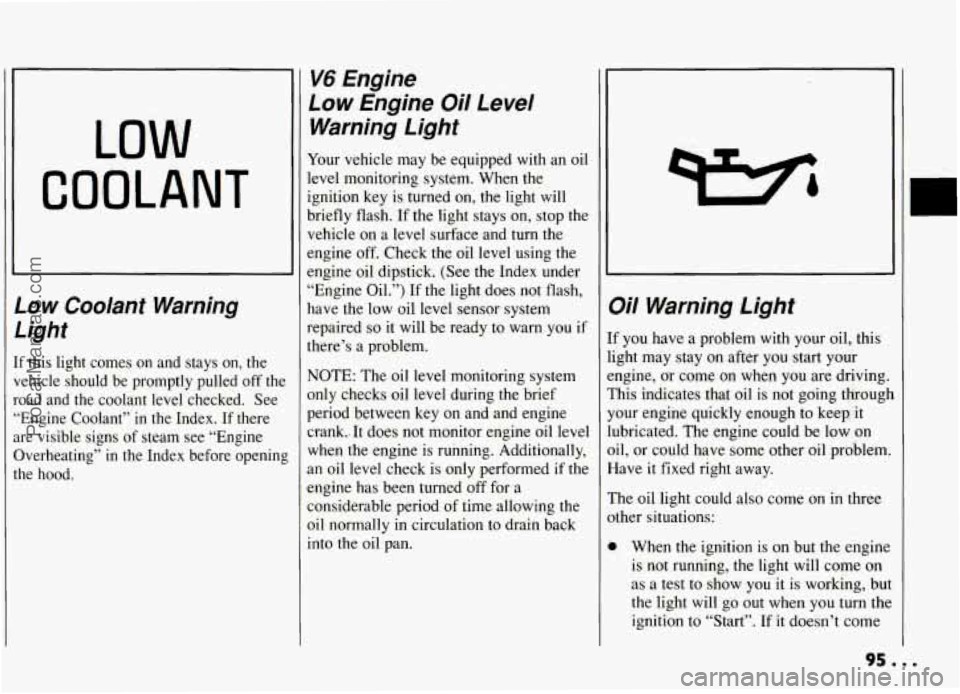
Low Coolant Warning
Light
F this light comes on and stays on, the
ehicle should be promptly pulled off the
Dad and the coolant level checked. See
Engine Coolant” in the Index. If there
re visible signs of steam see “Engine
herheating” in the Index before opening
le hood.
V6 Engine
Low Engine
Oil Level
Warning Light
Your vehicle may be equipped with an oil
level monitoring system. When the
ignition key is turned on, the light will
briefly flash. If the light stays on, stop the
vehicle on a level surface and turn the
engine off. Check the oil level using the
engine oil dipstick. (See the Index under
“Engine Oil.”) If the light does not flash,
have the low oil level sensor system
repaired
so it will be ready to warn you if
there’s a problem.
NOTE: The oil level monitoring system
only checks oil level during the brief
period between key on and and engine
crank.. It does not monitor engine ail level
when the engine
is running. Additionally,
an oil level check is only performed if the
engine has been turned off for a
considerable period of time allowing the
oil normally in circulation to drain back
into the oil pan.
Oiil Warning Light
If you have a problem with your oil, this
light may stay on after you start your
engine, or come on when you are driving.
This indicates that oil is not going through
your engine quickly enough to
keep it
lubricated. The engine could be low on
oil, or could have some other oil problem.
Have
it fixed right away.
The oil light could also come on in three
other situations:
0 When the ignition is on but the engine
is not running, the light will come on
as a test to show you it is working, but
the light will go out when you turn the
ignition to “Start”. If it doesn’t come
ProCarManuals.com
Page 97 of 274
Features & Controls
Oil Warning Light (CONT.)
on with the ignition on, you may have
a problem with the fuse or bulb. Have
it fixed right away.
0 Sometimes when the engine is idling
at a stop, the light may blink
on and
off. This is normal.
0 If you make a hard stop; the light may
come
on for a moment. This is normal.
NOTICE:
Damage to your engine from
neglected oil problems can be costly
and is
not covered by your warranty.
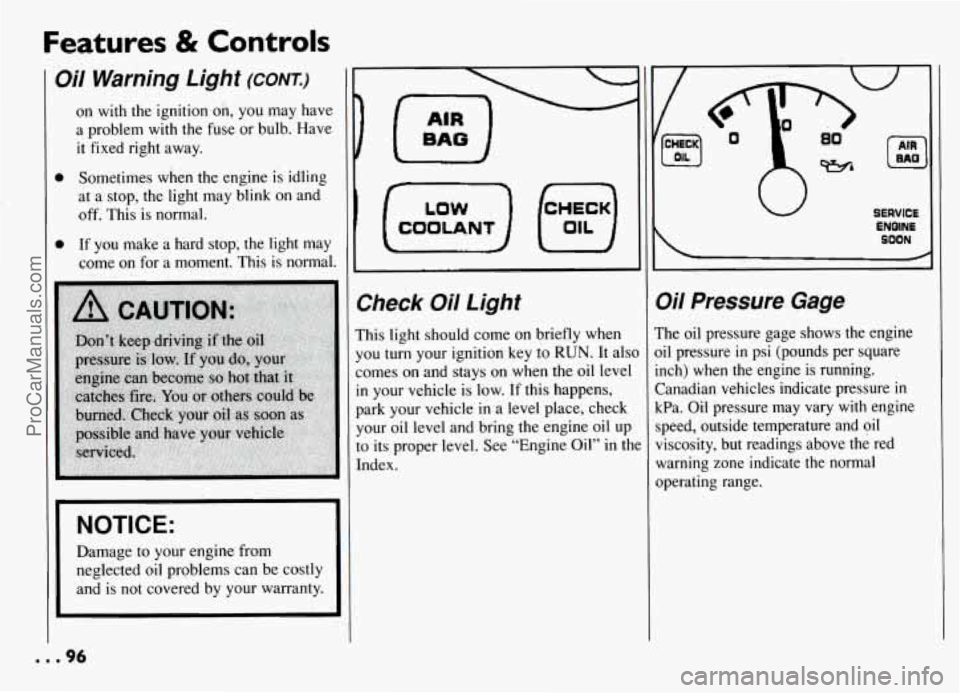
?heck Oil Light
’his light should come on briefly when
‘ou turn your ignition key to
RUN. It alsi
omes
on and stays on when the oil level
n your vehicle is low. If this happens,
ark your vehicle
in a level place, check
our oil level and bring the engine oil up
its proper level. See “Engine Oil” in th
Idex.
ENQINE
SOON
Oil Pressure Gage
The oil pressure gage shows the engine
oil pressure
in psi (pounds per square
inch) when the engine is running.
Canadian vehicles indicate pressure in
kPa. Oil pressure may vary with engine
speed, outside temperature and oil
viscosity, but readings above the red
warning zone indicate the normal
operating range.
... 96
ProCarManuals.com
Page 98 of 274
A reading in the red zone may be caused
by a dangerously low oil level or other
problem causing low oil pressure. Have
your vehicle serviced immediately.
NOTICE:
Damage to your engine from
neglected oil problems can be costly
and is not covered
by your warranty.
-
-
(
T
b
tt
SI
0
rl
dl
el
ir
dl
H
th
If
li;
ac
C(
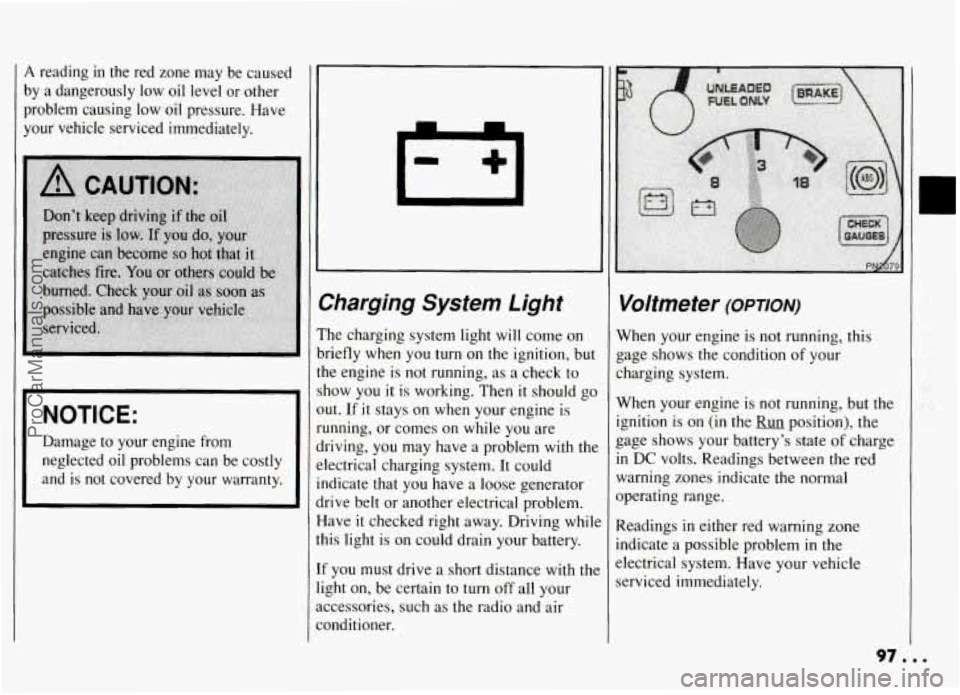
3harging System Light
'he charging system light will come on
riefly when you turn on
the ignition, but
le engine is not running, as a check to
low you
it is working. Then it should gc
ut. If it stays on when your engine is
Inning, or comes on while you are
riving, you may have a problem
with thc
lectrical charging system. It could
tdicate that you have a loose generator
rive belt or another electrical problem.
ave
it checked right away. Driving whih
lis light is on could drain your battery.
'you must drive a short distance with thc
ght on, be certain to turn off all your
xessories, such as the radio and air
mditioner.
Voltmeter (OPTION)
When your engine is not running, this
gage shows the condition
of your
charging system.
When your engine is not running, but the
ignition is on (in the Run position), the
gage shows your battery's state
of charge
in DC volts. Readings between the red
warning zones indicate the normal
operating range.
Readings in either red warning zone
indicate a possible problem in the
electrical system. Have your vehicle
serviced immediately.
970..
ProCarManuals.com
Page 99 of 274
Features & Controls
BRAKE
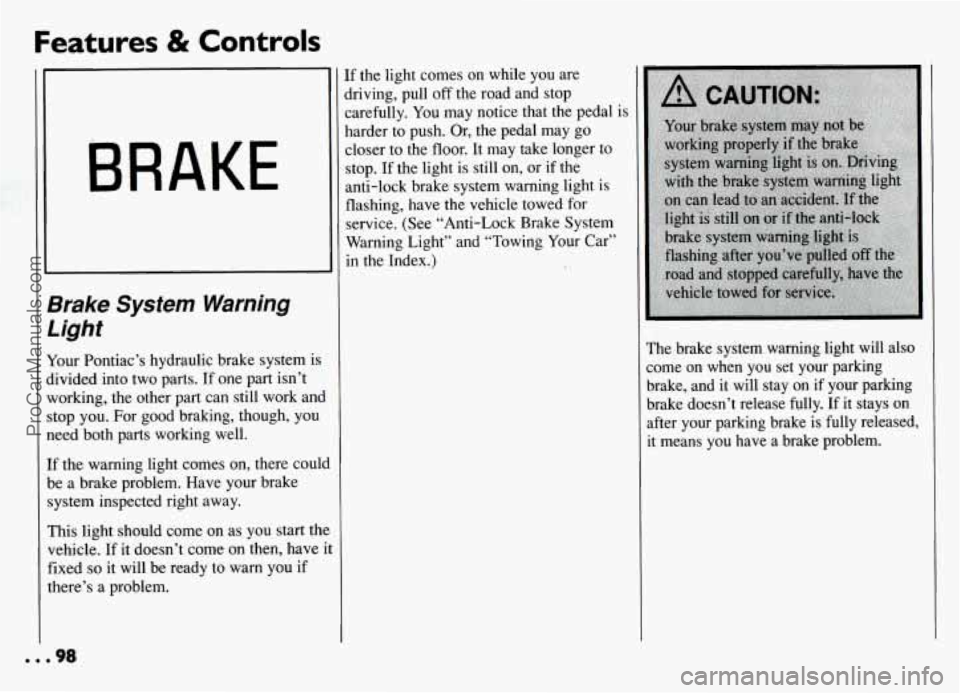
Brake System Warning
light
four Pontiac’s hydraulic brake system is
!ivided into two parts. If one part isn’t
qorking, the other part can still work and
top you. For good braking, though, you
leed both parts working well.
f the warning light comes on, there coulc
le a brake problem. Have your brake
ystem inspected right away.
ihis light should come on as you start tht
lehicle. If it doesn’t come
on then, have i
ixed so it will be ready to warn you if
here’s a problem.
[f the light comes on while you are
hiving, pull
off the road and stop
zarefully. You may notice that the pedal is
harder to push. Or, the pedal may go
;loser to the floor. It may take longer to
stop. If the light is still on, or if the
anti-lock brake system warning light is
flashing, have the vehicle towed for
service. (See “Anti-Lock Brake System
Warning Light” and “Towing Your Car”
in the Index.)
The brake system warning light will also
come on when you set your parking
brake, and it will stay on if your parking
brake doesn’t release fully. If it stays on
after your parking brake is fully released,
it means you have a brake problem.
... 98
ProCarManuals.com
Page 100 of 274
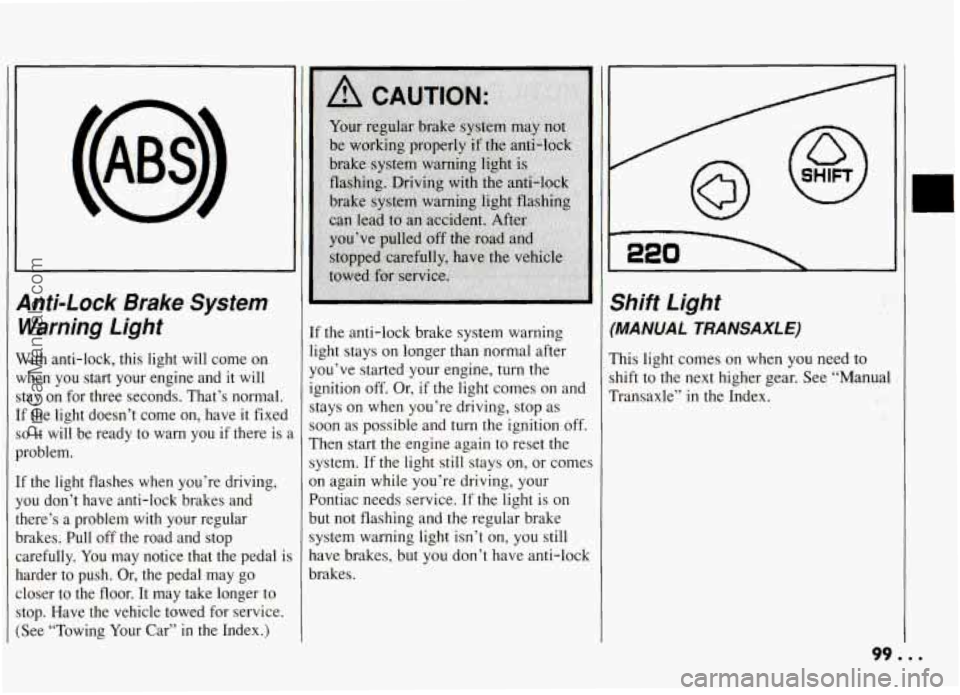
anti-Lock Brake System
Naming Light
Vith anti-lock, this light will come on
{hen you start your engine and it will
tay on for three seconds. That’s normal.
F the light doesn’t come on, have it fixed
D it will be ready to warn you if there is 2
roblem.
1 the light flashes when you’re driving,
ou don’t have anti-lock brakes and
lere’s a problem with your regular
rakes. Pull off the road and stop arefully. You may notice that the pedal
is
arder to push. Or, the pedal may go
loser to the floor. It may take longer to
:op. Have the vehicle towed for service.
See “Towing Your Car”
in the Index.)
If the anti-lock brake system warning
light stays on longer than normal after
you’ve started your engine, turn the
ignition
off. Or, if the light comes on and
stays on when you’re driving, stop as
soon as possible and turn the ignition off.
Then start the engine again to reset the
system.
If the light still stays on, or comes
3n again while you’re driving, your
Pontiac needs service.
If the light is on
but not flashing and the regular brake
system warning light isn’t on, you still
nave brakes, but you don’t have anti-lock
xakes.
Shift Light
(MANUAL TRA NSAXL E)
This light comes on when you need to
shift to the next higher gear. See “Manual
Transaxle”
in the Index.
99. ..
ProCarManuals.com
Page 101 of 274
Features & Controls
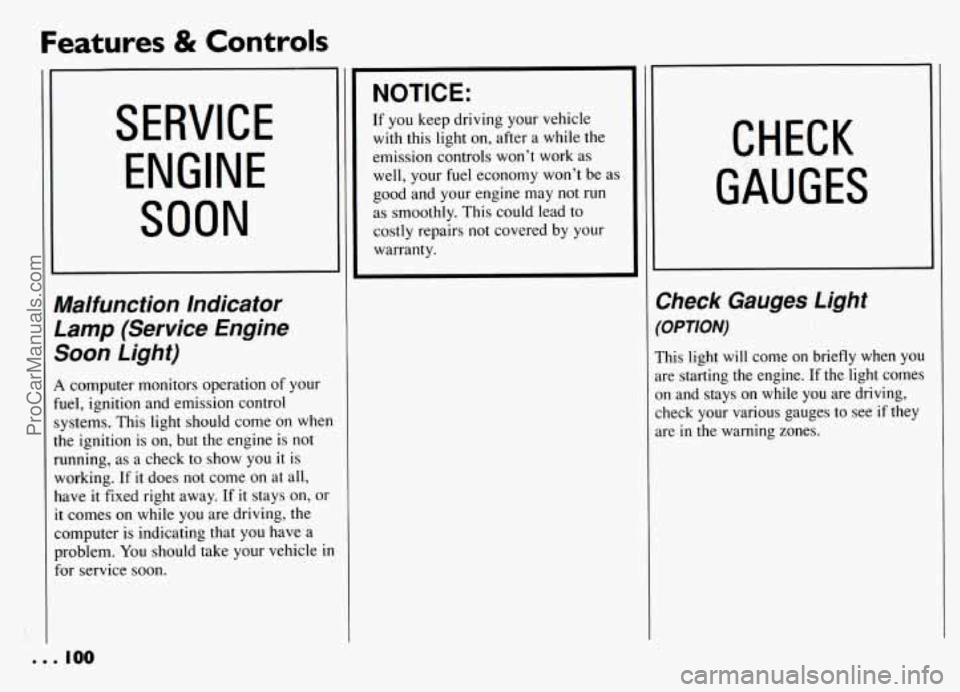
SERVICE
ENGINE
SOON
‘Malfunction Indicator
Lamp (Service Engine
Soon Light)
1 computer monitors operation of your
uel, ignition and emission control
,ystems. This light should come on when
he ignition is
on, but the engine is not
,unning, as a check to show you it is
working. If
it does not come on at all,
lave
it fixed right away. If it stays on, or
t comes on while you are driving, the
:omputer is indicating that you have a
aoblem.
You should take your vehicle in
or service soon.
NOTICE:
If you keep driving your vehicle
with
this light on, after a while the
emission controls won’t work as
well, your fuel economy won’t be as
good and your engine may not
run
as smoothly. This could lead to
costly repairs not covered by your
warranty.
CHECK
GAUGES
Check Gauges Light
(OPTION)
This light will come on briefly when you
are starting the engine. If the
light comes
on and stays
on while you are driving,
check your various gauges to see
if they
are
in the warning zones.
e.. 100
ProCarManuals.com
Page 125 of 274
Your Driving and the Road
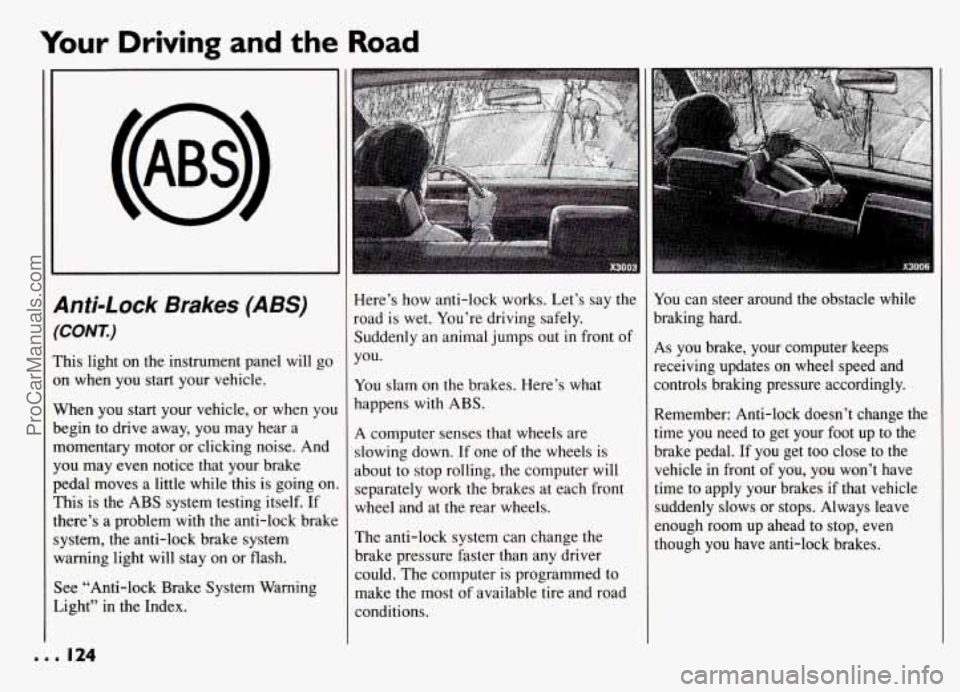
anti-Lock Brakes (ABS)
‘CONT.)
’his light on the instrument panel will go
In when you start your vehicle.
Nhen you start your vehicle, or when yo^
begin to drive away, you may hear a
nomentary motor or clicking noise. And
‘ou may even notice that your brake
edal moves a little while this
is going on
rhis is the ABS system testing itself.
If
here’s a problem with the anti-lock brakc
ystem, the anti-lock brake system
Yarning light will stay on or flash.
iee “Anti-lock Brake System Warning
ight” in the Index.
Here’s how anti-lock works. Let’s say the
road is wet. You’re driving safely.
Suddenly an animal jumps out in front of
you.
You slam on the brakes. Here’s what
happens with ABS.
A computer senses that wheels are
slowing down. If one of the wheels is
about to stop rolling, the computer will
separately work the brakes at each front
wheel and at the rear wheels.
The anti-lock system can change the
brake pressure faster than any driver
could. The computer is programmed to
make the most of available tire and road
conditions.
You can steer around the obstacle while
braking hard.
As you brake, your computer keeps
receiving updates
on wheel speed and
controls braking pressure accordingly.
Remember: Anti-lock doesn’t change the
time you need to get your foot up to the
brake pedal.
If you get too close to the
vehicle in front of you, you won’t have
time to apply your brakes
if that vehicle
suddenly slows
or stops. Always leave
enough room
up ahead to stop, even
though you have anti-lock brakes.
... 124
ProCarManuals.com
Page 130 of 274
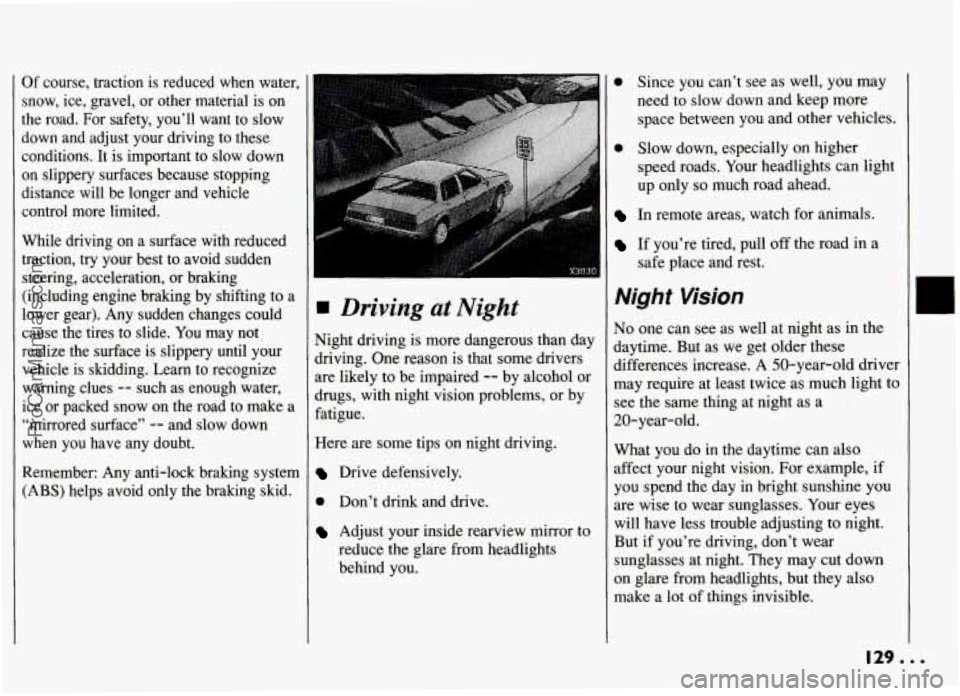
Of course, traction is reduced when water, I
snow, ice, gravel, or other material is on
the road. For safety, you’ll want to slow
down and adjust your driving to these conditions. It is important to slow down
on slippery surfaces because stopping
distance will be longer and vehicle
control more limited.
While driving on a surface with reduced traction, try your best to avoid sudden
steering, acceleration, or braking
(including engine braking by shifting to a
lower gear). Any sudden changes could cause the tires to slide.
You may not?
realize the surface is slippery until your
vehicle is skidding. Learn to recognize
warning clues
-- such as enough water;
ice or packed snow on the road to make a
“mirrored surface”
-- and slow down
when you have any doubt.
Remember: Any anti-lock braking system (ABS) helps avoid only the braking skid.
I
Driving at Night
Night driving is more dangerous than day
driving. One reason is that some drivers
are likely to be impaired
-- by alcohol or
drugs, with night vision problems, or by
fatigue.
Here are some tips on night driving.
Drive defensively.
0 Don’t drink and drive.
Adjust your inside rearview mirror to
reduce the glare from headlights
behind you.
0 Since you can’t see as well, you may
need to slow down and keep more
space between you and other vehicles.
0 Slow down, especially on higher
speed roads. Your headlights can light
up only
so much road ahead.
In remote areas, watch for animals.
If you’re tired, pull off the mad in a
safe place and rest.
Night Wsion
No one can see as well at night as in the
daytime. But as we get older these
differences increase. A 50-year-old driver
may require at least twice as much. light to
see the same thing at night as a
20-year-old.
What you do in the daytime can also
affect your night vision. For example, if
you spend the day
in bright sunshine you
are wise to wear sunglasses. Your eyes
will have less trouble adjusting to night.
But
if you’re driving, don’t wear
sunglasses at night. They may cut down
on glare from headlights, but they also
make a lot of things invisible.
129...
ProCarManuals.com
Page 133 of 274
Your Driving and the Road
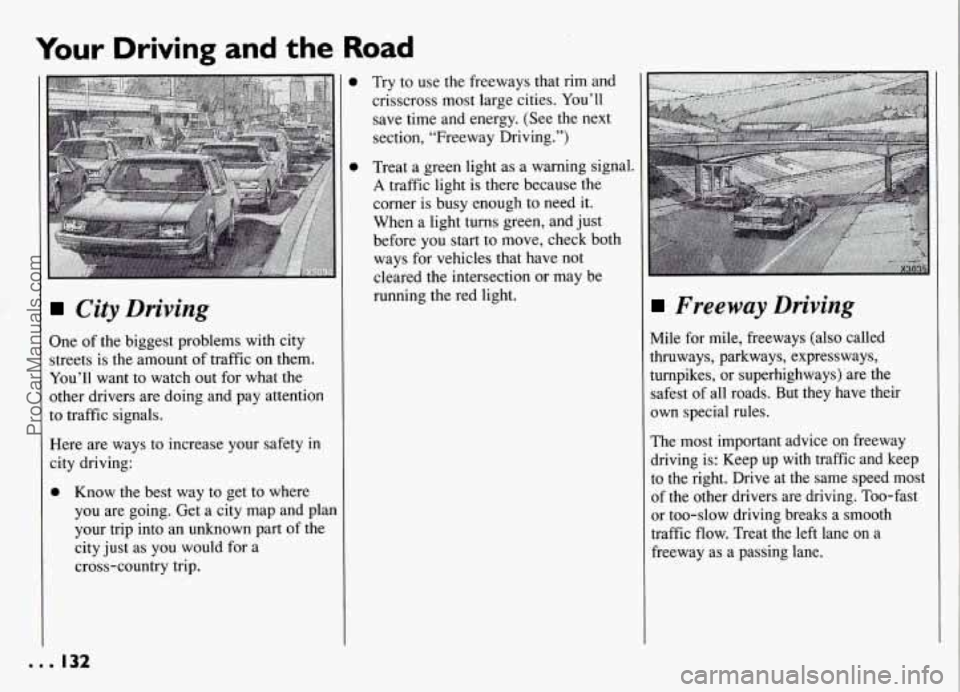
City Driving
One of the biggest problems with city
streets is the amount of traffic on them.
You’ll want to watch out for what the
other drivers are doing and pay attention
to traffic signals.
Here are ways to increase your safety in
city driving:
0 Know the best way to get to where
you are going. Get a city map and plan
your trip into an unknown part of the
city
just as you would for a
cross-country trip.
0
Try to use the freeways that rim and
crisscross most large cities. You’ll
save time and energy. (See
the next
section, “Freeway Driving.”)
Treat a green light as a warning signal.
A traffic light is there because the
corner is busy enough to need it.
When a light turns green, and just
before you start to move, check both
ways for vehicles that have not
cleared the intersection or may be
running the red light.
Freeway Driving
Mile for mile, freeways (also called
thruways, parkways, expressways,
turnpikes, or superhighways) are the
safest of all roads. But they have their
own special rules.
The most important advice on freeway
driving is: Keep up with traffic and keep
to the right. Drive at the same speed most of the other drivers are driving. Too-fast
or too-slow driving breaks a smooth
traffic flow. Treat the left lane on
a
freeway as a passing lane.
. . . 132
ProCarManuals.com