warning PONTIAC GRAND-AM 1994 Owner's Manual
[x] Cancel search | Manufacturer: PONTIAC, Model Year: 1994, Model line: GRAND-AM, Model: PONTIAC GRAND-AM 1994Pages: 274, PDF Size: 15.01 MB
Page 133 of 274
Your Driving and the Road
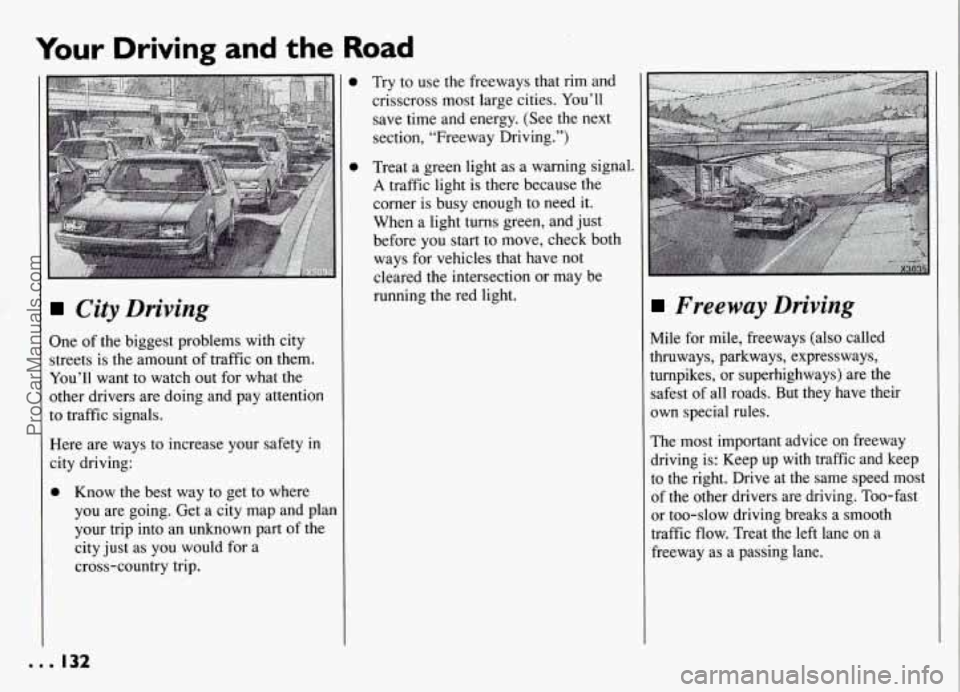
City Driving
One of the biggest problems with city
streets is the amount of traffic on them.
You’ll want to watch out for what the
other drivers are doing and pay attention
to traffic signals.
Here are ways to increase your safety in
city driving:
0 Know the best way to get to where
you are going. Get a city map and plan
your trip into an unknown part of the
city
just as you would for a
cross-country trip.
0
Try to use the freeways that rim and
crisscross most large cities. You’ll
save time and energy. (See
the next
section, “Freeway Driving.”)
Treat a green light as a warning signal.
A traffic light is there because the
corner is busy enough to need it.
When a light turns green, and just
before you start to move, check both
ways for vehicles that have not
cleared the intersection or may be
running the red light.
Freeway Driving
Mile for mile, freeways (also called
thruways, parkways, expressways,
turnpikes, or superhighways) are the
safest of all roads. But they have their
own special rules.
The most important advice on freeway
driving is: Keep up with traffic and keep
to the right. Drive at the same speed most of the other drivers are driving. Too-fast
or too-slow driving breaks a smooth
traffic flow. Treat the left lane on
a
freeway as a passing lane.
. . . 132
ProCarManuals.com
Page 137 of 274
Your Driving and the Road
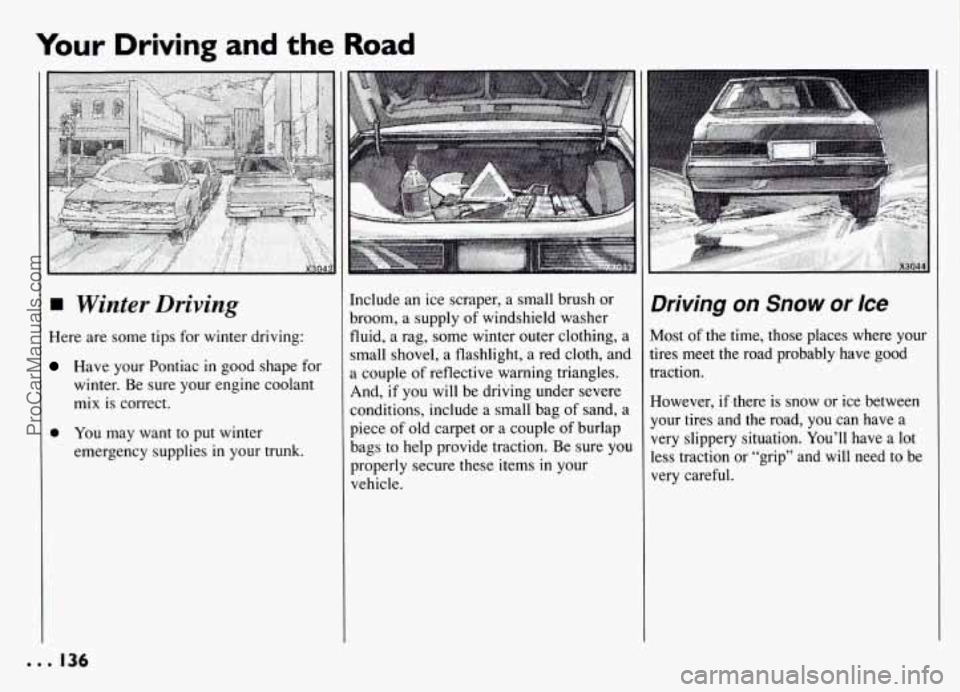
Winter Driving
Here are some tips for winter driving:
Have your Pontiac in good shape for
winter. Be sure your engine coolant
mix is correct.
0 You may want to put winter
emergency supplies in your trunk.
Include an ice scraper, a small brush or
broom, a supply
of windshield washer
fluid, a rag, some winter outer clothing, a
small shovel, a flashlight, a red cloth, and
a couple of reflective warning triangles.
And, if you will be driving under severe
conditions, include a small bag of sand, a
piece of old carpet or a couple
of burlap
bags
to help provide traction. Be sure you
properly secure these items
in your
vehicle.
Driving on Snow or Ice
Most of the time, those places where your
tires meet the road probably have good
traction.
However, if there is snow or ice between
your tires and the road, you can have a
very slippery situation. You’ll have a lot
less traction or “grip” and will need to be
very careful.
. . . 136
ProCarManuals.com
Page 148 of 274
Here you’ll find what to do about
some problems that can occur on the
road .
Problems on the
Part 5
Road
Hazard Warning Flashers ............................................
Jumpstarting .....................................................
TowingYourPontiac ...............................................
Engine Overheating ................................................
If Steam is Coming From Your Engine .................................
If a Tire Goes Flat .................................................
ChangingaFlatTire ................................................
Compactspare ....................................................
If You’re Stuck: In Sand, Mud, Ice or Snow .............................
148
148
152
156
156
161
162
167
167
147 ...
ProCarManuals.com
Page 149 of 274
Problems on the Road
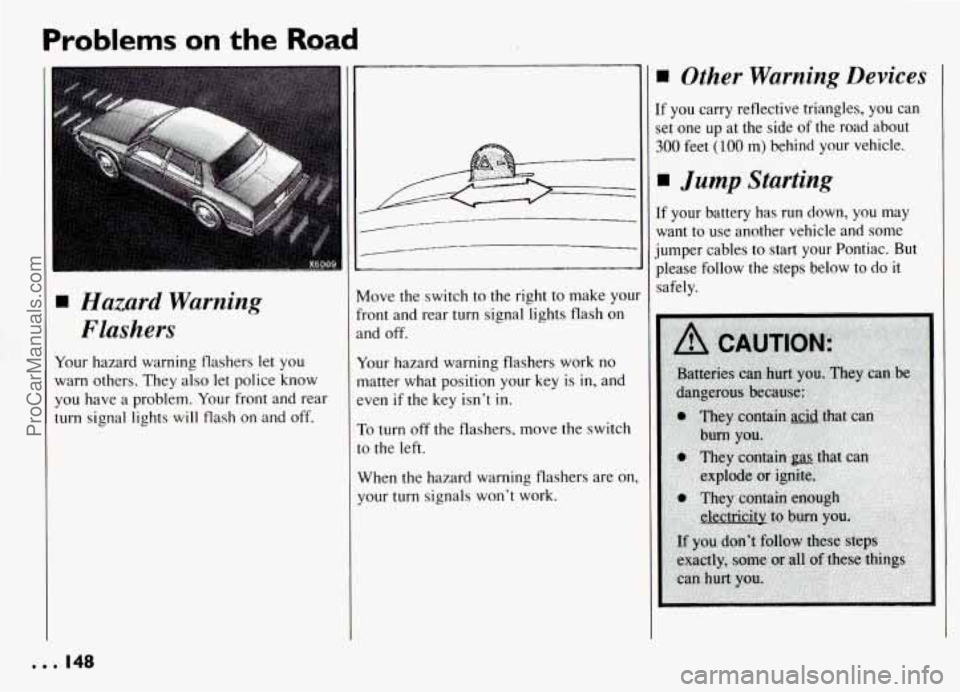
Hazard Warning Flashers
Your hazard warning flashers let you
warn others. They also let police know
you have a problem. Your front and rear
turn signal lights will flash on and off.
Move the switch to the right to make you
front and rear turn signal lights flash on
and off.
Your hazard warning flashers work no
matter what position your key is
in, and
even if the key isn’t in.
To turn off the flashers, move the switch
to the left.
When the hazard warning flashers are on,
your turn signals won’t work.
Other Warning Devices
If you carry reflective triangles, you can
set one up at the side of the road about
300 feet (100 m) behind your vehicle.
Jump Starting
If your battery has run down, you may
want to use another vehicle and some
jumper cables to
start your Pontiac. But
please follow the steps below to do it
safely.
... 148
ProCarManuals.com
Page 153 of 274
Problems .' on the .Road
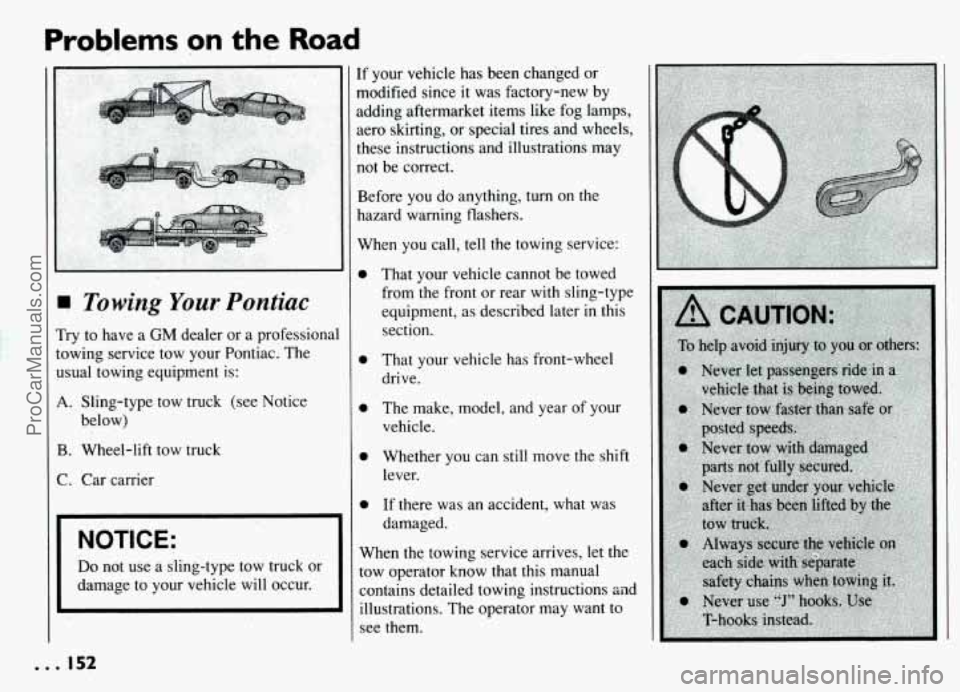
3 Towing Your Pontiac
'ry to have a GM dealer or a professional
)wing service tow your Pontiac. The
sua1 towing equipment is:
L Sling-type tow truck (see Notice
below)
!. Wheel-lift tow truck
:. Car carrier
NOTICE:
Do not use a sling-type tow truck or
damage to your vehicle will occur.
If your vehicle has been changed or
modified since it was factory-new by
adding aftermarket items like fog lamps,
aero skirting, or special tires and wheels,
these instructions and illustrations may
not be correct.
Before you do anything, turn on the
hazard warning flashers.
When you call, tell the towing service:
0 That your vehicle cannot be towed
from the front or rear with sling-type
equipment, as described later in this
section.
0 That your vehicle has front-wheel
drive.
0 The make, model, and year of your
vehicle.
0 Whether you can still move the shift
lever.
0 If there was an accident, what was
damaged.
When the towing service arrives, let the
tow operator know that this manual
contains detailed towing instructions sad
illustrations: The operator may want to
see them.
ProCarManuals.com
Page 157 of 274
Problems on the Road
Towing from the
Rear-Vehicle
Hook-Up
(CONT.)
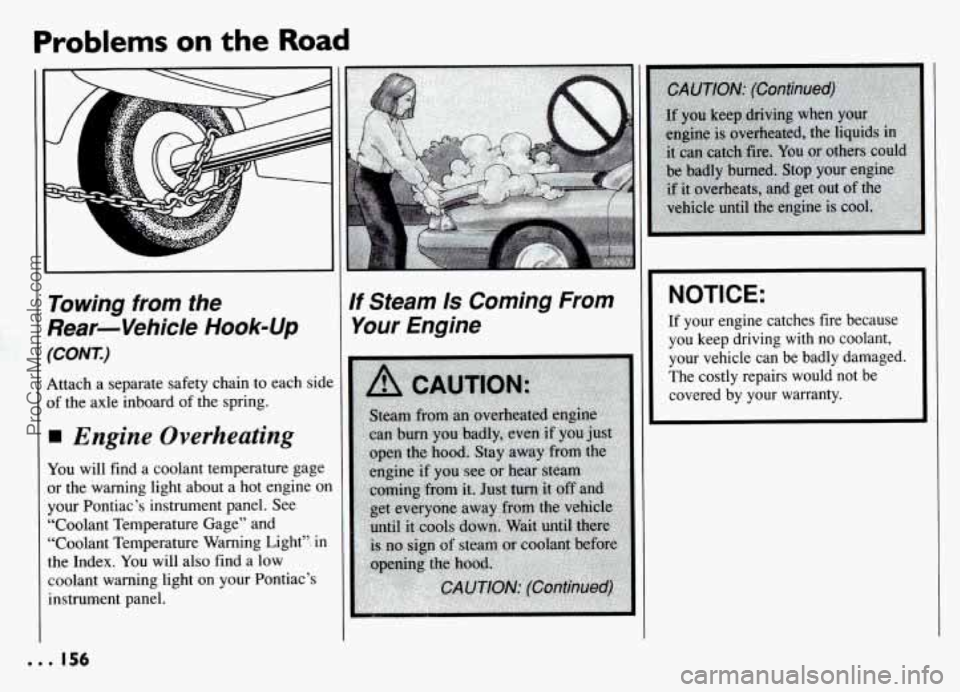
Attach a separate safety chain to each side
of the axle inboard of the spring.
Engine Overheating
You will find a coolant temperature gage
or the warning light about a hot engine on
your Pontiac’s instrument panel. See
“Coolant Temperature Gage” and
“Coolant Temperature Warning Light”; in
the Index. You will also find
a low
coolant warning light
on your Pontiac’s
instrument panel.
If Steam Is Coming From
Your Engine NOTICE:
If your engine catches fire because
you keep driving with no coolant,
your vehicle can be badly damaged.
The costly repairs would not be
covered by your warranty.
ProCarManuals.com
Page 158 of 274
If No Steam 1s Coming
From Your Engine
If you get the overheat warning but see or
hear no steam, the problem may not be
too serious. Sometimes the engine can get
a little too hot when you:
0 Climb a long hill on a hot day.
0 Stop after high speed driving.
0 Idle for long periods in traffic.
Tow a trailer.
[f you get the overheat warning with no
sign of steam, try this for a minute or so:
1. If you have an air conditioner, turn it
off.
2. Turn on your heater to full hot at the
highest fan speed and open the
window as necessary.
3. Try to keep your engine under load (in
a drive gear where the engine runs
slower).
If you no longer have the overheat
warning,
you can drive. Just to be safe,
drive slower for about ten minutes.
If the
warning doesn't come back on, you can
drive normally.
If the warning continues, pull over, stop,
and park your vehicle right away.
[f there's still no sign of steam, you can
idle the engine for two or three minutes
while you're parked, to see
if the warning
stops. But then, if you still have the
warning, TURN
OFF THE ENGINE
4ND GET EVERYONE OUT
OF THE
VEHICLE until it cools down.
You may decide not to lift the hood but to
get service help right away.
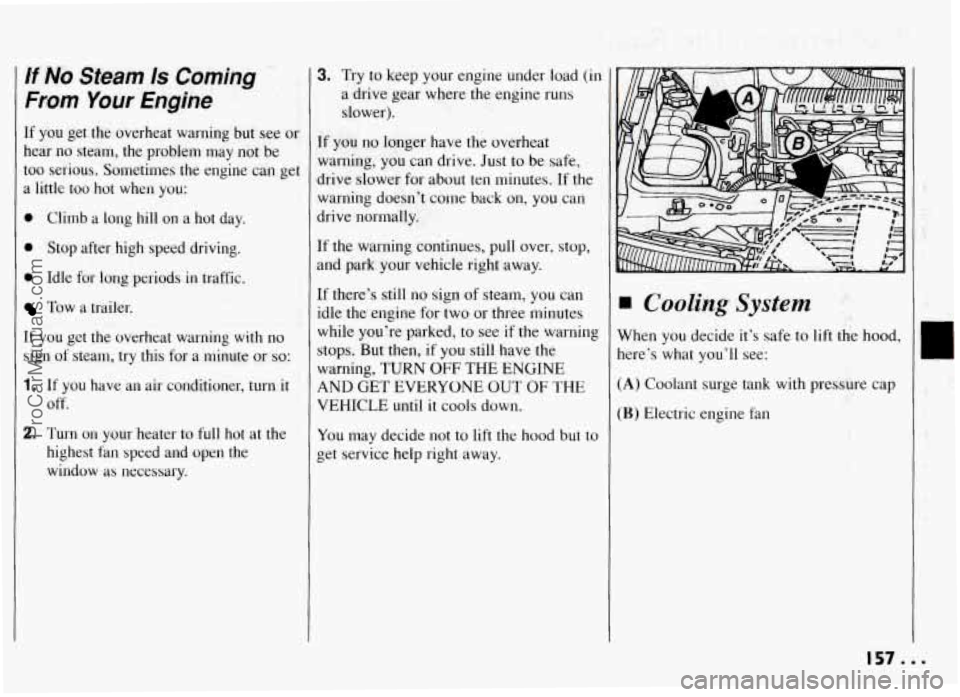
Cooling System
When you decide it's safe to lift the hood,
here's what you'll see:
(A) Coolant surge tank with pressure cap
(B) Electric engine fan ii" , I .. i I. i. 4:. .;I'
.r': 5.
157...
ProCarManuals.com
Page 163 of 274
Problems on the Road
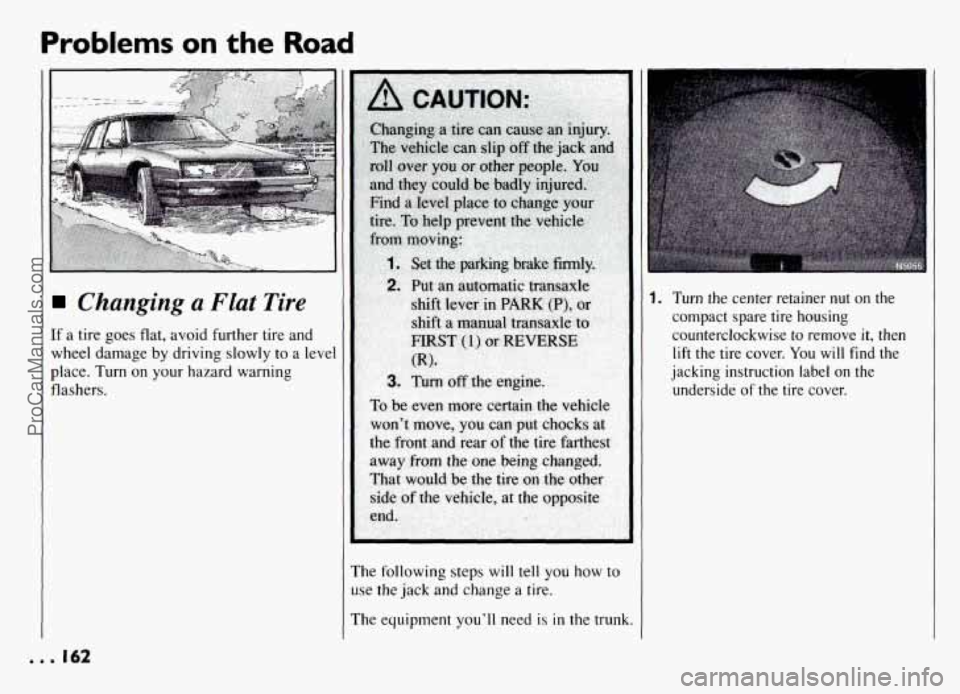
Changing a Flat Tire
If a tire goes flat, avoid further tire and
wheel damage
by driving slowly to a level
place. Turn on your hazard warning
flashers.
The following steps will tell you how to
use the jack and change a tire.
The equipment you’ll need is in the trunk.
1. Turn the center retainer nut on the
compact spare tire housing
counterclockwise
to remove it, then
lift the tire cover. You
will find the
jacking instruction label on the
underside
of the tire cover.
... 162
ProCarManuals.com
Page 183 of 274
Service & Appearance Care
Engine Oil Additives
Don’t add anything to your oil. Your
Pontiac dealer is ready to advise
if you
think something should be added.
When to Change Engine
Oil
See if any one of these is true for you:
Most trips are less than 4 miles
(6 km).
It’s below freezing outside and most
trips are less than
10 miles ( 16 km).
The engine is at low speed most of the
time (as
in door-to-door delivery, or
in stop-and-go traffic).
You tow a trailer often.
Most trips are through dusty places.
[f any one of these is true for your
Vrehicle, then you need to change your oil
md filter every 3,000 miles (5 000 km) or-
3 months -- whichever comes first.
[f none of them is true, change the oil
=very 7,500 miles (12 500 km,) or
12 months -- whichever comes first.
Change the filter at the first oil change
and at every other
oil change after that.
Engine Coolant Heater
(Engine Block Heater)
An engine coolant heater can be a big
help if
you have to park outside in very
cold weather,
0°F (- 18OC) or colder. If
your vehicle has this option, see “Engine
Coolant Heater” (Engine Block Heater)
in
the Index.
What to Do with Used Oil
lid you know that used engine oil
:ontains certain elements that may be
Inhealthy
for your skin and could even
:awe cancer? Don’t let used oil stay on
your skin for very long. Clean your skin
md nails with soap and water, or a good
land cleaner. Wash or properly throw
lway clothing or rags containing used
mgine oil. (See the manufacturer’s
warnings about the use and disposal of oil
products.)
Used oil can be a real threat to the
mvironment.
If you change your own oil,
be sure to drain all free-flowing oil from
the filter before disposal. Don’t ever
dispose of oil by putting
it in the trash,
pouring
it on the ground, into sewers, or
into streams or bodies of water. Instead,
recycle
it by taking it to a place that
collects used
oil. If you have a problem
properly disposing of your used oil, ask
your dealer, a service station or
a local
recycling center for help.
... 182
ProCarManuals.com
Page 189 of 274
Service & Appearance Care
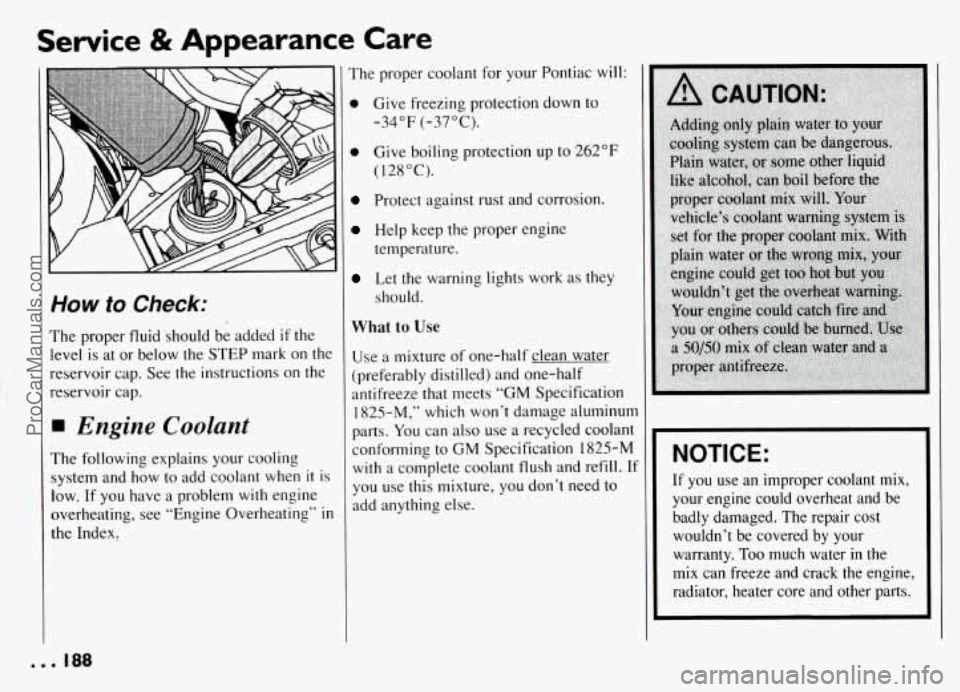
How to Check:
The proper fluid should be added if the
level is at or below the STEP mark on the
reservoir cap. See the instructions on the
reservoir cap.
Engine Coolant
The following explains your cooling
system and how to add coolant when
it is
low.
If you have a problem with engine
overheating, see “Engine Overheating”
in
the Index,
The proper coolant for your Pontiac will:
Give freezing protection down to
-34°F (-37°C).
Give boiling protection up to 262°F
( 128 “C).
Protect against rust and corrosion.
Help keep the proper engine
temperature.
Let the warning lights work as they
should.
What to Use
Use a mixture of one-half clean water
(preferably distilled) and one-half
antifreeze that meets “GM Specification
1825-M,” which won’t damage aluminum
parts.
You can also use a recycled coolant
conforming to GM Specification 1825-M
with a complete coolant flush and refill. If
you use this mixture, you don’t need to
add anything else. NOTICE:
If you use an improper coolant mix,
your engine could overheat and be
badly damaged. The repair cost
wouldn’t be covered by your
warranty. Too much water
in the
mix can freeze and crack the engine,
radiator, heater core and other parts.
... 188
ProCarManuals.com