overheating PONTIAC GRAND-AM 1994 Owners Manual
[x] Cancel search | Manufacturer: PONTIAC, Model Year: 1994, Model line: GRAND-AM, Model: PONTIAC GRAND-AM 1994Pages: 274, PDF Size: 15.01 MB
Page 4 of 274
How to Use This Manual
It
Using Your 1994 Pontiac
Owner’s Manual
I‘
Many people read their owner’s manual
from beginning
to end when they first
receive their new vehicle. This will help
you learn about the features and controls
for your vehicle. In this manual, you’ll
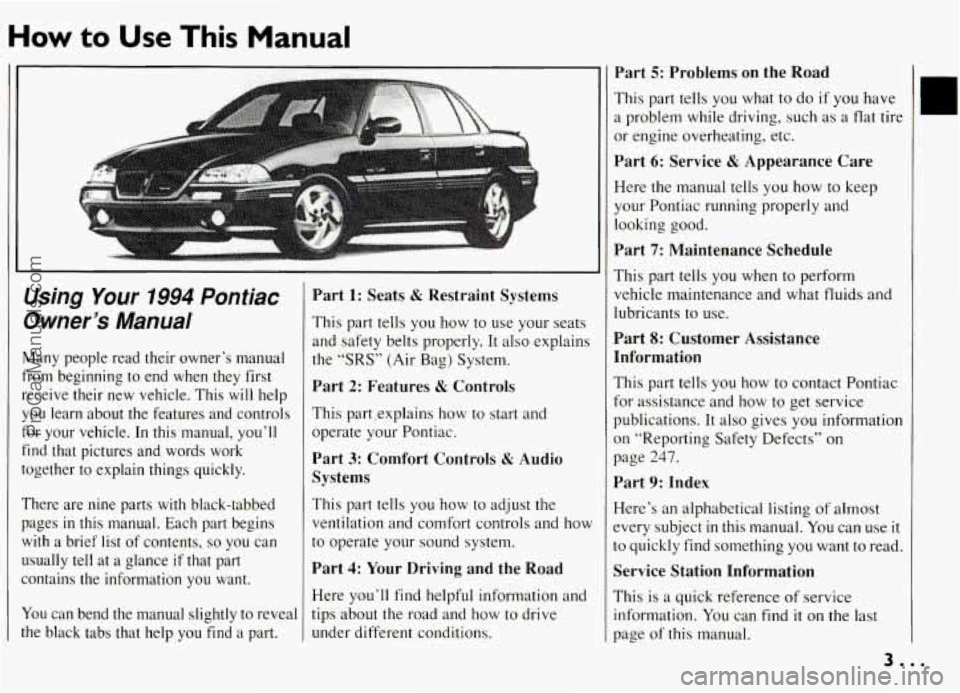
find that pictures and words work
together to explain things quickly.
There are nine parts with black-tabbed
pages
in this manual. Each part begins
with a brief list of contents, so you can
usually tell at a glance
if that part
contains the information you want.
You can bend the manual slightly to reveal
the black tabs that help you find a part.
I
Part 1: Seats & Restraint Systems
This part tells you how to use your seats
and safety belts properly. It also explains
the
“SRS” (Air Bag) System.
Part 2: Features & Controls
This part,explains how to start and
operate your Pontiac.
Part 3: Comfort Controls & Audio
Systems
This part tells you how to adjust the
ventilation and comfort controls and how
to operate your sound system.
Part 4: Your Driving and the Road
Here you’ll find helpful information and
tips about
the road and how to drive
under different conditions.
Part 5: Problems on the Road
This part tells you what to do if you have
a problem while driving, such as a flat tire
or engine overheating, etc.
Part 6: Service & Appearance Care
Here the manual tells you how to keep
your Pontiac running properly and
looking good.
Part 7: Maintenance Schedule
This part tells you when to perform
vehicle maintenance and what fluids and
lubricants to use.
Part 8: Customer Assistance
Information
This part tells you how to contact Pontiac
for assistance and how to get service
publications. It
also gives you information
on “Reporting Safety Defects’’ on
page 247.
Part 9: Index
Here’s an alphabetical listing of almost
?very subject
in this manual. You can use it
to quickly find something you want to read.
Service Station Information
This is a quick reference of service
information.
You can find it on the last
page of this manual.
3.. .
ProCarManuals.com
Page 95 of 274
Features & Controls
Fuel Gage (CONT.)
0 It takes a little more or less fuel to fill
up than the gage indicated. For
example, the gage may have indicated
the tank was half full, but it actually
took a little more or less than half the
tank’s capacity to fill the tank.
0 The gage moves a little when you turn
a corner or speed up.
0 The gage doesn’t go back to “E” when
you turn off the ignition.
For your fuel tank capacity, see “Service
Station Information”
on the last page of
this manual.
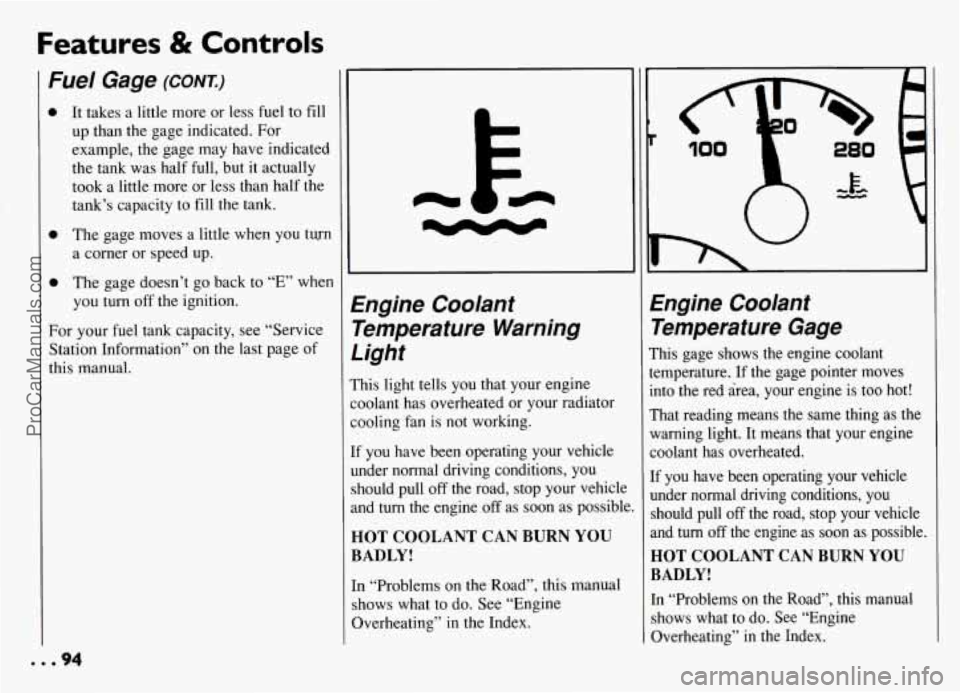
Engine Coolant Temperature Warning
Light
This light tells you that your engine
coolant has overheated or your radiator
cooling fan is not working.
If you have been operating your vehicle
under normal driving conditions, you should pull
off the road, stop your vehicle
and
turn the engine off as soon as possible
HOT COOLANT CAN BURN YOU
BADLY!
In “Problems on the Road”, this manual
shows what to do. See “Engine
Overheating” in the Index.
Engine Coolant
Temperature Gage
This gage shows the engine coolant
temperature. If the gage pointer moves
into the red area, your engine is too hot!
That reading means the same thing as the
warning light. It means that your engine
coolant has overheated.
If you have been operating your vehicle
under normal driving conditions, you
should pull
off the road, stop your vehicle
and
turn off the engine as soon as possible.
HOT COOLANT CAN BURN YOU
BADLY!
In “Problems on the Road”, this manual shows what to do. See “Engine
Overheating” in the Index.
ProCarManuals.com
Page 146 of 274
1 Driving On Grades
Reduce speed and shift to a lower gear
before you start down a long or steep
downgrade. If you don’t shift down,
you
might have to use your brakes so much
that they would get hot and no longer
work well.
On a long uphill grade, use the highest
gear possible. If you cannot maintain
posted speeds, driving at a lower speed
may help avoid overheating your engine
and transaxle.
If you have a manual transaxle with fifth
gear, it’s better not to use fifth gear. Just
drive
in fourth gear (or, as you need to, a
lower gear).
Parking on Hills
You really should not park your vehicle,
with a trailer attached, on
a hill. If
something goes wrong, your rig could
start to move. People can be injured, and
both your vehicle and the trailer can be
damaged.
But if you ever have to park your rig on a
hill, here’s how to do it:
1. Apply your regular‘brakes, but don’t
shift into PARK (P) yet, or into gear
for a manual transaxle.
2. Have someone place chocks under the
trailer wheels.
3. When the wheel chocks are in place,
release the regular brakes
until the
chocks absorb the load.
4. Reapply the regular brakes. Then
apply your parking brake, and then
shift to PARK
(P), or REVERSE (R)
for a manual transaxle.
5. Release the regular brakes.
When You Are Ready to Leave After
Parking
on a Hill
1. Apply your regular brakes and hold
the pedal down while you:
Start your engine;
Shift into a gear; and
Release the parking brake.
2. Let up on the brake pedal.
3. Drive slowly until the trailer is clear
of the chocks.
4. Stop and have someone pick up and
store the chocks.
145...
ProCarManuals.com
Page 148 of 274
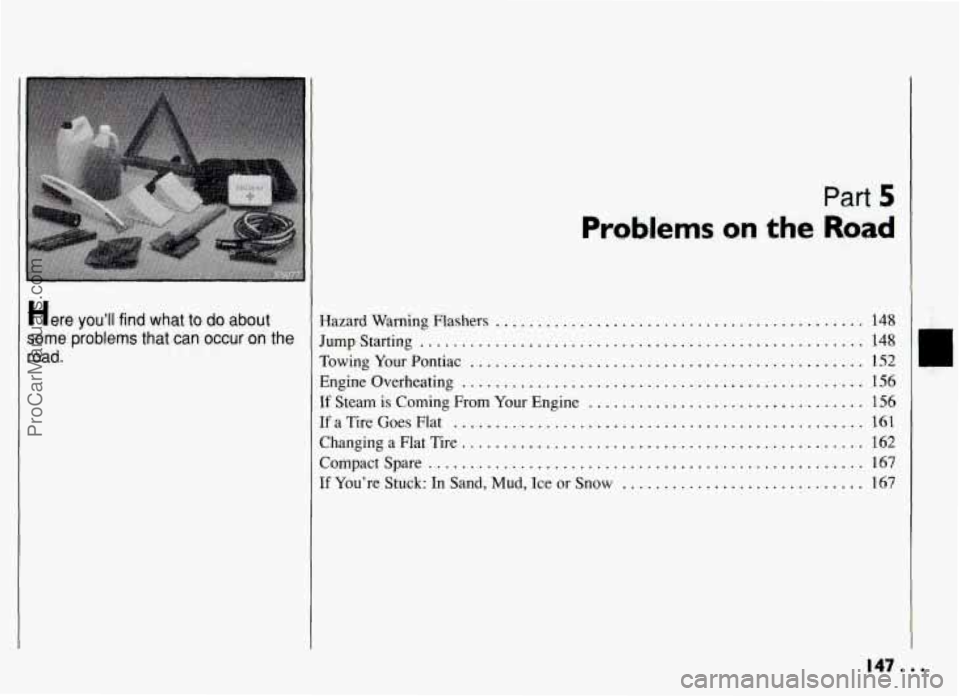
Here you’ll find what to do about
some problems that can occur on the
road .
Problems on the
Part 5
Road
Hazard Warning Flashers ............................................
Jumpstarting .....................................................
TowingYourPontiac ...............................................
Engine Overheating ................................................
If Steam is Coming From Your Engine .................................
If a Tire Goes Flat .................................................
ChangingaFlatTire ................................................
Compactspare ....................................................
If You’re Stuck: In Sand, Mud, Ice or Snow .............................
148
148
152
156
156
161
162
167
167
147 ...
ProCarManuals.com
Page 157 of 274
Problems on the Road
Towing from the
Rear-Vehicle
Hook-Up
(CONT.)
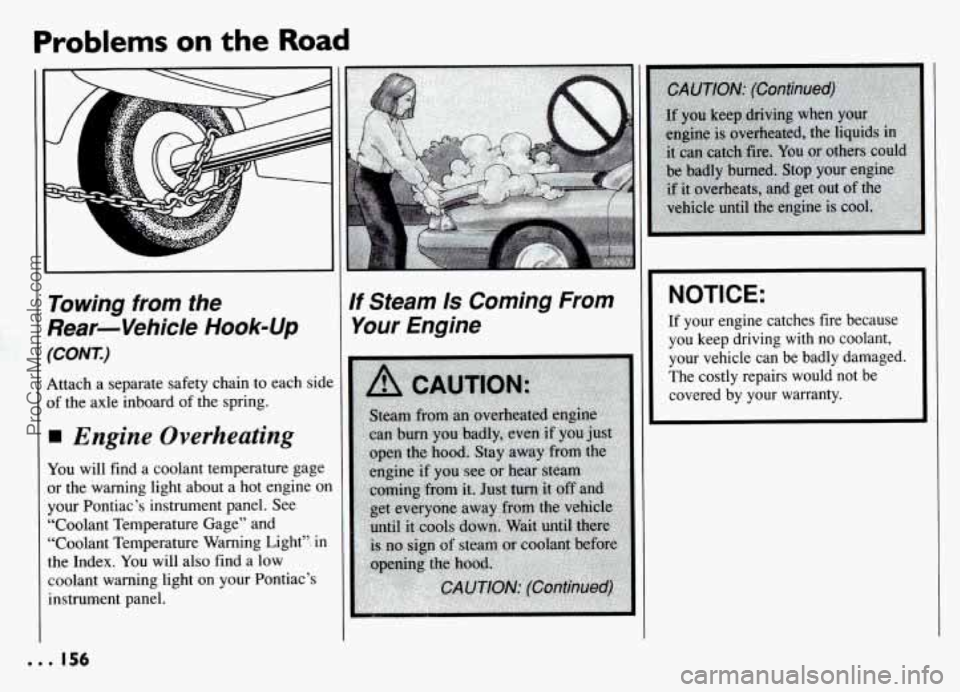
Attach a separate safety chain to each side
of the axle inboard of the spring.
Engine Overheating
You will find a coolant temperature gage
or the warning light about a hot engine on
your Pontiac’s instrument panel. See
“Coolant Temperature Gage” and
“Coolant Temperature Warning Light”; in
the Index. You will also find
a low
coolant warning light
on your Pontiac’s
instrument panel.
If Steam Is Coming From
Your Engine NOTICE:
If your engine catches fire because
you keep driving with no coolant,
your vehicle can be badly damaged.
The costly repairs would not be
covered by your warranty.
ProCarManuals.com
Page 159 of 274
Problems on the Road
1 Cooling System (CONK)
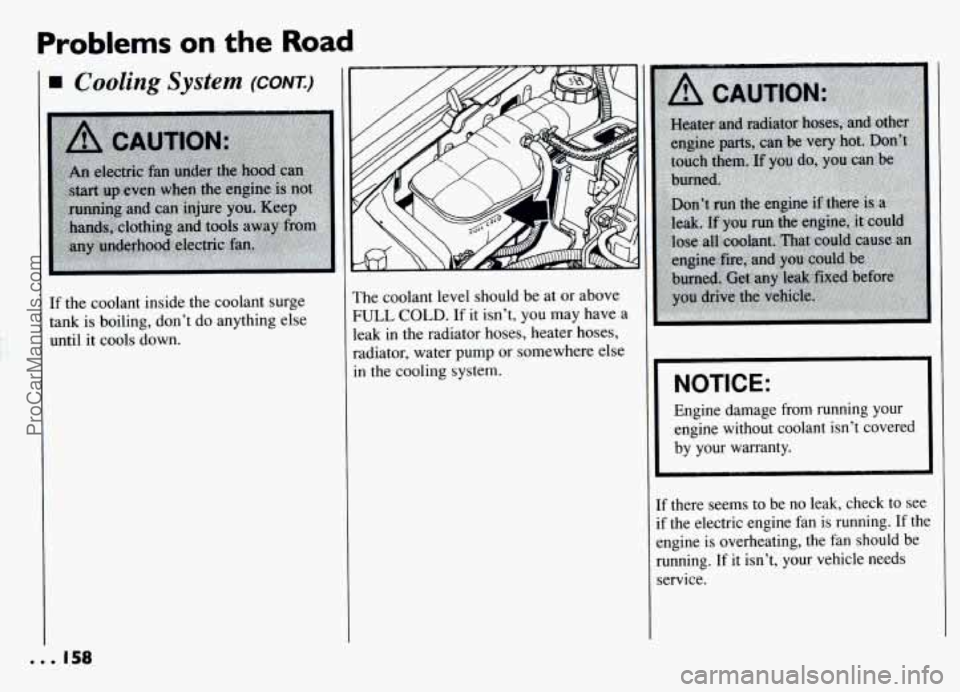
If the coolant inside the coolant surge
tank is boiling, don’t do anything else
until it cools down. The coolant level should be at or above
FULL COLD. If it isn’t, you may have a
leak in the radiator hoses, heater hoses,
radiator, water pump or somewhere else
in the cooling system. ~~~
NOTICE:
Engine
damage from running your
engine without coolant isn’t covered
by your warranty.
If there seems to be no leak, check to see
if the electric engine fan is running. If the
engine is overheating, the fan should be
running. If it isn’t, your vehicle needs
service.
e e e 158
ProCarManuals.com
Page 189 of 274
Service & Appearance Care
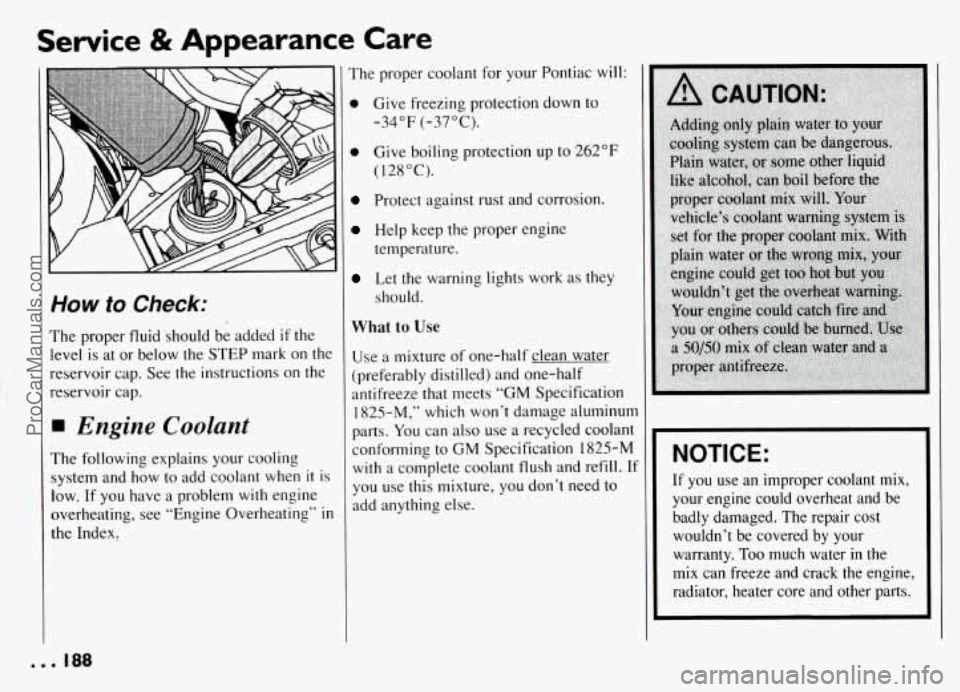
How to Check:
The proper fluid should be added if the
level is at or below the STEP mark on the
reservoir cap. See the instructions on the
reservoir cap.
Engine Coolant
The following explains your cooling
system and how to add coolant when
it is
low.
If you have a problem with engine
overheating, see “Engine Overheating”
in
the Index,
The proper coolant for your Pontiac will:
Give freezing protection down to
-34°F (-37°C).
Give boiling protection up to 262°F
( 128 “C).
Protect against rust and corrosion.
Help keep the proper engine
temperature.
Let the warning lights work as they
should.
What to Use
Use a mixture of one-half clean water
(preferably distilled) and one-half
antifreeze that meets “GM Specification
1825-M,” which won’t damage aluminum
parts.
You can also use a recycled coolant
conforming to GM Specification 1825-M
with a complete coolant flush and refill. If
you use this mixture, you don’t need to
add anything else. NOTICE:
If you use an improper coolant mix,
your engine could overheat and be
badly damaged. The repair cost
wouldn’t be covered by your
warranty. Too much water
in the
mix can freeze and crack the engine,
radiator, heater core and other parts.
... 188
ProCarManuals.com
Page 191 of 274
Service & Appearance Care
V
P
I
E
b
S’
C
C.
P
A
I Surge Tank Pressure
Cap
NOTICE:
Your pressure cap is an 18 psi
( 124 kPa) pressure-type cap and
must be tightly installed to prevent
coolant
loss and possible engine
damage from overheating.
irhen you replace your surge tank
ressure cap, a GM cap is recommended.
I Thermostat
lngine coolant temperature is controlled
y a thermostat in the engine coolant
ystem. The thermostat stops the flow
of
oolant through the radiator until the
oolant reaches a preset temperature.
Jhen you replace your thermostat, an
.C@ thermostat is recommended.
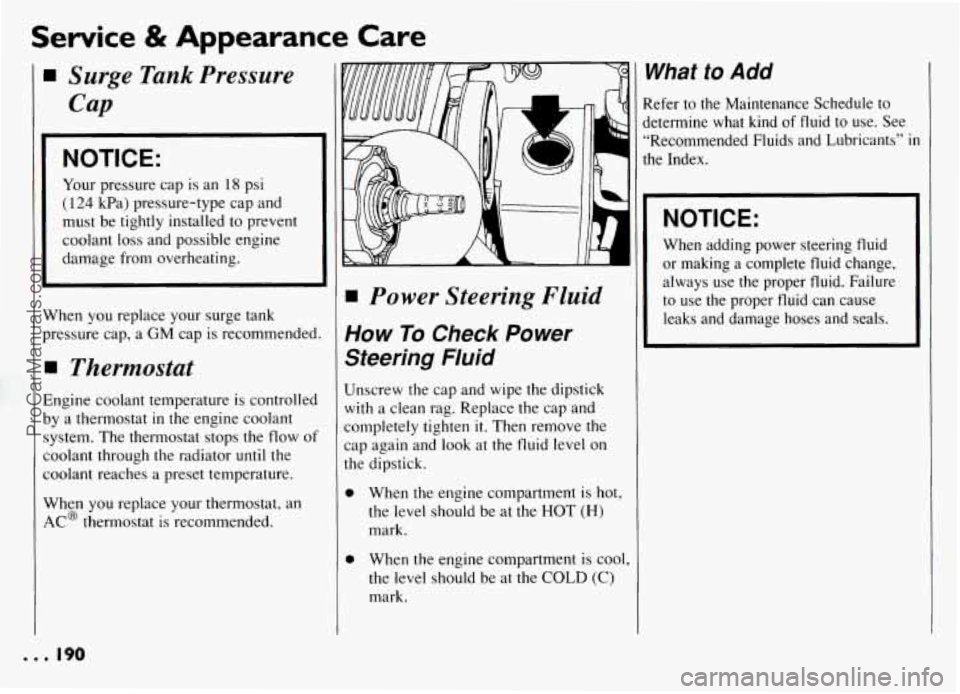
Power Steering Fluid
How To Check Power
Steering Fluid
Unscrew the cap and wipe the dipstick
with a clean rag. Replace the cap and
completely tighten
it. Then remove the
cap again and
look at the fluid level on
the dipstick.
0
0
When the engine compartment is hot,
the level should be at the HOT
(H)
mark.
When the engine compartment is cool,
the level should be at the
COLD (C)
mark.
1
I
1
What to Add
Refer to the Maintenance Schedule to
jetermine what kind
of fluid to use. See
“Recommended Fluids and Lubricants”
in
the Index.
NOTICE:
When adding power steering fluid
or making a complete fluid change,
always use the proper fluid. Failure
to use the proper fluid can cause
leaks and damage hoses and seals.
... 190
ProCarManuals.com
Page 266 of 274
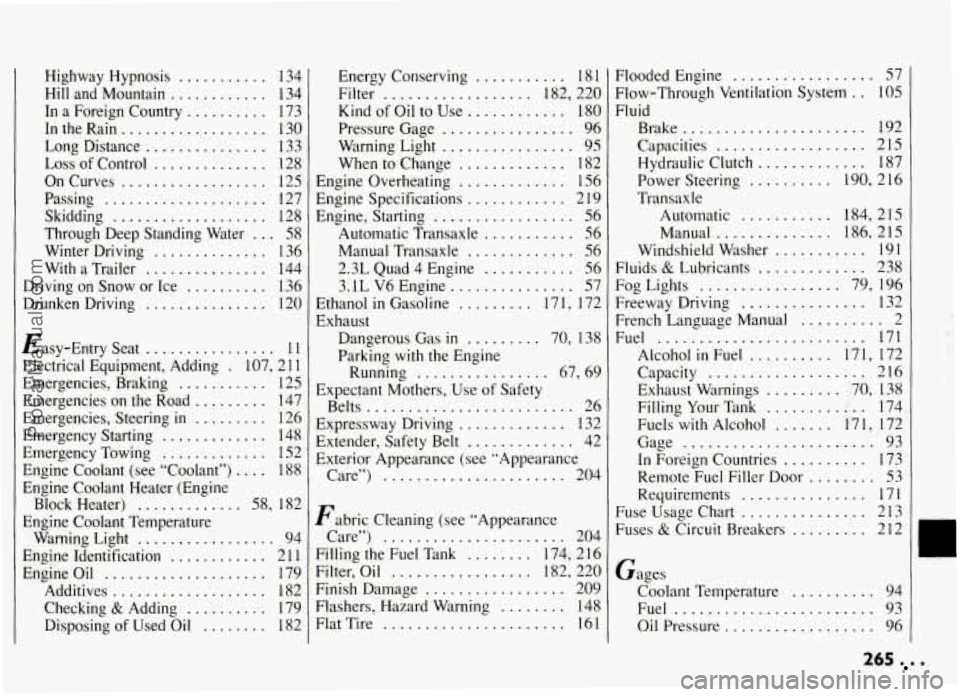
Highway Hypnosis ........... 134
.Hill and Mountain ............ 134
In a Foreign Country
.......... 172
In the Rain
.................. 13C
Logg Distance ............... 132
Loss of Control
.............. 128
On Curves
.................. 125
Passing
.................... 127
Skidding
................... 128
Through Deep Standing Water
... 58
Winter Driving .............. 136
With a Trailer
............... 144
Driving.on Snow or Ice .......... 136
Drunken Driving
............... 120
Easy-Entry Seat ................ 11
Electrical Equipment. Adding
. 107. 2 1 1
Emergencies. Braking .. .. ........ 125
Emergencies on the Road
......... 147
Emergencies. Steering
in ......... 126
Emergency Starting
.. i .......... 148
Emergency Towing
............. 152
Engine Coolant Heater (Engine Block Heater)
....... : ..... 58. 182
Engine Coolant Temperature
Warning Light ................. 94
Engine Identification
............ 2 11
Engine Oil
.................... 179
Additives ................... 182
Checking
& Adding .......... 179
Disposing of Used Oil
........ 182
Engine Coolant (see “Coolant”) .... 188
Energy Conserving ........... 18 I
Filter .................. 182. 22C
Kind of Oil to Use
............ 18C
Pressure- Gage ................ 9f
Warning Light
................ 95
When to Change ............. 182
Engine Overheating ............. 156
Engine Specifications
............ 2 19
Engine. Starting
................. 56
Automatic Transaxle ........... 56
Manual Transaxle ............. 56
2.3L Quad 4 Engine
........... 56
3.lL V6 Engine ............... 57
Ethanol in Gasoline ......... 17 1. 172
Exhaust
Dangerous Gas in
......... 70. 138
Pirking with the Engine
Running ................ 67. 69
Expectant Mothers. Use of Safety
Belts ......................... 26
Expressway Driving
............. 132
Extender. Safety Belt
............. 42
Exterior Appearance (see “Appearance
Care”) ....................... 204
Fabric Cleaning (see “Appearance
Care”) ...................... 204
Filling the Fuel Tank
........ 174. 2 16
Filter. Oil
................ 182. 220
Finish Damage
................. 209
Flashers. Hazard Warning
........ 148
Flat Tire
...................... 161
Flooded Engine ................. 57
Flow-Through Ventilation System . . 105
Fluid
‘Brake ...................... 192
Capacities
.................. 215
Hydraulic Clutch
............. 187
Power Steering
.......... 190. 216
Transaxle
Automatic ........... 184. 215
Manual
.............. 186. 215
Windshield Washer
........... 191
Fluids
& Lubricants ............. 238
Fog Lights
................. 79. 196
Freeway Driving
............... 132
French Language Manual
.......... 2
Fuel
......................... 171
Alcohol
in Fuel .......... 17 1. 172
Capacity
................... 216
Exhaust Warnings
......... ..70. 138
Filling Your Tank
......... 1 .. 174
Fuels
with Alcohol ....... !7 1. 172
Gage
........................ 93
In Foreign Countries .......... 173
Remote Fuel Filler Door
........ 53
Requirements
............... 171
Fuse Usage Chart ............... 213
Fuses
& Circuit Breakers ......... 212
Gages
Coolant Temperature .......... 94
Fuel ........................ 93
Oil Pressure .................. 96
265
E
ProCarManuals.com
Page 268 of 274
Lights on Reminder .............. 77
Loading Your Vehicle
........... 197
Locks. Door
.................... 47
Automatic Door Lock .......... 48
Rear Door Security Locks
...... 49
Low Battery
................... 149
Low Oil Pressure Warning
...... 95. 96
Lubricants and Fluids
............ 238
Lumbar Support
.................. 9
Maintenance Record ........... 240
Maintenance Schedule
........... 223
Maintenance Services. Scheduled
. . 225
Malfunction Indicator Lamp
...... 100
Manual 4-Way Adjustable Seat ...... 8
Manual Front Seat ................ 8
Manual Lumbar Support
........... 9
Manual Transaxle
Adding Fluid ............ 187. 215
Checking Fluid
.............. 186
Parking
..................... 69
Shifting
..................... 64
Starting Your Engine
........... 56
Upshift Indicator Light
......... 67
Master Cylinder. Brake .......... 191
Methanol in Gasoline ........ 171. 172
Mileage Indicator (see “Odometer
Mirrors
& Speedometer”)
Convex Outside .............. 83
Inside Manual Daymight
....... 82
Manual Remote Control
........ 83
I
I
I
I
I
I
1
Power Remote Control ......... 84
Mountain Driving
............... 134
New Vehicle “Break-In”
Requirements .................. 54
Night Driving
.................. 129
Night Vision
................... 129
Octane Requirements (see “Fuel
Requirements”) ............... 17 1
Odometer
& Speedometer ......... 92
Off Road Recovery
............. 127
Oil. Engine
.................... 179
Pressure Gage ................ 96
Quality
.................... 180
Thickness .................. 180
Used Oil
................... 182
When to Change
.............. 182
Operation of Lights .............. 77
Outside Rearview Mirrors
......... 83
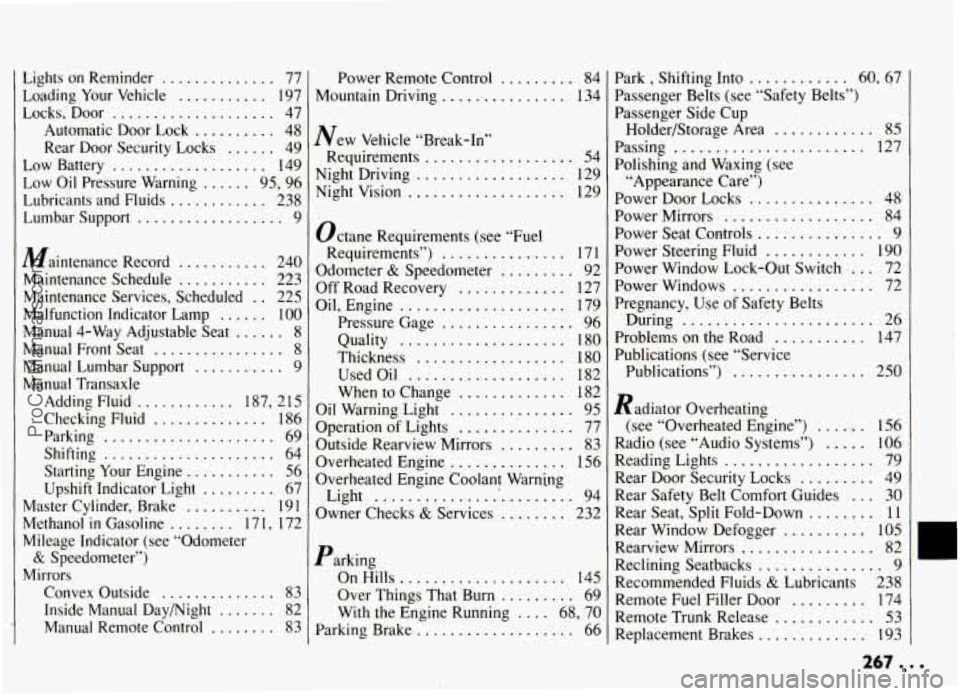
Overheated Engine
.............. 156
Overheated Engine Coolant Warning
Light ......................... 94
Owner Checks
& Services ........ 232
Oil Warning Light ............... 95
Parking
On Hills .................... 145
With the Engine Running
.... 68. 70
Parking Brake
................... 66
Over Things That Burn ......... 69
Park . Shifting Into ............ 60. 67
Passenger Belts (see “Safety Belts”)
Passenger Side Cup
Holder/Storage Area ............ 85
Passing
....................... 127
Polishing and Waxing (see
Power Door Locks ............... 48
Power Mirrors
.................. 84
Power Seat Controls
............... 9
Power Steering Fluid ............ 190
Power Window Lock-Out Switch ... 72
Power Windows
................. 72
Pregnancy. Use of Safety Belts
During ....................... 26
Problems on the Road
........... 147
Publications (see “Service
Publications”) ................ 250
Radiator Overheating
(see “Overheated Engine”) ....... 156
Radio (see “Audio Systems”)
..... 106
Reading Lights
.................. 79
Rear Door Security Locks
......... 49
Rear Safety Belt Comfort Guides
... 30
Rear Seat. Split Fold-Down ........ 11
Rear Window Defogger
.......... 105
Rearview Mirrors ................ 82
Reclining Seatbacks
............... 9
Recommended Fluids
& Lubricants 238
Remote Fuel Filler Door
......... 174
Remote Trunk Release
............ 53
Replacement Brakes
............. 193
“Appearance Care”)
267 . .
ProCarManuals.com