light PONTIAC GRAND-AM 1994 Workshop Manual
[x] Cancel search | Manufacturer: PONTIAC, Model Year: 1994, Model line: GRAND-AM, Model: PONTIAC GRAND-AM 1994Pages: 274, PDF Size: 15.01 MB
Page 139 of 274
Your Driving and the Road
If You’re Caught in a
Blizzard (CONT.)
you. If you have no blankets or extra
clothing, make body insulators from
newspapers, burlap bags, rags,
floor mats
-- anything you can wrap around yourself
or tuck under your clothing to keep warm.
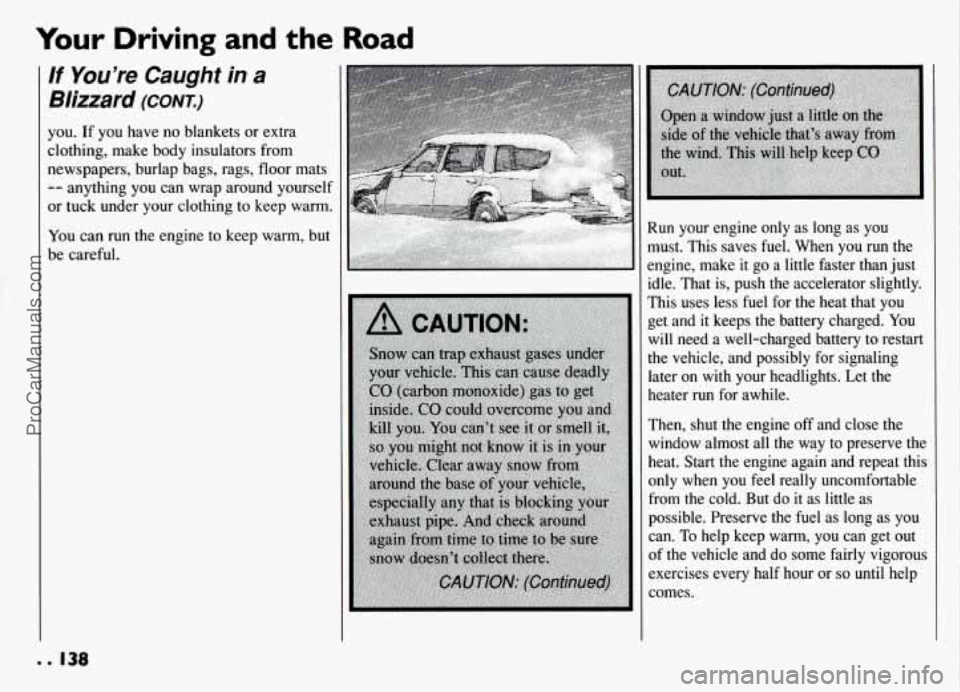
You can run the engine to keep warm, but
be careful. Run your engine only as long as you
must. This saves fuel. When you run the
engine, make
it go a little faster than just
idle. That is, push the accelerator slightly.
This uses less fuel for the heat that you
get and it keeps the battery charged. You
will need a well-charged battery to restart
the vehicle, and possibly for signaling
later on with your headlights.
Let the
heater run for awhile.
Then, shut the engine off and close the
window almost all the way to preserve the
heat. Start the engine again and repeat this
only when you feel really uncomfortable from the cold. But do it as
little as
possible. Preserve the fuel as long as you
can.
To help keep warm, you can get out
of the vehicle and do some fairly vigorous
exercises every half hour or
so until help
comes.
.. 138
ProCarManuals.com
Page 145 of 274
Your Driving and the Road
I Driving with a Trailer
Towing a trailer requires a certain amount
of experience. Before setting out for the
open road, you’ll want to get to know
your rig. Acquaint yourself with the feel
of handling and braking with the added
weight
of the trailer. And always keep in
mind that the vehicle you are driving is
now a good deal longer and not nearly
so
.responsive as your vehicle is by itself.
Before you start, check the trailer hitch
and platform, safety chains, electrical
connector, lights, tires and mirror
adjustment. If the trailer has electric
brakes, start your vehicle and trailer
moving and then apply the trailer brake
controller by hand to be sure the brakes
are working. This lets you check your
electrical connection at the same time.
During your trip, check occasionally to be
sure that the load is secure, and that the
lights and any trailer brakes are still
working.
Following Distance
Stay at least twice as far behind the
vehicle ahead as you would when driving
your vehicle without a trailer. This can
help you avoid situations that require
heavy braking and sudden turns.
Passing
You’ll need more passing distance up
ahead when you’re towing a trailer. And,
because you’re a good deal longer, you’ll
need to go much farther beyond the
passed vehicle before you can return to
your lane.
Backing Up
Hold the bottom of the steering wheel
with one hand. Then, to move the trailer
to the left, just move that hand to the left.
To move the trailer to the right, move
your hand to the right. Always back up
slowly and,
if possible, have someone
guide you.
Making Turns
When you’re turning with a trailer, make
wider turns than normal. Do this
so your
railer won’t strike soft shoulders, curbs,
road signs, trees, or other objects. Avoid
ierky or sudden maneuvers. Signal well
in
3dvance.
Turn Signals When
Towing
a Trailer
When you tow a trailer, your vehicle has
to have a different turn signal flasher and
extra wiring. The green arrows on your
instrument panel will flash whenever you
signal a
turn or lane change. Properly
hooked up, the trailer lights will also
flash, telling other drivers you’re about to
turn, change lanes or stop.
When towing a trailer, the green arrows
on your instrument panel will flash for
turns even
if the bulbs on the trailer are
burned out. Thus, you may
think drivers
behind you are seeing your signal when
they are not. It’s important to check
occasionally to be sure the trailer bulbs
are still working.
. . . 144
ProCarManuals.com
Page 149 of 274
Problems on the Road
Hazard Warning Flashers
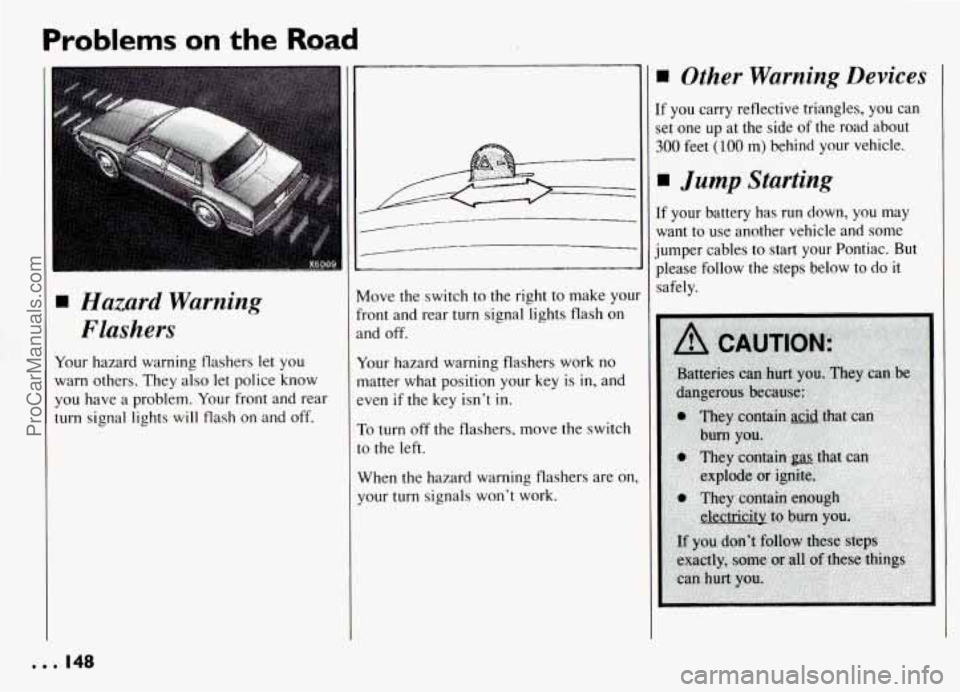
Your hazard warning flashers let you
warn others. They also let police know
you have a problem. Your front and rear
turn signal lights will flash on and off.
Move the switch to the right to make you
front and rear turn signal lights flash on
and off.
Your hazard warning flashers work no
matter what position your key is
in, and
even if the key isn’t in.
To turn off the flashers, move the switch
to the left.
When the hazard warning flashers are on,
your turn signals won’t work.
Other Warning Devices
If you carry reflective triangles, you can
set one up at the side of the road about
300 feet (100 m) behind your vehicle.
Jump Starting
If your battery has run down, you may
want to use another vehicle and some
jumper cables to
start your Pontiac. But
please follow the steps below to do it
safely.
... 148
ProCarManuals.com
Page 150 of 274
NOTICE:
Ignoring these steps could result in
costly damage to your vehicle that
wouldn’t be covered by your
warranty.
Trying to start your Pontiac by
pushing or pulling it could damage
your vehicle, even if you have a
manual transaxle. And
if you have
an automatic transaxle,
it won’t start
that way.
To Jump Start Your
Pontiac:
1. Check the other vehicle. It must have
a 12-volt battery with a negative
ground system.
NOTICE:
If the other system isn’t a 12-volt
system with a negative ground, both
vehicles can be damaged.
2. Get the vehicles close enough so the
jumper cables can reach, but be sure
the vehicles aren’t touching each
other. If they are, it could cause a
ground connection you don’t want.
You wouldn’t be able to start your
Pontiac, and the bad grounding could
damage the electrical systems.
3. Turn off the ignition on both vehicles.
Turn off
all lights that aren’t needed,
and radios. This will avoid sparks and
help save both batteries. And
it could
save your radio!
NOTICE:
If you leave your radio on, it could
be badly damaged. The repairs
wouldn’t be covered by your
warranty.
4. Open the hoods and locate the
batteries. Find the positive (+) and
negative
(-) terminals on each battery.
To uncover the positive
(+) terminal,
lift the red plastic cap.
149. .
ProCarManuals.com
Page 154 of 274
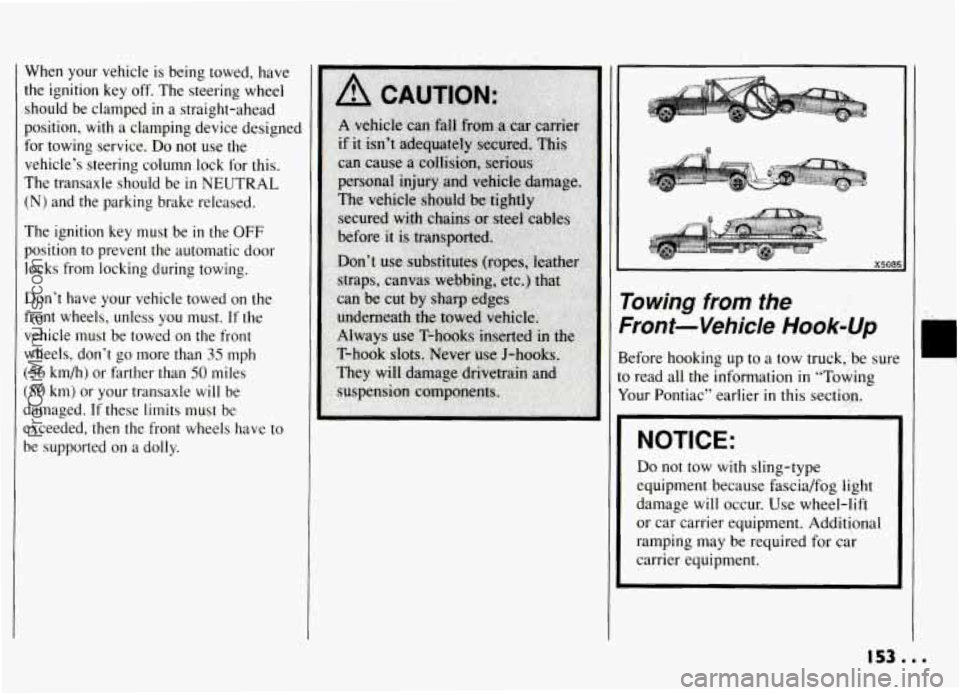
When your vehicle is being towed, have
the ignition key off. The steering wheel
should be clamped
in a straight-ahead
position,
with a clamping device designed
for towing service.
Do not use the
vehicle’s steering column lock for this.
The transaxle should be
in NEUTRAL
(N) and the parking brake released.
The ignition key must be in the OFF
position to prevent the automatic door
locks from locking during towing.
Don’t have your vehicle towed on the
front wheels, unless you must. If the
vehicle must be towed on the front
wheels, don’t go more than
35 mph
‘56 i. km/h) or farther than 50 miles
:SO km) or your transaxle will be
ilamaged. If these limits must be
:xceeded, then the front wheels have to
,e supported on a dolly.
,I 7
F
B
tc
Y
I
1
‘owing from the
?ont-Vehicle Hook-Up
efore hooking up to a tow truck, be sur(
1 read all the information in “Towing
our Pontiac” earlier
in this section.
NOTICE:
Do not tow with sling-type
equipment because fascia/fog light
damage will occur. Use wheel-lift
or car carrier equipment. Additional
ramping may be required for car
carrier equipment.
153...
ProCarManuals.com
Page 157 of 274
Problems on the Road
Towing from the
Rear-Vehicle
Hook-Up
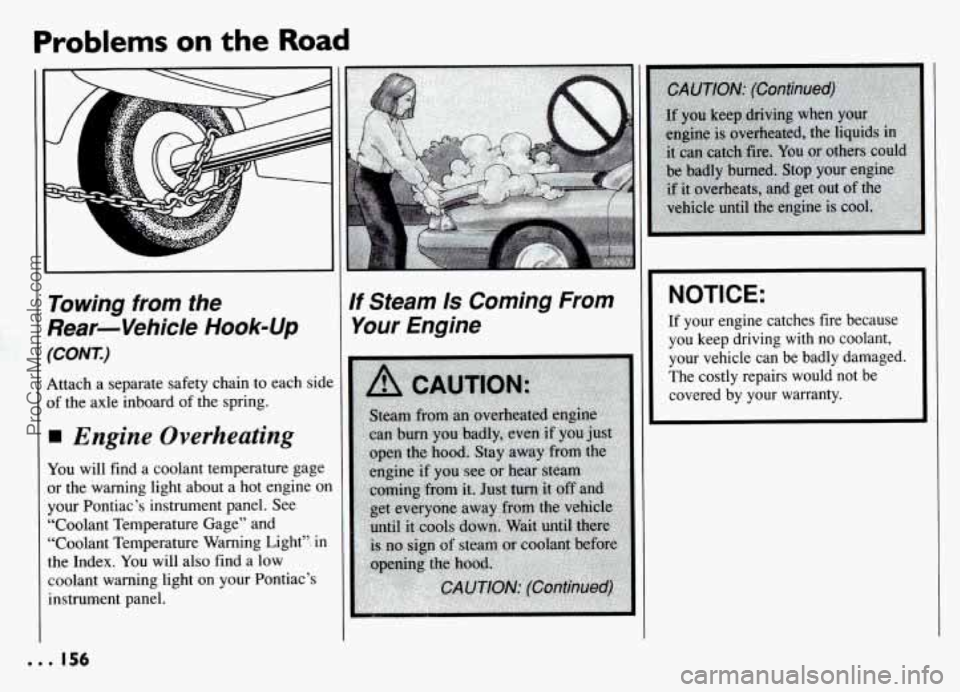
(CONT.)
Attach a separate safety chain to each side
of the axle inboard of the spring.
Engine Overheating
You will find a coolant temperature gage
or the warning light about a hot engine on
your Pontiac’s instrument panel. See
“Coolant Temperature Gage” and
“Coolant Temperature Warning Light”; in
the Index. You will also find
a low
coolant warning light
on your Pontiac’s
instrument panel.
If Steam Is Coming From
Your Engine NOTICE:
If your engine catches fire because
you keep driving with no coolant,
your vehicle can be badly damaged.
The costly repairs would not be
covered by your warranty.
ProCarManuals.com
Page 169 of 274
Problems on the Road
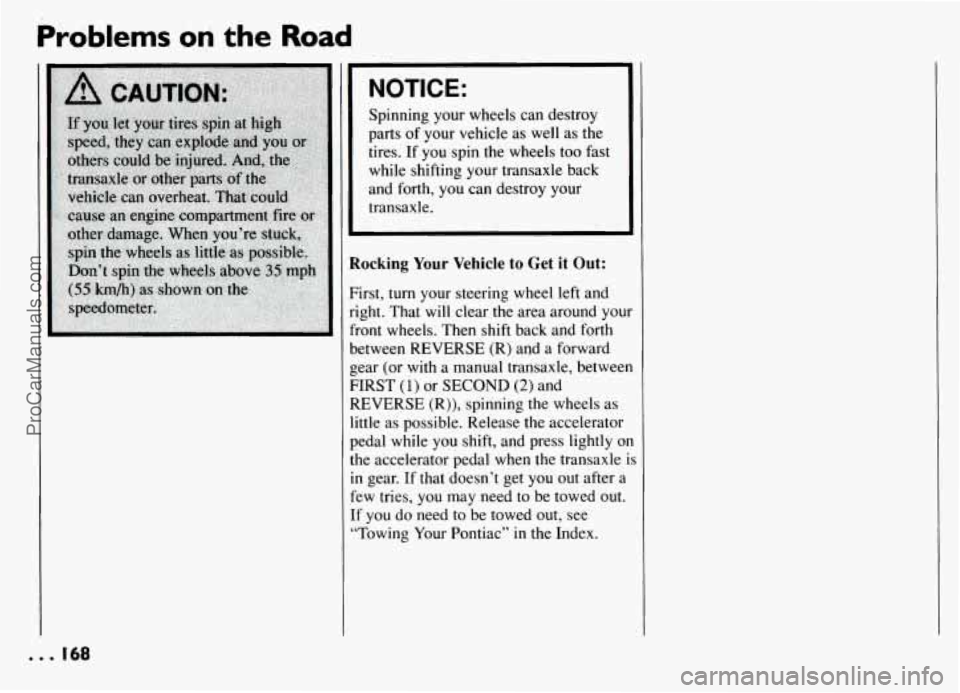
NOTICE:
Spinning your wheels can destroy
parts of your vehicle
as well as the
tires. If you spin the wheels too fast
while shifting your transaxle back
and forth, you can destroy your
transaxle.
..
locking Your Vehicle to Get it Out:
‘irst, turn your steering wheel left and
ight. That will clear the area around your
ront wheels. Then shift back and forth
letween REVERSE (R) and a forward
ear (or with a manual transaxle, between
IRST
(1) or SECOND (2) and
.EVERSE
(R)), spinning the wheels as
ttle as possible. Release
the accelerator
edal while you shift, and press lightly
on
le accelerator pedal when the transaxle is
1 gear. If that doesn’t get you out after a
:w tries, you may need to be towed out.
F you do need to be towed out, see
Towing Your Pontiac”
in the Index.
ProCarManuals.com
Page 180 of 274
Engine Oil
If the CHECK OIL light on the
instrument panel comes on,
it means you
need to check your engine oil level right
away. For more information, see “Check
Oil Light”
in the Index. You should check
the engine
oil regularly; this is an added
reminder.
It’s a good idea to check your engine oil
every time you get fuel. In order to get an
accurate reading, the oil must be warm
and the vehicle must be on level ground.
Turn off the engine and give the oil a few
minutes to drain back into the oil pan.
If
you don’t, the oil dipstick might not show
the actual level.
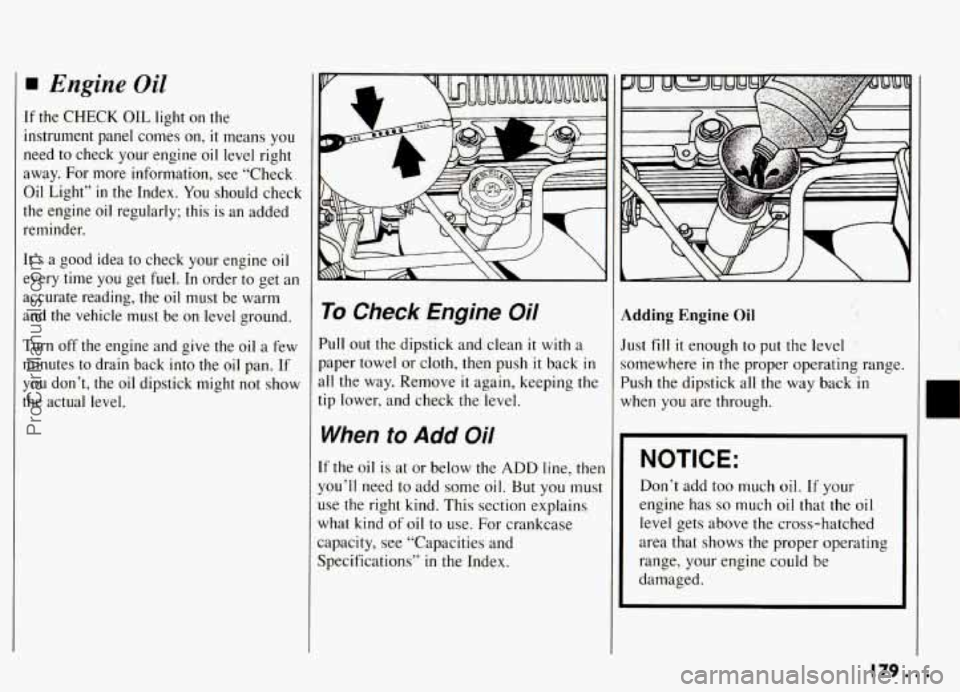
To Check Engine Oil
Pull out the dipstick and clean it with a
paper towel or cloth, then push
it back in
all the way. Remove it again, keeping the
tip lower, and check the level.
When to Add Oil
If the oil is at or below the ADD line, then
you’ll need to add some oil. But
you must
use the right kind. This section explains
what kind of oil
to use. For crankcase
capacity, see “Capacities and
Specifications” in the Index.
Adding Engine Oil
Just fill it enough to put the level
somewhere
in the proper operating range.
Push the dipstick all the way back
in
when you are through.
NOTICE:
Don’t add too much oil. If your
engine has
so much oil that the oil
level gets above the cross-hatched
area that shows the proper operating
range, your engine could
be
damaged.
179. . .
ProCarManuals.com
Page 189 of 274
Service & Appearance Care
How to Check:
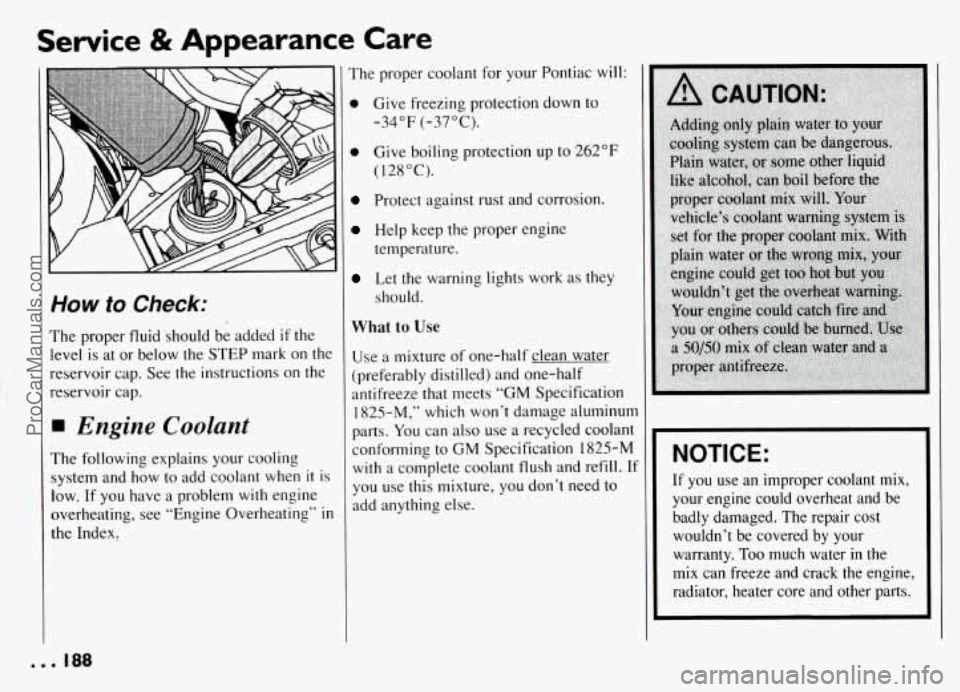
The proper fluid should be added if the
level is at or below the STEP mark on the
reservoir cap. See the instructions on the
reservoir cap.
Engine Coolant
The following explains your cooling
system and how to add coolant when
it is
low.
If you have a problem with engine
overheating, see “Engine Overheating”
in
the Index,
The proper coolant for your Pontiac will:
Give freezing protection down to
-34°F (-37°C).
Give boiling protection up to 262°F
( 128 “C).
Protect against rust and corrosion.
Help keep the proper engine
temperature.
Let the warning lights work as they
should.
What to Use
Use a mixture of one-half clean water
(preferably distilled) and one-half
antifreeze that meets “GM Specification
1825-M,” which won’t damage aluminum
parts.
You can also use a recycled coolant
conforming to GM Specification 1825-M
with a complete coolant flush and refill. If
you use this mixture, you don’t need to
add anything else. NOTICE:
If you use an improper coolant mix,
your engine could overheat and be
badly damaged. The repair cost
wouldn’t be covered by your
warranty. Too much water
in the
mix can freeze and crack the engine,
radiator, heater core and other parts.
... 188
ProCarManuals.com
Page 193 of 274
Service & Appearance Care
Brake Master Cylinder
(CONT.)
when your linings are worn, then you’ll
have too much fluid when you get new
brake linings. You should add (or remove)
brake fluid, as necessary, only when work
is done on the brake hydraulic system.
When your brake fluid falls to a low level.
your brake warning light wil1,come on.
See “Brake System Warning Light” in the
Index.
What to Add:
When you do need brake fluid, use only
DOT-3 brake fluid -- such as Delco
Supreme
11 @ (GM Part No. 1052535).
Use new brake fluid from a sealed
:ontainer only, and always clean the brak
fluid reservoir cap before removing it.
NOTICE:
e
0
Don’t let someone put in the
wrong kind
of fluid. For
example, just a few drops
of
mineral-based oil, such as
engine oil, in your brake
system can damage brake
system parts
so badly that
they’ll have to be replaced.
Brake fluid can damage
paint,
so be careful not to
spill brake fluid on your
vehicle. If you
do, wash it off
immediately. See
“Appearance Care” in the
Index.
3rake Wear
‘our Pontiac has front disc brakes and
ear drum brakes.
Xsc brake pads have built-in wear
ndicators that make a high-pitched
varning sound when the brake pads are
vorn and new pads are needed. The
ound may come and
go or be heard all
he time your vehicle is moving (except
when you are pushing on the brake pedal
irmly).
ProCarManuals.com