lock PONTIAC GRAND-AM 1994 Workshop Manual
[x] Cancel search | Manufacturer: PONTIAC, Model Year: 1994, Model line: GRAND-AM, Model: PONTIAC GRAND-AM 1994Pages: 274, PDF Size: 15.01 MB
Page 164 of 274
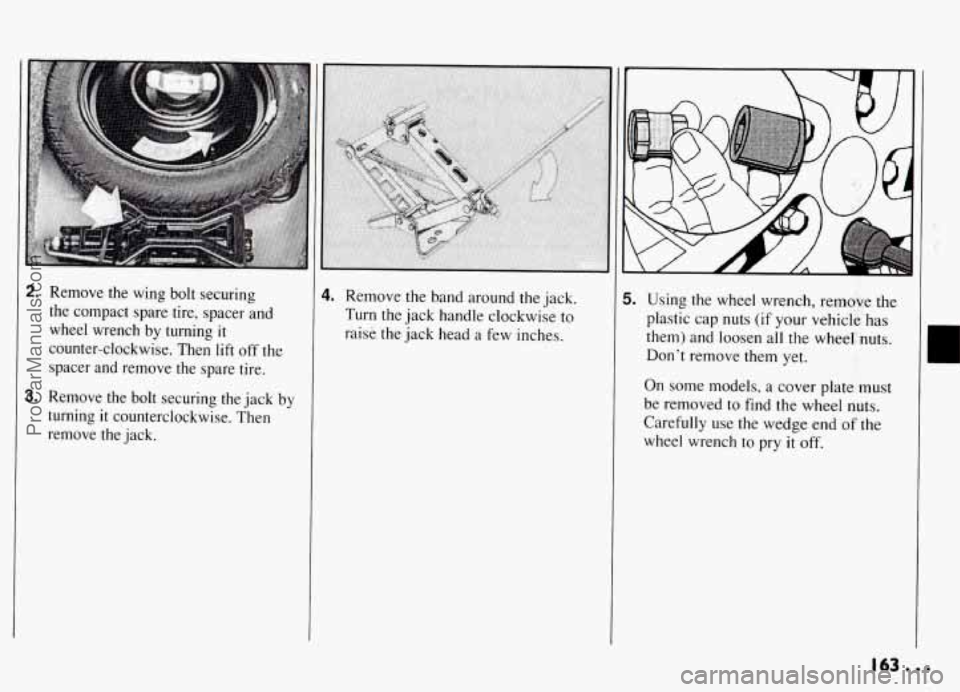
2. Remove the wing bolt securing
the compact spare tire, spacer and
wheel wrench by turning
it
counter-clockwise. Then lift off the
spacer and remove the spare tire.
3. Remove the bolt securing the jack by
turning
it counterclockwise. Then
remove the jack.
4. Remove the band around the jack.
Turn the jack handle clockwise to
raise the jack head a few inches. 5. Using the wheel wrench, remove the
plastic cap nuts (if your vehicle has
them) and loosen all the wheel nuts.
Don’t remove them yet.
On some models, a cover plate must
be removed to find
the wheel nuts.
Carefully use the wedge end of the
wheel wrench to pry
it off.
163...
ProCarManuals.com
Page 165 of 274
Problems on the Road
18 (46cm) 18" (46cm)
Changing a Flat Tire
(CONT.)
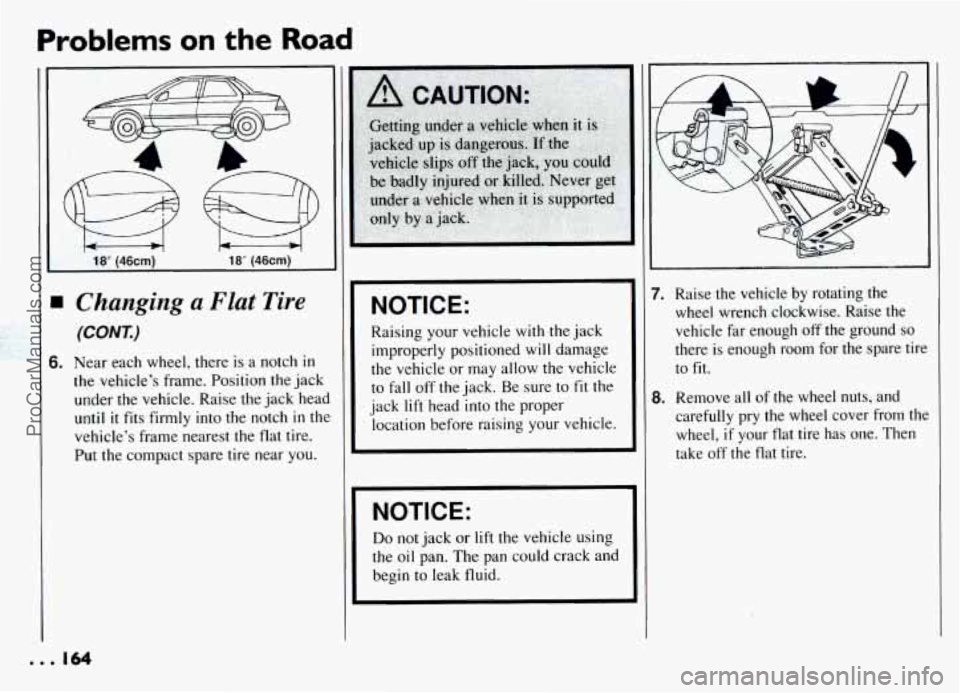
i. Near each wheel, there is a notch in
the vehicle's frame. Position the jack
under the vehicle. Raise the jack head
until it fits firmly into the notch
in the
vehicle's frame nearest the flat tire.
Put the compact spare tire near you.
NOTICE:
Raising your vehicle with the jack
improperly positioned
will damage
the vehicle or may allow the vehicle
to fall off the jack. Be sure to
fit the
jack lift head into the proper
location before raising your vehicle.
NOTICE:
Do not jack or lift the vehicle using
the oil pan. The pan could crack and
begin to leak fluid.
7. Raise the vehicle by rotating the
wheel wrench clockwise. Raise the
vehicle far enough
off the ground so
there is enough room for the spare tire
to
fit.
3. Remove all of the wheel nuts, and
carefully pry the wheel cover from the
wheel,
if your flat tire has one. Then
take off the flat tire.
... 164
ProCarManuals.com
Page 167 of 274
Problems on the Road
II
Changing a Flat Tire
(CONT.)
12. Lower the vehicle by rotating the
wheel wrench counterclockwise.
Lower the jack completely.
A
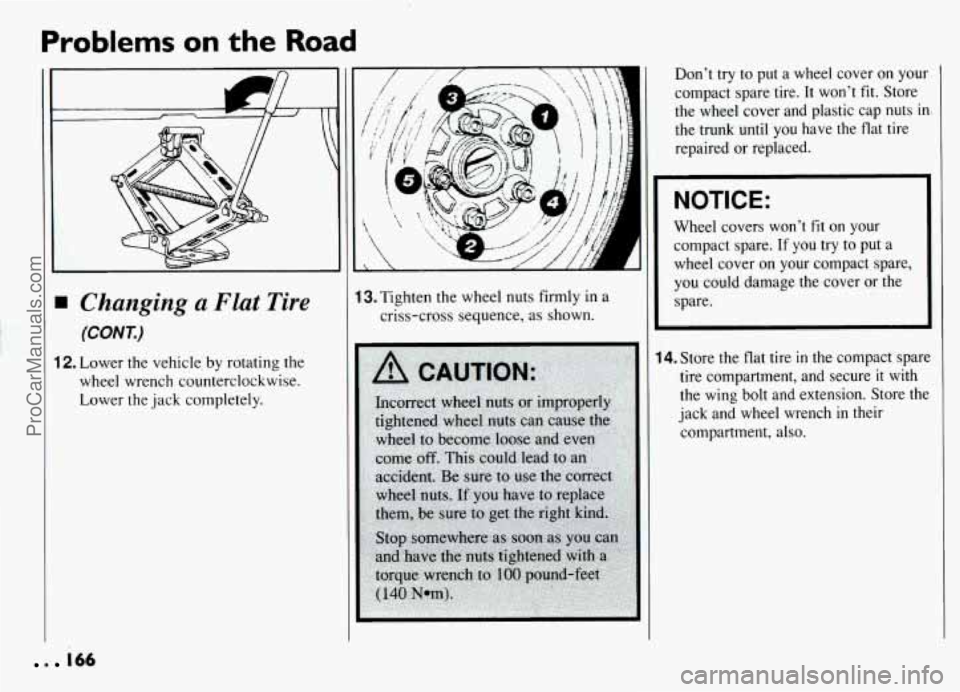
13. Tighten the wheel nuts firmly in a
criss-cross sequence, as shown.
Don’t try to put a wheel cover on your
compact spare tire. It won’t
fit. Store
the wheel cover and plastic cap nuts
int
the trunk until you have the flat tire
repaired or replaced.
NOTICE:
Wheel covers won’t fit on your
compact spare.
If you try to put a
wheel cover on your compact spare,
you could damage the cover or the
spare.
14. Store the flat tire in the compact spare
tire compartment, and secure
it with
the wing bolt and extension. Store the
jack and wheel wrench
in their
compartment, also.
. 166
ProCarManuals.com
Page 169 of 274
Problems on the Road
NOTICE:
Spinning your wheels can destroy
parts of your vehicle
as well as the
tires. If you spin the wheels too fast
while shifting your transaxle back
and forth, you can destroy your
transaxle.
..
locking Your Vehicle to Get it Out:
‘irst, turn your steering wheel left and
ight. That will clear the area around your
ront wheels. Then shift back and forth
letween REVERSE (R) and a forward
ear (or with a manual transaxle, between
IRST
(1) or SECOND (2) and
.EVERSE
(R)), spinning the wheels as
ttle as possible. Release
the accelerator
edal while you shift, and press lightly
on
le accelerator pedal when the transaxle is
1 gear. If that doesn’t get you out after a
:w tries, you may need to be towed out.
F you do need to be towed out, see
Towing Your Pontiac”
in the Index.
ProCarManuals.com
Page 175 of 274
Service & Appearance Care
N Remote Fuel Filler
Door Release
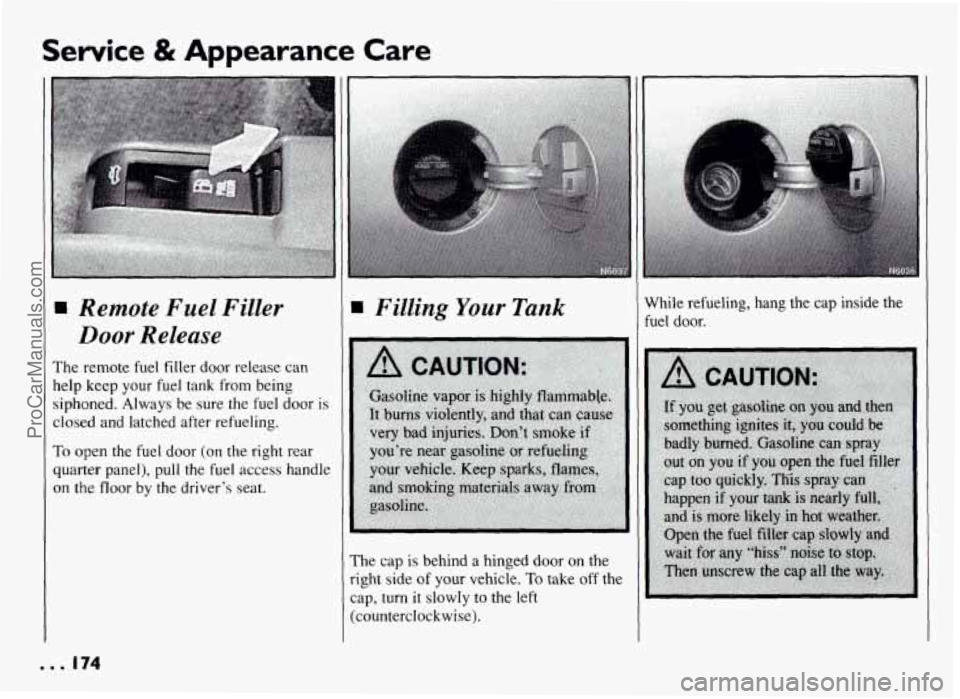
The remote fuel filler door release can
help keep your fuel
tank from being
siphoned. Always be sure the fuel door
is
closed and latched after refueling.
To open the fuel door (on the right rear
quarter panel),
pull the fuel access handle
on the floor by the driver's seat.
rn Filling Your Tank
The cap is behind a hinged door on the
right side of your vehicle. To take
off the
cap, turn it slowly to the left
(counterclockwise).
While refueling, hang the cap inside the
fuel
door.
ProCarManuals.com
Page 183 of 274
Service & Appearance Care
Engine Oil Additives
Don’t add anything to your oil. Your
Pontiac dealer is ready to advise
if you
think something should be added.
When to Change Engine
Oil
See if any one of these is true for you:
Most trips are less than 4 miles
(6 km).
It’s below freezing outside and most
trips are less than
10 miles ( 16 km).
The engine is at low speed most of the
time (as
in door-to-door delivery, or
in stop-and-go traffic).
You tow a trailer often.
Most trips are through dusty places.
[f any one of these is true for your
Vrehicle, then you need to change your oil
md filter every 3,000 miles (5 000 km) or-
3 months -- whichever comes first.
[f none of them is true, change the oil
=very 7,500 miles (12 500 km,) or
12 months -- whichever comes first.
Change the filter at the first oil change
and at every other
oil change after that.
Engine Coolant Heater
(Engine Block Heater)
An engine coolant heater can be a big
help if
you have to park outside in very
cold weather,
0°F (- 18OC) or colder. If
your vehicle has this option, see “Engine
Coolant Heater” (Engine Block Heater)
in
the Index.
What to Do with Used Oil
lid you know that used engine oil
:ontains certain elements that may be
Inhealthy
for your skin and could even
:awe cancer? Don’t let used oil stay on
your skin for very long. Clean your skin
md nails with soap and water, or a good
land cleaner. Wash or properly throw
lway clothing or rags containing used
mgine oil. (See the manufacturer’s
warnings about the use and disposal of oil
products.)
Used oil can be a real threat to the
mvironment.
If you change your own oil,
be sure to drain all free-flowing oil from
the filter before disposal. Don’t ever
dispose of oil by putting
it in the trash,
pouring
it on the ground, into sewers, or
into streams or bodies of water. Instead,
recycle
it by taking it to a place that
collects used
oil. If you have a problem
properly disposing of your used oil, ask
your dealer, a service station or
a local
recycling center for help.
... 182
ProCarManuals.com
Page 188 of 274
How to Add Fluid
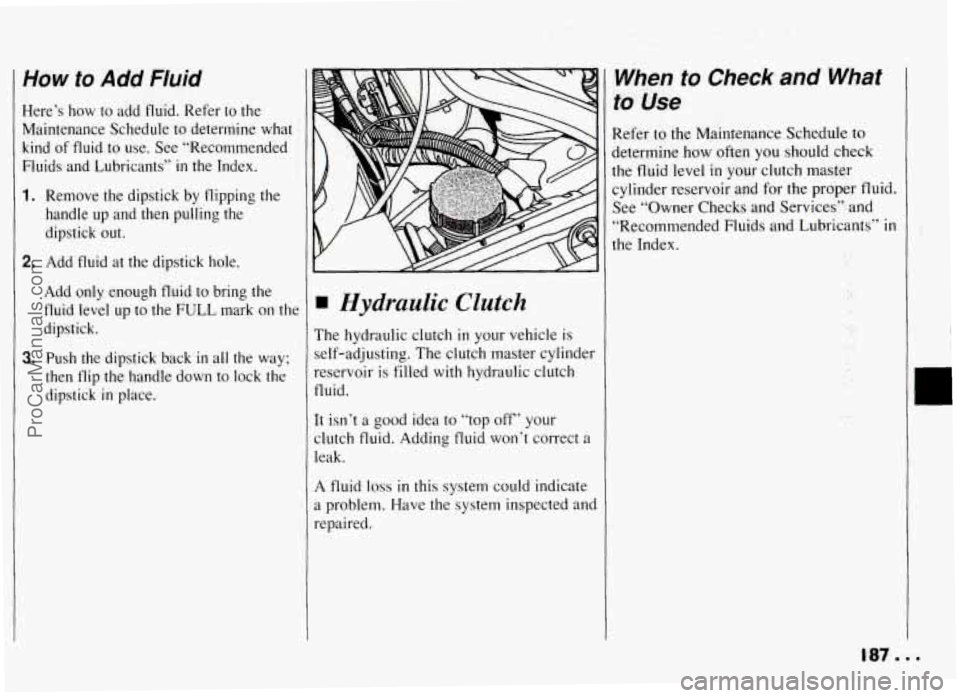
Here’s how to add fluid. Refer to the
Maintenance Schedule to determine what
kind of fluid
to use. See “Recommended
Fluids and Lubricants”
in the Index.
1. Remove the dipstick by flipping the
handle up and then pulling the
dipstick out.
2. Add fluid at the dipstick hole.
Add only enough fluid to bring the
fluid level up to the
FULL mark on the
dipstick.
3. Push the dipstick back in all the way;
then flip the handle down to lock the
dipstick
in place.
Hydraulic Clutch
The hydraulic clutch in your vehicle is
self-adjusting. The clutch master cylinder
reservoir is filled with hydraulic clutch
fluid.
It isn’t a good idea to “top off’ your
clutch fluid. Adding fluid won’t correct a
leak.
A fluid loss in this system could indicate
a problem. Have the system inspected and
repaired.
When to Check and What
to Use
Refer to the Maintenance Schedule to
determine how often you should check
the fluid level
in your clutch master
cylinder reservoir and for the proper fluid.
See “Owner Checks and Services” and
“Recommended Fluids and Lubricants”
in
the Index.
187...
ProCarManuals.com
Page 196 of 274
Headlight Bulb
Replacement
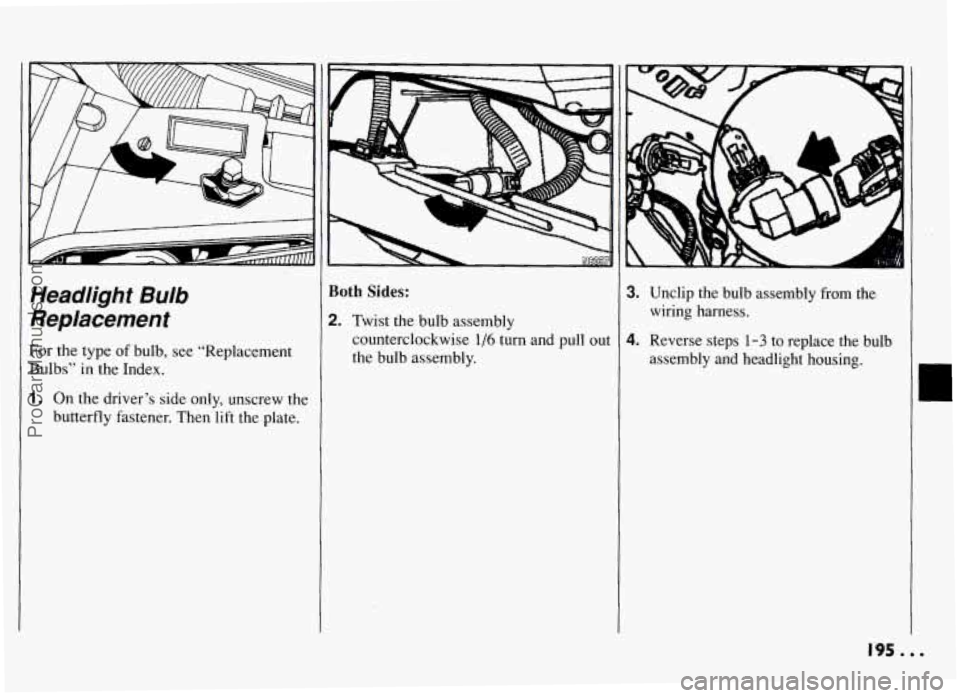
For the type of bulb, see “Replacement
Bulbs”
in the Index.
1. On the driver’s side only, unscrew the
butterfly fastener. Then lift the plate.
Both Sides:
2. Twist the bulb assembly
counterclockwise 1/6 turn and pull out
the bulb assembly.
3. Unclip the bulb assembly from the
wiring harness.
4. Reverse steps 1-3 to replace the bulb
assembly and headlight housing.
195...
ProCarManuals.com
Page 214 of 274
IC
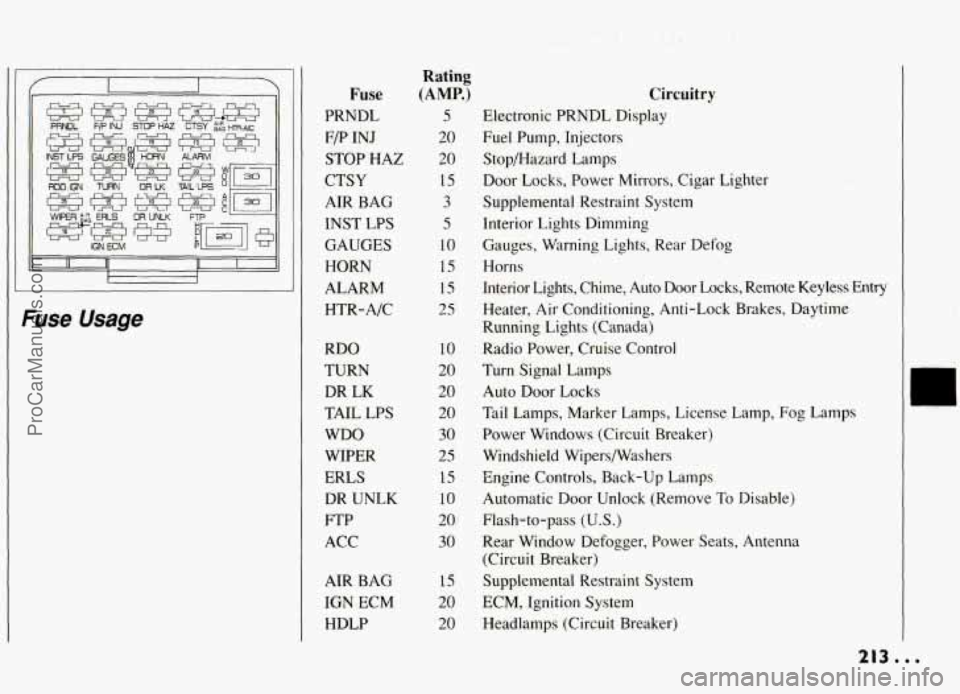
Fuse Usage
Fuse
PRNDL
F/P INJ
STOP HAZ
CTSY
AIR BAG
INST
LPS
GAUGES HORN
ALARM
HTR-A/C
RDO
TURN
DR LK
TAIL LPS
WDO WIPER
ERLS DR UNLK
FTP
ACC
AIR BAG
IGN ECM
HDLP
Rating
(AMP. )
5
20
20
15
3
5
10
15
15
25
10
20
20
20
30
25
15
10
20,
30
15
20
20
Circuitry
Electronic PRNDL Display
Fuel Pump, Injectors
Stop/Hazard Lamps
Door Locks, Power Mirrors, Cigar Lighter
Supplemental Restraint System
Interior Lights Dimming
Gauges, Warning Lights, Rear Defog
Horns
Interior Lights, Chime, Auto Door Locks, Remote Keyless Entry Heater, Air Conditioning, Anti-Lock Brakes, Daytime
Running Lights (Canada)
Radio Power, Cruise Control
Turn Signal Lamps
Auto Door Locks
Tail Lamps, Marker Lamps, License Lamp, Fog Lamps
Power Windows (Circuit Breaker)
Windshield Wipers/Washers
Engine Controls, Back-up Lamps
Automatic Door Unlock (Remove
To Disable)
Flash-to-pass
(U.S.)
Rear Window Defogger, Power Seats, Antenna
(Circuit Breaker)
Supplemental Restraint System
ECM, Ignition System
Headlamps (Circuit Breaker)
1
213 b
ProCarManuals.com
Page 215 of 274
Service & Appearance Care
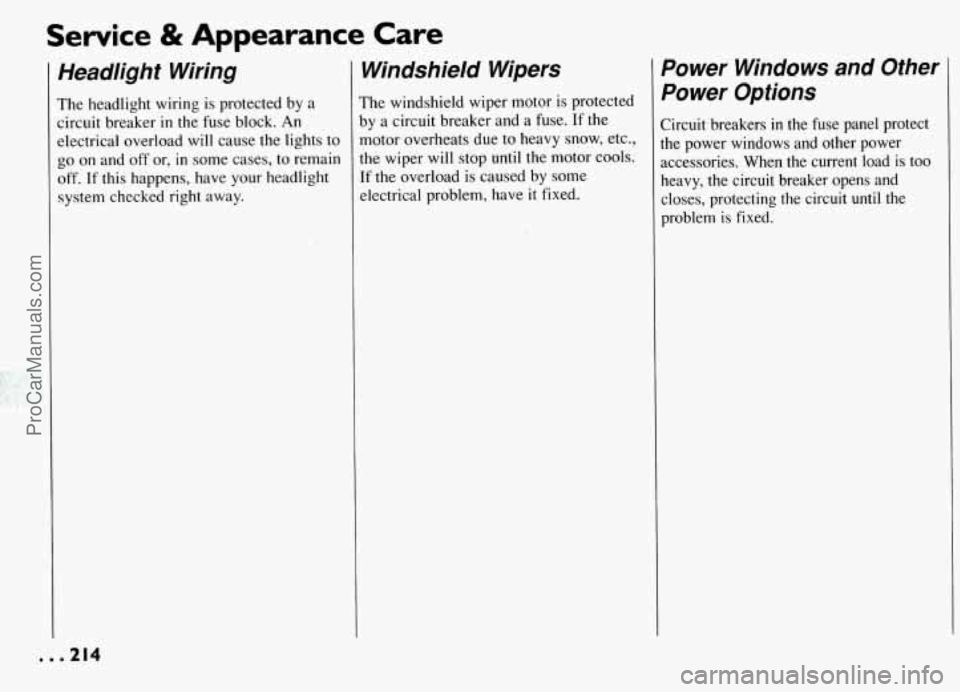
I Headlight Wiring
The headlight wiring is protected by a
circuit breaker in the fuse block. An
electrical overload
will cause the lights to
go on and off or,
in some cases, to remain
off. If this happens, have your headlight
system checked right away.
I
Windshield Wipers
The windshield wiper motor is protected
~y a circuit breaker and a fuse. If the
notor overheats due to heavy snow, etc.,
:he wiper will stop until the motor
cools.
[f the overload is caused by some
:lectrical problem, have
it fixed.
Power Windows and Other
Power Options
Clircuit breakers in the fuse panel protect
:he power windows and other power
iccessories. When the current load is too
leavy, the circuit breaker opens and
:loses, protecting
the circuit until the
aroblem is fixed.
. . . 214
ProCarManuals.com