fuel PONTIAC GRAND-AM 1994 Owners Manual
[x] Cancel search | Manufacturer: PONTIAC, Model Year: 1994, Model line: GRAND-AM, Model: PONTIAC GRAND-AM 1994Pages: 274, PDF Size: 15.01 MB
Page 6 of 274
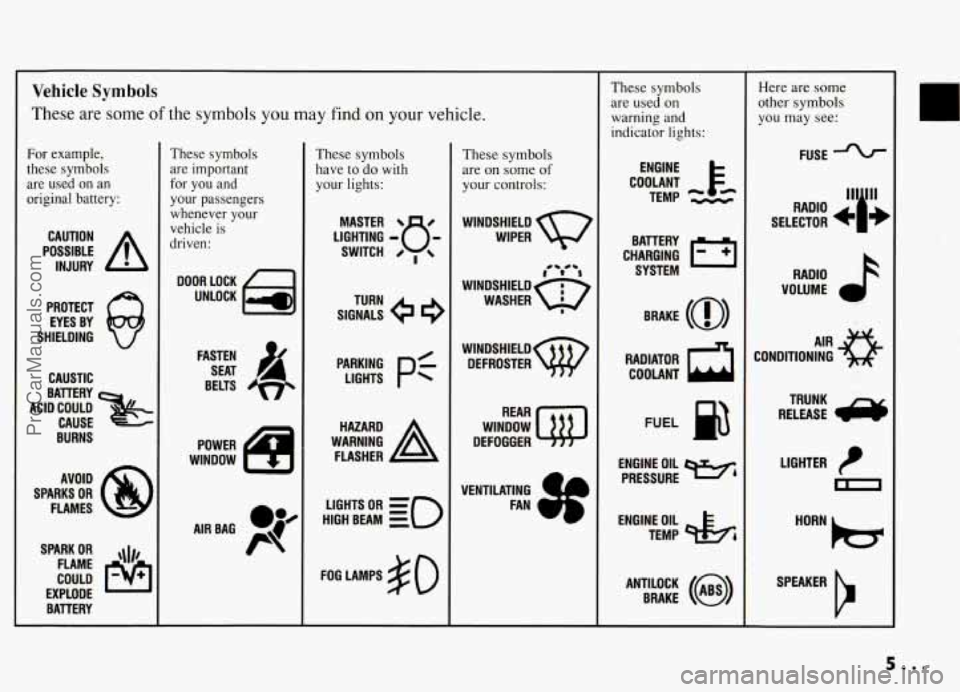
Vehicle Symbols
These are some of the symbols you may find on your vehicle.
For example,
these symbols
are used on an
original battery:
PROTECT
EYES BY
SHIELDING
CAUSTIC
BURNS
AVOID
SPARKS
OR
FLAMES
SPARK OR ,\I/,
COULD FLAME
EXPLODE BATTERY
These symbols
are important
for you and
your passengers
whenever your
vehicle is
driven:
DOOR LOCK
UNLOCK
FASTEN SEAT 4
BELTS
POWER
WINDOW
These symbols
have
to do with
your lights:
SIGNALS e
TURN
HIGH BEAM OR = =o
FOG LAMPS $0
These symbols
are
on some of
your controls:
WIPER Q
WINDSHIELD
WASHER
wlNDSHIELDw DEFROSTER
WINDOW REAR
DEFOGGER.
VENTILATING ca
FAN c.
These symbols
are used
on
warning and
indicator lights:
COOLANT F-
TEMP --
ENGINE
CHARGING BATTERY
SYSTEM
BRAKE (0)
RADIATOR a
COOLANT
FUEL
ENGINE OIL
PRESSURE
-4
TEMP OIL &
ANTILOCK (e)
BRAKE
Here are some
other symbols
you may
see:
FUSE *
RADIO
VOLUME
AIR
CONDITIONING
RELEASE TRUNK
LIGHTER
SPEAKER
b
ProCarManuals.com
Page 58 of 274
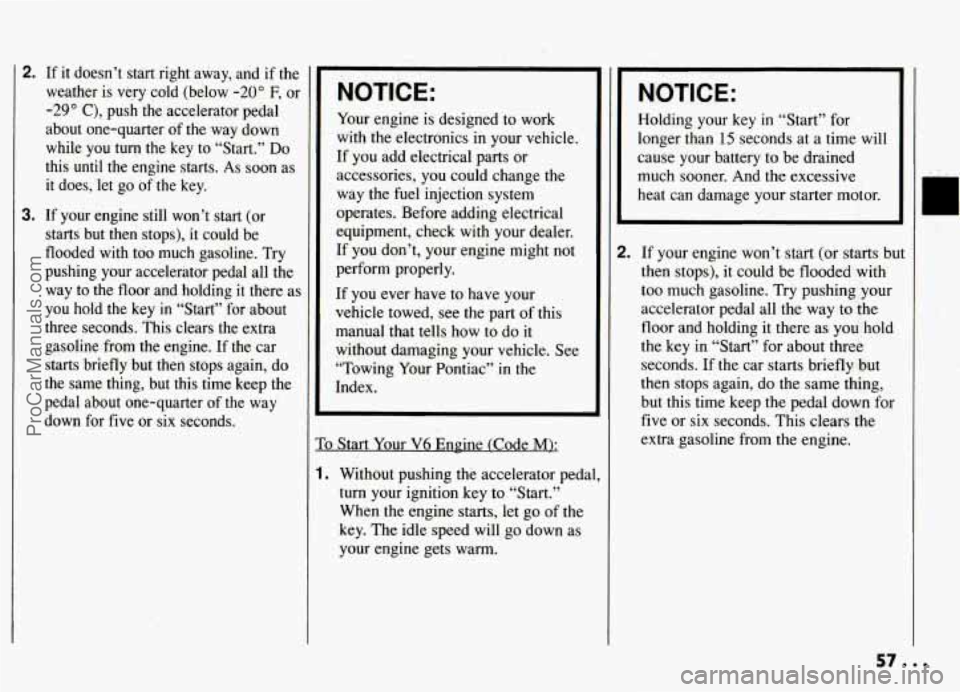
2. If it doesn’t start right away, and if the
weather is very cold (below
-20” F, or
-29” C), push the accelerator pedal
about one-quarter of
the way down
while you
turn the key to “Start.” Do
this until the engine starts. As soon as
it does, let go of the key.
3. If your engine still won’t start (or
starts but then stops), it could be
flooded with too much gasoline. Try
pushing your accelerator pedal all the
way to the floor and holding it there as
you hold the key
in “Start”.for about
three seconds. This clears the extra
gasoline from
the engine. If the car
starts briefly but then stops again, do
the same thing, but this time keep the
pedal
about one-quarter of the way
down for five or six seconds.
NOTICE:
Your engine is designed to work
with the electronics in your vehicle.
If you add electrical parts or
accessories, you could change the
way the fuel injection system
operates. Before adding electrical
equipment, check with your dealer.
If you don’t, your engine might not
perform properly.
If you ever have to have your
vehicle towed, see the part of this
manual that tells how to do it
without damaging your vehicle. See
“Towing Your Pontiac”
in the
Index.
To Start Your V6 Engine (Code M):
1. Without pushing the accelerator pedal,
turn your ignition key to “Start.”
When the engine starts, let
go of the
key. The idle speed will go down as
your engine gets warm.
NOTICE:
Holding your key in “Start” for
longer than
15 seconds at a time will
cause your battery to
be drained
much sooner. And the excessive
heat can damage your starter motor.
. If your engine won’t start (or starts but
then stops), it could be flooded with
too much gasoline. Try pushing your
accelerator pedal all the way
to the
floor and holding it there as you hold
the key
in “Start” for about three
seconds. If the car starts briefly but
then stops again, do the same thing,
but this time keep the pedal down for
five or six seconds. This clears the
extra gasoline from the engine.
ProCarManuals.com
Page 59 of 274

Features & Controls
Bofh Transaxles (CONT.)
NOTICE:
Your engine is designed to work
with the electronics
in your vehicle.
If you add electrical parts or accessories, you could change the
way the fuel injection system
operates. Before adding electrical
equipment, check
with your dealer.
If you don’t, your engine might not
perform properly.
If you ever have to have your
vehicle towed, see the part of this
manual that
tells how to do it
without damaging your vehicle. See
“Towing Your Pontiac”
in the
Index.
Driving Through Deep
Standing Water
NOTICE:
If you drive too quickly through
deep puddles or standing water,
water can come in through your
engine’s air intake and badly
damage your engine. If you can’t
avoid deep puddles or standing
water, drive through them very
slowly.
I Engine Coolant Heater (Engine
Block Heater)
(OPTION)
[n very cold weather, 0°F (- 18°C) or
;older, the engine coolant heater can help.
You’ll get easier starting and better fuel
zconomy during engine warm-up.
Usually, the coolant heater should be
plugged.
in a minimum of four hours prior
to starting your vehicle.
To Use the Coolant Heater:
1. Turn off the engine.
2. Open the hood and unwrap the
electrical cord.
... 58
ProCarManuals.com
Page 63 of 274
Features & Controls
Shifting the Automatic
Transaxle
(3 or 4 Speeds) (CONT.)
I NOTICE: I
Damage to your transaxle caused by
shifting out of
“P’ (Park) or “N”
(Neutral) with the engine racing
isn’t covered by your warranty.
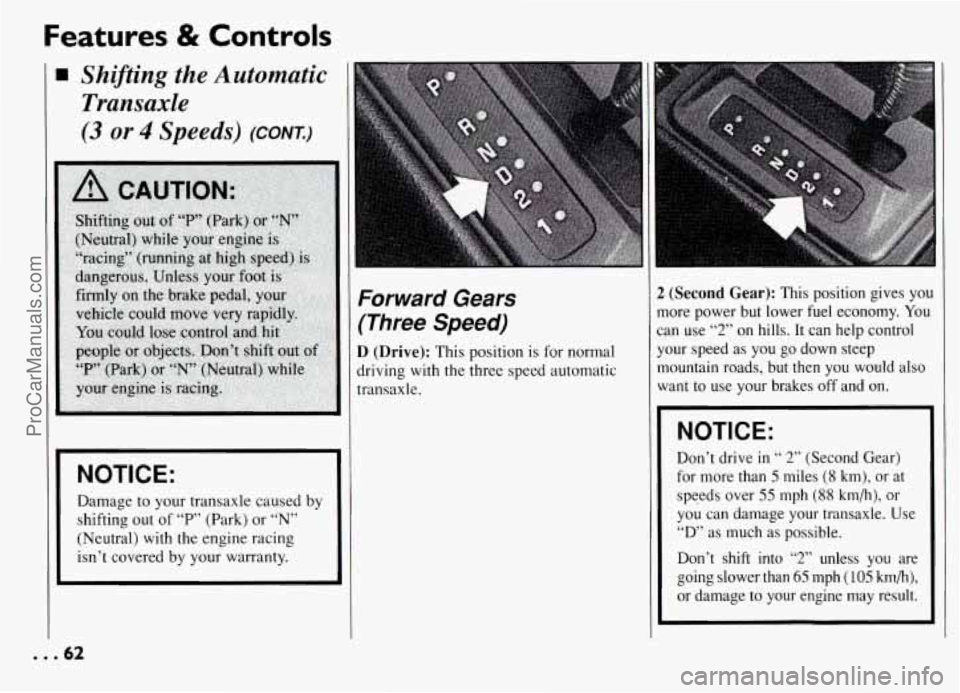
Forward Gears
(Three Speed)
D (Drive): This position is for normal
driving with the three speed automatic
transaxle.
2 (Second Gear): This position gives you
more power but lower fuel economy.
You
can use “2” on hills. It can help control
your speed as
you go down steep
mountain roads, but then you would also
want to use your brakes off and on.
NOTICE:
Don’t drive in “ 2” (Second Gear)
for more than
5 miles (8 km), or at
speeds over
55 mph (88 km/h), or
you can damage your transaxle. Use
“D” as much as possible.
Don’t shift into “2” unless you are
going slower than
65 mph (105 km/h),
or damage to your engine may result.
I
... 62
ProCarManuals.com
Page 64 of 274

FIRST (1): This position gives you even
more power
(but lower fuel economy)
than
SECOND. You can use it on very
steep
hills, or in deep snow or mud. If the
selector lever
is put in FIRST, the
transaxle won’t downshift into
first gear
until the vehicle is going slowly enough.
NOTICE:
If your front wheels can’t rotate,
don’t try
to drive. This might
happen
if you were stuck in very
deep sand or mud or were up
against a solid object. You could
damage your transaxle.
Also, if you stop when going uphill,
don’t hold your vehicle there
with
only the accelerator pedal. This
could overheat and damage the
transaxle. Use your brakes to hold
your vehicle
in position on a hill.
Forward Gears
(Four Speed)
AUTOMATIC OVERDRIVE (D): This
position is for normal driving
with the
four speed automatic transaxle.
If you
need more power for passing, and you’re:
Going less than about 35 mph
(55 kmh), push your accelerator pedal
about halfway down.
Going about 35 mph (55 km/h) or
more, push the accelerator all the way
down.
The transaxle will automatically shift
down to the next gear and provide more
power.
ProCarManuals.com
Page 66 of 274
1 3 5
2 4 R
C
E
il
F
4
h
II
t'
C
4
I1
C
F
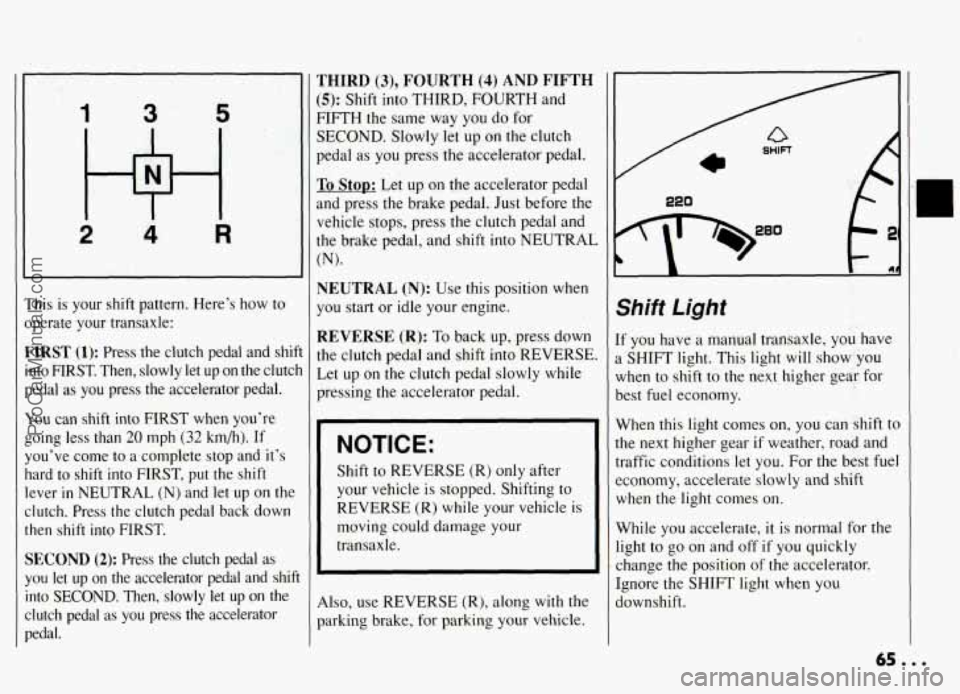
'his is your shift pattern. Here's how to
bperate your transaxle:
rIRST (1): Press the clutch pedal and shi
nto FIRST. Then, slowly let up on the clutc
kedal as you press the accelerator pedal.
lou can shift into FIRST when you're
;oing less than
20 mph (32 km/h). If
fou've come to a complete stop and it's
lard to
shift into FIRST, put the shift
ever
in NEUTRAL (N) and let up on the
Iutch. Press the clutch pedal back down
hen shift into FIRST.
iECOND (2): Press the clutch pedal as
'ou let up on the accelerator pedal and shij
nto
SECOND. Then, slowly let up on the
:lutch pedal as
you press the accelerator
Iedal.
HIRD (3), FOURTH (4) AND FIFTH
;): Shift into THIRD, FOURTH and
IFTH the same way you do for
ECOND. Slowly let up on the clutch
:dal as you press the accelerator pedal.
o Stop: Let up on the accelerator pedal
Id press the brake pedal. Just before the
:hicle stops, press
the clutch pedal and
le brake pedal, and shift into NEUTRAL
9.
'EUTRAL (N): Use this position when
3u start or idle your engine.
.EVERSE (R): To back up, press down
Le clutch pedal and shift into REVERSE.
et
up on the clutch pedal slowly while
ressing the accelerator pedal. ~
NOTICE:
Shift
to REVERSE (R) only after
your vehicle is stopped. Shifting to
REVERSE (R) while your vehicle is
moving could damage your
transaxle.
ho, use REVERSE (R), along with the
arking brake, for parking your vehicle.
Shift Light
If you have a manual transaxle, you have
a SHIFT light. This light will show you
when to shift to the next higher gear for
best fuel economy.
When this light comes on, you can shift to
the next higher gear if weather, road and
traffic conditions let you. For the best fuel
economy, accelerate slowly and shift
when the light comes on.
While you accelerate, it is normal for the
light to go on and off if you quickly
change the position of the accelerator.
Ignore the SHIFT light when you
downshift.
ProCarManuals.com
Page 67 of 274
Features & Controls
Shift Speeds
(Manual Transaxle)
This chart shows when to shift to the next
higher gear for best fuel economy.
Acceleration Shift Speeds for 2.3L
OHC and 2.3L High Output Quad 4
Engines (Codes 3 and A):
FIRST to SECOND 15 mph (24 km/h)
SECOND to THIRD
25 mph (40 km/h)
THIRD to FOURTH 40 mph
(64 km/h)
FOURTH to FIFTH 45 mph (72 km/h)
If your speed drops below 20 mph
(32 km/h), or if the engine is not running
smoothly, you should downshift to the
next lower gear.
You may have to
downshift two or more gears to keep the
engine running smoothly or for good
performance.
NOTICE:
If you skip more than one gear
when you downshift, or if you race
the engine when you downshift, you
can damage the clutch or transaxle.
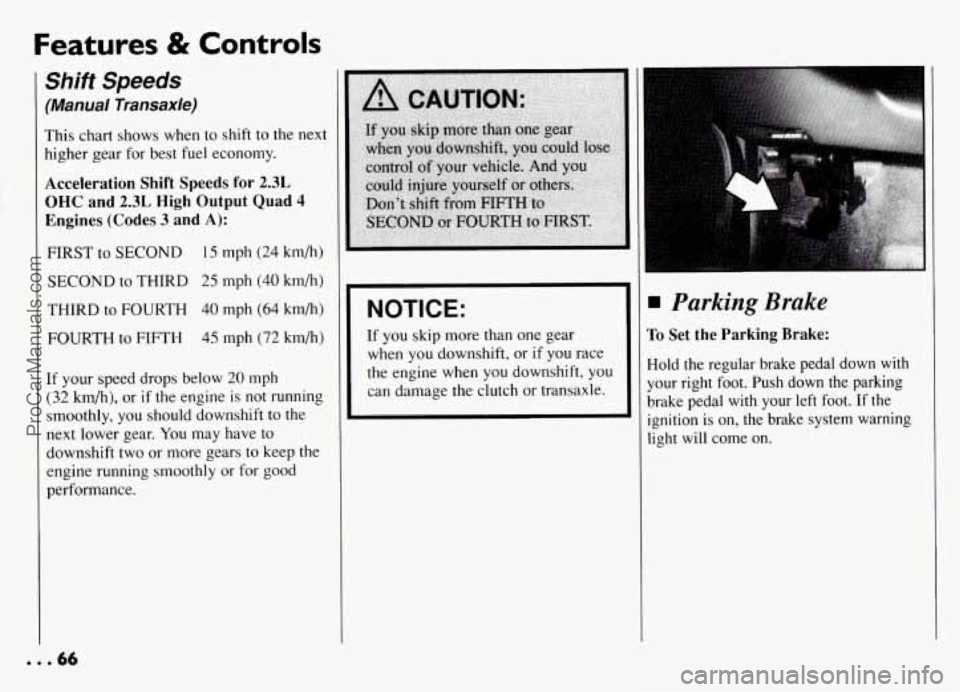
Parking Brake
To Set the Parking Brake:
Hold the regular brake pedal down with
your right foot. Push down the parking
brake pedal with your left foot. If the
ignition is on, the brake system warning
light will come on.
... 66
ProCarManuals.com
Page 90 of 274
The Instrument
Panel-Your Information System
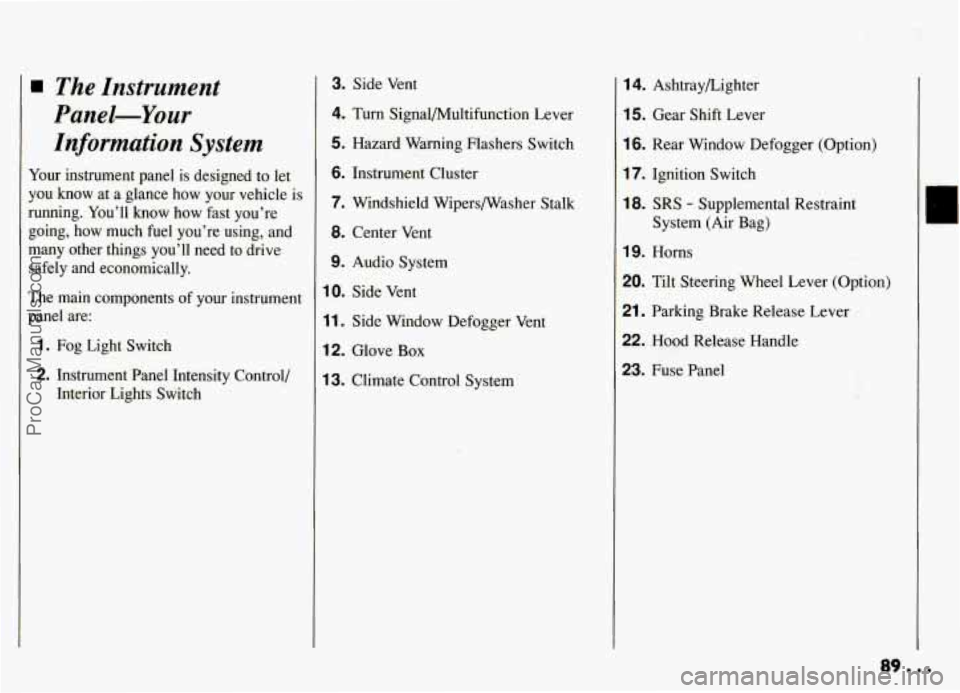
Your instrument panel is designed to let
you know at a glance how
your vehicle is
running. You’ll know how fast you’re
going, how much fuel you’re using, and
many other things you’ll need to drive
safely and economically.
The main components of your instrument
panel are:
1. Fog Light Switch
2. Instrument Panel Intensity Control,’
Interior Lights Switch
3. Side Vent
4. Turn Signal/Multifunction Lever
5. Hazard Warning Flashers Switch
6. Instrument Cluster
7. Windshield Wipersmasher Stalk
8. Center Vent
9. Audio System
10. Side Vent
11. Side Window Defogger Vent
12. Glove Box
13. Climate Control System
14. Ashtraybighter
15. Gear Shift Lever
16. Rear Window Defogger (Option)
17. Ignition Switch
18. SRS - Supplemental Restraint
System (Air Bag)
19. Horns
20. Tilt Steering Wheel Lever (Option)
21. Parking Brake Release Lever
22. Hood Release Handle
23. Fuse Panel
ProCarManuals.com
Page 94 of 274
Warning Lights, Gages
and Indicators
This section describes the warning lights
and gages that may be on your vehicle. The pictures will help you locate them.
Warning lights and gages can signal that
something is wroug before it becomes
serious enough to cause an expensive
repair or replacement. Paying attention to
your warning lights and gages could also
save you
or others from injury.
Warning lights go on when there may be
Dr is a problem with one of your vehicle’s
functions. As you will see
in the details
on the next few pages, some warning
lights come on briefly
when you turn the
ignition key just to let you know they’re
working. If you are familiar with this
section, you should not be alarmed when
this happens.
Gages can indicate when there may be or
is a problem with one of your vehicle’s
functions. Often gages and warning lights
work together to let you know when
there’s a problem with your vehicle.
When one of the warning lights comes on
and stays on when you are driving, or
when one of the gages shows there may
be a problem, check the section that tells
you what to do about
it. Please follow the
manual’s advice. Waiting to do repairs
can
be costly -- and even dangerous. So
please get to know your warning lights
and gages. They’re
a big help.
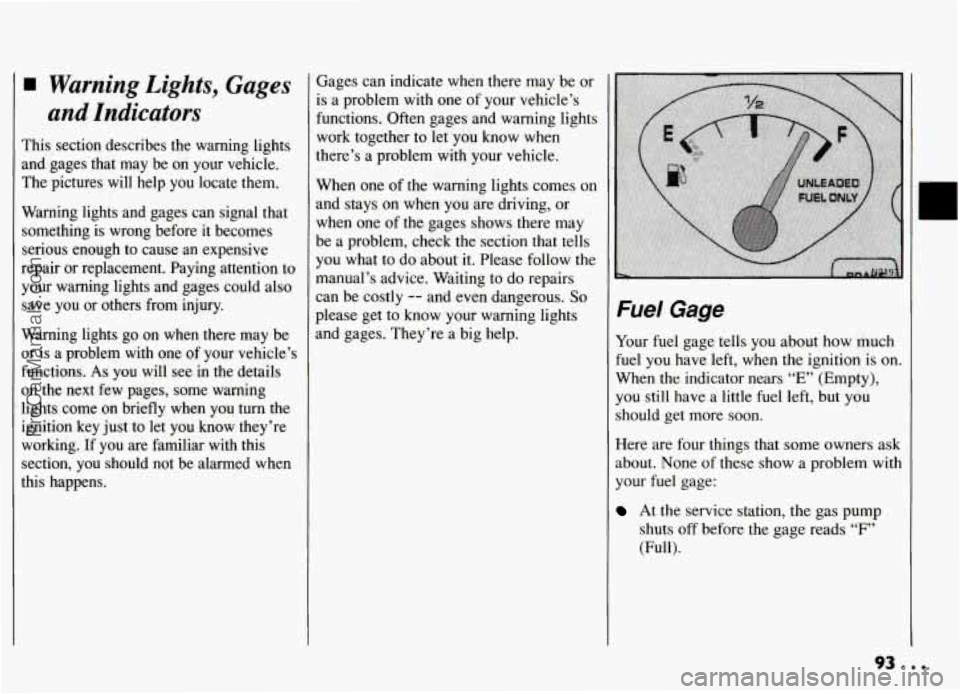
Fuel Gage
Your fuel gage tells you about how much
fuel you have left, when the ignition is on.
When
the indicator nears “E” (Empty),
you still have a little
fuel left, but you
should get more soon.
Here are four things that some owners ask
about. None of these show a problem with
your fuel gage:
At the service station, the gas pump
shuts off before the gage reads “F”
(Full).
c
93...
ProCarManuals.com
Page 95 of 274
Features & Controls
Fuel Gage (CONT.)
0 It takes a little more or less fuel to fill
up than the gage indicated. For
example, the gage may have indicated
the tank was half full, but it actually
took a little more or less than half the
tank’s capacity to fill the tank.
0 The gage moves a little when you turn
a corner or speed up.
0 The gage doesn’t go back to “E” when
you turn off the ignition.
For your fuel tank capacity, see “Service
Station Information”
on the last page of
this manual.
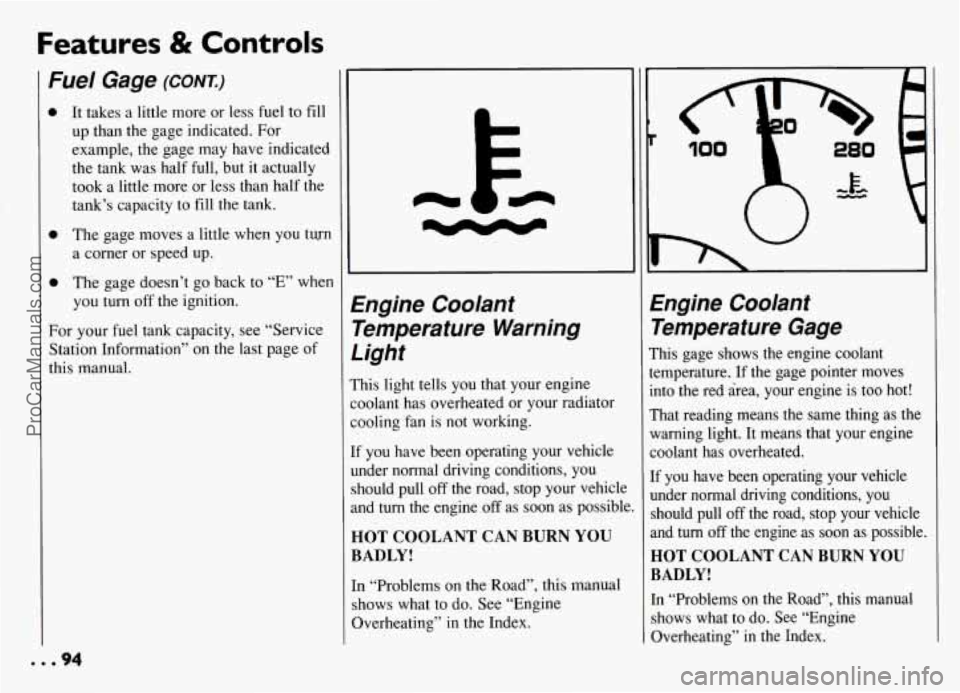
Engine Coolant Temperature Warning
Light
This light tells you that your engine
coolant has overheated or your radiator
cooling fan is not working.
If you have been operating your vehicle
under normal driving conditions, you should pull
off the road, stop your vehicle
and
turn the engine off as soon as possible
HOT COOLANT CAN BURN YOU
BADLY!
In “Problems on the Road”, this manual
shows what to do. See “Engine
Overheating” in the Index.
Engine Coolant
Temperature Gage
This gage shows the engine coolant
temperature. If the gage pointer moves
into the red area, your engine is too hot!
That reading means the same thing as the
warning light. It means that your engine
coolant has overheated.
If you have been operating your vehicle
under normal driving conditions, you
should pull
off the road, stop your vehicle
and
turn off the engine as soon as possible.
HOT COOLANT CAN BURN YOU
BADLY!
In “Problems on the Road”, this manual shows what to do. See “Engine
Overheating” in the Index.
ProCarManuals.com