weight PONTIAC GRAND-AM 1994 Owners Manual
[x] Cancel search | Manufacturer: PONTIAC, Model Year: 1994, Model line: GRAND-AM, Model: PONTIAC GRAND-AM 1994Pages: 274, PDF Size: 15.01 MB
Page 69 of 274
Features & Controls
T
Shifting Into
PARK (P)
(Automatic Transaxle
Models Only) (cow)
1. Hold the brake pedal down with your
right foot and set the parking brake.
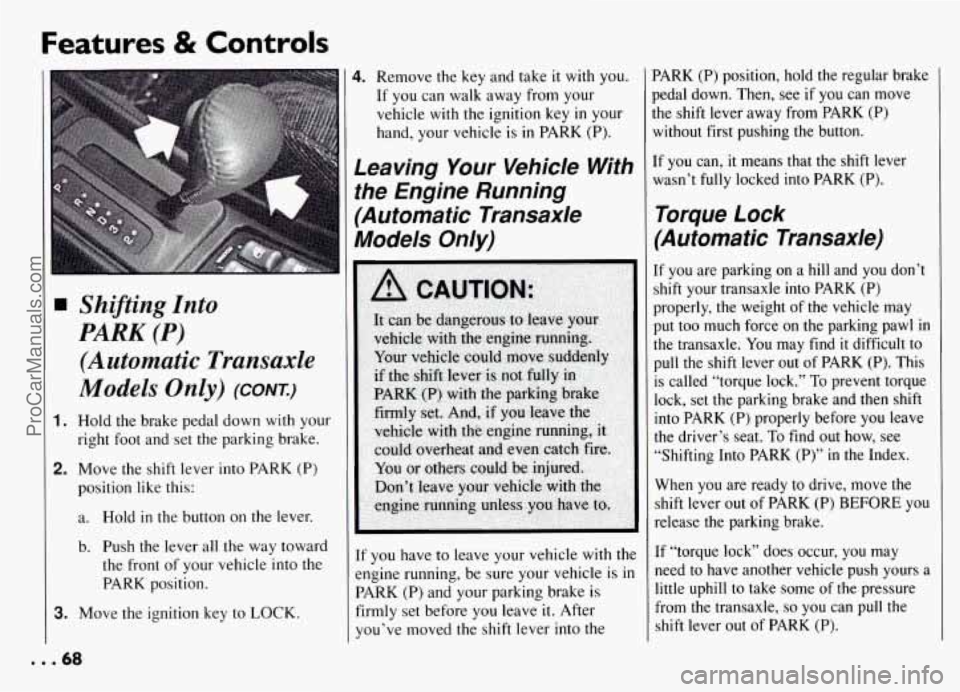
2. Move the shift lever into PARK (P)
position like this:
a. Hold
in the button on the lever.
b.
Push the lever all the way toward
the front of your vehicle into the
PARK position.
3. Move the ignition key to LOCK.
4. Remove the key and take it with you.
If you can walk away from your
vehicle
with the ignition key in your
hand, your vehicle
is in PARK (P).
Leaving Your Vehicle With
the Engine Running
(Automatic Transaxle
Models Only)
If you have to leave your vehicle with the
engine running, be sure your vehicle is
in
PARK (P) and your parking brake is
firmly set before you leave it. After
you’ve moved the shift lever into the
’ARK (P) position, hold the regular brake
Jedal down. Then, see
if you can move
he shift lever away from
PARK (P)
without first pushing the button.
:f you can, it means that the shift lever
wasn’t
fully locked into PARK (P).
Torque Lock
(Automatic Transaxle)
[f you are parking on a hill and you don’t
shift your transaxle into PARK (P)
properly, the weight of the vehicle may
put too much force on the parking pawl
in
[he transaxle. You may find it difficult to
pull the shift lever out of PARK (P). This
is called “torque lock.” To prevent torque
lock, set the parking brake and then shift
into
PARK (P) properly before you leave
the driver’s seat.
To find out how, see
”Shifting Into
PARK (P)” in the Index.
When you are ready to drive, move the
shift lever out of PARK (P) BEFORE you
release the parking brake.
If “torque lock” does occur, you may
need to have another vehicle push yours a
little uphill to take some of the pressure
from the transaxle,
so you can pull the
shift lever out of
PARK (P).
... 68
ProCarManuals.com
Page 121 of 274
Your Driving and the Road
Defensive Driving
The best advice anyone can give about
driving is: Drive defensively.
Please start with a very important safety
device
in your Pontiac: Buckle up. (See
“Safety Belts”
in the Index.)
Defensive driving really means “be ready
for anything.” On city streets, rural roads,
or freeways,
it means “always expect the
unexpected.”
Assume that pedestrians or other drivers
are going to be careless and make
mistakes. Anticipate what they might do.
Be ready for their mistakes.
Rear-end collisions are about the most
preventable of accidents. Yet they are
common. Allow enough following
distance. It’s the best defensive driving
maneuver,
in both city and rural driving.
You never know when the vehicle in front
of you is going to brake or
turn suddenly.
Drunken Driving
Death and injury associated with drinking
and driving is a national tragedy. It’s the
number one contributor to the highway
death toll, claiming thousands of victims
every year. Alcohol takes away three
things that anyone needs to drive a
vehicle:
Judgment
0 Muscular Coordination
0 Vision
Police records show that almost half of all
motor vehicle-related deaths involve
alcohol
- a driver, a passenger or
someone else, such as a pedestrian, had
been drinking. In’most cases, these deaths
are the result
of someone who was
drinking and driving. About
20,000 motor
vehicle-related deaths occur each year
because of alcohol, and thousands of
people are injured.
Just how much alcohol is too much if a
person plans to drive? Ideally, no one
should drink alcohol and then drive. But
if one does, then what’s “too much”? It
;an be a lot less than many
might think.
Although it depends on each person and
situation, here is some general
information on the problem.
The Blood Alcohol Content (BAC) of
someone who is drinking depends upon
four things:
0 How much alcohol is in the drink.
0 The drinker’s body weight.
The amount of food that is consumed
before and during drinking.
The length of time it has taken the
drinker to consume the alcohol.
. . . I20
ProCarManuals.com
Page 122 of 274
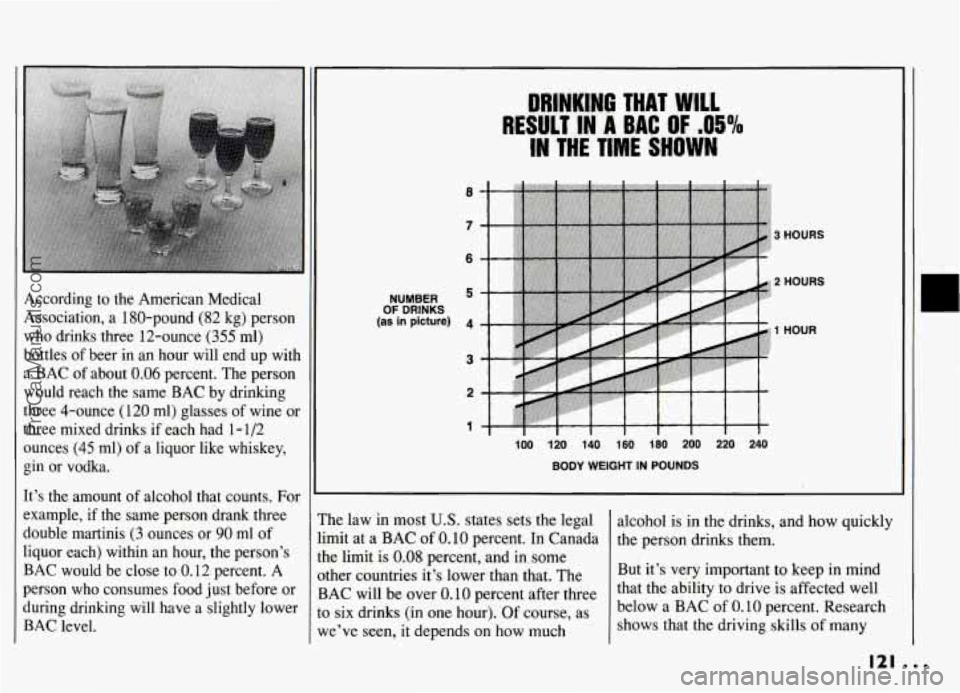
According to the American Medical
Association, a 180-pound
(82 kg) person
who drinks three 12-ounce
(355 ml)
bottles of beer in an hour will end up with
a BAC of about
0.06 percent. The person
would reach the same BAC by drinking
three 4-ounce
( 120 ml) glasses of wine or
three mixed drinks if each had 1
- 1/2
ounces (45 ml) of
a liquor like whiskey,
gin or vodka.
It’s the amount of alcohol that counts. For
example, if the same person drank three
double martinis
(3 ounces or 90 ml of
liquor each) within an hour, the person’s
BAC would be close to 0.12 percent.
A
person who consumes food just before or
during drinking will have a slightly lower
BAC level.
P””’IKIMG THAT WILL
RE! LI IN A BAC OF .@5#
IN THE TIME SHOWN
3 HOURS
NUMBER OF DRfNKS (as in picture)
100 120 140 160 180 200 220 240
BODY WEIGHT IN POUNDS
2 HOURS
1 HOUR
The law in most U.S. states sets,the legal
limit at a BAC
of 0.10 percent. In Canada
the limit is
0.08 percent, and in.some
other countries it’s lower than that. The
BAC will be over
0.10 percent after three
to six drinks (in one hour). Of course, as
we’ve seen, it depends on how much
alcohol is in the drinks, and how quickly
the person drinks them.
But it’s very important to keep in mind
that the ability to drive is affected well
below a BAC
of 0.10 percent. Research
shows that
the driving skills of many
ProCarManuals.com
Page 142 of 274
Towing a Trailer
NOTICE:
Pulling a trailer improperly can
damage your vehicle and result
in
costly repairs not covered by your
warranty. To pull
a trailer correctly,
follow the advice
in this section, and
see your Pontiac dealer for important information about towing
a trailer
with your vehicle .
Do not tow a trailer if your vehicle is
equipped with the 2.3L OHC or Quad 4
Engine (Code 3 or D).
Your car can tow a trailer if it is equipped
with the
2.3L High Output Quad 4 (Code
A) or 3.1 L V6 (Code M) engine and
proper trailer towing equipment. To
identify what the vehicle trailering
capacity is for your vehicle, you should
read the information
in ‘‘Weight of the
Trailer” that appears later
in this section.
But trailering is different than just driving
your vehicle by itself. Trailering means
changes
in handling, durability, and fuel
economy. Successful, safe trailering takes
correct equipment, and
it has to be used
properly.
That’s the reason for this section. In it are
many time-tested, important trailering
tips and safety rules. Many of these are
important for your safety and that of your
passengers.
So please read this section
carefully before you puli a trailer.
Load-pulling components such as the
mgine, transaxle, wheel assemblies, and
tires are forced
to work harder against the
jrag of the added weight. The engine is
required to operate at relatively higher
speeds and under greater loads,
generating extra heat. What’s more, the
trailer adds considerably to wind
resistance, increasing the pulling
requirements.
If You Do Decide To Pull A Trailer
If you do, here are some important points.
0 There are many different laws,
including speed limit restrictions,
having to do with trailering. Make
sure your rig will be legal, not only
where you live but also where you’ll
be driving.
A good source for this
information can be state or provincial
police.
0 Consider using a sway control.
You can ask a hitch dealer about sway
controls.
Don’t tow a trailer at all during the
first 1000 miles (1 600 km) your new
vehicle is driven. Your engine, axle or
other parts could be damaged.
Then, during the first 500 miles (800
km) that you tow a trailer, don’t drive
over
50 mph (80 km/h) and don’t
make starts
at full throttle. This helps
141
ProCarManuals.com
Page 143 of 274
Your Driving and the Road
Towing a Trailer (CONK)
your engine and other parts of your
vehicle wear
in at the heavier loads.
Obey speed limit restrictions when
towing a trailer. Don’t drive faster
than the maximum speed for trailers
(or no more than
55 mph (90 km/h))
to save wear on your vehicle’s parts.
Three important considerations have to do
with weight:
Weight of the Trailer
How heavy can a trailer safely be?
It should never weigh more than 1,000
pounds (450 kg). But even that can be too
heavy.
It depends on how you plan to use your
rig. For example, speed, altitude, road
grades, outside temperature and how
much your vehicle is used to pull a trailer
are all important. And,
it can also depend
on any special equipment that you have
on your vehicle.
A B
fou can ask your dealer for our trailering
nformation or advice, or you can write
us
It:
Pontiac Customer Services
Department
One Pontiac Plaza
Pontiac, Michigan 48340-2952
[n Canada, write to:
General Motors of Canada Limited,
Customer Assistance Center
1908 Colonel Sam Drive
Oshawa, Ontario L1H 8P7.
Weight of the Trailer
Tongue
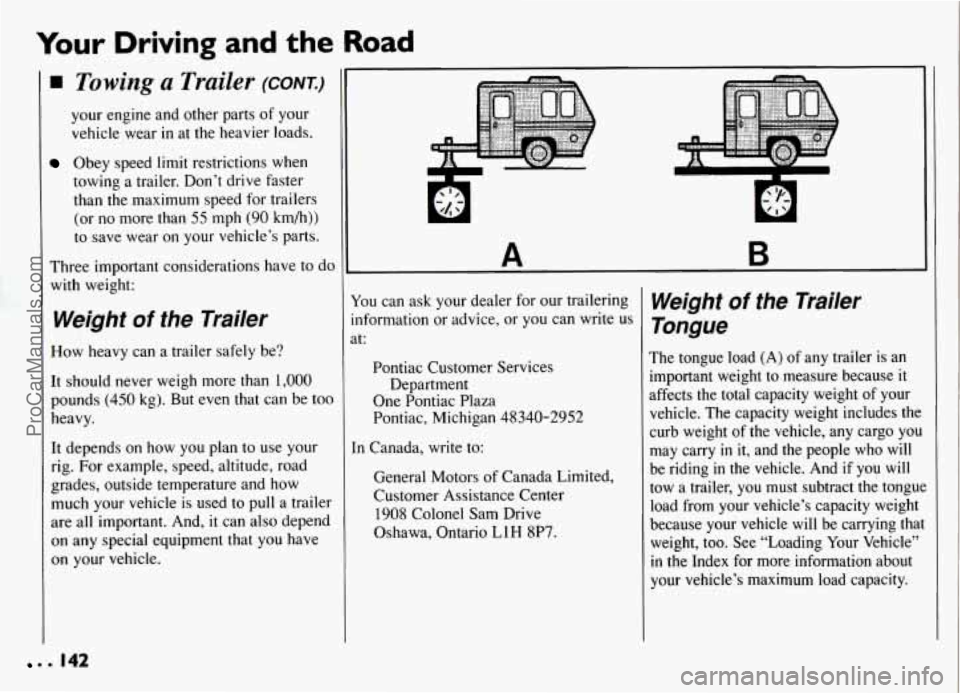
The tongue load (A) of any trailer is an
important weight to measure because
it
affects the total capacity weight of your
vehicle. The capacity weight includes the
curb weight of the vehicle, any cargo you
may carry
in it, and the people who will
be riding in the vehicle. And if you will
tow a trailer, you must subtract the tongu
load from your vehicle’s capacity weight
because your vehicle
will be carrying tha
weight, too. See “Loading Your Vehicle”
in the Index for more information about
your vehicle’s maximum load capacity.
. . 142
ProCarManuals.com
Page 144 of 274
If you’re using a “dead-weight” hitch, the
trailer tongue
(A) should weigh 10% of
the total loaded trailer weight (B). If you
have
a “weight-distributing” hitch, the
trailer tongue
(A) should weigh 12% of
the total loaded trailer weight
(B).
After you’ve loaded your trailer, weigh
the trailer and then the tongue, separately, to see if the weights are proper. If they
aren’t, you may
be able to get them right
simply by moving some items around in
the trailer.
Total Weight on Your
Vehicle’s Tires
Be sure your vehicle’s tires are inflated to
the limit for cold tires. You’ll find these
numbers on the Certification label at the
rear edge of the driver’s door or see
“Loading Your Vehicle”
in the Index.
Then be sure you don’t go over the GVW
limit for your vehicle.
Hitches
It’s important to have the correct hitch
equipment. Crosswinds, large trucks
going by, and rough roads are a few
reasons
why you’ll need the right hitch.
Here are some rules to follow:
Will you have to make any holes in
the body
of your vehicle when you
install a trailer hitch? If
you do, then
be sure to seal the holes later when
you remove the hitch. If you don’t
seal them, deadly carbon monoxide
(CO) from your exhaust can get into
your vehicle (see “Carbon Monoxide”
in the Index). Dirt and water can, too.
The bumpers on your vehicle are
not
intended for hitches. Do not attach
rental hitches or other bumper-type hitches to them. Use only a
frame-mounted hitch that does not
attach to the bumper.
Sa#ety Chains
You should always attach chains between
your vehicle
and your trailer. Cross the
safety chains under the tongue of the
trailer
so that the tongue will not drop to
the road if it becomes separated from the
hitch. Instructions about safety chains may be provided by the hitch
manufacturer or by the trailer
manufacturer. Follow the manufacturer’s
recommendation for attaching safety chains. Always leave just enough slack
so
you can turn with your rig. And, never
allow safety chains to drag on the .ground.
Trailer Brakes
Does your trailer have its own brakes?
Be sure to read and follow the instructions
for the trailer brakes
so you’ll be able to
install, adjust and maintain them properly.
And because you have anti-lock brakes,
do not try to tap into your vehicle’s brake
system. If you do, both brake systems
won’t work well, or at all.
0
!
1
I I
!
143...
ProCarManuals.com
Page 145 of 274
Your Driving and the Road
I Driving with a Trailer
Towing a trailer requires a certain amount
of experience. Before setting out for the
open road, you’ll want to get to know
your rig. Acquaint yourself with the feel
of handling and braking with the added
weight
of the trailer. And always keep in
mind that the vehicle you are driving is
now a good deal longer and not nearly
so
.responsive as your vehicle is by itself.
Before you start, check the trailer hitch
and platform, safety chains, electrical
connector, lights, tires and mirror
adjustment. If the trailer has electric
brakes, start your vehicle and trailer
moving and then apply the trailer brake
controller by hand to be sure the brakes
are working. This lets you check your
electrical connection at the same time.
During your trip, check occasionally to be
sure that the load is secure, and that the
lights and any trailer brakes are still
working.
Following Distance
Stay at least twice as far behind the
vehicle ahead as you would when driving
your vehicle without a trailer. This can
help you avoid situations that require
heavy braking and sudden turns.
Passing
You’ll need more passing distance up
ahead when you’re towing a trailer. And,
because you’re a good deal longer, you’ll
need to go much farther beyond the
passed vehicle before you can return to
your lane.
Backing Up
Hold the bottom of the steering wheel
with one hand. Then, to move the trailer
to the left, just move that hand to the left.
To move the trailer to the right, move
your hand to the right. Always back up
slowly and,
if possible, have someone
guide you.
Making Turns
When you’re turning with a trailer, make
wider turns than normal. Do this
so your
railer won’t strike soft shoulders, curbs,
road signs, trees, or other objects. Avoid
ierky or sudden maneuvers. Signal well
in
3dvance.
Turn Signals When
Towing
a Trailer
When you tow a trailer, your vehicle has
to have a different turn signal flasher and
extra wiring. The green arrows on your
instrument panel will flash whenever you
signal a
turn or lane change. Properly
hooked up, the trailer lights will also
flash, telling other drivers you’re about to
turn, change lanes or stop.
When towing a trailer, the green arrows
on your instrument panel will flash for
turns even
if the bulbs on the trailer are
burned out. Thus, you may
think drivers
behind you are seeing your signal when
they are not. It’s important to check
occasionally to be sure the trailer bulbs
are still working.
. . . 144
ProCarManuals.com
Page 198 of 274
I Loading Your Vehicle
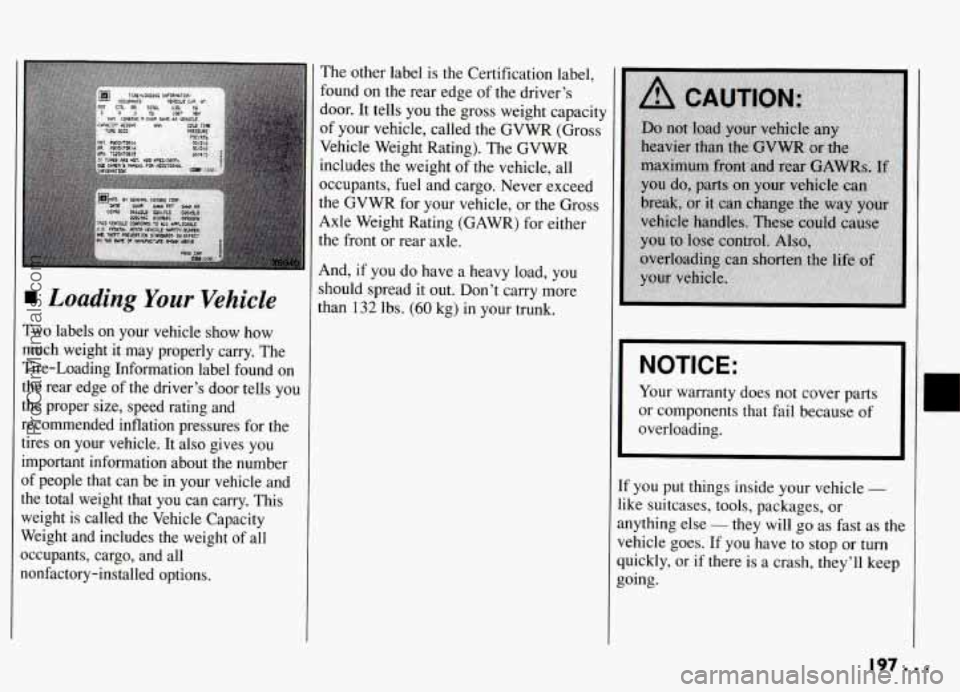
Two labels on your vehicle show how
much weight it may properly carry. The
Tire-Loading Information label found on
the rear edge of the driver’s door tells you
the proper size, speed rating and
recommended inflation pressures for the
tires on your vehicle. It also gives you
important information about the number
af people that can be in your vehicle and
the total weight that you can carry. This
weight is called the Vehicle Capacity
Weight and includes the weight of all
xcupants, cargo, and all
lonfactory-installed options.
The other label is the Certification label,
found on the rear edge of the driver’s
door. It tells you the gross weight capacity
of your vehicle, called the GVWR (Gross
Vehicle Weight Rating). The GVWR
includes the weight of the vehicle, all
occupants, fuel and cargo. Never exceed
the GVWR for your vehicle, or the Gross
Axle Weight Rating (GAWR) for either
the front or rear axle.
And, if you do have a heavy load, you
should spread it out. Don’t carry more
than
132 lbs. (60 kg) in your trunk.
I NOTICE: 1
Your warranty does not cover parts
or components that fail because of
overloading.
[f you put things inside your vehicle -
like suitcases, tools, packages, or
mything else
- they will go as fast as the
Jehicle goes. If you have to stop or turn
quickly, or if there is a crash, they’ll keep
going.
197.. .
ProCarManuals.com
Page 267 of 274
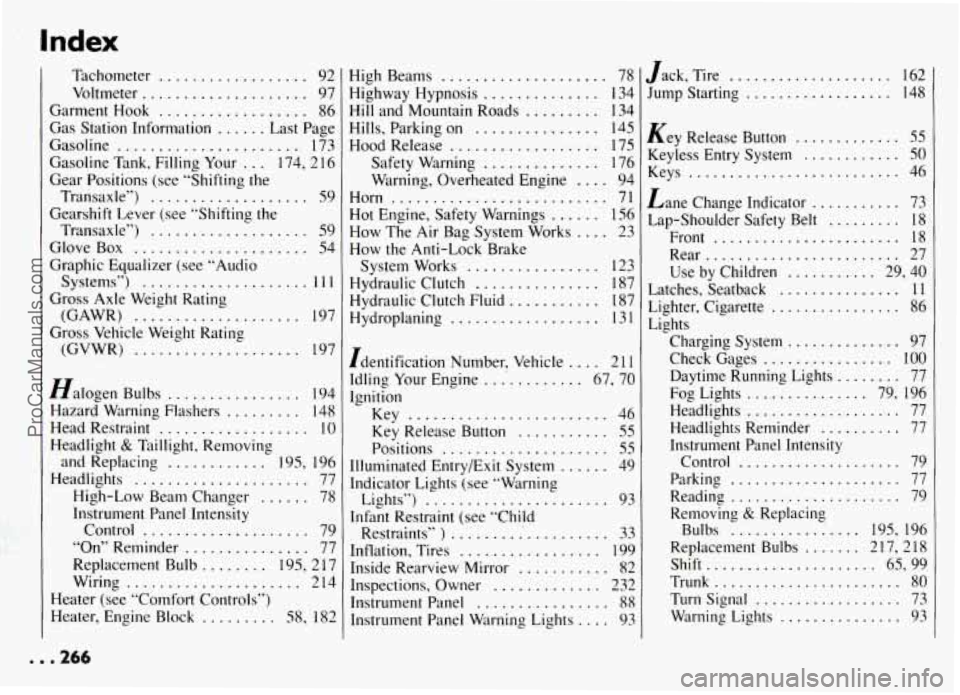
Index
Tachometer .................. 92
Voltmeter
.................... 97
Garment Hook
.................. 86
Gas Station Information
...... Last Page
Gasoline
...................... 173
Gasoline Tank. Filling Your
... 174. 2 I6
Gear Positions (see “Shifting the
Gearshift Lever (see “Shifting the
Transaxle”) ................... 59
GloveBox
..................... 54
Graphic Equalizer (see “Audio
Gross Axle Weight Rating
Gross Vehicle Weight Rating
Transaxle”) ................... 59
Systems”) .................... 11 1
(GAWR) .................... 197
(GVWR) .................... 197
Halogen Bulbs ................ 194
Hazard Warning Flashers ......... 148
Head Restraint .................. 10
H.eadlight
& Taillight. Removing
and Replacing ............ 195. 196
High-Low Beam Changer ...... 78
Instrument Panel Intensity
Control
.................... 79
“On” Reminder
............... 77
Headlights ..................... 77
Replacement Bulb ........ 195. 2 17
Wiring ..................... 2 i4
Heater (see “Comfort Controls”)
Heater,.Engine Block
.. 1 ...... 58. 182
iigh Beams .................... 78
3ighway Hypnosis
.............. 134
dill and Mountain Roads ......... 134
Hills. Parking
on ............... 145
Hood Release .................. 175
Safety Warning .............. 176
Warning. Overheated Engine
.... 94
Horn
.......................... 71
Hot Engine. Safety Warnings
...... 156
How The Air Bag System Works .... 23
How the Anti-Lock Brake
System Works ................ 123
Hydraulic Clutch
............... 187
Hydraulic Clutch Fluid
........... 187
Hydroplaning
.................. 13 1
Identification Number. Vehicle .... 2 11
Idling Your Engine ............ 67. 70
Ignition
Key
........................ 46
Key Release Button
........... 55
Positions
.................... 55
Illuminated Entry/Exit System ...... 49
Lights”) ...................... 93
Restraints”
) .................... 33
Inflation. Tires ................. 199
Inside Rearview Mirror
........... 82
Inspections. Owner
............. 232
Instrument Panel
................ 8E
Instrument Panel Warning Lights .... 91
Indicator Lights (see “Warning
Infant Restraint (see “Child
lack. Tire .................... 162
Key Release Button
............. 55
Cane Change Indicator
........... 73
‘ump Starting .................. 148
Ceyless Entry System ............ 50
Ceys .......................... 46
Lap-Shoulder Safety Belt ......... 18
Front
....................... 18
Rear
........................ 27
Use by Children
........... 29. 40
Latches. Seatback
............... 11
Lighter. Cigarette ................ 86
Charging System .............. 97
Daytime Running Lights
........ 77
Fog Lights ............... 79. 196
Headlights
................... 77
Headlights Reminder
.......... 77
Control .................... 79
Parking
..................... 77
Reading
..................... 79
Bulbs .. - ......... i .... 195. 196
Replacement Bulbs ....... 2 17. 218
Shift ..................... 65. 99
Trunk ....................... 80
Turn Signal .................. 73
Warning Lights ............... 93
Lights
Check Gages ................ 100
Instrument Panel Intensity
Removing & Replacing
ProCarManuals.com
Page 271 of 274
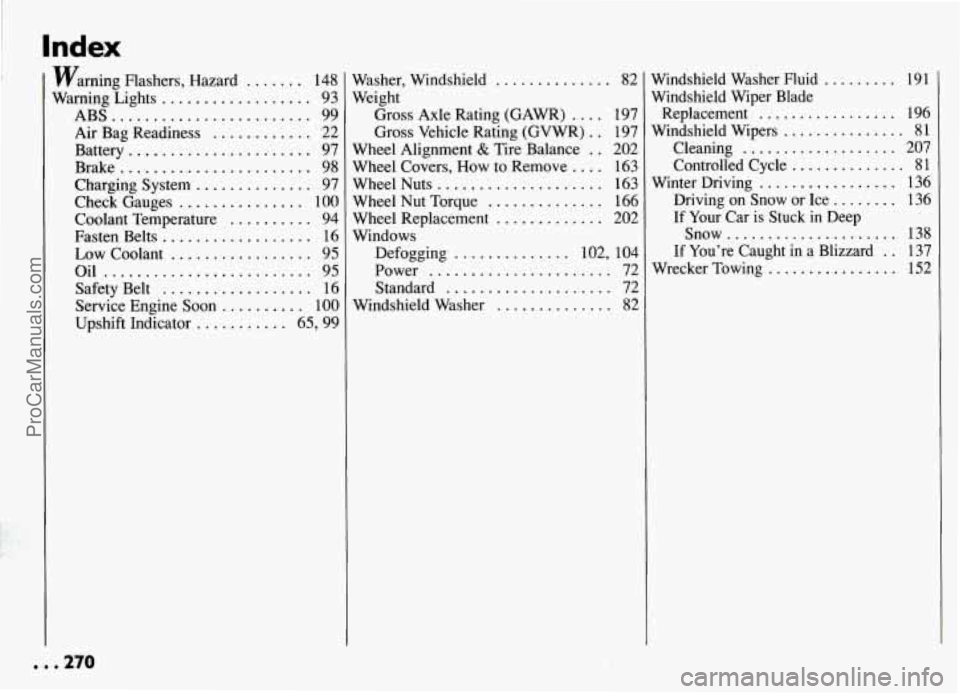
warning Flashers. Hazard ....... 148
Warning Lights
.................. 93
ABS
........................ 99
Air Bag Readiness
............ 22
Battery
...................... 97
Brake
....................... 98
Charging System
.............. 97
Check Gauges
............... 100
Coolant Temperature
.......... 94
Fasten Belts
.................. 16
Low Coolant ................. 95
Oil
......................... 95
Safety Belt
.................. 16
Service Engine Soon
.......... 100
Upshift Indicator
............ 65. 99
Washer. Windshield .............. 82
Weight
Gross Axle Rating (GAWR) .... 197
Gross Vehicle Rating (GVWR)
. . 197
Wheel Alignment
& Tire Balance . . 202
Wheel Covers.
How to Remove .... 163
Wheel Nuts
.................... 163
Wheel Nut Torque
.............. 166
Wheel Replacement
............. 202
Defogging .............. 102. 104
Power
...................... 72
Standard
.................... 72
Windshield Washer .............. 82
Windows
Windshield Washer Fluid ......... 191
Windshield Wiper Blade
Replacement ................. 196
Windshield Wipers
............... 81
Cleaning
................... 207
Controlled Cycle
.............. 81
Winter Driving
................. 136
Driving on Snow or Ice
........ 136
If Your Car is Stuck in Deep
Snow ..................... 138
If You’re Caught in a Blizzard
. . 137
Wrecker Towing
................ 152
... 270
ProCarManuals.com