light PONTIAC GRAND-AM 1995 Owner's Manual
[x] Cancel search | Manufacturer: PONTIAC, Model Year: 1995, Model line: GRAND-AM, Model: PONTIAC GRAND-AM 1995Pages: 354, PDF Size: 17.81 MB
Page 119 of 354
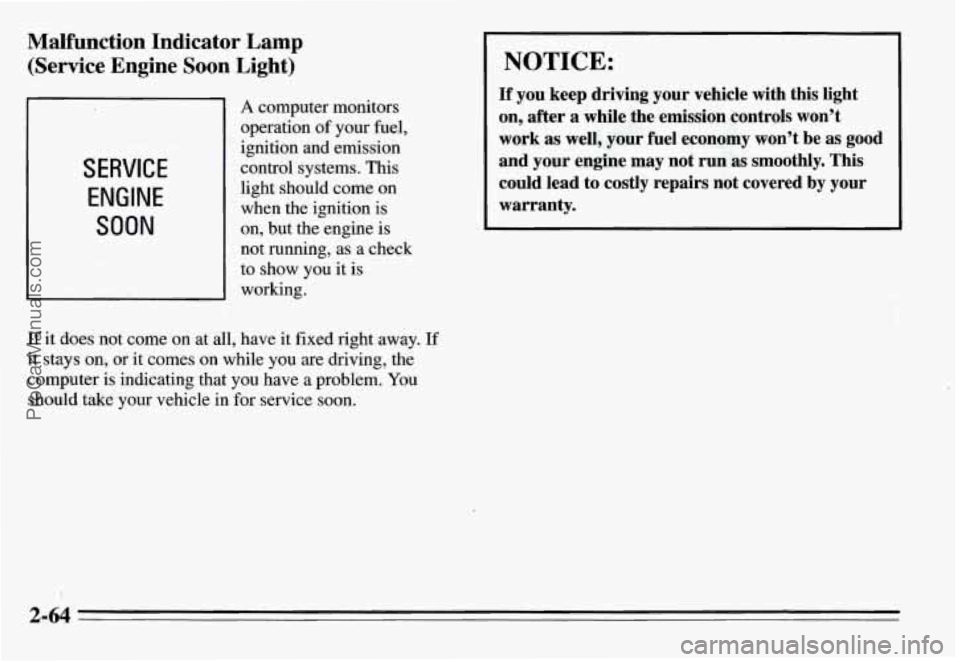
Malfunction Indicator Lamp
(Service Engine Soon Light)
SERVICE
ENGINE SOON
A computer monitors
operation of your fuel,
ignition and emission
control systems.
This
light should come on
when the ignition is
on, but the engine is
not running, as a check
to show you it is
working.
If it does not come on at all, have it fixed right away. If
it stays on, or it comes on while you are driving, the
computer is indicating that you have a problem. You
should take your vehicle in for service soon.
NOTICE:
If you keep driving your vehicle with this light
on, after a while the emission controls won’t
work as well, your fuel economy won’t be as good
and your engine may not run as smoothly. This could lead to costly repairs not covered by your
warranty.
2-64
ProCarManuals.com
Page 120 of 354
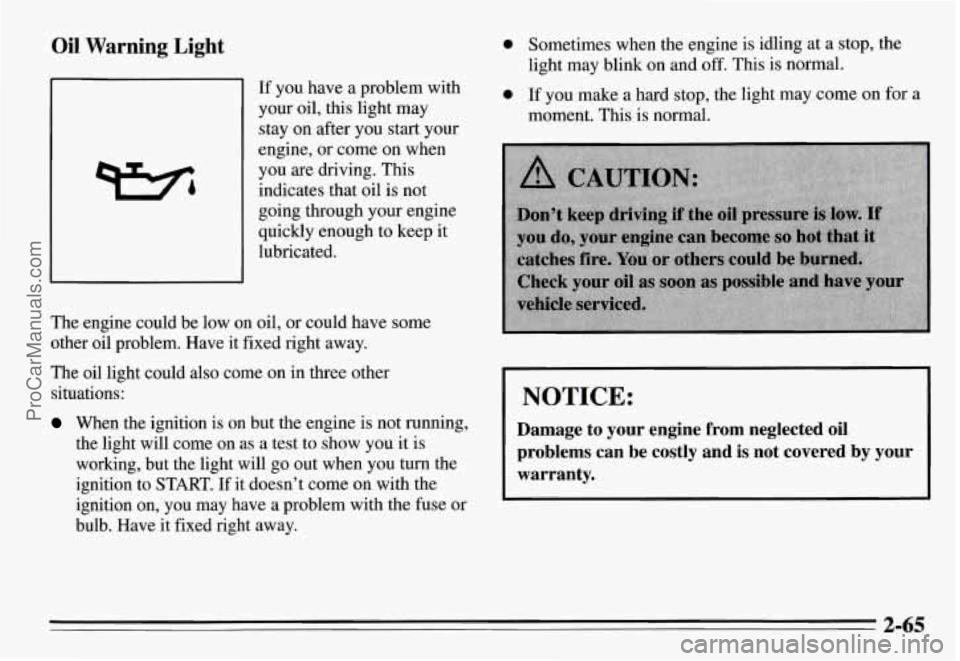
Oil Warning Light
If you have a problem with your oil, this light may
stay on after you start your
engine, or come on when
you
are driving. This
indicates that oil is not
going through your engine
quickly enough to keep it
lubricated.
The engine could be low on oil, or could have some
other oil problem. Have it fixed right away.
The oil light could
also come on in three other
situations:
When the ignition is on but the engine is not running,
the light will come on as a test to show you it is
working, but the light
will go out when you turn the
ignition
to START. If it doesn’t come on with the
ignition on, you may have a problem with the fuse or
bulb. Have it fixed right away.
0 Sometimes when the engine is idling at a stop, the
0 If you make a hard stop, the light may come on for a
light may blink on and off. This is normal.
moment. This is normal.
NOTICE:
Damage to your engine from neglected oil
problems can be costly and is not covered by your
warranty.
2-65
ProCarManuals.com
Page 121 of 354
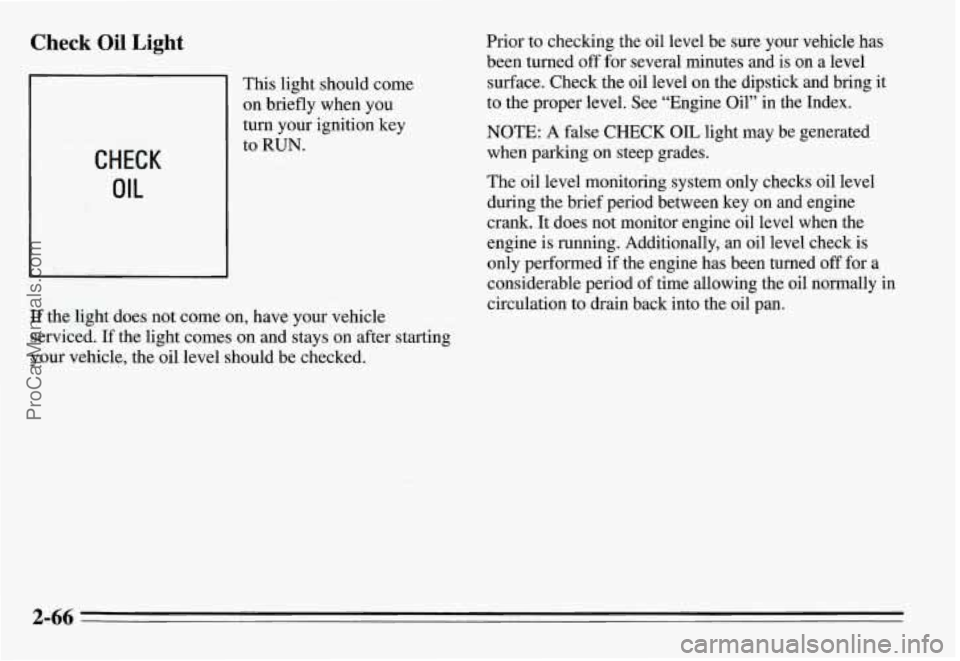
Check Oil Light
This light should come
on briefly when you
turn your ignition key
to
RUN.
If the light does not come on, have your vehicle
serviced.
If the light comes on and stays on after starting
your vehicle, the oil level should be checked.
Prior to checking the oil level be sure your vehicle has
been turned
off for several minutes and is on a level
surface. Check the oil level on the dipstick and bring it
to the proper level. See “Engine Oil” in the Index.
NOTE: A false CHECK OIL, light may be generated
when parking on steep grades.
The oil level monitoring system only checks oil level
during the brief period between key on and engine
crank. It does not monitor engine oil level when the
engine is running. Additionally, an oil level check
is
only performed if the engine has been turned off for a
considerable period of time allowing the oil normally in
circulation to drain back into the oil pan.
2-66
ProCarManuals.com
Page 123 of 354
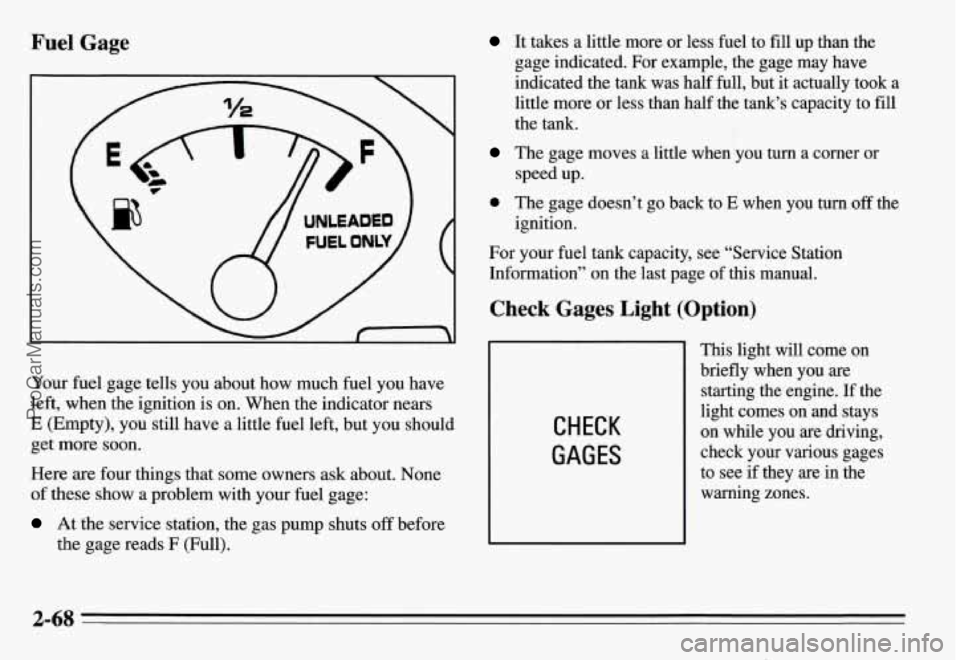
Fuel Gage
Your fuel gage tells you about how much fuel you have
left, when the ignition is on. When the indicator nears
E (Empty), you still have a little fuel left, but you should
get more soon.
Here are four things that some owners ask about. None
of these show a problem with your fuel gage:
At the service station, the gas pump shuts off before
the gage reads F (Full).
It takes a little more or less fuel to fill up than the
gage indicated. For example, the gage may have
indicated the tank was half full, but it actually took a
little more or less than half the tank’s capacity to fill
the tank.
The gage moves a little when you turn a corner or
0 The gage doesn’t go back to E when you turn off the
For your fuel tank capacity, see “Service Station
Information” on the last page of this manual.
Check Gages Light (Option)
speed up.
ignition.
CHECK
GAGES
This light will come on
briefly when you
are
starting the engine. If the
light comes on and stays
on while you are driving,
check your various gages
to see if they
are in the
warning zones.
2-68
ProCarManuals.com
Page 124 of 354
Section 3 Comfort Controls and Audio Systems
In this section you’ll find out how to operate the comfort
control systems and audio systems offered with your
Pontiac. Be sure to read about the particular system
supplied with your vehicle.
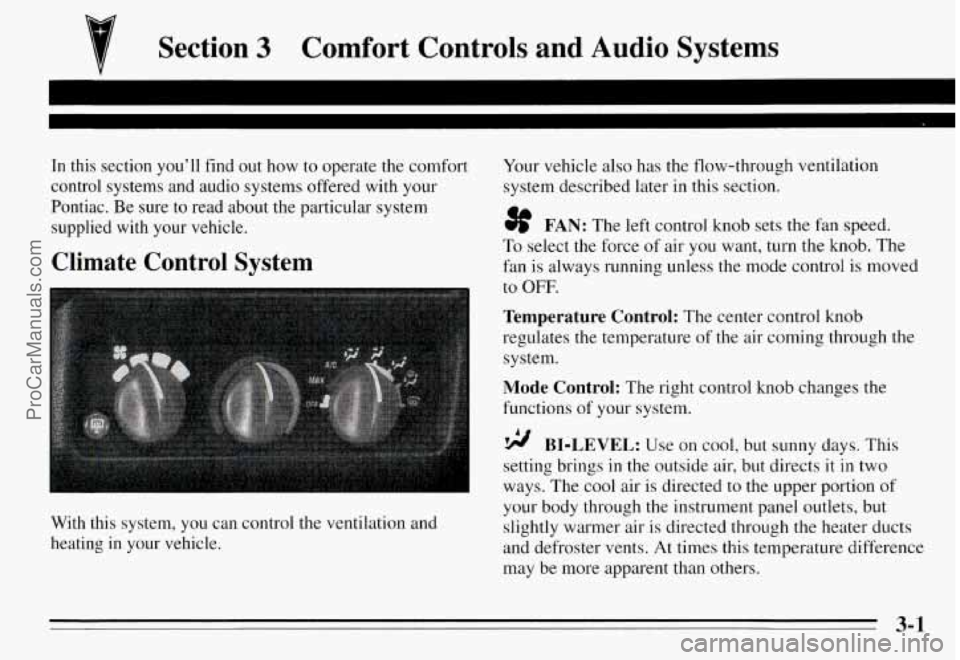
Climate Control System
With this system, you can control the ventilation and
heating in your vehicle.
Your vehicle also has the flow-through ventilation
system described later in this section.
3f FAN: The left control knob sets the Fan speed.
To select the force of air you want, turn the knob. The
fan
is always running unless the mode control is moved
to OFF.
Temperature Control: The center control knob
regulates the temperature of the air coming through the
system.
Mode Control: The right control knob changes the
functions
of your system.
BI-LEVEL: Use on cool, but sunny days. This
setting brings
in the outside air, but directs it in two
ways. The cool air is directed to the upper portion of
your body through the instrument panel outlets, but
slightly warmer air is directed through the heater ducts
and defroster vents.
At times this temperature difference
may be more apparent than others.
3-1
ProCarManuals.com
Page 125 of 354
VENT Use when outside temperatures are mild,
and little heating or cooling is needed. Air flow is
through the instrument panel outlets. Set the center
control knob to the temperature desired.
HEATER: This setting brings heated air through
the heater ducts, and some through the windshield
defroster vents.
If you have the optional engine coolant heater (engine
block heater) and use it during cold weather,
0°F
(- 18 “C) or lower, your heating system will more quickly
provide heat because the engine coolant is already
warmed. See “Engine Coolant Heater” in the Index.
9 BLEND: This setting divides air flow equally
between the heater ducts and the windshield defroster
vents.
DEFROST This setting directs air through the
windshield defroster vents located on top of the
instrument panel.
Defogging Windows
To defog the windshield, turn all three control knobs to
the
far right.
Air Conditioning System (Option)
The air conditioner and heater work best if you keep
your windows closed while using them. Your vehicle
also has the flow-through ventilation system described
later in this section.
Air Conditioning
Your system has three air conditioner settings. Before using
your
air conditioner on very hot days, open the windows
long enough to let hot inside
air escape. This reduces the
amount
of work your air conditioner’s compressor will have
to do, which should help fuel economy.
MAX: Use for maximum cooling. This setting
recirculates much of the air inside your vehicle
so it
maximizes your air conditioner’s performance and your
vehicle’s fuel economy.
A/C: Use for normal cooling on hot days. This setting
cools outside air and directs it through the instrument
panel outlets.
BI-LEVEL: Use on cool, but sunny days. This
setting brings in the outside air, but directs it in two
ways. The cool air is directed to the upper portion
of
your body through the instrument panel outlets, but
slightly warmer air is directed through the heater ducts
and defroster vents. At times this temperature difference
may be more apparent than others.
ProCarManuals.com
Page 127 of 354
Rear Window Defogger (Option)
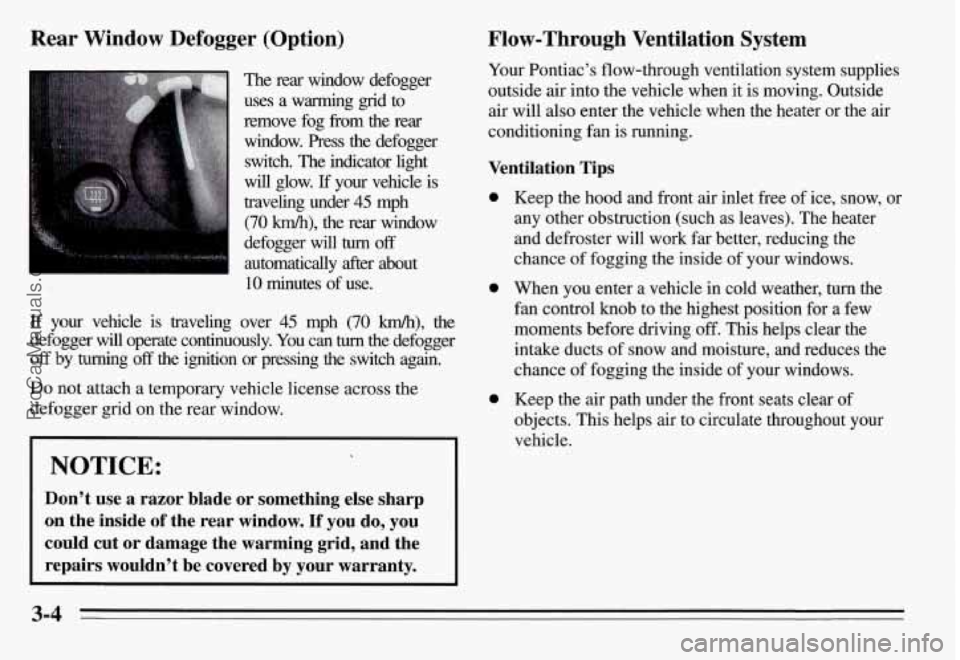
The rear window defogger
uses a warming grid to
remove fog from the rear
window.
Press the defogger
switch. The indicator light
will glow. If your vehicle is
traveling under
45 mph
(70 km/h), the rear window
defogger will
turn off
automatically after about
10 minutes of use.
If your vehicle is traveling over 45 mph (70 km/h), the
defogger will operate continuously. You can
h’rm the defogger
off by turning off the ignition or pressing the switch again.
Do not attach a temporary vehicle license across the
defogger grid on the rear window.
I NOTICE:
Don’t use a razor blade or something else sharp
on the inside
of the rear window. If you do, you
could cut or damage the warming grid, and the
repairs wouldn’t be covered by your warranty.
Flow-Through Ventilation System
Your Pontiac’s flow-through ventilation system supplies
outside air into the vehicle when it
is moving. Outside
air will also enter the vehicle when the heater or the air
conditioning fan
is running.
Ventilation Tips
0
0
0
Keep the hood and front air inlet free of ice, snow, or
any other obstruction (such as leaves). The heater
and defroster will work far better, reducing the
chance of fogging the inside of your windows.
When you enter a vehicle in cold weather, turn the
fan control
knob to the highest position for a few
moments before driving
off. This helps clear the
intake ducts of
snow and moisture, and reduces the
chance of fogging the inside of your windows.
Keep the air path under the front seats clear of
objects. This helps air to circulate throughout your
vehicle.
3-4
ProCarManuals.com
Page 142 of 354
Care of Your Cassette Tape Player
A tape player that is not cleaned regularly can cause
reduced sound quality, mined cassette, or a damaged
mechanism. Cassette tapes should be stored in their
cases away from contaminants, direct sunlight, and
extreme heat.
If they aren’t, they may not operate
properly or cause failure of the tape player.
Your tape player should be cleaned every 50 hours of
use. If you notice a reduction in sound quality,
try a
known good cassette to see if the tape or the tape player
is at fault. If this other cassette has no improvement in
sound quality, clean the tape player.
Cleaning may be done with a scrubbing action
non-abrasive cleaning cassette. This system uses a
cleaning cassette with pads which scrub the tape head as
the hubs of the cleaner cassette turn. It
is normal for the
cartridge to eject while cleaning. Insert the cassette at
least three times to ensure
a thorough cleaning. A
scrubbing action cleaning cassette is available through
your Pontiac dealership.
You may use a non-scrubbing action, wet-type cleaner
which uses a cassette with a fabric belt to clean the tape
head. This type of cleaning cassette will not eject. It may
not clean as thoroughly as the scrubbing type cleaner.
Cassettes are subject to wear and the sound quality may
degrade over time. Always make sure that the cassette
tape is in good condition before you have your tape
player serviced.
Care of Your Compact Discs
Handle discs carefully. Store them in their original cases
or other protective cases and away from direct sunlight
and dust. If the surface of a disc is soiled, dampen a
clean, soft cloth in a mild, neutral detergent solution and
clean it, wiping from the center to the edge.
Be sure never to touch the signal surface when handling
discs. Pick up discs by grasping the outer edges or the
edge of the hole and the outer edge.
Fixed Mast Antenna -+..
The fixed mast antenna can withstand most car washes
without being damaged. If the mast should ever become
slightly bent, you can straighten
it out by hand. If the
mast
is badly bent, as it might be by vandals, you should
replace it.
Check every once in a while to be sure the mast is still
tightened to the fender.
3-19
ProCarManuals.com
Page 149 of 354
Avoid needless heavy braking. Some people drive
in spurts
-- heavy acceleration followed by heavy
braking
-- rather than keeping pace with traffic. This
is a mistake. Your brakes may not have time to cool
between hard btops. Your brakes will wear out much
faster if you do a lot
of heavy braking. If you keep pace
with the traffic and allow realistic following distances,
you will elimiaate a lot
of unnecessary braking. That
means better biaking and longer brake life.
If your engine ever stops while you’re driving, brake
normally but don’t pump your brakes.
If you do, the
pedal may get harder to push down. If your engine
stops, you will. still have some power brake assist. But
you will use it’when you brake. Once the power assist is
used
up, it may t&e longer to stop and the brake pedal
will
be harder to push.
Anti-Lock Brakes (ABS)
Your Pontiac has an advanced electronic braking system
that will help prevent a braking skid.
1
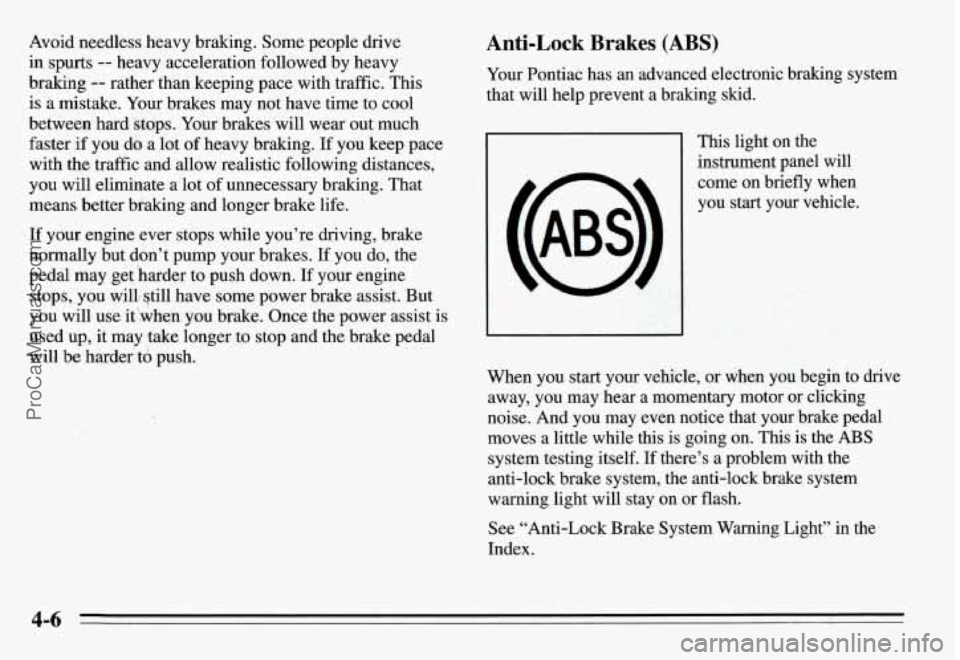
This light on the
instrument panel will come on briefly when
you start your vehicle.
When you start your vehicle, or when you begin to drive
away, you may hear a momentary motor or clicking
noise. And you may even notice that your brake pedal
moves a
little while this is going on. This is the ABS
system testing itself. If there’s a problem with the
anti-lock brake system, the anti-lock brake system
warning light will stay on or flash.
See “Anti-Lock Brake System Warning Light” in the
Index.
4-6
ProCarManuals.com
Page 151 of 354
close to the vehicle in front of you, you won’t have time
to apply your brakes
if that vehicle suddenly slows or
stops. Always leave enough room up ahead to stop, even
though
you have anti-lock brakes.
To Use Anti-Lock
Don’t pump the brakes. Just hold the brake pedal down
and let anti-lock work for you. You may feel the system
working, or
you may notice some noise, but this is normal.
Braking in Emergencies
Use your anti-lock braking system when you need to.
With anti-lock, you can steer and brake at the same
time.
In many emergencies, steering can help you more
than even the very best braking.
Steering
Power Steering
If you lose power steering assist because the engine
stops or the system is not functioning, you can steer but
it will take much more effort.
Variable Effort Steering (Option)
This steering system provides lighter steering effort for
parking and at low vehicle speeds. Steering effort will
increase at higher speeds for improved road feel.
Steering Tips
Driving on Curves
It’s important to take curves at a reasonable speed.
A lot of the “driver lost control” accidents mentioned on
the news happen on curves. Here’s why:
Experienced driver or beginner, each of us is subject to
the same laws of physics when driving on curves. The
traction of the tires against the road surface makes it
possible for the vehicle to change its path when you turn
the front wheels. If there’s no traction, inertia will keep
the vehicle going in the same direction.
If you’ve ever
tried to steer a vehicle on wet ice, you’ll understand this.
The traction you can get in a curve depends on the
condition
of your tires and the road surface, the angle at
which the curve is banked, and your speed. While you’re
in a curve, speed is the
one factor you can control.
Suppose you’re steering through a sharp curve. Then you
suddenly accelerate. Both control systems
-- steering and
acceleration
-- have to do their work where the tires meet
the road. Adding the sudden acceleration can demand too
much
of those places. You can lose control.
What should you do if this ever happens? Ease up on the
accelerator pedal, steer the vehicle the way you want it
to go, and slow down.
4-8
ProCarManuals.com