overheating PONTIAC GRAND-AM 1995 Owners Manual
[x] Cancel search | Manufacturer: PONTIAC, Model Year: 1995, Model line: GRAND-AM, Model: PONTIAC GRAND-AM 1995Pages: 354, PDF Size: 17.81 MB
Page 2 of 354
v The 1995 Pontiac Grand Am Owner’s Manual
... How to Use this Manual .............................................................. .111
Seats and Restraint Systems .......................................................... 1-1
Features and Controls ............................................................... 2-1
Comfort Controls and Audio Systems .................................................. 3-1
This section tells you how to use your manual and includes safety and vehicle damage warnings and symbols.
This section tells you how to use your seats and safety belts properly. It also explains the “SRS” system.
This section explains how to start and operate your Pontiac.
This section tells you how to adjust the ventilation and comfo\
rt controls and how to operate your
audio system.
Here you’ll find helpful information and tips about the road\
and how
to drive under different conditions.
This section tells you what to do
if you have a problem while driving, such as a flat tire or engine
overheating, etc.
Here the manual tells you how to keep your Pontiac running properly and looking good.
This section tells you when to perform vehicle maintenance and what fluids and lubricants to use.
This section tells you how to contact Pontiac for assistance and how to get service publications.
It also gives you information on “Reporting Safety Defects” on page 8-4.
Here’s an alphabetical listing of almost every subject in this manual. You can use it to quickly find
something you want to read.
YourDrivingandtheRoad ........................................................... 4-1
ProblemsontheRoad ............................................................... 5-1
Service and Appearance Care. ........................................................ 6-1
Maintenanceschedule ............................................................... 7-1
Customer Assistance Information ..................................................... 8-1
Index ........................................................................\
..... 9-1
i
ProCarManuals.com
Page 117 of 354
If the anti-lock brake system warning light stays on
longer than normal after you’ve started your engine, turn
the ignition off. Or, if the light comes on
and stays on
when you’re driving, stop as soon as possible and turn
the ignition
off. Then start the engine again to reset the
system. If the light still stays on, or comes on again
while you’re driving, your Pontiac needs service.
If the
light
is on but not flashing and the regular brake system
warning light isn’t on, you still have brakes, but you
don’t have anti-lock brakes.
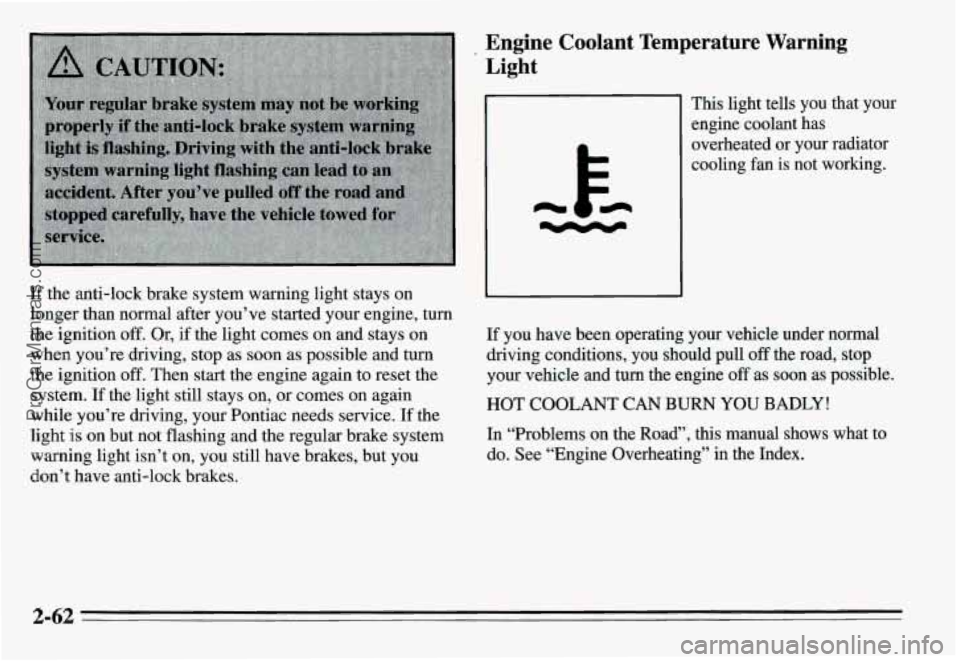
. Engine Coolant Temperature Warning
Light
This light tells you that your
engine coolant has
overheated or your radiator
cooling fan is not working.
If you have been operating your vehicle under normal
driving conditions, you should pull off the road, stop
your vehicle and turn the engine
off as soon as possible.
HOT COOLANT CAN BURN YOU BADLY!
In “Problems on the Road”, this manual shows what to
do. See “Engine Overheating” in the Index.
2-62
ProCarManuals.com
Page 118 of 354
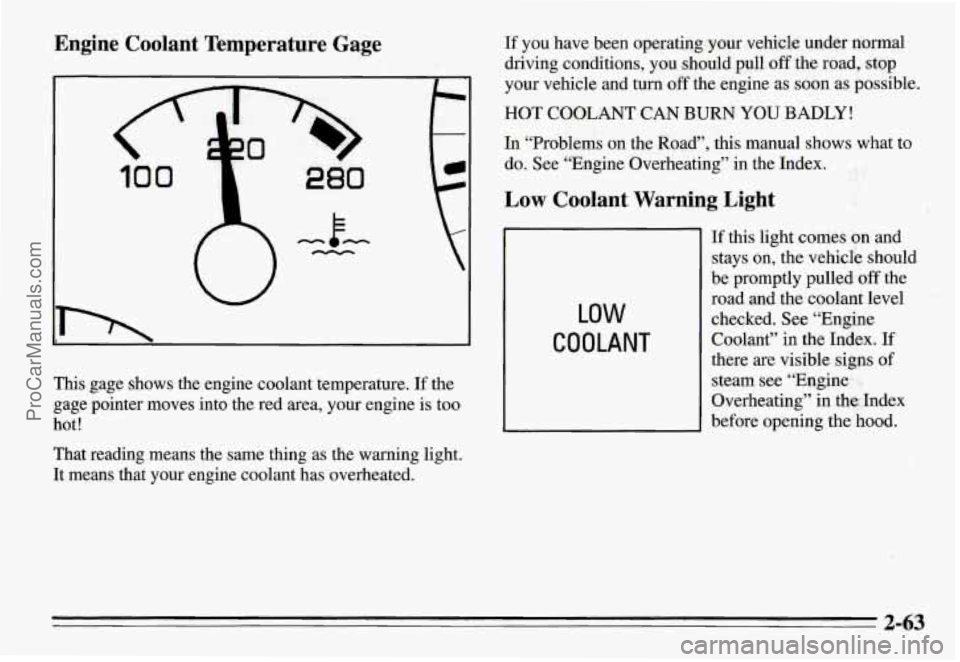
Engine Coolant Temperature Gage
loo b
280
-E- -
r-r .J
This gage shows the engine coolant temperature. If the
gage pointer moves into the red area, your engine
is too
hot!
That reading means the same thing as the warning light.
It means that your engine coolant has overheated.
If you have been operating your vehicle under normal
driving conditions, you should pull
off the road, stop
your vehicle and
turn off the engine as soon as possible.
HOT COOLANT CAN BURN YOU BADLY!
In “Problems on the Road”, this manual shows what to
do. See “Engine Overheating’, in the Index.
Low Coolant Warning Light
LOW
COOLANT
If this light comes on and
stays on, the vehicle should
be promptly pulled off the
road
and the coolant level
checked. See “Engine
Coolant” in the Index.
If
there are visible signs of
steam see “Engine
Overheating” in the:Index
before opening the hood.
2-63
ProCarManuals.com
Page 179 of 354
When towing a trailer, the green arrows on your
instrument panel will flash for turns even
if the bulbs on
the trailer
are burned out. Thus, you may think drivers
behind you are seeing your signal when they
are not. It’s
important to check occasionally to be sure the trailer
bulbs
are still working.
Driving On Grades
Reduce speed and shift to a lower gear before you start
down a long or steep downgrade. If you don’t shift
down, you might have to use your brakes
so much that
they would get hot and no longer work well.
On a long uphill grade, use the highest gear possible. If
you cannot maintain posted speeds, driving at a lower
speed may help avoid overheating your engine and
transaxle.
If you have a manual transaxle with fifth gear, it’s better
not
to use fifth gear. Just drive in fourth gear (or, as you
need to, a lower gear).
Parking on Hills
You really should not park your vehicle, with a trailer
attached, on a
hill. If something goes wrong, your rig
could
start to move. People can be injured, and both
your vehicle and the trailer can be damaged.
But if you ever have to park your rig on a hill, here’s
how to do it:
1. Apply your regular brakes, but don’t shift into
PARK (P) yet, or into gear for a manual transaxle.
2. Have someone place chocks under the trailer wheels.
3. When the wheel chocks are in place, release the
regular brakes until the chocks absorb the load.
4. Reapply the regular brakes. Then apply your parking
brake, and then shift to PARK (P), or REVERSE (R)
for a manual transaxle.
5. Release the regular brakes.
4-36
ProCarManuals.com
Page 193 of 354
NOTICE:
Towing a vehicle over rough surfaces could
damage a vehicle. Damage can occur from vehicle
to ground or vehicle to wheel-lift equipment. To
help avoid damage, install a towing dolly and
raise the vehicle until adequate clearance is
obtained between the ground and/or wheel-lift
equipment.
Do not attach winch cables or J-hooks to
suspension components when using car carrier
equipment.
Always use T-hooks inserted in the
T-hook Slots.
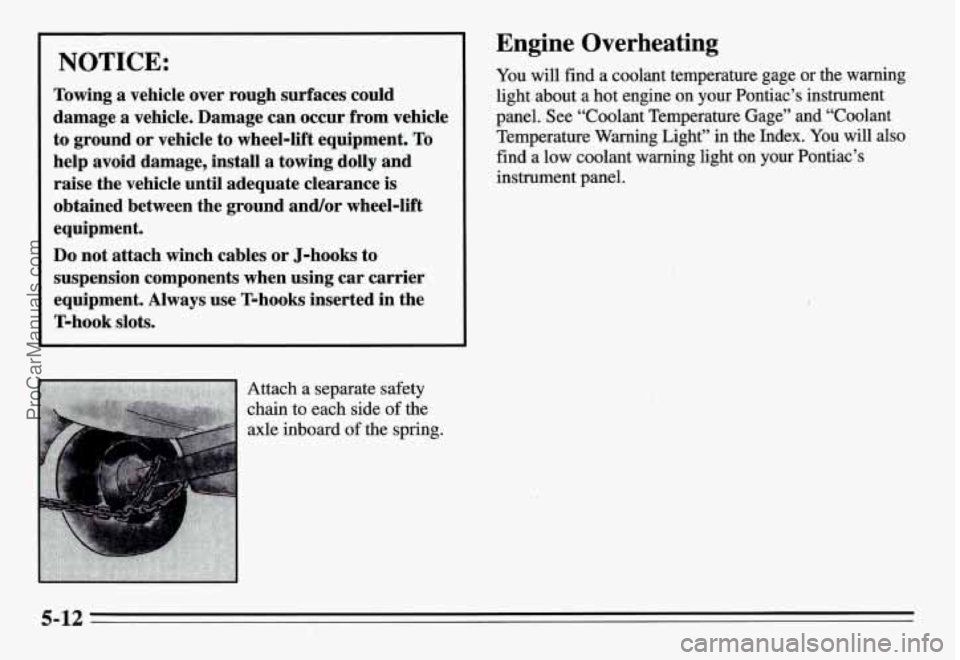
Attach a separate safety
chain to each side of the
axle inboard
of the spring.
Engine Overheating
You will find a coolant temperature gage or the warning
light about
a hot engine on your Pontiac’s instrument
panel. See “Coolant Temperature Gage” and “Coolant
Temperature Warning Light” in the Index. You will also
find a low coolant warning light on your Pontiac’s
instrument panel.
5-12
ProCarManuals.com
Page 197 of 354
Engine damage from running your engine
without coolant isn’t covered
by your warranty.
If there seems to be no leak, with the engine on check to
see if the electric engine fan is running.
If the engine is
overheating, the fan should be running. If it isn’t, your
vehicle needs service.
How to Add Coolant to the Coolant Surge
Tank
If you haven’t found a problem yet, but the coolant level
isn’t at or above FULL COLD, add a 50/50 mixture of
clean water (preferably distilled) and a proper antifreeze
at the coolant surge
tank, but be sure the cooling system,
including the coolant surge tank pressure cap, is cool
before you do it. (See “Engine Coolant” in the Index for
more information about the proper coolant
mix.)
I NOTICE:
5-16
ProCarManuals.com
Page 233 of 354
Hydraulic Clutch Refer to the Maintenance Schedule to determine how often you should check the fluid level in your clutch
The hydraulic clutch linkage in your vehicle is master cylinder reservoir and for the proper fluid. See
self-adjusting. The clutch master cylinder reservoir is “Owner Checks and Services” and “Recommended
filled with hydraulic clutch fluid. Fluids and Lubricants” in the Index.
It isn’t a good idea to “top off’ your clutch fluid. Adding
fluid won’t correct a leak. How to Check
A fluid loss in this system could indicate a problem.
Have the system inspected and repaired.
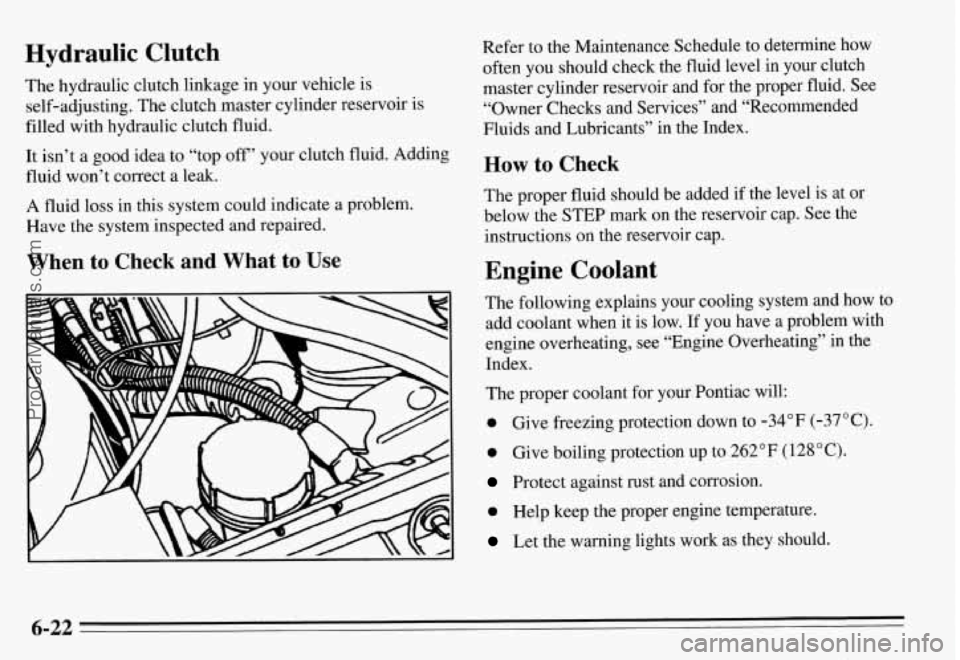
When to Check and What to Use
The proper fluid should be added if the level is at or
below the STEP mark on the reservoir cap. See the
instructions on the reservoir cap.
Engine Coolant
The following explains your cooling system and how to
add coolant when it is low. If you have a problem with
engine overheating, see “Engine Overheating” in the
Index.
The proper coolant for your Pontiac will:
0 Give freezing protection down to -34°F (-37°C).
0 Give boiling protection up to 262 OF ( 128 O C).
Protect against rust and corrosion.
0 Help keep the proper engine temperature.
Let the warning lights work as they should.
6-22
ProCarManuals.com
Page 236 of 354
II WASH
FLUID
LOW
COOLANT
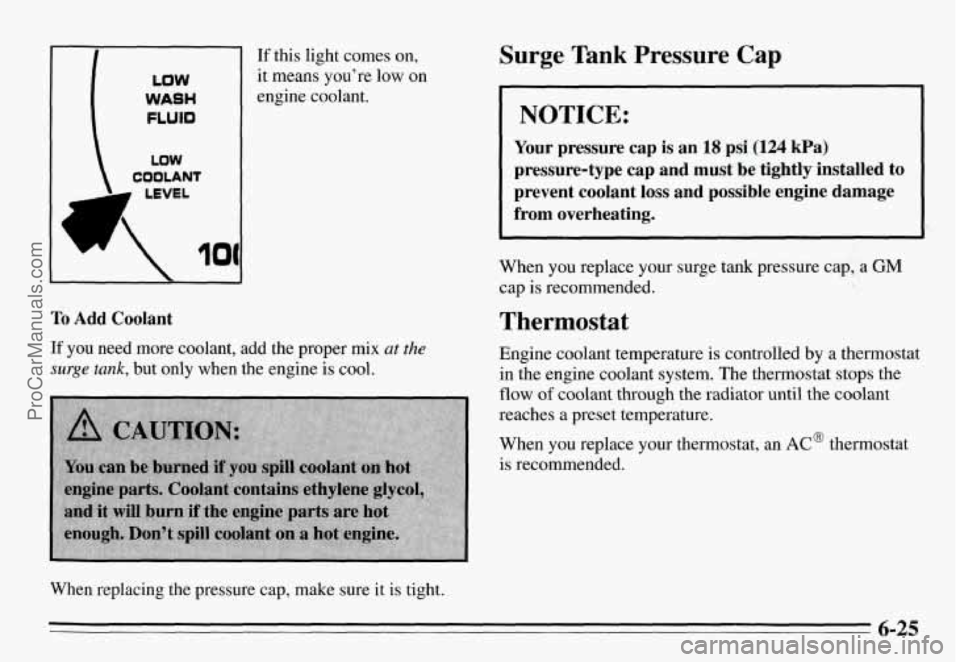
To Add Coolant
If this light comes on,
it means you’re low on
engine coolant.
If you need more coolant, add the proper mix at the
surge tank, but only when the engine is cool.
When replacing the pressure cap, make sure it is tight.
Surge Tank Pressure Cap
NOTICE:
Your pressure cap is an 18 psi (124 kPa)
pressure-type cap and must be tightly installed to
prevent coolant
loss and possible engine damage
from overheating.
When you replace your surge tank pressure cap, a GM
cap is recommended.
Thermostat
Engine coolant temperature is controlled by a thermostat
in the engine coolant system. The thermostat stops the
flow of coolant through the radiator until the coolant
reaches a preset temperature.
When you replace your thermostat, an AC@ thermostat
is recommended.
6-25
ProCarManuals.com
Page 345 of 354

Damage. Finish ............................... 6-49
Damage. Sheet Metal ............................ 6-49
Daytime Running Lamps
......................... 2-43
Dead Battery
................................... 5-2
Defects. Reporting
............................... 8-4
Defensive Driving
............................... 4- 1
Defogger. Rear Window .......................... 3-4
Defogging
................................... 3-2. 3
Defrosting
.................................. 3-2. 3
Delco LOC 11'
................................. 3- 16
Dome Lamp. Bulb Change
....................... 2-45
DoorLocks
..................................... 2-3
Drive (D) Position. Automatic Transaxle
............ 2-20
DriverPosition
................................. 1-12
Driving On Grades. With a Trailer
.................. 4-36
Driving
AtNight ................................... 4-13
City
....................................... 4-17
Defensive
................................... 4-1
Drunken
.................................... 4-2
Freeway
.................................... 4-18
In a Blizzard
................................ 4-24
In Foreign Countries
........................... 6-4
In the Rain .................................. 4-14
OnCurves
................................... 4-8
On Hill and Mountain Roads
................... 4-20
On Snow and Ice
............................. 4-23
Through Deep Standing Water
.................. 2-16
Winter ..................................... 4-22
With a Trailer
............................... 4-34
Drunken Driving
................................ 4-2
Easy-Entry Seat ................................ 1-6
Electrical Equipment. Adding ........ 2-14. 15. 3- 18. 6-51
Engine Coolant ................................. 6-22
Adding ............................... 5-1 6. 6-24
Heater ................................ 2-16. 6-16
Temperature Gage
............................ 2-63
Temperature Warning Light
.................... 2-62
Checking ................................... 6-24
Engine
Exhaust .................................... 2-29
Identification ................................ 6-51
Overheating
................................. 5-12
Running It While You're Parked
................ 2-30
Specifications
............................... 6-57
Starting .................................... 2-13
2.3 Liter
..................................... 6-9
3.1 Liter
.................................... 6-10
Engineoil ..................................... 6-11
Adding
.................................... 6-12
Additives
................................... 6-15
Checking
................................... 6-11
What Kind to Use ............................ 6-14
What to Do with Used Oil ..................... 6-16
Ethanol (In Fuel)
................................ 6-3
Extender, Safety Belt
............................ 1-46
Whentochange ............................. 6-16
Expectant Mothers. Use of Safety Belts
............. 1-23
9-4
ProCarManuals.com