lock PONTIAC GRAND-AM 1995 Workshop Manual
[x] Cancel search | Manufacturer: PONTIAC, Model Year: 1995, Model line: GRAND-AM, Model: PONTIAC GRAND-AM 1995Pages: 354, PDF Size: 17.81 MB
Page 170 of 354
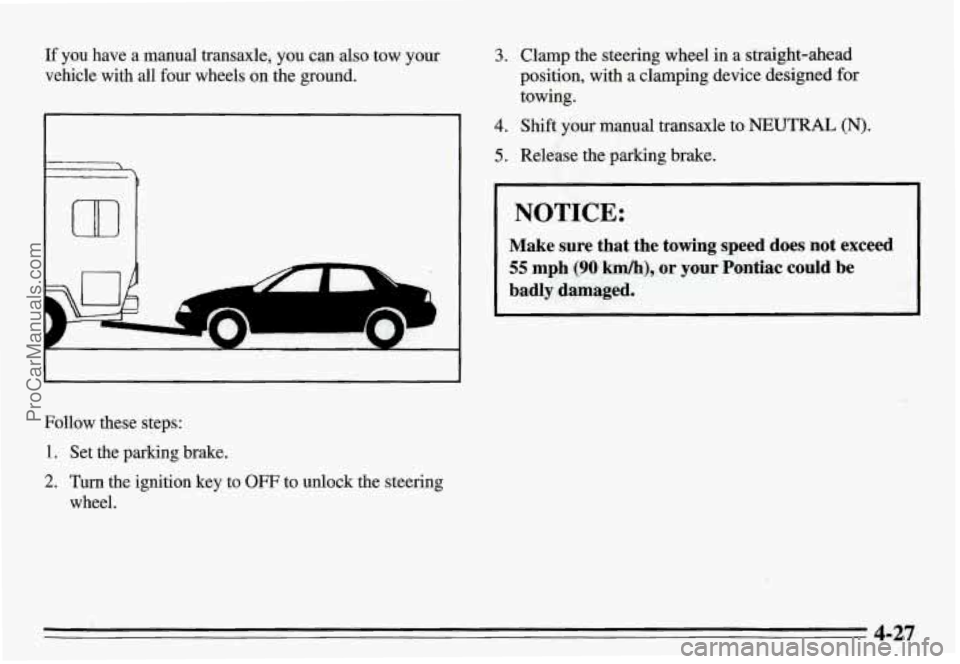
If you have a manual transaxle, you can also tow your
vehicle with all four wheels on the ground.
I
Follow these steps:
1. Set the parking brake.
2. Turn the ignition key to OFF to unlock the steering
wheel.
3. Clamp the steering wheel in a straight-ahead
position, with a clamping device designed
for
towing.
4. Shift your manual transaxle to NEUTRAL IN).
5. Release the parking brake.
NOTICE:
Make sure that the towing speed does not exceed
55 mph (90 km/h), or your Pontiac could be
badly damaged.
4-27
ProCarManuals.com
Page 177 of 354
Safety Chains
You should always attach chains between your vehicle
and your trailer.
Cross the safety chains under the tongue
of the trailer so that the tongue will not drop to the road
if it becomes separated from the hitch. Instructions
about safety chains may be provided by the hitch
manufacturer or by the trailer manufacturer. Follow the
manufacturer’s recommendation for attaching safety
chains and do not attach them to the bumper. Always
leave just enough slack
so you can turn with your rig.
And, never allow safety chains to drag on the ground.
Trailer Brakes
Does your trailer have its own brakes?
Be sure to read and follow the instructions for the trailer
brakes
so you’ll be able to install, adjust and maintain
them properly. And because you have anti-lock brakes,
do not
try to tap into your vehicle’s brake system. If you
do, both brake systems won’t work well, or at all.
Driving with a Trailer
Towing a trailer requires a certain amount of experience.
Before setting out for the open road, you’ll want to get
to know your
rig. Acquaint yourself with the feel of
handling and braking with the added weight of the
trailer. And always keep in mind that the vehicle you are
driving is now a
good deal longer and not nearly as
responsive as your vehicle is by itself.
Before you start, check the trailer hitch and platform
(and attachments), safety chains, electrical connector,
lamps, tires and mirror adjustment.
If the trailer has
electric brakes, start your vehicle and trailer moving and
then apply the trailer brake controller by hand to be sure
the brakes
are working. This lets you check your
electrical connection at the same time.
During your trip, check occasionally to be sure that the
load is secure, and that the lamps and any trailer brakes
are still working.
4-34
ProCarManuals.com
Page 189 of 354
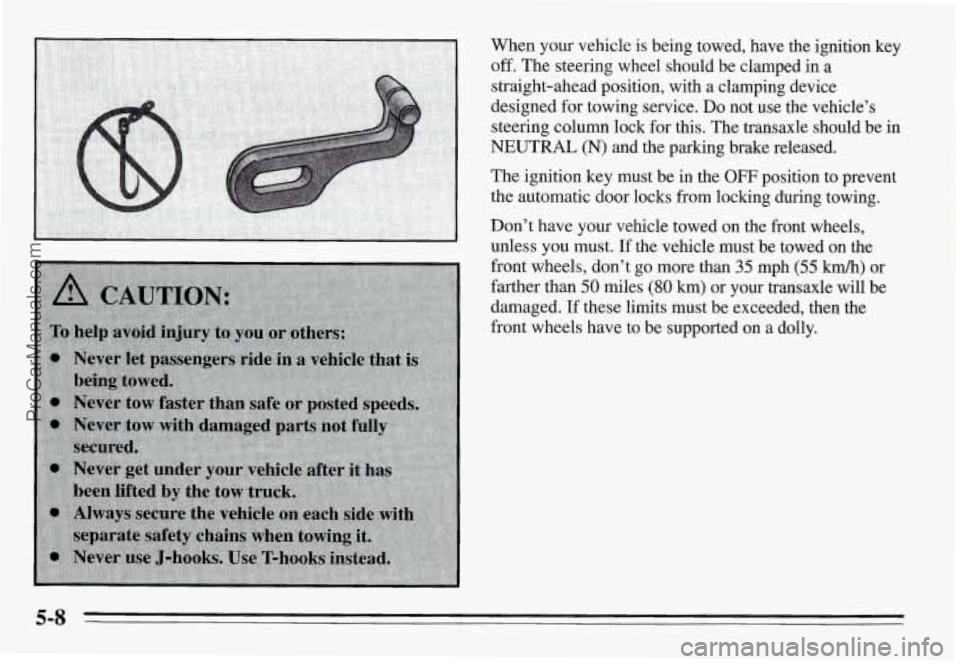
When your vehicle is being towed, have the ignition key
off. The steering wheel should be clamped in a
straight-ahead position, with a clamping device
designed for towing service. Do not use the vehicle’s
steering column lock for this. The transaxle should be in
NEUTRAL (N) and the parking brake released.
The ignition key must be in the OFF position to prevent
the automatic door locks from locking during towing.
Don’t have your vehicle towed on the front wheels,
unless you must.
If the vehicle must be towed on the
front wheels, don’t go more than
35 mph (55 km/h) or
farther than
50 miles (80 km) or your transaxle will be
damaged.
If these limits must be exceeded, then the
front wheels have to be supported on
a dolly.
ProCarManuals.com
Page 192 of 354
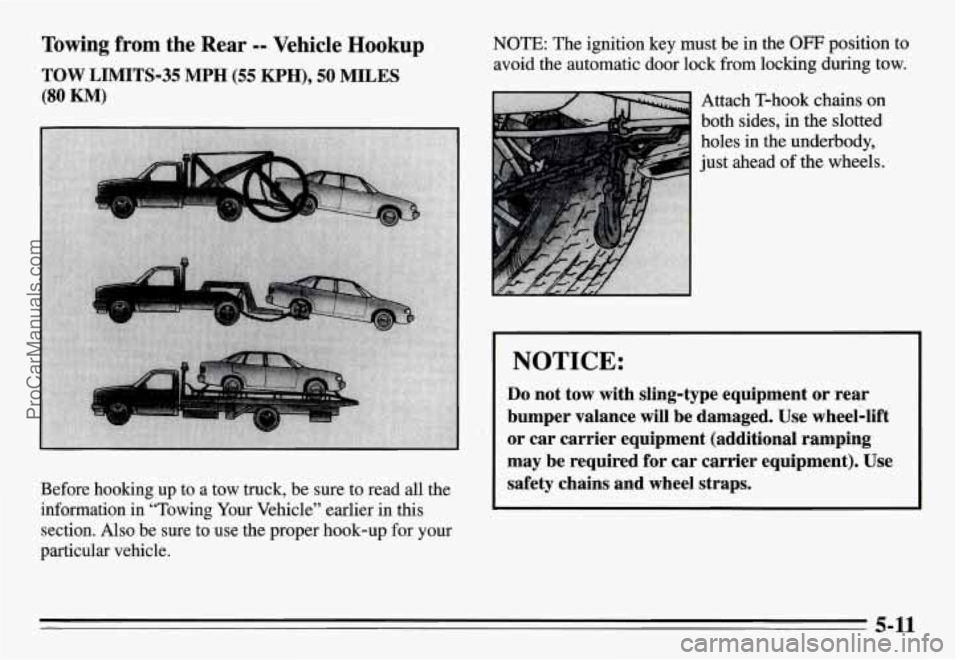
Towing from the Rear -- Vehicle Hookup
TOW LIMITS-35 MPH (55 KPH), 50 MILES
(80 KM)
Before hooking up to a tow truck, be sure to read all the
information in “Towing
Your Vehicle” earlier in this
section.
Also be sure to use the proper hook-up for your
particular vehicle.
NOTE: The ignition key must be in the OFF position to
avoid the automatic door lock from locking during tow.
Attach T-hook chains on
both sides, in the slotted
holes in the underbody,
just ahead
of the wheels.
NOTICE:
Do not tow with sling-type equipment or rear
bumper valance will be damaged. Use wheel-lift
or car carrier equipment (additional ramping
may be required for car carrier equipment). Use
safety chains and wheel straps.
5-11
ProCarManuals.com
Page 203 of 354
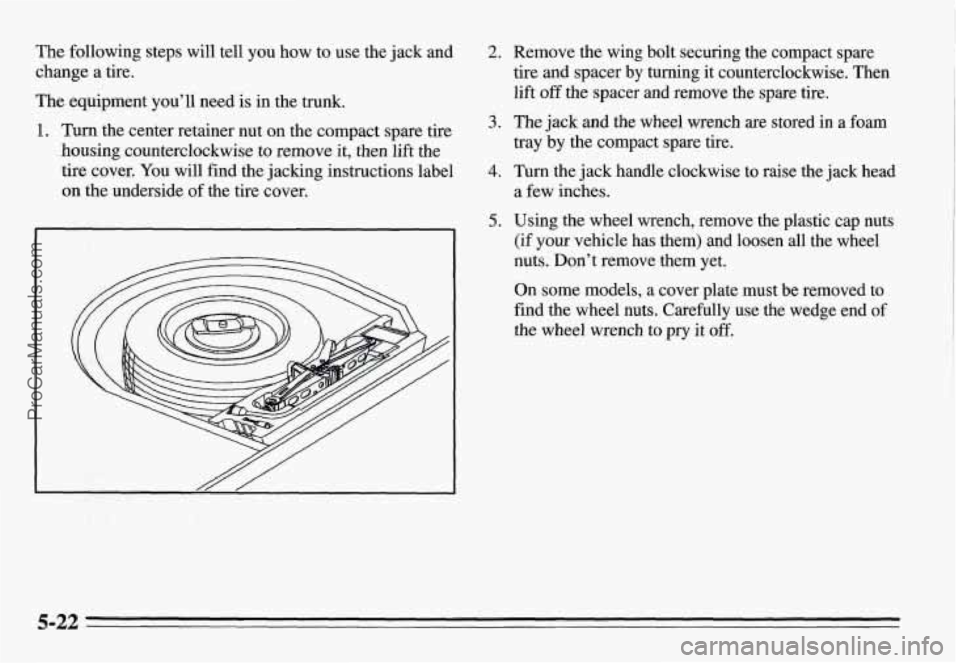
The following steps will tell you how to use the jack and
change a tire.
The equipment you’ll need is in the trunk.
1. Turn the center retainer nut on the compact spare tire
housing counterclockwise to remove it, then lift the
tire cover. You will find the jacking instructions label
on the underside of the tire cover,
2. Remove the wing bolt securing the compact spare
tire and spacer by turning it counterclockwise. Then
lift
off the spacer and remove the spare tire.
3. The jack and the wheel wrench are stored in a foam
tray by the compact spare tire.
a few inches.
4. Turn the jack handle clockwise to raise the jack head
5. Using the wheel wrench, remove the plastic cap nuts
(if your vehicle has them) and loosen all the wheel
nuts. Don’t remove them yet.
On some models, a cover plate must be removed to
find the wheel nuts. Carefully use the wedge end
of
the wheel wrench to pry it off.
5-22
ProCarManuals.com
Page 205 of 354
I I
NOTICE: I
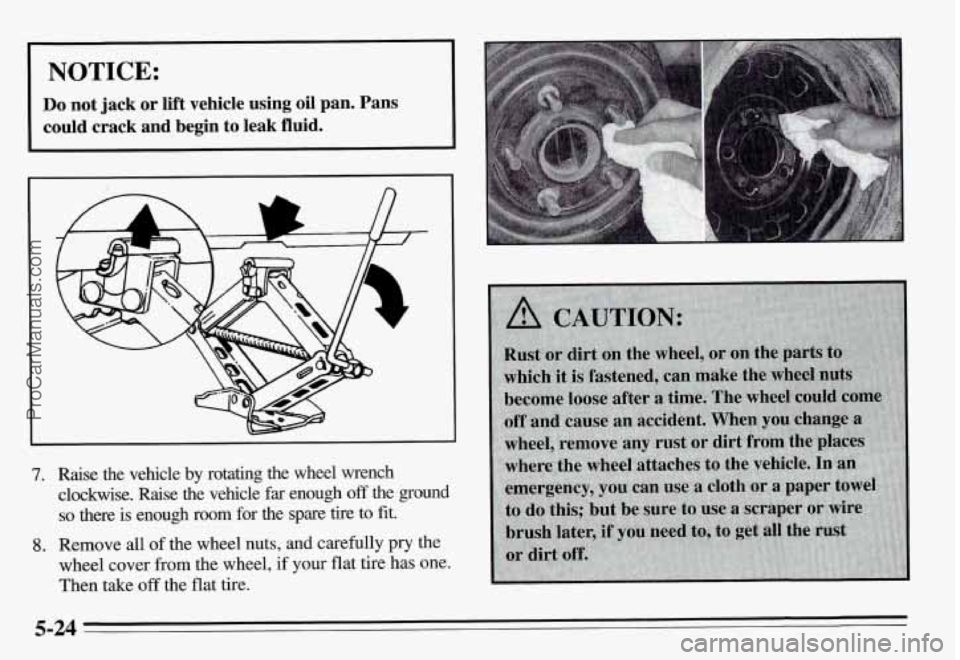
Do not jack or lift vehicle using oil pan. Pans
could crack and begin to leak fluid.
I
7. Raise the vehicle by rotating the wheel wrench
clockwise. Raise the vehicle far enough
off the ground
so there is enough room for the spare tire to fit.
wheel cover from the wheel, if your flat tire has one.
Then take
off the flat tire.
8. Remove all of the wheel nuts, and carefully pry the
5-24
ProCarManuals.com
Page 207 of 354
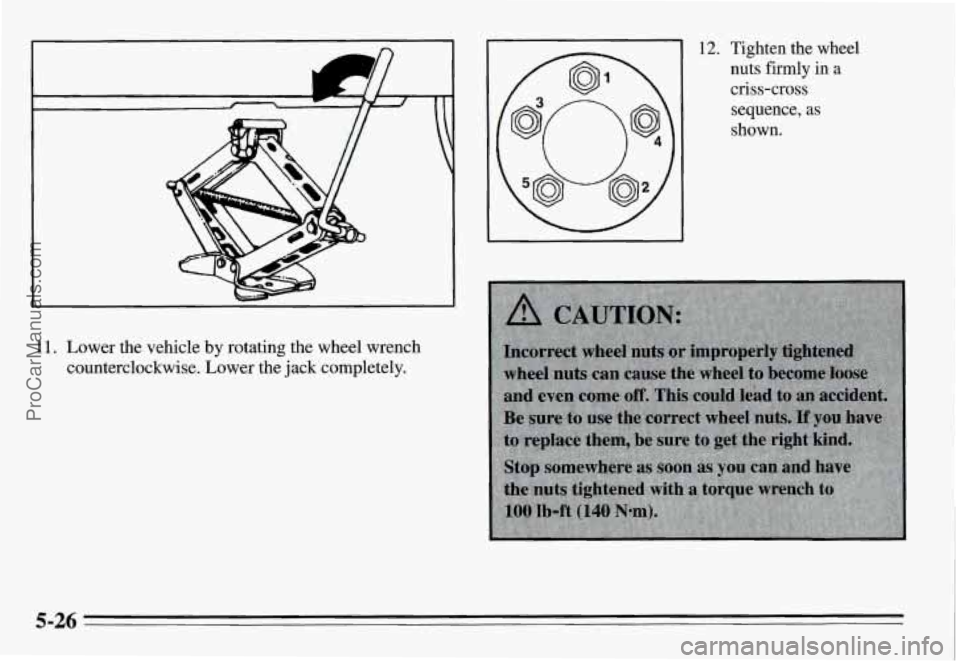
11. Lower the vehicle by rotating the wheel wrench
counterclockwise. Lower the jack completely.
12. Tighten the wheel
nuts firmly in a
criss-cross
sequence,
as
shown.
5-26
ProCarManuals.com
Page 216 of 354
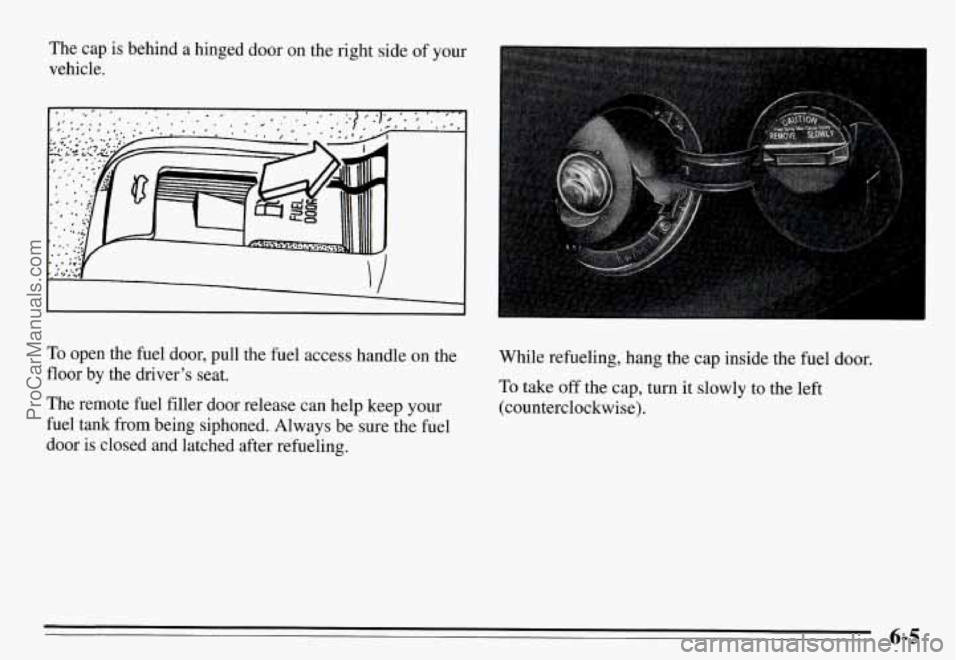
The cap is behind a hinged door on the right side of your
vehicle.
To open the fuel door, pull the fuel access handle on the
floor by the driver’s seat.
The remote fuel filler door release can help keep your
fuel tank from being siphoned. Always be sure the fuel
door is closed and latched after refueling.
While refueling, hang the cap inside the fuel door.
To take off the cap, turn it slowly to the left
(counterclockwise).
6-5
ProCarManuals.com
Page 232 of 354
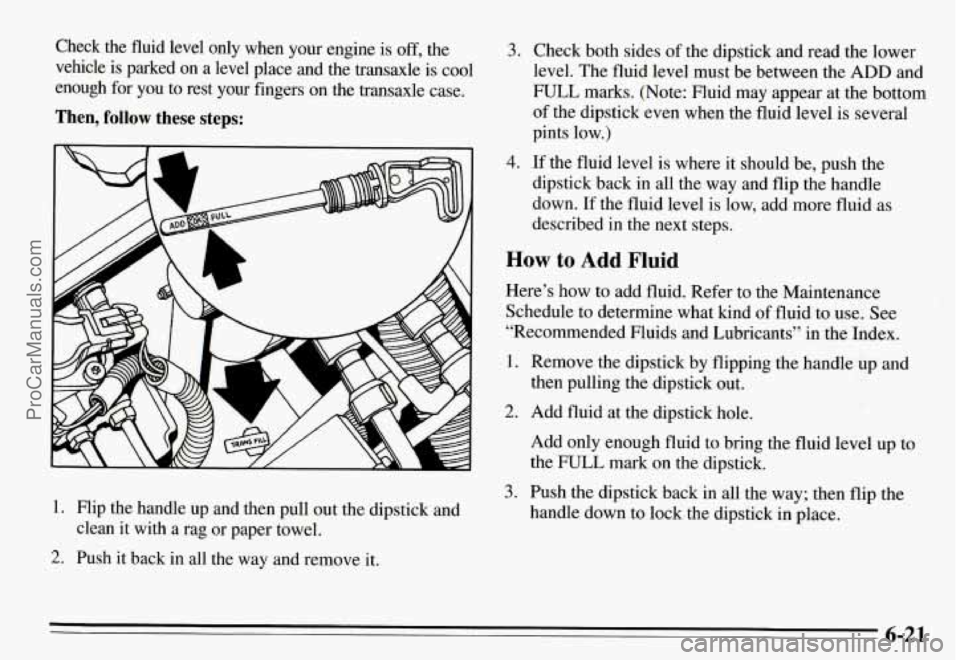
Check the fluid level only when your engine is off, the
vehicle is parked
on a level place and the transaxle is cool
enough
for you to rest your fingers on the transaxle case.
Then, follow these steps:
1. Flip the handle up and then pull out the dipstick and
2. Push it back in all the way and remove it.
clean it with a rag or paper towel.
3. Check both sides of the dipstick and read the lower
level. The fluid level must be between the ADD and
FULL marks. (Note: Fluid may appear at the bottom
of the dipstick even when the fluid level
is several
pints low.)
4. If the fluid level is where it should be, push the
dipstick back in all the way and flip the handle
down. If the fluid level is low, add more fluid as
described in the next steps.
How to Add Fluid
Here’s how to add fluid. Refer to the Maintenance
Schedule to determine what kind
of fluid to use. See
“Recommended Fluids and Lubricants” in the Index.
1. Remove the dipstick by flipping the handle up and
2. Add fluid at the dipstick hole.
then pulling the dipstick out.
Add only enough fluid to bring the fluid level up to
the FULL mark on the dipstick.
handle down to lock the dipstick in place.
3. Push the dipstick back in all the way; then flip the
6-21
ProCarManuals.com
Page 243 of 354
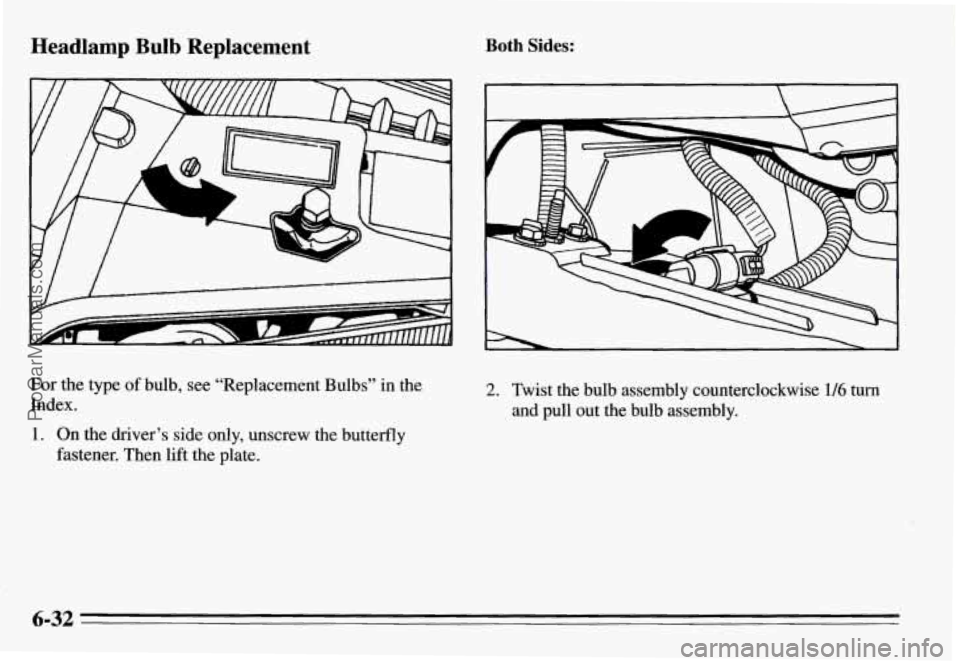
Headlamp Bulb Replacement
For the type of bulb, see “Replacement Bulbs” in the
Index.
1. On the driver’s side only, unscrew the butterfly
fastener. Then lift the plate.
Both Sides:
2. Twist the bulb assembly counterclockwise 1/6 turn
and pull out the bulb assembly.
6-32
ProCarManuals.com