warning light PONTIAC GRAND AM 1997 User Guide
[x] Cancel search | Manufacturer: PONTIAC, Model Year: 1997, Model line: GRAND AM, Model: PONTIAC GRAND AM 1997Pages: 371, PDF Size: 18.14 MB
Page 119 of 371
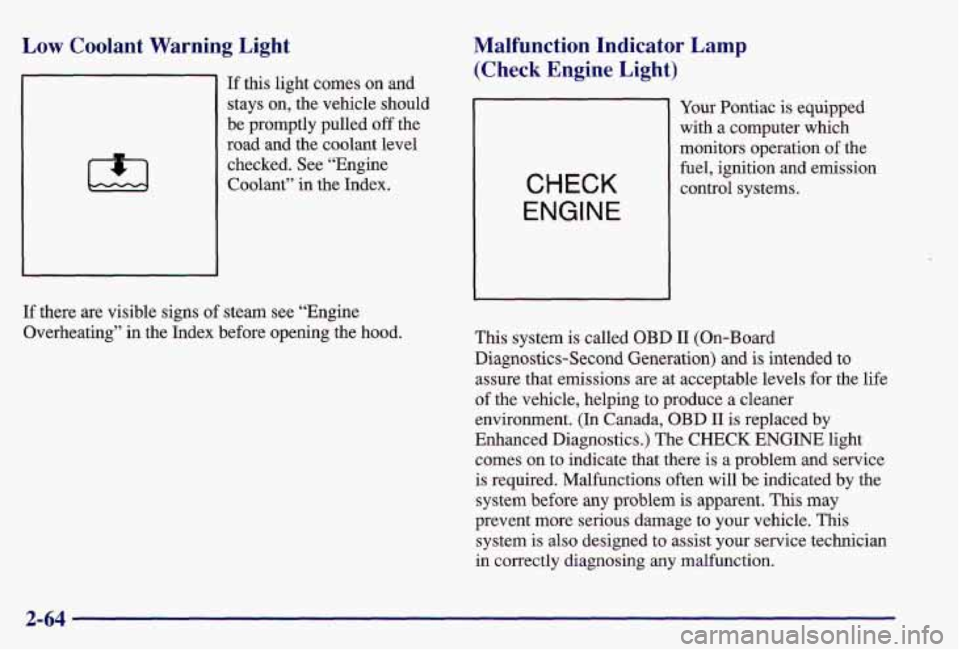
Low Coolant Warning Light
If this light comes on and
stays on, the vehicle should
be promptly pulled off the
road and the coolant level
checked. See “Engine
Coolant” in the Index.
If there are visible signs of steam see “Engine
Overheating” in the Index before opening the hood.
Malfunction Indicator Lamp
(Check Engine Light)
Your Pontiac is equipped
with a computer which
monitors operation
of the
fuel, ignition and emission
CHECK
ENGINE
This system is called OBD I1 (On-Board
Diagnostics-Second Generation) and is intended to
assure that emissions are at acceptable levels for the life
of the vehicle, helping to produce a cleaner
environment. (In Canada, OBD
I1 is replaced by
Enhanced Diagnostics.) The CHECK
ENGINE light
comes on
to indicate that there is a problem and service
is required. Malfunctions often will be indicated by the
system before any problem is apparent. This may
prevent more serious damage to your vehicle.
This
system is also designed to assist your service technician
in correctly diagnosing
any malfunction.
2-64
Page 122 of 371
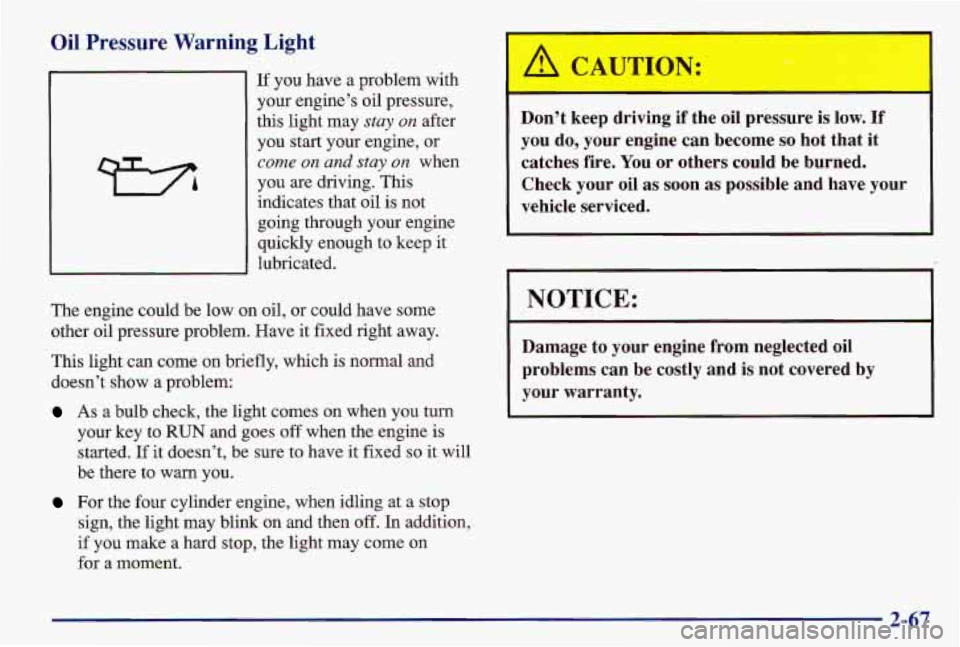
Oil Pressure Warning Light
If you have a problem with
your engine’s oil pressure,
this light may
stay on after
you start your engine, or
come on and stay on when
you are driving. This
indicates that oil is not
going through your engine
quickly enough to keep it
lubricated.
The engine could be low on oil, or could have some
other oil pressure problem. Have it fixed right away.
This light can come on briefly, which is normal and
doesn’t show a problem:
As a bulb check, the light comes on when you turn
your key to
RUN and goes off when the engine is
started.
If it doesn’t, be sure to have it fixed so it will
be there to warn you.
For the four cylinder engine, when idling at a stop
sign, the light may blink on and then off. In addition,
if you make a hard stop, the light may come on
for
a moment. Don’t
keep driving
if the oil pressure is low. If
you do, your engine can become so hot that it
catches fire. You or others could be burned.
Check your
oil as soon as possible and have your
vehicle serviced.
I I
NOTICE:
Damage to your engine from neglected oil
problems can be costly and is not covered by
your warranty.
2-67
Page 123 of 371
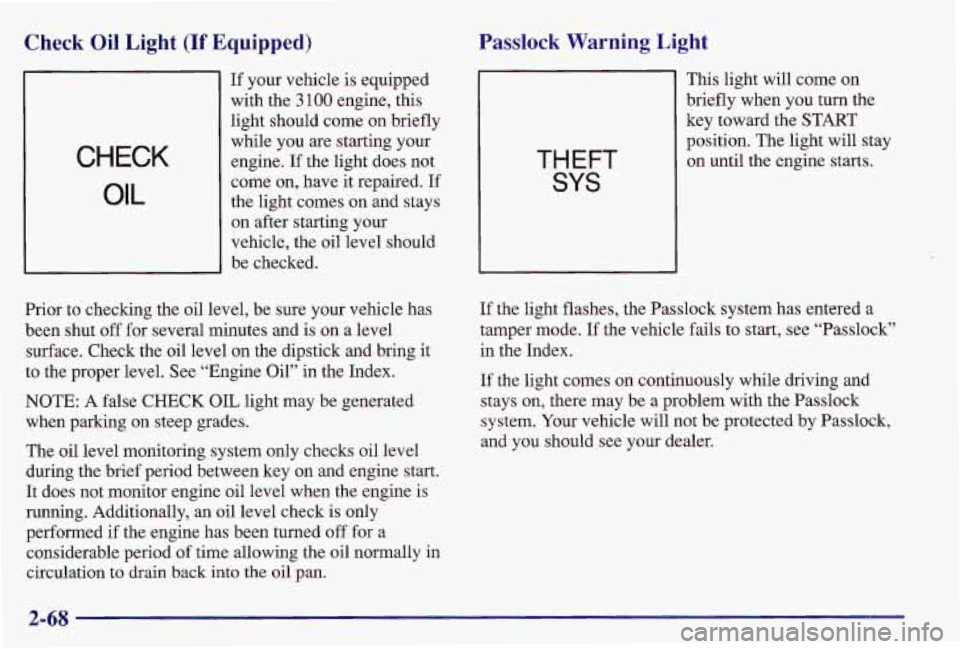
Check Oil Light (If Equipped)
CHECK
OIL
If your vehicle is equipped
with the
3 100 engine, this
light should come on briefly
while you are starting your engine.
If the light does not
come on, have it repaired. If
the light comes on and stays on after starting your
vehicle, the oil level should
be checked.
Prior to checking the oil level, be sure your vehicle has been shut off for several minutes and is on a level
surface. Check the oil level on the dipstick and bring it
to the proper level. See “Engine Oil” in the Index.
NOTE: A false
CHECK OIL light may be generated
when parking on steep grades.
The oil level monitoring system only checks oil level
during the brief period between key on and engine start.
It does not monitor engine oil level when the engine is
running. Additionally,
an oil level check is only
performed if the engine has been turned
off for a
considerable period
of time allowing the oil normally in
circulation
to drain back into the oil pan.
Passlock Warning Light
THEFT
SYS
This light will come on
briefly when you turn the
key toward the START
position. The light will stay
on until the engine starts.
If the light flashes, the Passlock system has entered a
tamper mode. If the vehicle fails to start, see “Passlock”
in the Index.
If the light comes on continuously while driving and
stays
on, there may be a problem with the Passlock
system. Your vehicle will not be protected by Passlock,
and
you should see your dealer.
2-68
Page 158 of 371
Avoid needless heavy braking. Some people drive in
spurts
-- heavy acceleration followed by heavy
braking
-- rather than keeping pace with traffic. This is a
mistake. Your brakes may
not have time to cool between
hard stops. Your brakes will wear out much faster if you
do a lot of heavy braking. If you keep pace with the
traffic and allow realistic following distances, you will
eliminate a lot
of unnecessary braking. That means
better braking and longer brake life.
If your engine ever stops while you’re driving, brake
normally but don’t pump your brakes. If you do, the
pedal may get harder to push down.
If your engine
stops, you will still have some power brake assist. But
you will use it when you brake. Once the power assist is
used up, it may take longer
to stop and the brake pedal
will be harder to push.
Anti-Lock Brakes (ABS)
Your vehicle has anti-lock brakes (ABS). ABS is an
advanced electronic braking system that will help
prevent a braking skid.
When you start your engine, or when you begin to drive
away, your anti-lock brake system will check itself. You
may hear a momentary motor or clicking noise while
this test is going on, and you may even notice that your
brake pedal moves a little. This is normal.
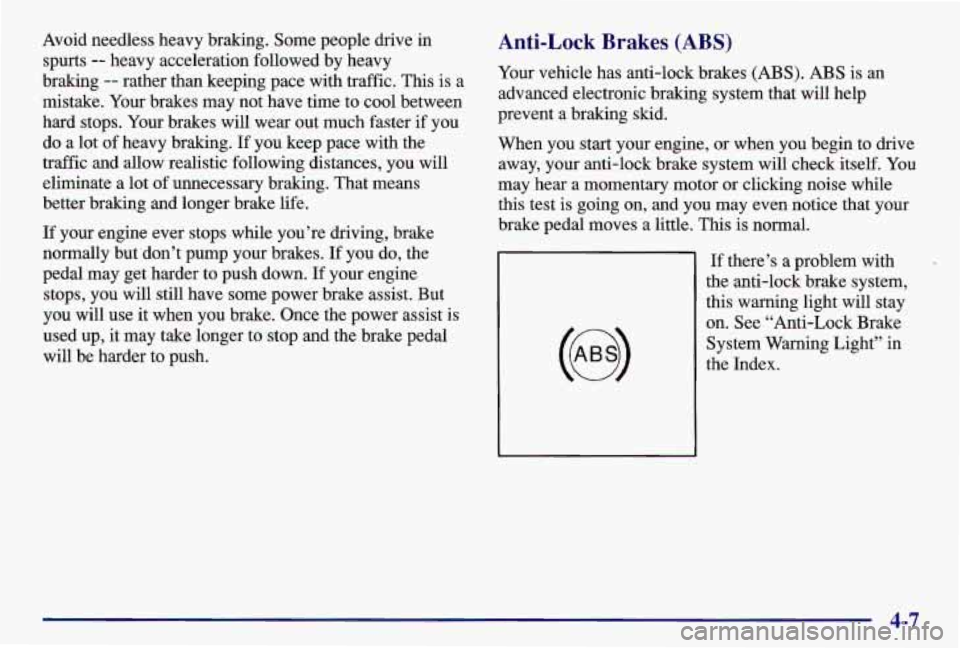
If there’s a problem with
the anti-lock brake system,
this warning light will stay
on. See “Anti-Lock Brake
System Warning Light” in
the Index.
4-7
Page 161 of 371
ETS
OFF
When the system is on and
the parking brake is fully
released, this warning light will come on to let you
know if there’s a problem
with the system. See
“Enhanced Traction System
Warning Light” in the
Index. When this warning
light
is on, the system will
not limit wheel spin. Adjust
your driving accordingly.
To limit wheel spin, especially in slippery road
conditions, you should always leave the Enhanced
Traction System on. But you can turn the system off if
you ever need
to. (You should turn the system off if your
vehicle ever gets stuck in sand, mud, ice or snow. See
“Rocking Your Vehicle” in the Index.) To
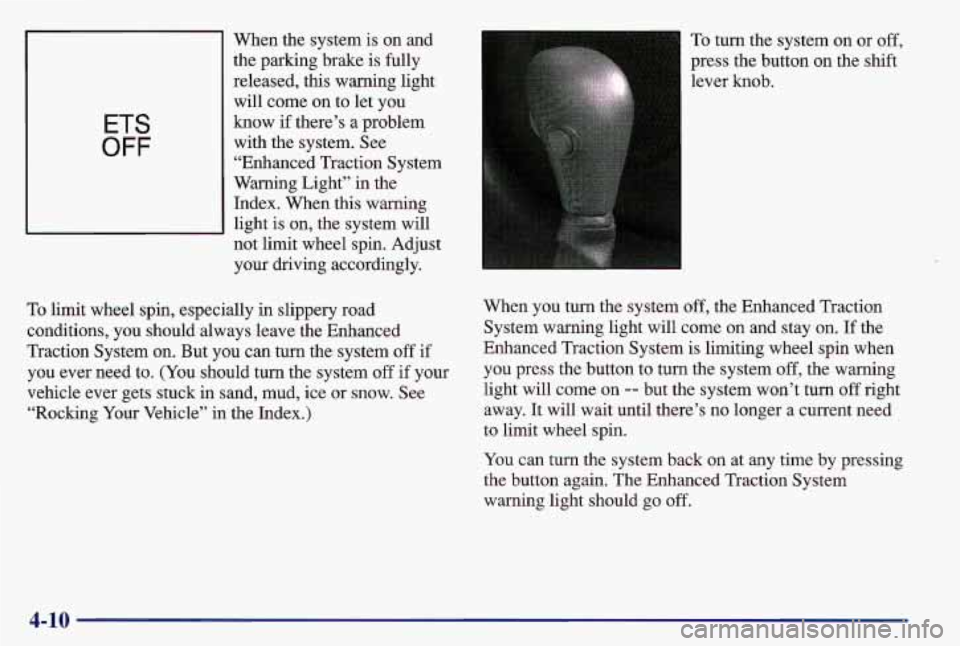
turn the system on or off,
press the button on the shift
lever knob.
When you turn the system off, the Enhanced Traction
System warning light will come
on and stay on. If the
Enhanced Traction System is limiting wheel spin when
you press the button to turn the system off, the warning
light will come on
-- but the system won’t turn off right
away. It will wait until there’s no longer a current need
to limit wheel spin.
You can turn the system back on at any time by pressing
the button again. The Enhanced Traction System
warning light should go
off.
4-10
Page 172 of 371
City Driving
One of the biggest problems with city streets is the
amount of traffic on them. You’ll want to watch out for
what the other drivers are doing and pay attention to
traffic signals. Here are ways to increase your safety
in city driving:
0 Know the best way to get to where you are going.
Get a city map and plan your trip into an unknown
part of the city just as you would for a
cross-country trip.
0 Try to use the freeways that rim and crisscross most
large cities. You’ll save time and energy. (See the
next part, “Freeway Driving.”)
Treat a green light as a warning signal. A traffic light is
there because the corner is busy enough to need it.
When a light
turns green, and just before you start to e
move, check both ways for vehicles that have not
cleared the intersection or may be running the red light.
4-21
Page 177 of 371

Winter Driving U
Here are some tips for winter driving:
0 Have your Pontiac in good shape for winter.
YOU may want to put winter emergency supplies in
your
trunk.
Include an ice scraper, a small brush or broom, a supply
of windshield washer fluid, a rag, some winter outer
clothing, a small shovel, a flashlight, a red cloth and a
couple
of reflective warning triangles. And, if you will
be driving under severe conditions, include a small bag
of sand, a piece of old carpet or a couple of burlap bags
to help provide traction. Be sure you properly secure
these items in your vehicle.
4-26
Page 207 of 371
Engine Overheating
You will find a coolant temperature gage and a low
coolant warning light on your Pontiac’s instrument
panel. See “Engine Coolant Temperature Gage”
and
“Low Coolant Warning Light” in the Index.
If Steam Is Coming From Your Engine
A CAUTION:
I
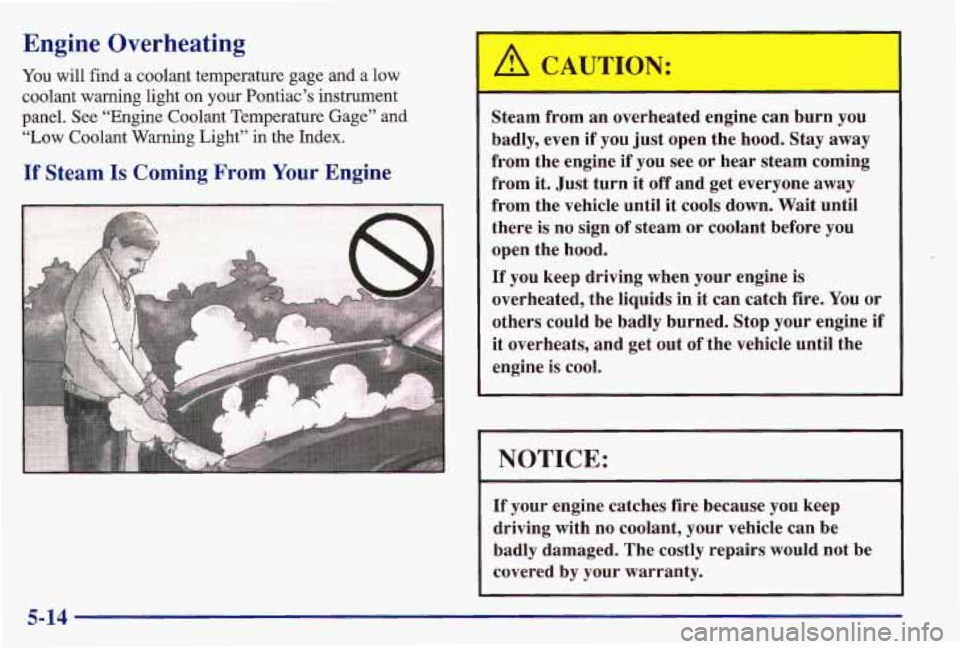
Steam from an overheated engine can burn you
badly, even if you just open the hood. Stay away
from the engine if you see or hear steam coming
from it. Just turn it off and get everyone away
from the vehicle until it cools down. Wait until
there is no sign of steam or coolant before
you
open the hood.
If you keep driving when your engine is
overheated, the liquids in it can catch fire.
You or
others could be badly burned. Stop your engine
if
it overheats, and get out of the vehicle until the
engine is cool.
NOTICE:
If your engine catches fire because you keep
driving with no coolant, your vehicle can be
badly damaged. The costly repairs would not be covered
by your warranty.
Page 251 of 371

When to Check and What to Use
Refer to the Maintenance Schedule to determine how
often you should check the
fluid level in your clutch
master cylinder reservoir
and for the proper fluid. See
“Owner Checks and
Services” and
“Recommended Fluids and
Lubricants” in the Index.
., , I . ...
How to Check
The proper fluid should be added if the level is at or
below the STEP mark on the reservoir cap. See the
instructions on the reservoir cap.
Engine Coolant
The cooling s stem in your vehicle is filled with new
DEX-COOL
J engine coolant. This coolant is designed
to remain in your vehicle for
5 years or 150,000 miles
(240
000 krn) whichever occurs first, if you add only
DEX-COOLd extended life coolant.
The following explains
your cooling system and how to
add coolant when it is low. If you have a problem with
engine overheating, see “Engine Overheating” in
the Index.
A 50/50 mixture of water and the proper coolant for
your Pontiac will:
0 Give freezing protection down to -34°F (-37°C).
0 Give boiling protection up to 265 OF (1 29 O C).
0 Protect against rust and corrosion.
Help keep the proper engine temperature.
Let the warning lights and gages work as
they should.
6-24
Page 254 of 371

A CAUTION:
nrning the surge tank pressure cap when the
engine and radiator are hot can allow steam and
scalding liquids to blow out and burn you badly.
Never turn the surge tank pressure cap
-- even a
little
-- when the engine and radiator are hot,
When your engine is cold, the coolant level should be at
the
FULL COLD mark, or a little higher.
If the low coolant light
comes on, it means you’re
low on engine coolant.
~ ~~~
See “Low Coolant Warning Light” in the Index. Adding Coolant
If you need
more coolant, add the proper DEX-COOL’
coolant mixture
at the surge tank, but only when the
engine is
cool.
A CAUTION:
You can be burned if you spill coolant on hot
engine parts. Coolant contains ethylene glycol,
and it will burn if the engine parts are hot
enough. Don’t spill coolant on a hot engine.
1
When replacing the pressure cap, make sure it is tight.
6-27