engine PONTIAC GRAND AM 1997 Owner's Guide
[x] Cancel search | Manufacturer: PONTIAC, Model Year: 1997, Model line: GRAND AM, Model: PONTIAC GRAND AM 1997Pages: 371, PDF Size: 18.14 MB
Page 121 of 371
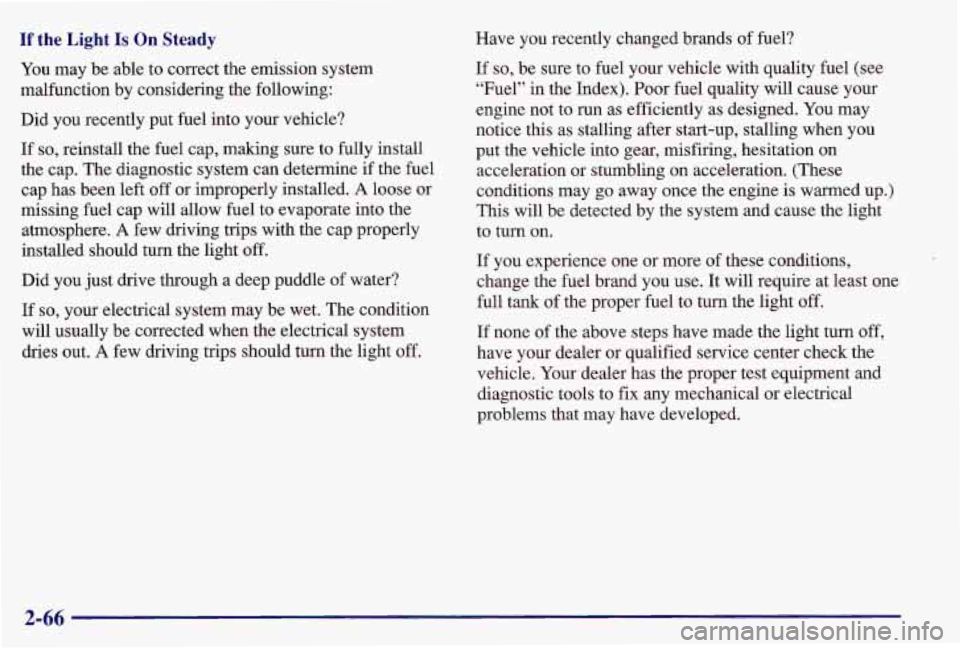
If the Light Is On Steady
You may be able to correct the emission system
malfunction by considering the following:
Did you recently put fuel into your vehicle?
If so, reinstall the fuel cap, making sure to fully install
the cap. The diagnostic system can determine
if the fuel
cap has been left off or improperly installed.
A loose or
missing fuel cap will allow fuel to evaporate into the
atmosphere.
A few driving trips with the cap properly
installed should turn the light off.
Did you just drive through a deep puddle of water?
If
so, your electrical system may be wet. The condition
will usually be corrected when the electrical system
dries out.
A few driving trips should turn the light off. Have
you recently changed brands of fuel?
If
so, be sure to fuel your vehicle with quality fuel (see
“Fuel” in the Index). Poor fuel quality will cause your
engine not to run as efficiently as designed. You may
notice this as stalling after start-up, stalling when you
put the vehicle into gear, misfiring, hesitation on
acceleration or stumbling on acceleration. (These
conditions may go away once the engine is warmed up.)
This will be detected by the system and cause the light
to
turn on.
If you experience one or more of these conditions,
change the fuel brand you use. It will require at least one
full tank of the proper fuel to turn the light off.
If none of the above steps have made the light turn off,
have your dealer or qualified service center check the
vehicle. Your dealer has the proper test equipment and
diagnostic tools to fix any mechanical or electrical
problems that may have developed.
2-66
Page 122 of 371
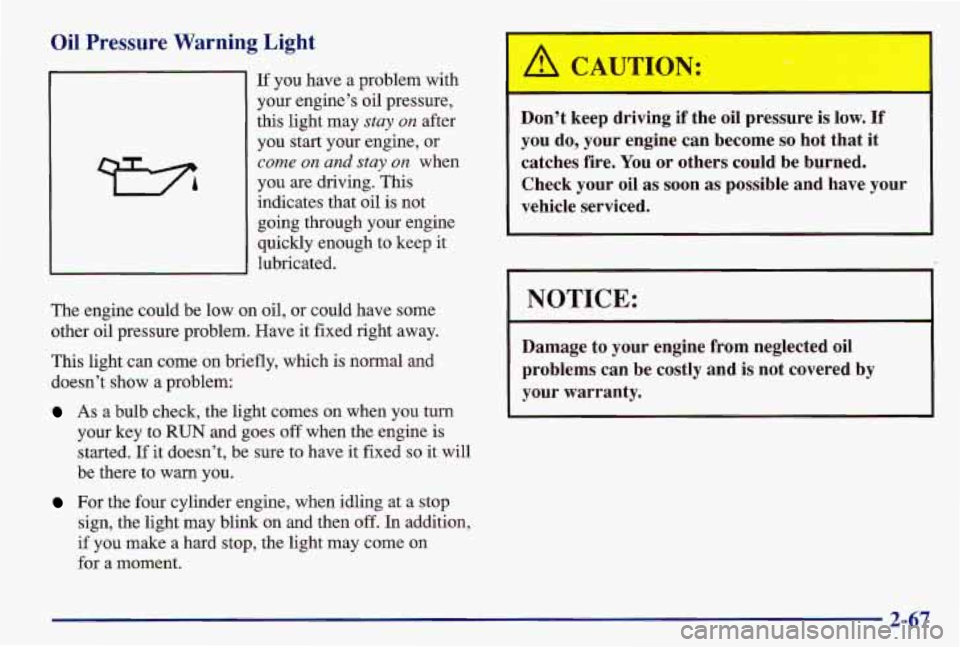
Oil Pressure Warning Light
If you have a problem with
your engine’s oil pressure,
this light may
stay on after
you start your engine, or
come on and stay on when
you are driving. This
indicates that oil is not
going through your engine
quickly enough to keep it
lubricated.
The engine could be low on oil, or could have some
other oil pressure problem. Have it fixed right away.
This light can come on briefly, which is normal and
doesn’t show a problem:
As a bulb check, the light comes on when you turn
your key to
RUN and goes off when the engine is
started.
If it doesn’t, be sure to have it fixed so it will
be there to warn you.
For the four cylinder engine, when idling at a stop
sign, the light may blink on and then off. In addition,
if you make a hard stop, the light may come on
for
a moment. Don’t
keep driving
if the oil pressure is low. If
you do, your engine can become so hot that it
catches fire. You or others could be burned.
Check your
oil as soon as possible and have your
vehicle serviced.
I I
NOTICE:
Damage to your engine from neglected oil
problems can be costly and is not covered by
your warranty.
2-67
Page 123 of 371
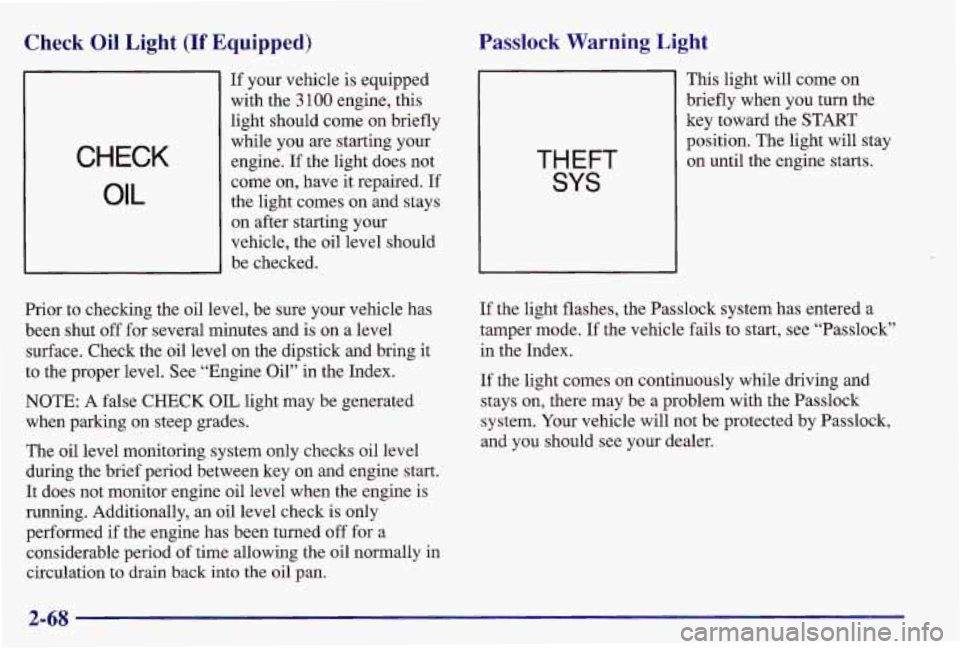
Check Oil Light (If Equipped)
CHECK
OIL
If your vehicle is equipped
with the
3 100 engine, this
light should come on briefly
while you are starting your engine.
If the light does not
come on, have it repaired. If
the light comes on and stays on after starting your
vehicle, the oil level should
be checked.
Prior to checking the oil level, be sure your vehicle has been shut off for several minutes and is on a level
surface. Check the oil level on the dipstick and bring it
to the proper level. See “Engine Oil” in the Index.
NOTE: A false
CHECK OIL light may be generated
when parking on steep grades.
The oil level monitoring system only checks oil level
during the brief period between key on and engine start.
It does not monitor engine oil level when the engine is
running. Additionally,
an oil level check is only
performed if the engine has been turned
off for a
considerable period
of time allowing the oil normally in
circulation
to drain back into the oil pan.
Passlock Warning Light
THEFT
SYS
This light will come on
briefly when you turn the
key toward the START
position. The light will stay
on until the engine starts.
If the light flashes, the Passlock system has entered a
tamper mode. If the vehicle fails to start, see “Passlock”
in the Index.
If the light comes on continuously while driving and
stays
on, there may be a problem with the Passlock
system. Your vehicle will not be protected by Passlock,
and
you should see your dealer.
2-68
Page 128 of 371
d HEATER: This setting brings heated air through
the heater ducts, and
some through the windshield
defroster vents.
If you have the optional engine coolant heater (engine
block heater) and use it during cold weather,
0°F
(- 18°C) or lower, your heating system will more quickly
provide heat because the engine coolant is already
warmed. See “Engine Coolant Heater” in the Index.
9 BLEND: This setting divides airflow equally
between the heater ducts and the windshield defroster
vents.
DEFROST This setting directs air through the
windshield defroster vents located on top
of the
instrument panel.
Climate Control System with
Air Conditioning
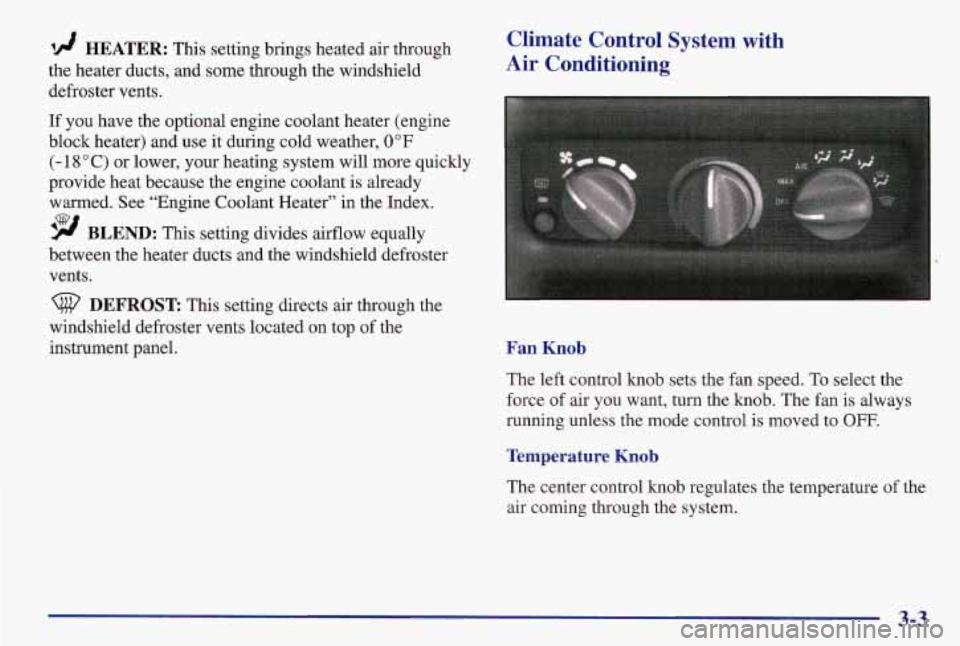
Fan Knob
The left control knob sets the fan speed. To select the
force of air
you want, turn the knob. The fan is always
running unless the mode control is moved
to OFF.
Temperature Knob
The center control knob regulates the temperature of the
air coming through the system.
3-3
Page 129 of 371
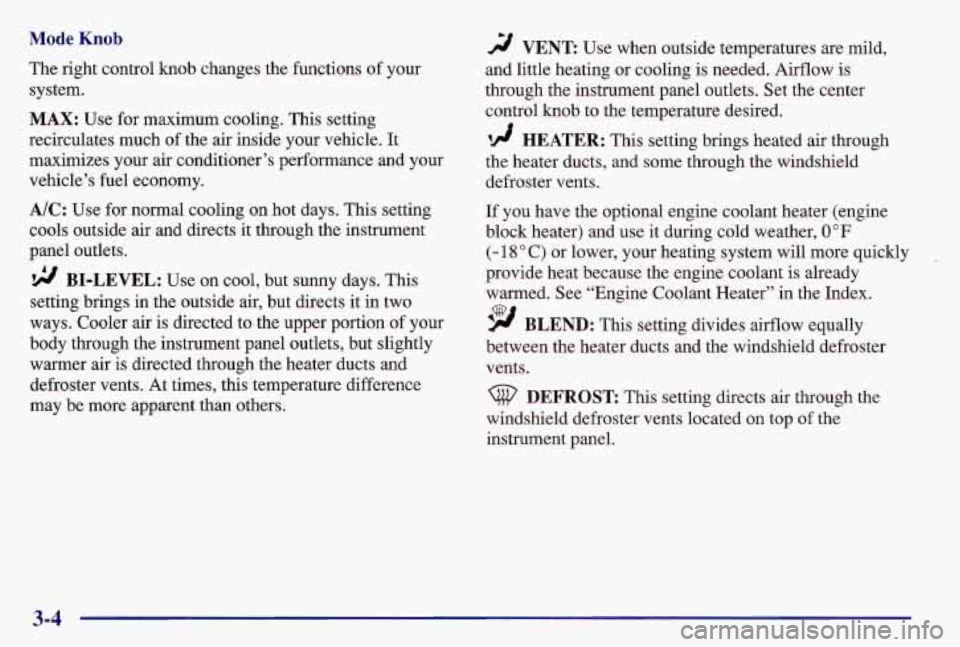
Mode Knob
The right control knob changes the functions of your
system.
MAX: Use for maximum cooling. This setting
recirculates much of the air inside your vehicle. It
maximizes your air conditioner’s performance and your
vehicle’s fuel economy.
A/C: Use for normal cooling on hot days. This setting
cools outside air and directs it through the instrument
panel outlets.
9 BI-LEVEL: Use on cool, but sunny days. This
setting brings in the outside air, but directs it in two
ways. Cooler air is directed to the upper portion
of your
body through the instrument panel outlets, but slightly
warmer air is directed through the heater ducts and
defroster vents. At times, this temperature difference
may be more apparent than others.
2 VENT Use when outside temperatures are mild,
and little heating or cooling is needed. Airflow is
through the instrument panel outlets. Set the center
control knob to the temperature desired.
‘!A HEATER: This setting brings heated air through
the heater ducts, and some through the windshield
defroster vents.
If you have the optional engine coolant heater (engine
block heater) and use it during cold weather,
0°F
(- 18 O C) or lower, your heating system will more quickly
provide heat because the engine coolant is already
warmed. See “Engine Coolant Heater” in the Index.
9 BLEND: This setting divides airflow equally
between the heater ducts and the windshield defroster
vents.
DEFROST This setting directs air through the
windshield defroster vents located on top of the
instrument panel.
3-4
Page 130 of 371
Air Conditioning Heating
Turning
the right control knob to HEATER and the
center control knob clockwise sends some heated air
through the heater ducts toward your feet, and some
through the defroster vents.
On very
hot days, open the windows long enough to let
hot, inside air escape. This reduces the time
it takes for
your vehicle to cool down, which should help fuel
economy.
For quick cool-down on very hot days, use MAX with
the temperature knob all the way in the blue area.
If the
setting is used for long periods of time, the air in your
vehicle may become too dry.
For normal cooling on hot days, use
NC with the
temperature knob in the blue area. The system will bring
in outside air and cool it.
On cool but sunny days, the sun may warm your upper
body, but your lower body may not be warm enough. You
can use
BI-LEVEL with the temperature knob in the
middle. The system will bring in outside air and direct
it
to your upper body, while sending slightly warmed air to
your lower body. You may notice this temperature
difference more at some times than at others. VENT
and HEATER are economical positions because
the air conditioner compressor doesn’t run in these
two settings. This reduces engine load, resulting in
improved fuel economy.
If either setting fails to keep
you comfortable, or causes your windows to fog up, turn
the right control knob to one of the air conditioning
positions, or to DEFROST.
If you have the optional engine coolant heater
(engine block heater) and use
it during cold weather,
0 “F (- 18 O C) or lower, your heating system will more
quickly provide heat because the engine coolant is
already warmed. See “Engine Coolant Heater” in
the Index.
3-5
Page 133 of 371
Audio Systems
Your Delco@ audio system has been designed to operate
easily and give years of listening pleasure. You will get
the most enjoyment out of it if you acquaint yourself
with it first. Find out what your Delco system can do
and how to operate all its controls, to be sure you’re
getting the most out of the advanced engineering that
went into it.
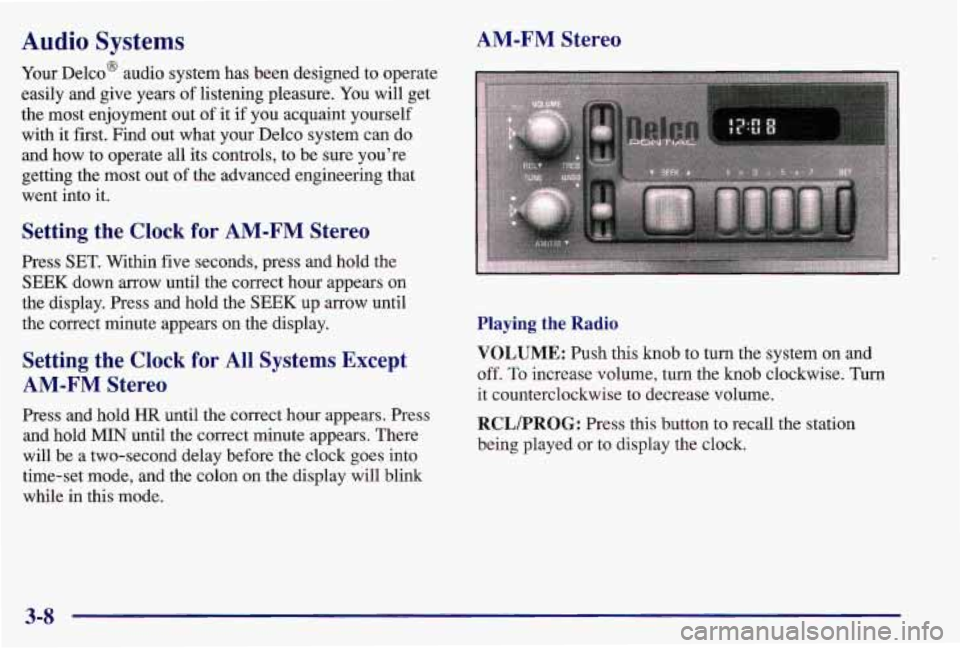
Setting the Clock for AM-FM Stereo
Press SET. Within five seconds, press and hold the
SEEK down arrow until the correct hour appears on
the display. Press and hold the
SEEK up arrow until
the correct minute appears on the display.
Setting the Clock for All Systems Except
AM-FM Stereo
Press and hold HR until the correct hour appears. Press
and hold
MIN until the correct minute appears. There
will be a two-second delay before the clock goes into
time-set mode, and the colon on the display will blink
while in this mode.
AM-FM Stereo
Playing the Radio
VOLUME: Push this knob to turn the system on and
off.
To increase volume, turn the knob clockwise. Turn
it counterclockwise to decrease volume.
RCL/PROG: Press this button to recall the station
being played or to display the clock.
3-8
Page 149 of 371
Tips About Your Audio System
Hearing damage from loud noise is almost undetectable
until
it is too late. Your hearing can adapt to higher
volumes of sound. Sound that seems normal can be
loud and harmful
to your hearing. Take precautions by
adjusting the volume control on your radio to a safe
sound level before your hearing adapts to it.
To help avoid hearing loss or damage:
0 Adjust the volume control to the lowest setting.
0 Increase volume slowly until you hear comfortably
and clearly.
NOTICE:
Before you add any sound equipment to your
vehicle
9- like a tape player, CB radio, mobile
telephone or two-way radio
-- be sure you can
add what you want. If you can, it’s very
important to do it properly. Added sound
equipment may interfere with the operation of
your vehicle’s engine, Deico radio or other
systems, and even damage them. Your vehicle’s
systems may interfere with the operation of
sound equipment that has been added
improperly.
So, before adding sound equipment, check with
your dealer and be sure to check Federal rules
covering mobile radio and telephone units.
3-24
Page 158 of 371
Avoid needless heavy braking. Some people drive in
spurts
-- heavy acceleration followed by heavy
braking
-- rather than keeping pace with traffic. This is a
mistake. Your brakes may
not have time to cool between
hard stops. Your brakes will wear out much faster if you
do a lot of heavy braking. If you keep pace with the
traffic and allow realistic following distances, you will
eliminate a lot
of unnecessary braking. That means
better braking and longer brake life.
If your engine ever stops while you’re driving, brake
normally but don’t pump your brakes. If you do, the
pedal may get harder to push down.
If your engine
stops, you will still have some power brake assist. But
you will use it when you brake. Once the power assist is
used up, it may take longer
to stop and the brake pedal
will be harder to push.
Anti-Lock Brakes (ABS)
Your vehicle has anti-lock brakes (ABS). ABS is an
advanced electronic braking system that will help
prevent a braking skid.
When you start your engine, or when you begin to drive
away, your anti-lock brake system will check itself. You
may hear a momentary motor or clicking noise while
this test is going on, and you may even notice that your
brake pedal moves a little. This is normal.
If there’s a problem with
the anti-lock brake system,
this warning light will stay
on. See “Anti-Lock Brake
System Warning Light” in
the Index.
4-7
Page 160 of 371
As you brake, your computer keeps receiving updates on
wheel speed and controls braking pressure accordingly.
Remember: Anti-lock doesn’t change the time you need
to get your foot up to the brake pedal or always decrease
stopping distance. If you get too close
to the vehicle in
front of you, you won’t have time to apply your brakes
if that vehicle suddenly slows or stops. Always leave
enough room up ahead to
stop, even though you have
anti-lock brakes.
Using Anti-Lock
Don’t pump the brakes. Just hold the brake pedal down
and let anti-lock work for you. You may feel the system
working, or you may notice some noise, but this is normal.
Enhanced Traction System (If Equipped)
If your vehicle has the optional four-speed automatic
transaxle, it also has an Enhanced Traction System
(ETS) that limits wheel spin. This is especially useful in
slippery road conditions. The system operates only
if it
senses that one or both
of the front wheels are spinning
or beginning to lose traction. When this happens, the
system reduces engine power and may also upshift the
transaxle to limit wheel spin.
LOW
TRAC
This light will come on
when your Enhanced
Traction System is limiting
wheel spin. See “Enhanced
Traction System Active Light” in the Index.
You
may feel or hear the system
working, but this is normal.
The Enhanced Traction System operates in all transaxle shift lever positions. But the system can upshift the
transaxle only as high
as the shift lever position you’ve
chosen,
so you should use the lower gears only when
necessary. See “Automatic Transaxle” in the Index.
4-9