lock PONTIAC GRAND AM 2004 Owner's Guide
[x] Cancel search | Manufacturer: PONTIAC, Model Year: 2004, Model line: GRAND AM, Model: PONTIAC GRAND AM 2004Pages: 364, PDF Size: 2.48 MB
Page 99 of 364
Leaving Your Vehicle With the Engine
Running (Automatic Transaxle Only)
{CAUTION:
It can be dangerous to leave your vehicle with
the engine running. Your vehicle could move
suddenly if the shift lever is not fully in
PARK (P) with the parking brake rmly set.
And, if you leave the vehicle with the engine
running, it could overheat and even catch re.
You or others could be injured. Do not leave
your vehicle with the engine running.
If you have to leave your automatic transaxle vehicle
with the engine running, be sure your vehicle is in
PARK (P) and your parking brake is firmly set before
you leave it. After you’ve moved the shift lever into
PARK (P), hold the regular brake pedal down. Then, see
if you can move the shift lever away from PARK (P)
without first pushing the button.
If you can, it means that the shift lever wasn’t fully
locked into PARK (P).
Torque Lock
If you are parking on a hill and you don’t shift your
automatic transaxle into PARK (P) properly, the weight
of the vehicle may put too much force on the parking
pawl in the transaxle. You may find it difficult to pull the
shift lever out of PARK (P). This is called “torque
lock.” To prevent torque lock, set the parking brake and
then shift into PARK (P) properly before you leave
the driver’s seat. To find out how, see “Shifting Into Park
(P)” previously in the section.
When you are ready to drive, move the shift lever out of
PARK (P)beforeyou release the parking brake.
If torque lock does occur, you may need to have another
vehicle push yours a little uphill to take some of the
pressure from the parking pawl in the transaxle, so you
can pull the shift lever out of PARK (P).
2-31
Page 100 of 364
Shifting Out of Park (P)
If your vehicle has an automatic transaxle, it has an
automatic transaxle shift lock control system which locks
the shift lever in PARK when the ignition is in the
(OFF/OFF LOCK) position. In addition, you have to fully
apply your regular brakes before you can shift from
PARK (P) when the ignition is in RUN (ON). See
Automatic Transaxle Operation on page 2-24.
If you cannot shift out of PARK (P), ease pressure on
the shift lever and push the shift lever all the way
into PARK (P) as you maintain brake application. Then
move the shift lever into the gear you want.
If you hold the brake pedal down but still can’t shift out
of PARK (P), try this:
1. Turn the ignition key to (OFF/ACCESSORY). There
is no shift interlock in this key position.
2. Apply and hold the brake until the end of Step 4.3. Shift the transaxle to NEUTRAL (N).
4. Start the vehicle and then shift to the gear you
want.
5. Have the system fixed as soon as possible.
Parking Your Vehicle/Key Removal
Before leaving your manual transaxle model vehicle,
fully press the clutch pedal in, move the shift lever into
REVERSE (R) and firmly apply the parking brake.
Once the shift lever has been placed in REVERSE (R)
with the clutch pedal pressed in, you can turn the
ignition key to OFF, remove the key and release the
clutch. SeeManual Transaxle Operation on page 2-27.
2-32
Page 107 of 364
Instrument Panel Overview...............................3-2
Hazard Warning Flashers................................3-4
Other Warning Devices...................................3-5
Horn.............................................................3-5
Tilt Wheel.....................................................3-5
Turn Signal/Multifunction Lever.........................3-6
Windshield Wiper Lever...................................3-9
Cruise Control..............................................3-10
Exterior Lamps.............................................3-14
Interior Lamps..............................................3-17
Ashtrays and Cigarette Lighter........................3-18
Climate Controls............................................3-19
Climate Control System.................................3-19
Outlet Adjustment.........................................3-21
Warning Lights, Gages, and Indicators............3-22
Instrument Panel Cluster................................3-23
Speedometer and Odometer...........................3-24
Tachometer.................................................3-24
Safety Belt Reminder Light.............................3-25
Air Bag Readiness Light................................3-25
Charging System Light..................................3-26
Up-Shift Light...............................................3-26
Brake System Warning Light..........................3-27
Anti-Lock Brake System
Warning Light...........................................3-28
Enhanced Traction System
Warning Light...........................................3-28Enhanced Traction System
Active Light..............................................3-29
Engine Coolant Temperature Gage..................3-30
Low Coolant Warning Light............................3-30
Malfunction Indicator Lamp.............................3-31
Oil Pressure Light.........................................3-34
Change Engine Oil Light................................3-35
Security Light...............................................3-35
Low Washer Fluid Warning Light.....................3-36
Service Vehicle Soon Light............................3-36
Fuel Gage...................................................3-37
Audio System(s).............................................3-38
Setting the Time for Radios without Radio
Data Systems (RDS)..................................3-38
Setting the Time for Radios with Radio Data
Systems (RDS).........................................3-38
Radio with CD (Base Level)...........................3-39
Radio with CD (Up Level)..............................3-43
Radio with CD (MP3)....................................3-54
Theft-Deterrent Feature..................................3-68
Audio Steering Wheel Controls.......................3-69
Radio Reception...........................................3-70
Care of Your CDs.........................................3-70
Care of Your CD Player................................3-70
Fixed Mast Antenna......................................3-71
XM™ Satellite Radio Antenna System.............3-71
Chime Level Adjustment................................3-71
Section 3 Instrument Panel
3-1
Page 109 of 364
The main components of your instrument panel are the following:
A. Fog Lamp Button (If Equipped). See “Fog Lamps” in
Exterior Lamps on page 3-14.
B. Instrument Panel Brightness Thumbwheel. See
“Instrument Panel Brightness” inInterior Lamps on
page 3-17.
C. Turn Signal/Multifunction Lever. SeeTurn
Signal/Multifunction Lever on page 3-6.
D. Horn. SeeHorn on page 3-5.
E. Instrument Panel Cluster. SeeInstrument Panel
Cluster on page 3-23.
F. Windshield Wiper/Washer Lever. SeeWindshield
Wiper Lever on page 3-9.
G. Ignition Switch. SeeIgnition Positions on page 2-18.
H. Enhanced Traction System Button (If Equipped).
SeeEnhanced Traction System (ETS) on page 4-9.
I. Hazard Warning Flashers Button. SeeHazard
Warning Flashers on page 3-4.J. Instrument Panel Fuse Blocks. SeeFuses and
Circuit Breakers on page 5-87.
K. Hood Release Handle. SeeHood Release on
page 5-10.
L. Tilt Wheel Lever. SeeTilt Wheel on page 3-5.
M. Audio System Steering Wheel Controls (If Equipped).
SeeAudio Steering Wheel Controls on page 3-69.
N. Cruise Control Buttons (If Equipped). SeeCruise
Control on page 3-10.
O. Shift Lever. SeeAutomatic Transaxle Operation on
page 2-24.
P. Cigarette Lighter. SeeAshtrays and Cigarette
Lighter on page 3-18.
Q. Climate Control System. SeeClimate Control
System on page 3-19.
R. Audio System. SeeAudio System(s) on page 3-38.
3-3
Page 111 of 364
Other Warning Devices
If you carry reflective triangles, you can set one up at
the side of the road about 300 feet (100 m) behind your
vehicle.
Horn
You can sound the horn by pressing the horn symbol on
your steering wheel.
Tilt Wheel
A tilt wheel allows you to adjust the steering wheel
before you drive. You can raise it to the highest level to
give your legs more room when you exit and enter
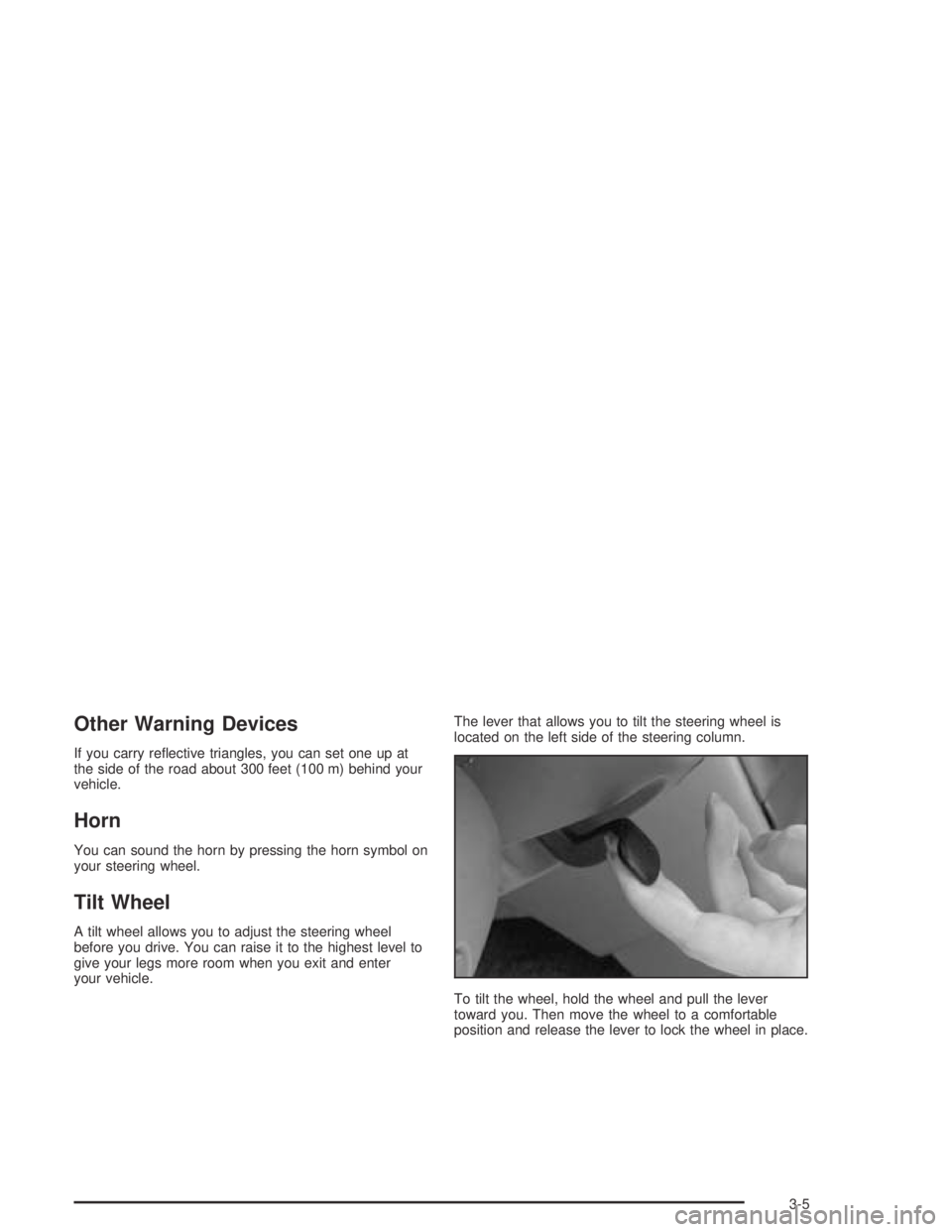
your vehicle.The lever that allows you to tilt the steering wheel is
located on the left side of the steering column.
To tilt the wheel, hold the wheel and pull the lever
toward you. Then move the wheel to a comfortable
position and release the lever to lock the wheel in place.
3-5
Page 116 of 364
Windshield Washer
To wash your windshield, press the button at the end of
the lever until the washers begin.
{CAUTION:
In freezing weather, do not use your washer
until the windshield is warmed. Otherwise the
washer uid can form ice on the windshield,
blocking your vision.
When you release the button, the washers will stop, but
the wipers will continue to wipe for about three times
or will resume the speed you were using before.
Cruise Control
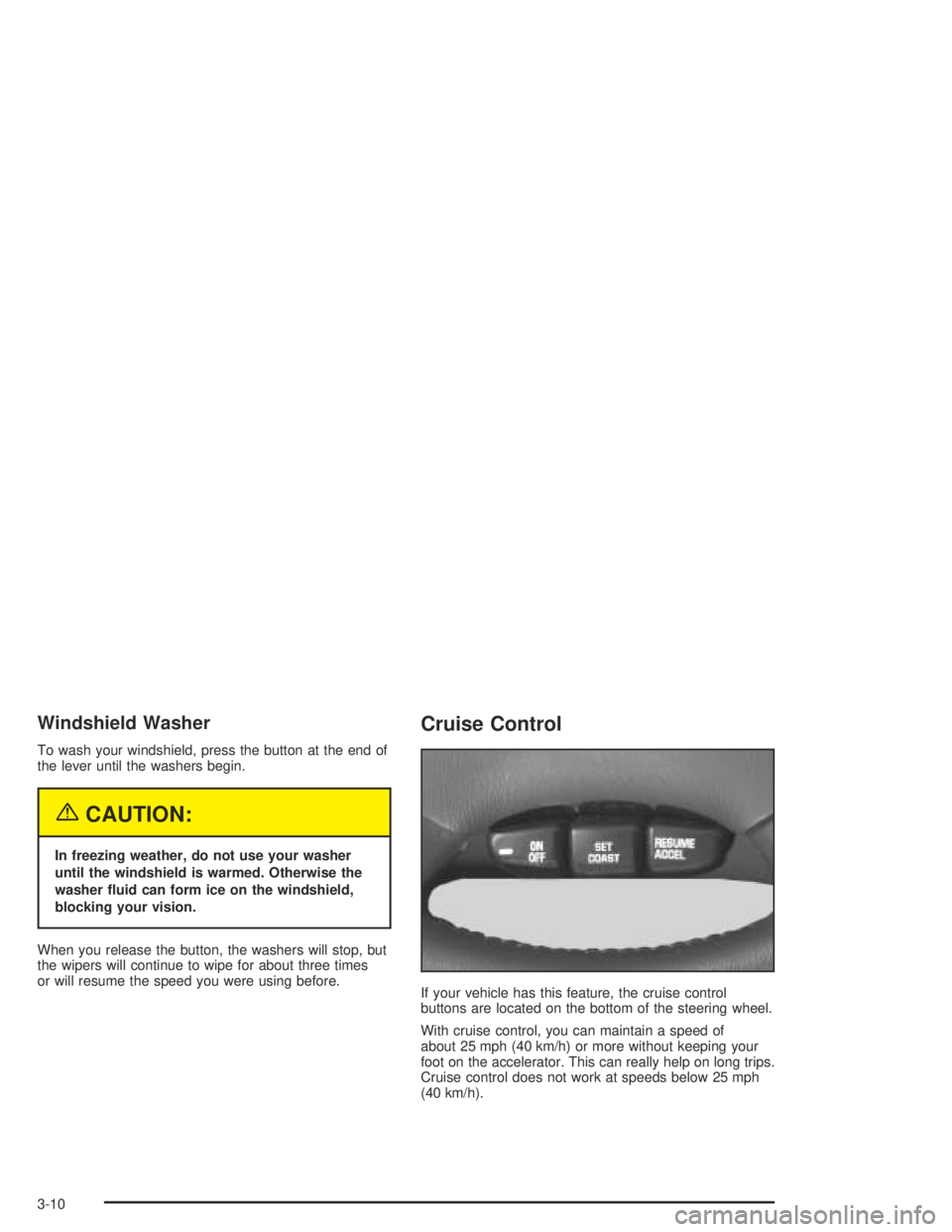
If your vehicle has this feature, the cruise control
buttons are located on the bottom of the steering wheel.
With cruise control, you can maintain a speed of
about 25 mph (40 km/h) or more without keeping your
foot on the accelerator. This can really help on long trips.
Cruise control does not work at speeds below 25 mph
(40 km/h).
3-10
Page 123 of 364
Interior Lamps
Instrument Panel Brightness
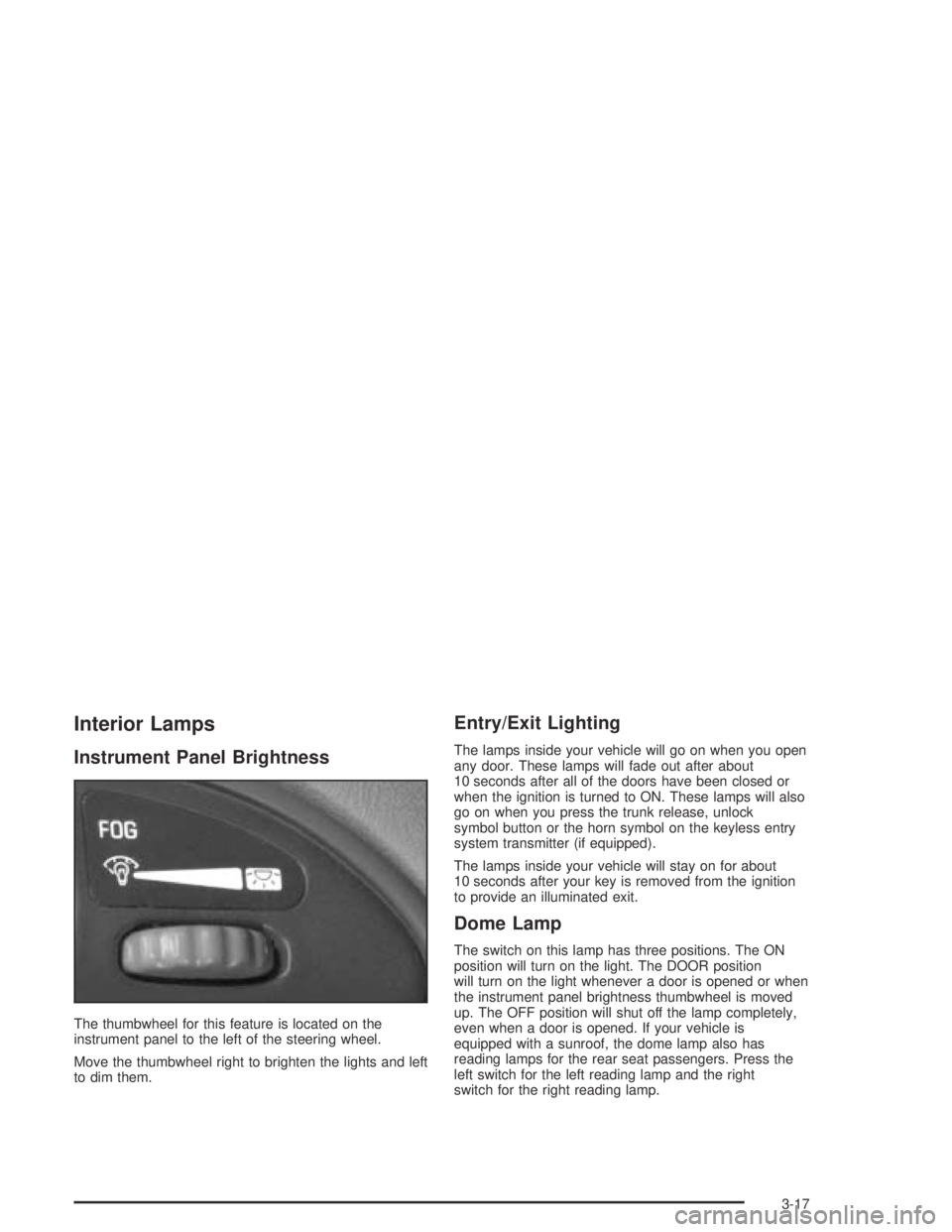
The thumbwheel for this feature is located on the
instrument panel to the left of the steering wheel.
Move the thumbwheel right to brighten the lights and left
to dim them.
Entry/Exit Lighting
The lamps inside your vehicle will go on when you open
any door. These lamps will fade out after about
10 seconds after all of the doors have been closed or
when the ignition is turned to ON. These lamps will also
go on when you press the trunk release, unlock
symbol button or the horn symbol on the keyless entry
system transmitter (if equipped).
The lamps inside your vehicle will stay on for about
10 seconds after your key is removed from the ignition
to provide an illuminated exit.
Dome Lamp
The switch on this lamp has three positions. The ON
position will turn on the light. The DOOR position
will turn on the light whenever a door is opened or when
the instrument panel brightness thumbwheel is moved
up. The OFF position will shut off the lamp completely,
even when a door is opened. If your vehicle is
equipped with a sunroof, the dome lamp also has
reading lamps for the rear seat passengers. Press the
left switch for the left reading lamp and the right
switch for the right reading lamp.
3-17
Page 124 of 364
Trunk Lamp
The trunk lamp comes on when you open your trunk.
Battery Run-Down Protection
Your vehicle has a battery run-down feature designed to
protect your vehicle’s battery.
When any interior lamp (trunk, reading lamps, dome
lamp or glove box) is left on when the ignition is turned
off, the battery run-down protection system will
automatically shut the lamp off after 20 minutes. This
will avoid draining the battery.
To reactivate the interior lamps, do one of the following:
•Lift the driver’s door handle,
•open any door or
•press any remote keyless entry transmitter button
(if equipped),
•press the power door lock switch,
•press the remote trunk release or
•turn the lamp that was left on to off and then to
on again.
Ashtrays and Cigarette Lighter
To use the lighter, push it in all the way and let go.
Notice:If you put papers or other ammable items
in the ashtray, hot cigarettes or other smoking
materials could ignite them and possibly damage
your vehicle. Never put ammable items in the
ashtray.
Notice:Holding a cigarette lighter in while it is
heating will not allow the lighter to back away from
the heating element when it is hot. Damage from
overheating may occur to the lighter or heating
element. Do not hold a cigarette lighter in while it is
heating.
3-18
Page 125 of 364
Climate Controls
Climate Control System
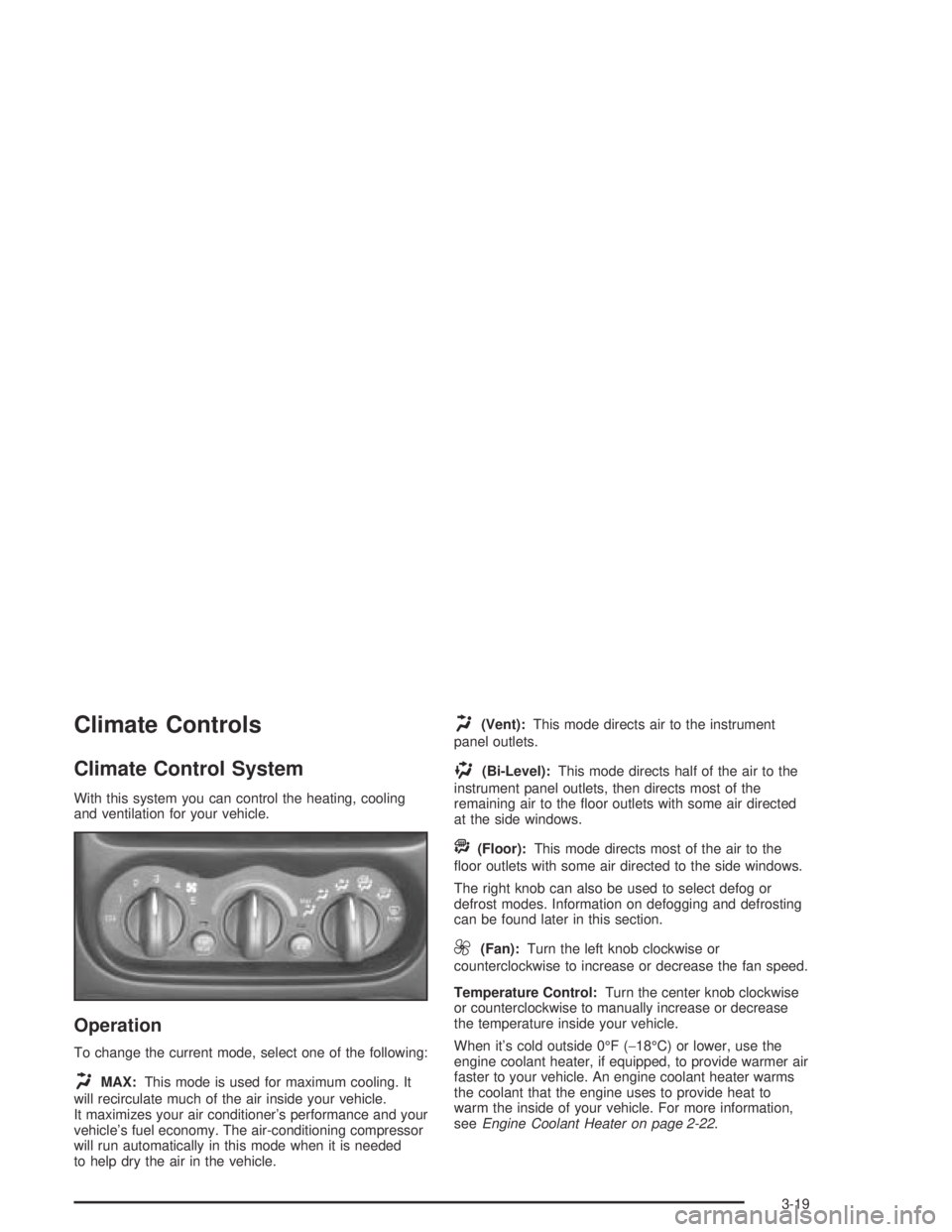
With this system you can control the heating, cooling
and ventilation for your vehicle.
Operation
To change the current mode, select one of the following:
HMAX:This mode is used for maximum cooling. It
will recirculate much of the air inside your vehicle.
It maximizes your air conditioner’s performance and your
vehicle’s fuel economy. The air-conditioning compressor
will run automatically in this mode when it is needed
to help dry the air in the vehicle.
H(Vent):This mode directs air to the instrument
panel outlets.
)(Bi-Level):This mode directs half of the air to the
instrument panel outlets, then directs most of the
remaining air to the floor outlets with some air directed
at the side windows.
A(Floor):This mode directs most of the air to the
floor outlets with some air directed to the side windows.
The right knob can also be used to select defog or
defrost modes. Information on defogging and defrosting
can be found later in this section.
9(Fan):Turn the left knob clockwise or
counterclockwise to increase or decrease the fan speed.
Temperature Control:Turn the center knob clockwise
or counterclockwise to manually increase or decrease
the temperature inside your vehicle.
When it’s cold outside 0°F (−18°C) or lower, use the
engine coolant heater, if equipped, to provide warmer air
faster to your vehicle. An engine coolant heater warms
the coolant that the engine uses to provide heat to
warm the inside of your vehicle. For more information,
seeEngine Coolant Heater on page 2-22.
3-19
Page 126 of 364
A/C (Air Conditioning):Press this button to turn the
air-conditioning system on or off. When A/C is pressed,
an indicator light above the button will come on to let
you know that air conditioning is activated. The fan knob
must be set to a speed for the air conditioning to
operate.
On hot days, open the windows to let hot inside air
escape; then close them. This helps to reduce the time
it takes for your vehicle to cool down. It also helps
the system to operate more efficiently.
For quick cool down on hot days:
1. Select the vent mode.
2. Select the highest fan speed.
3. Select A/C.
4. Select the recirculation mode.
5. Select the coolest temperature.
Using these settings together for long periods of time
may cause the air inside of your vehicle to become
to dry. To prevent this from happening, after the air in
your vehicle has cooled, turn the recirculation mode off.
The air-conditioning system removes moisture from
the air, so you may sometimes notice a small amount of
water dripping underneath your vehicle while idling or
after turning off the engine. This is normal.Defogging and Defrosting
Fog on the inside of windows is a result of high humidity
(moisture) condensing on the cool window glass. This
can be minimized if the climate control system is
used properly. There are two modes to choose from to
clear fog or frost from your windshield. Use the
defog mode to clear the windows of fog or moisture and
warm the passengers. Use the defrost mode to
remove fog or frost from the windshield more quickly.
Turn the right knob clockwise or counterclockwise
to select defog or defrost mode.
-(Defog):This mode directs half of the air to the
windshield with most of the remaining air directed to the
floor outlets and some air directed at the side windows.
When you select this mode, the system turns off
recirculation automatically and runs the air-conditioning
compressor unless the outside temperature is at or
below freezing. The recirculation mode cannot be
selected while in the defog mode.
1FRONT (Defrost):This mode directs most of the
air to the windshield, with some air directed to the
floor outlets. In this mode, the system will automatically
turn off recirculation and run the air-conditioning
compressor, unless the outside temperature is at or
below freezing. Recirculation cannot be selected while
in the defrost mode. Do not drive the vehicle until all the
windows are clear.
3-20