check engine PONTIAC GRAND-PRIX 1993 User Guide
[x] Cancel search | Manufacturer: PONTIAC, Model Year: 1993, Model line: GRAND-PRIX, Model: PONTIAC GRAND-PRIX 1993Pages: 338, PDF Size: 17.3 MB
Page 169 of 338
your Driving and the Road
-1
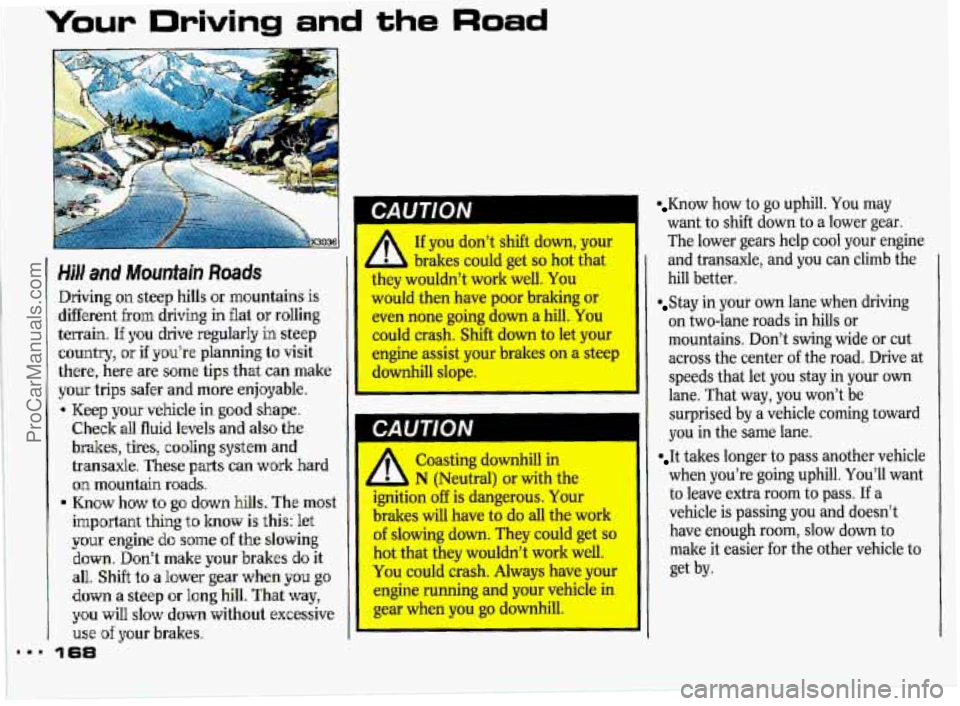
HM and Mountain Roads
Driving on steep hills or mountains is
different fiom driving in flat or rolling
terrain.
If you drive regularly in step
country, or if you’re planning to visit
there, here are some tips that can make
your trips safer and more enjoyable.
* Keep your vehicle in go’od shape.
Check all fluid levels and also the
brakes, tires, co’oling system and
transaxle. These
parts can work hard
~n mountain roads.
. K~QW how to go, down hills. The most
important thing
to how is this: let
your engine do some of the slowing
down. Don’t make your brakes do it
an.. Shift to a lower gear when YQU go
down a steep or long hill. That way,
you will slow down without excessive
use of your brakes.
168
If you don’t shift down, your
brakes could get
so hot that
they wouldn’t work well. You
would then have poor braking or
even none going down a hill.
You
could crash. Shift down to let your
engine assist your brakes on a steep
downhill slope.
I
A Coasting downhill in
- N (Neutral) or with the
* ignition off is dangerous. Your
akes will have
to do all the work
slowing down. They could get
so
riot that they wouldn’t work well.
You could crash. Always have your
Pngine running and your vehicle in
a-ar when you
go downhill.
Know how to go uphill. You may
want to shift down to a lower gear.
The lower gears help
cool your engine
and transaxle, and you can climb the
hill better.
Stay in your own lane when driving
on two-lane roads in hills or
mountains. Don’t swing wide or cut
across the center
of the road. Drive at
speeds that let you stay in your own
lane. That way, you won’t be ’ surprised by a vehicle coming toward
you in the same lane.
It takes longer to pass another vehicle
when you’re going uphill. You’ll want
to leave extra room to pass. If a
vehicle is passing you and doesn’t
have enough room, slow down to
make it easier for the other vehicle to
get by.
ProCarManuals.com
Page 174 of 338
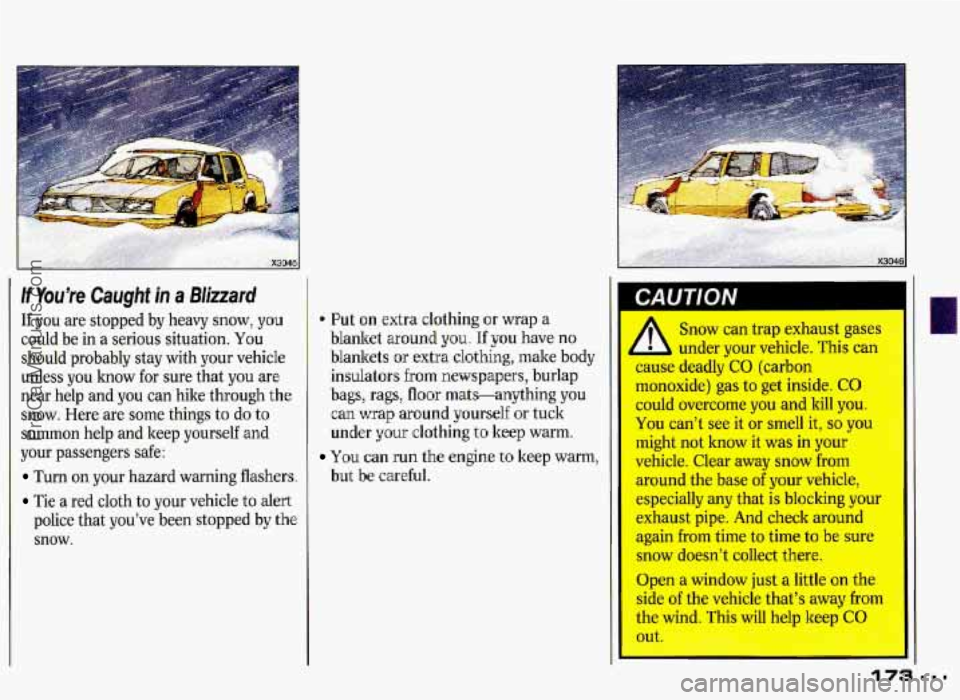
If You’re Caught in a Blizzard
If you are stopped by heavy snow, you
could be in a serious situation. You
should probably stay with your vehicle
unless you
how for sure that you are
near help and you can hike through the
snow. Here are some things
to do to
summon help and keep yourself and
your passengers safe:
Turn on your hazard warning flashers.
Tie a red cloth to your vehicle to alert
police that you’ve been stopped by the
snow.
* Put on extra clothing or wrap a
blanket
around you, If you have no
blankets or extra clothing, make body
insulators
from newspapers, burlap
bags, rags,
floor mats-anything you
can
wrap around yourself or tuck
under
your clothing to keep warm.
but be
careful.
You can run the engine to keep warm,
A Snow can trap exhaust gases
under your vehicle. This can
cause deadly CO (carbon
monoxide) gas to get inside.
CO
could overcome you and kill you.
You can’t see it or smell
it, so you
might not know
it was in your
vehicle. Clear away snow from
around the base of your vehicle,
especially any that
is blocking your
exhaust pipe. And check around
again from time to time to be
sure
snow doesn’t collect there.
Open a window just a little on the
side of the vehicle that’s away from
the wind. This will help keep CO
out.
(17=3.=.
ProCarManuals.com
Page 181 of 338
Your Driving and the Road
Driving with a Trailer (CONT.)
Making Turns
When you’re turning with a trailer,
make wider turns than normal. Do this
so your trailer won’t strike soft
sh’oulders, curbs, road signs, trees, or
other objects. Avoid jerky or sudden
maneuvers. Signal well in advance.
Turn Signals When Towing a Trailer
When you tow a trailer, your vehicle has
to have a different turn signal flasher
and extra wiring. The green arrows on
your instrument panel will flash
whenever you signal
a turn or lane
change. Properly hooked
up, the trailer
lights will also flash, telling other
drivers you’re about to turn, change
lanes or stop.
When towing a trailer, the green arrows
on your instrument panel will flash for
turns even if the bulbs on the trailer are
burned out. Thus, you may think
drivers behind you are seeing your
signal when they are not.
It’s important
to check occasionally
to be sure the
trailer bulbs are still working.
Your vehicle has bulb warning lights.
When you plug trailer lights into your
vehicle’s lighting system, its bulb
warning lights may not let you know if
one of your lights goes out.
So, when
you have trailer lights plugged in, be
sure
to check your vehicle and trailer
lights
from time to time to be sure
they’re all working. Once
you
disconnect the trailer lights, the bulb
warning lights again can tell you if one
of your vehicle lights is out.
Driving On Grades
Reduce speed and shift to a lower gear
before you start down a long or steep
downgrade.
If you don’t shift down, you
might have to use your brakes so much
that they would get hot and
no longer
work well.
On a long uphill grade, shift down and
reduce your speed to around
45 mph
(70 kwh) to reduce the possibility of
engine and transaxle overheating.
If you are towing a trailer and you have
an automatic transaxle with Overdrive,
it’s best to drive in
D instead of (or
as you need to, a lower gear). This will
minimize heat build-up and extend the
life of your transaxle.
ProCarManuals.com
Page 182 of 338
Parking on Hills
You really should not park your vehicle,
with a trailer attached, on a hill.
If
something goes wrong, your rig could
start to move. People can be injured,
and both your vehicle and the trailer
can be damaged.
But if you ever have to park your rig on
a hill, here’s how to do it:
1. Apply your regular brakes, but don’t
shift into
P (Park) yet.
2. Have someone place chocks under
the trailer wheels.
3. When the wheel chocks are in place,
release the regular brakes until the
chocks absorb the load.
4. Reapply the regular brakes. Then
apply your parking brake, and then
shift to
P (Park).
5. Release the regular brakes.
When You Are Ready to Leave After
Parking
on a Hill
1. Apply your regular brakes and hold
the pedal down while you:
Start your engine;
Shift into a gear; and
Release the parking brake.
2. Let up on the brake pedal.
3. Drive slowly until the trailer is clear
4. Stop and have someone pick up and
of
the chocks.
store the choclts.
Maintenance When Trailer Towing
Your vehicle will need service more
often when you’re pulling a trailer. See
the Maintenance Schedule for more on
this. Things that are especially
important in trailer operation
are
automatic transaxle fluid (don’t
overfill), engine oil, belts, cooling
system, and brake adjustment. Each
of
these is covered in this manual, and the
Index will help you find them quickly. If
you’re trailering, it’s a good idea to
review these sections before you start
your trip.
Check periodically to see that all hitch
nuts and bolts are tight.
IBI ...
ProCarManuals.com
Page 188 of 338
A Using a match near a battery I
I can cause battery ga
explode. People have been nurI
doing this, and some have been
blinded. Use a flashlight
if vou nccL
more light.
Be sure the
ua enougn
you accidentally get it in your e
or
on your skin, flush the place
with water and get medical help
immediately.
? ih. w-m I
5. Check that the jumper cables don’t
have loose or missing insulation. If
they do, you could get a shock. The
vehicles could be damaged, too.
engine part. Don’t connect
(+) to (-) or
you’ll get a short that would damage the
battery and maybe other parts, too.
Before you
connect the cables, here are
water.
You doll L IIGW to addware some things you should know. Positive
to the Delco Freedom@ battery
(+) will go to positive (+) and negative
installed in every new
GM vehicle (-) will go to negative (-) or a metal
But if a battery has filler caps, b
sure the right amount of fluid is
there.
If it is low,-add water to t
care of that first.
If you don’t,
explosive gas could be present.
Batte-ry fluid contains acid that
burn
you. Don’t get it on you. I
PA/ ITION I
A
Fans or other moving engine
parts can injure you badly.
Keep your hands away from
moving parts once the engines are
runnin-
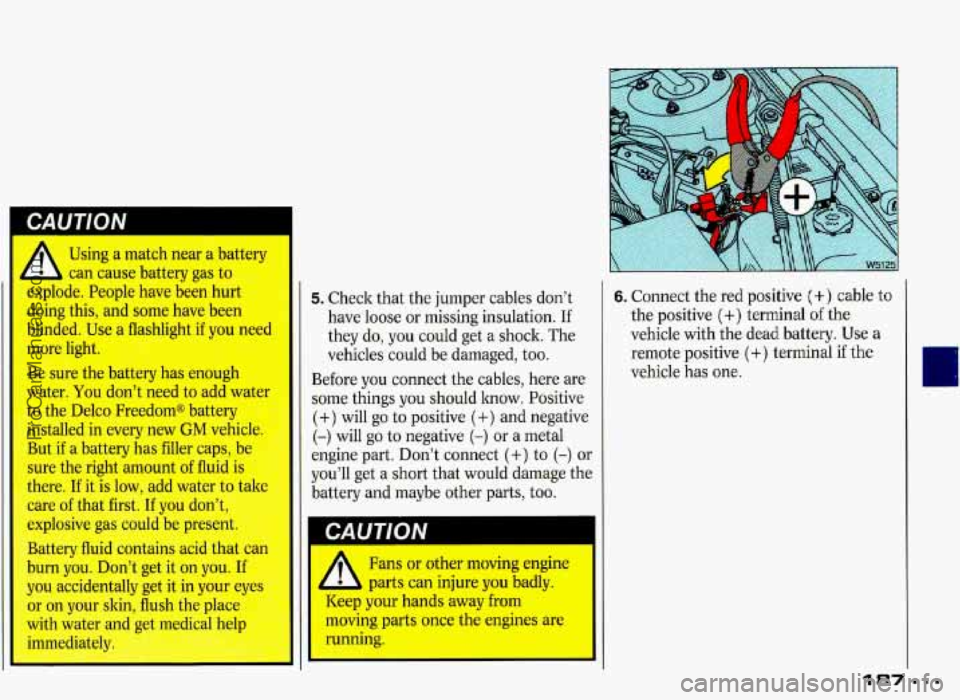
6. Connect the red positive (+) cable to
the positive
(+) terminal of the
vehicle with the dead battery. Use a
remote positive
(+) terminal if the
vehicle has one.
ProCarManuals.com
Page 196 of 338
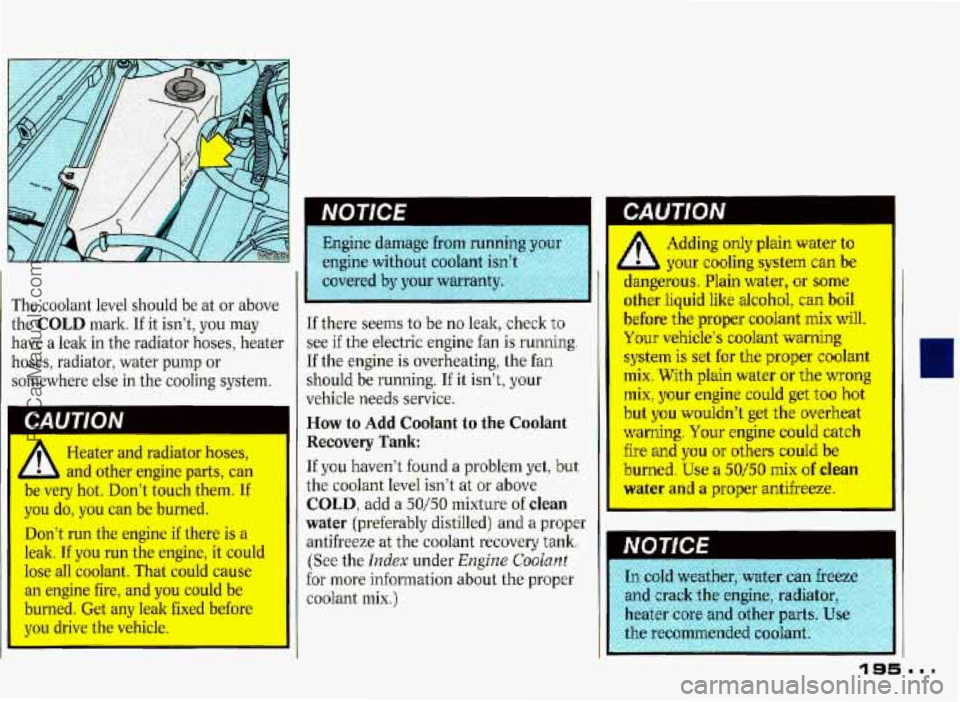
The coolant level should be at or above
the
COLD mark. If it isn’t, you may
have a leak in the radiator hoses, heater
hoses, radiator, water pump or
somewhere else in the cooling system.
~ CAUTION
A
Heater and radiator hoses,
and other
engine parts, can
be very hot. Don’t touch them. If
you do, you can be burned.
Don’$ run the engine if there is a
leak. If you run the engine, it could
lose all coolant. That could cause
an engine fire, and you could be
burned. Get any leak fixed before
I vou drive the vehicle.
If there seems to be no leak, check to
see if the electric engine fan is running.
If the engine is overheating, the fan
should be running. If it isn’t, your
vehicle needs service.
How to Add Coolant to the Coolant
Recovery Tank:
If you haven’t found a problem yet, but
the coolant level isn’t at or above
COLD, add a 50/50 mixture of clean
water (preferably distilled) and a proper
antifreeze at the coolant recovery tank.
(See the
Index under Engine Coolant
for more information about the proper
coolant mix.)
A
Adding only plain water to
your cooling system
can be
dangerous. Plain water,
or some I
other liquid like alcohol, can boil
before the proper coolant
mix will.
Your vehicle’s coolant warning
system
is set for the proper coolant
mix. With plain water or the wrong
mix, your engine could get too hot
but you wouldn’t get the overheat
warning. Your engine could catch
fire and
you or others could be
burned. Use a
50/50 mix of clean
water and a proper antifreeze.
cold weather, water can free-
d crack the engine, radiatnr
ater core and other parts.
ProCarManuals.com
Page 200 of 338
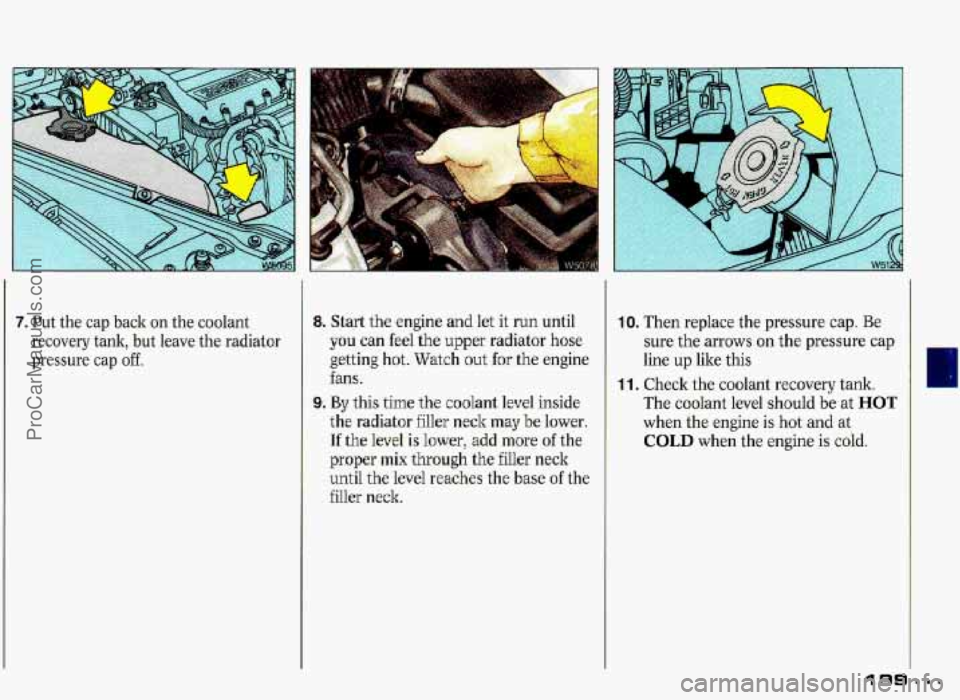
7. Put the cap back on the coolant 8. Start the engine and let it run until
recovery tank, but leave the radiator
you can feel the upper radiator hose
pressure cap off. getting hot.
Watch out for the engine
fans.
9. By this time the coolant level inside
the radiator filler neck
may be lower.
If the level is lower, add more of the
proper
mix through the filler neck
until the level reaches the base of the
filler neck.
10. Then replace the pressure cap. Be
sure the arrows
on the pressure cap ~
line up like this
11. Check the coolant recovery tank.
The coolant level should be at
HOT
when the engine is hot and at
COLD when the engine is cold.
ISS...
ProCarManuals.com
Page 212 of 338
Part 6
Here you will find information
about the care
of your Pontiac . This
part begins with service
and fuel
information. and then it
shows how
to check important fluid and lubricant levels
. There is also
technical information about your
vehicle. and a section devoted
to its
appearance care
.
81 1
Service & Appearance Care
Service ........................................................................\
...................................... 212
Fuel ........................................................................\
............................................ 213
Hood Release ........................................................................\
............................ 216
Engine Oil
........................................................................\
................................ 220
Air Cleaner ........................................................................\
............................... 224
Transaxle
Fluid ........................................................................\
........................ 225
Engine Coolant ........................................................................\
........................ 230
Power Steering Fluid ........................................................................\
............... 233
Windshield Washer
Fluid ........................................................................\
........ 233
Brakes
.......... .......................... ........................................................................\
... 234
Battery
........................................................................\
........................ .... .......... 236
Bulb Replacement ........................................................................\
.................... 236
Loading
Your Vehicle ........................................................................\
.............. 252
Vehicle Identification Number (VIN) ............................................................. 268
Capacities
& Specifications ........................................................................\
..... 276
Replacement
Bulbs ................................................................... .......- ............... 280
Windshield Wiper
Blade Replacement ............................................................ 252
Tires ........................................................................\
.......................................... 254
Appearance Care ........................................................................\
...................... 261
Add-on Electrical Equipment ........................................................................\
. 269
Fuses & Circuit Breakers ........................................................................\
........ 270
Fluids
& Lubricants ........................................................................\
................. 278
Normal Maintenance Replacement Parts ....................................................... 284
ProCarManuals.com
Page 221 of 338
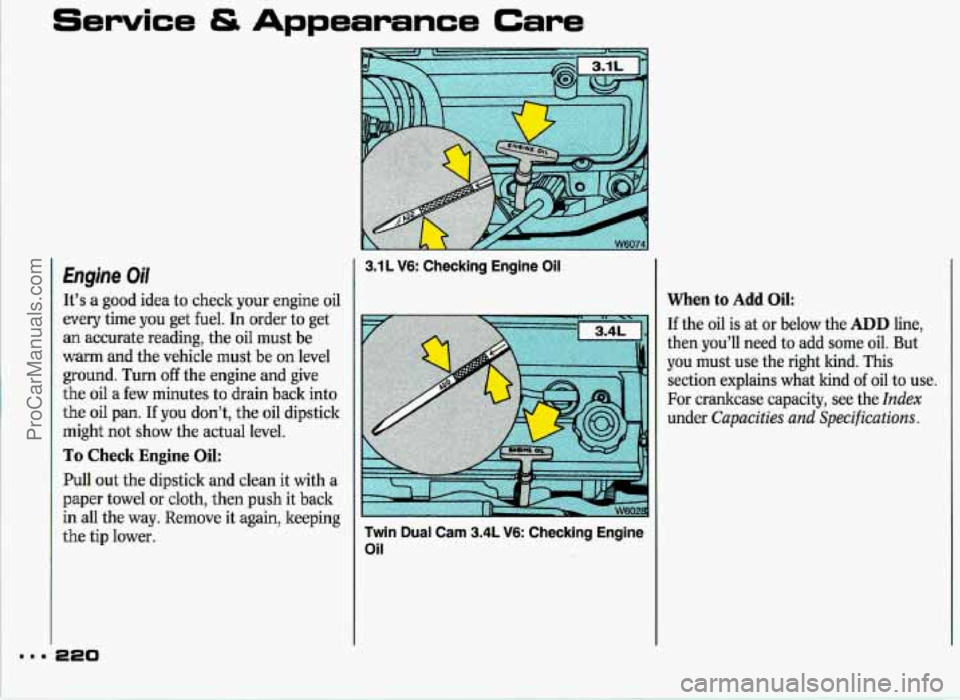
Service & Appearance Care
Eagine Oil
It’s a good idea to check your engine oil
every time you get fuel.
In order to get
an accurate reading, the oil must be
warm and the vehicle must be on level
ground. Turn
off the engine and give
the oil a few minutes to drain back into
the oil pan.
If you don’t, the oil dipstick
might not show the actual level.
To Check Engine Oil:
Pull out the dipstick and clean it with a
paper towel or cloth, then push it back
in all the way. Remove it again, keeping
the tip lower.
3.1 L V6: Checking Engine Oil
Twin Dual Cam
3.4L V6: Checking Engine
Oil
When to Add Oil:
If the oil is at or below the ADD line,
then you’ll need to add some
oil. But
you must use the right kind. This
section explains what kind
of oil to use.
For crankcase capacity, see the
Index
under Capacities and Specifications.
ProCarManuals.com
Page 225 of 338
Service & Appearance Care
i
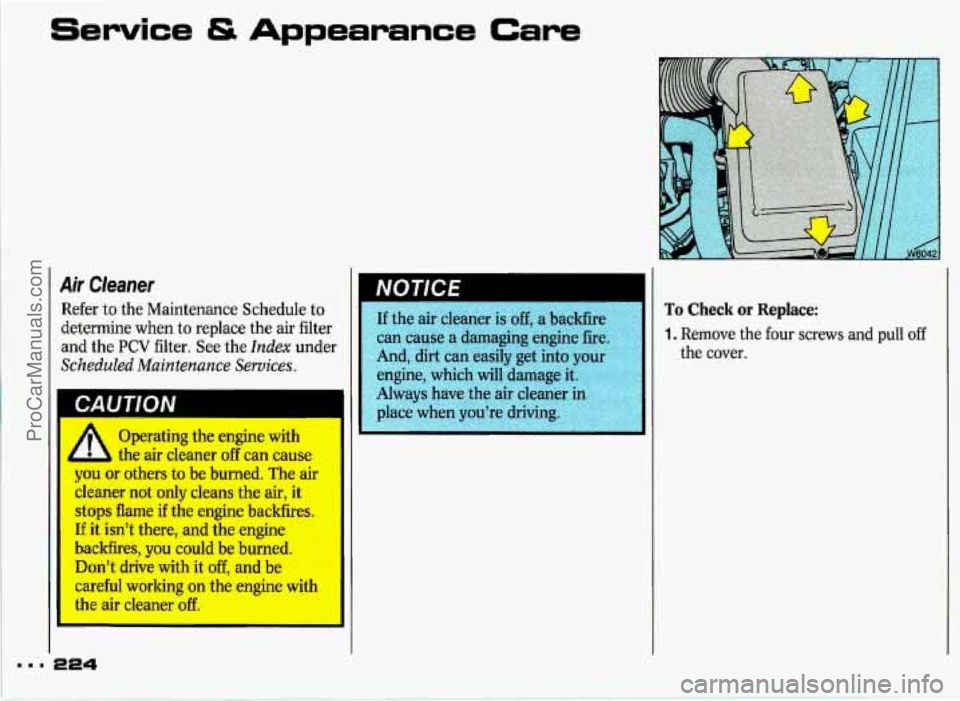
Air Cleaner
Refer to the Maintenance Schedule to
determine when to replace the
air filter
and the
PCV filter. See the Index under
Scheduled Maintenance Services.
CAUTlON
A Operating the engine with
1 L the air cleaner off can cause
ywu or others to be burned. The air
cleaner not only cleans the air, it
stops flame if the engine backfires.
If it isn’t there, and the engine
backfires, you could be burned.
Don’t drive with it off, and be
careful working on the engine with
the air clearier off.
-
If the air cleaner is off, a backfire
can cause a damaging engine fire.
And, dirt can easily get into your
engine, which will damage
i
Always have the air cleaner
place when you’re driv
To Check or Replace:
1. Remove the four screws and pull off
the cover.
ProCarManuals.com