check engine PONTIAC GRAND-PRIX 1993 Owner's Manual
[x] Cancel search | Manufacturer: PONTIAC, Model Year: 1993, Model line: GRAND-PRIX, Model: PONTIAC GRAND-PRIX 1993Pages: 338, PDF Size: 17.3 MB
Page 226 of 338
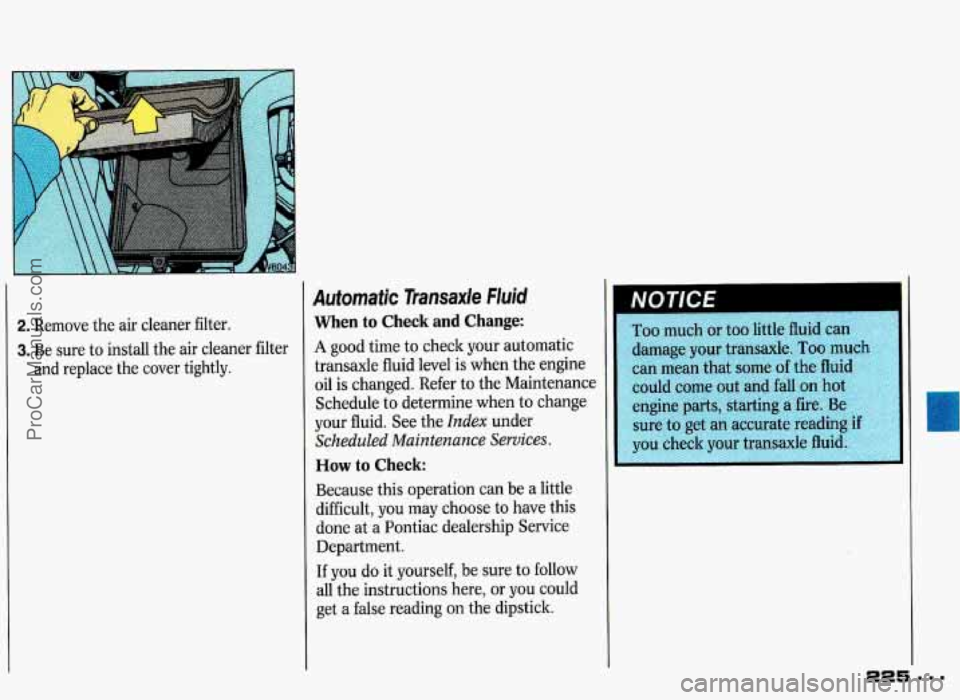
2. Remove the air cleaner filter.
3. Be sure to install the air cleaner filter
and replace the cover tightly.
Automatic Transaxle Fluid
When to Check and Change:
A good time to check your automatic
transaxle fluid level
is when the engine
oil is changed. Refer to the Maintenance
Schedule to determine when to change
your fluid. See the
Index under
Scheduled Maintenance Services.
How to Check:
Because this operation can be a little
difficult, you may choose to have this
done at a Pontiac dealership Service
Department.
If you do
it yourself, be sure to follow
all the instructions here, or you could
get a false reading on the dipstick.
NOTICE I
00 much or too little fluid
mage your transaxle.
Too
n mean that some of the flu
Id come out and fall on
ho
ine parts, starting a fi
I
225 . .
ProCarManuals.com
Page 227 of 338
Service & Appearance Care
Automatic Transaxle Fluid (CONT.)
Wait at least 30 minutes before
checking the transaxle fluid level
if you
have been driving:
When outside temperatures are above
90°F (32°C).
At high speed for quite a while.
In heavy traffic-especially in hot
While pulling a trailer.
To get the right reading, the fluid
should be at normal operating
temperature, which is
180°F to 200°F
(82°C to 93°C).
Get the vehicle warmed up by driving
about
15 miles (24 la) when outside
temperatures are above
50°F (10°C). If
it's colder than
50°F ( 10°C), you may
have to drive longer.
weather.
To Check the Fluid Level:
Park
your vehicle on a level place.
Place the shift lever in P (Park) with
With your foot on the brake pedal,
the
parking brake applied.
move the shift lever through each gear
range, pausing for about three
seconds in each range. Then, position
the shift lever in
P (Park).
Let the engine run at idle for three to
five minutes.
Then, Without Shutting Off the
Engine,
Follow These Steps:
1. Pull out the dipstick and wipe it with
a clean rag or paper towel.
2. Push it back in all the way, wait three
seconds and then pull it back out
again.
3. Check both sides of the dipstick, and
read the lower level. The fluid level
must be in the cross-hatched area.
4. If the fluid level is where it should be,
push the dipstick back in all the way.
ProCarManuals.com
Page 229 of 338
Service & Appearance Care
Manual Pransaxle Fluid
When to Check:
A good time to have it checked is when
the engine oil is changed. However, the
fluid in your manual transaxle does not
require changing.
How to Check:
Because this operation can be a little
difficult,
you may choose to have this
done at a Pontiac dealership service
department.
If you do it yourself, be
sure
to follow all the instructions here,
or YQU could get a false reading on the
dipstick.
’. 22%
00 little fluid can
amage your transaxle.
Too much
an mean that some of the fluid
ould come out and fall on hot
ngine parts, starting a fire. Be
ure to get
an accurate reading if
ou check your transaxle fluid. The manual
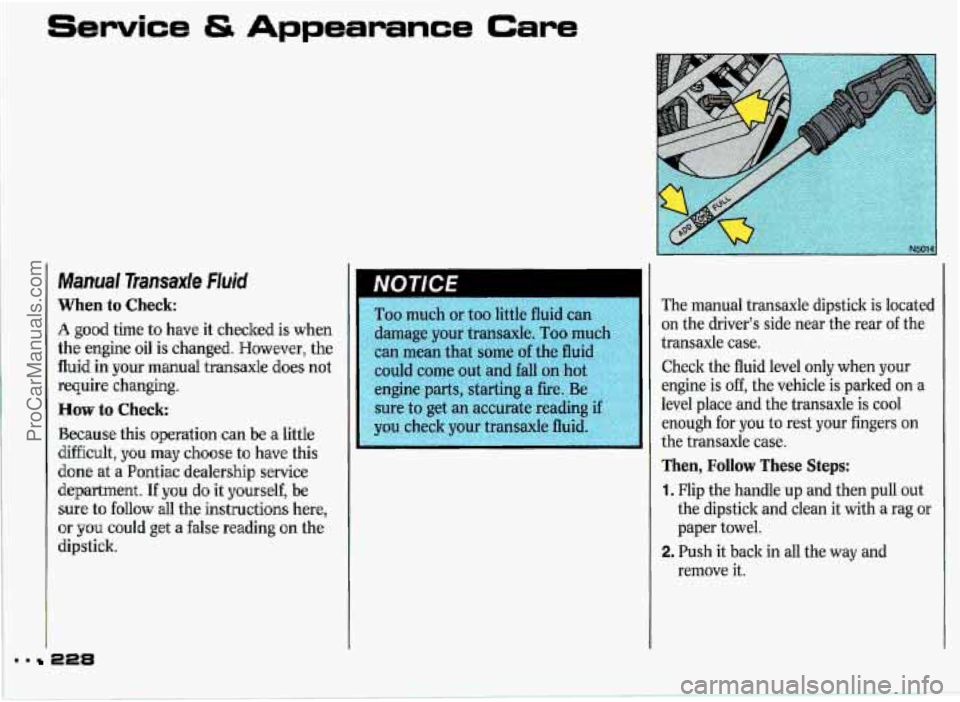
transaxle dipstick is located
on the driver’s
side near the rear of the
transaxle case.
Check the fluid level
only when your
engine is
off, the vehicle is parked on a
level place and the transaxle is cool
enough for
you to rest your fingers on
the transaxle case.
Then, Follow These Steps:
1. Flip the handle up and then pull out
the dipstick and clean it with
a rag or
paper towel.
remove it.
2. Push it back in all the way and
ProCarManuals.com
Page 231 of 338
Service & Appearance Cam
Hydraulic Clutch Fluid (CONTJ
How to Check
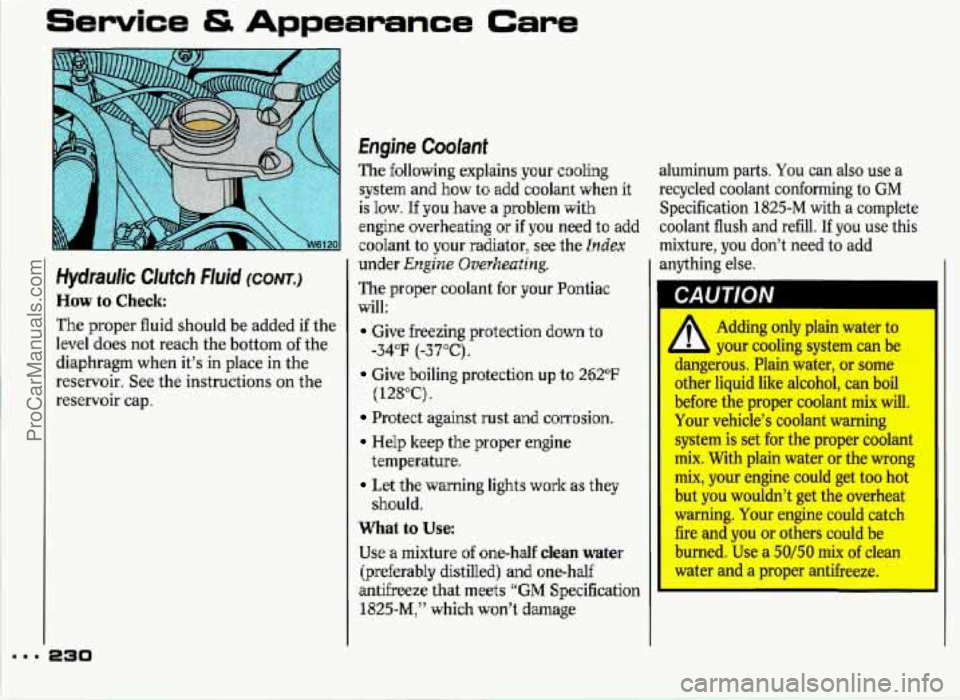
The proper fluid should be added if the
level does not reach the bottom
of the
diaphragm when it’s in place in the
reservoir. See the instructions on the
reservoir cap.
230
Engine Coolant
The following explains your cooling
system and
how to add coolant when it
is low. If you have a problem with
engine overheating or
if you need to add
coolant to your radiator, see the Index
under Engine Overheuling.
The proper coolant for your Pontia’c
will:
Give freezing protection do;wn to
Give boiling protection up to 262°F
Protect against rust and corrosion.
Help keep the proper engine
Let the warning lights work as they
What to Use:
Use a mixture of one-half dean water
(preferably distilled) and one-half
antifreeze that meets
“GM Specification
1825-M,” which won’t darnage
-34°F (-3 7 “C) .
(12S°C).
temperature.
should.
aluminum parts. You can also use a
recycled coolant conforming to
GM
Specification 1825-M with a complete
coolant flush and refill. If you use this
mixture, you don’t need to add
anything else.
Adding only plain water
to
your cooling system can be
dangerous. Plain water, or some
other liquid like alcohol, can boil
before the proper coolant mix will.
Your vehicle’s coolant warning
system is set for the proper coolant
mix. With plain water or the wrong
mix, your engine could get
too hot
but you wouldn’t get the overheat
warning. Your engine could catch
fire and you or others could be
burned. Use a
50/50 mix of clean
water and
a Droner antifreeze.
ProCarManuals.com
Page 232 of 338
I
NOTICE
If you use an improper coolant
mix, your engine could overheat
and be badly damaged. The repair
cost wouldn’t be covered by your
warranty. Too much water in the
mix can freeze and crack the
engine, radiator, heater core and
other parts.
i,,~~~,~,,”;l,,I;i,.,t”. ~~,,,~,~,~~~~,~,~~.~~~,~
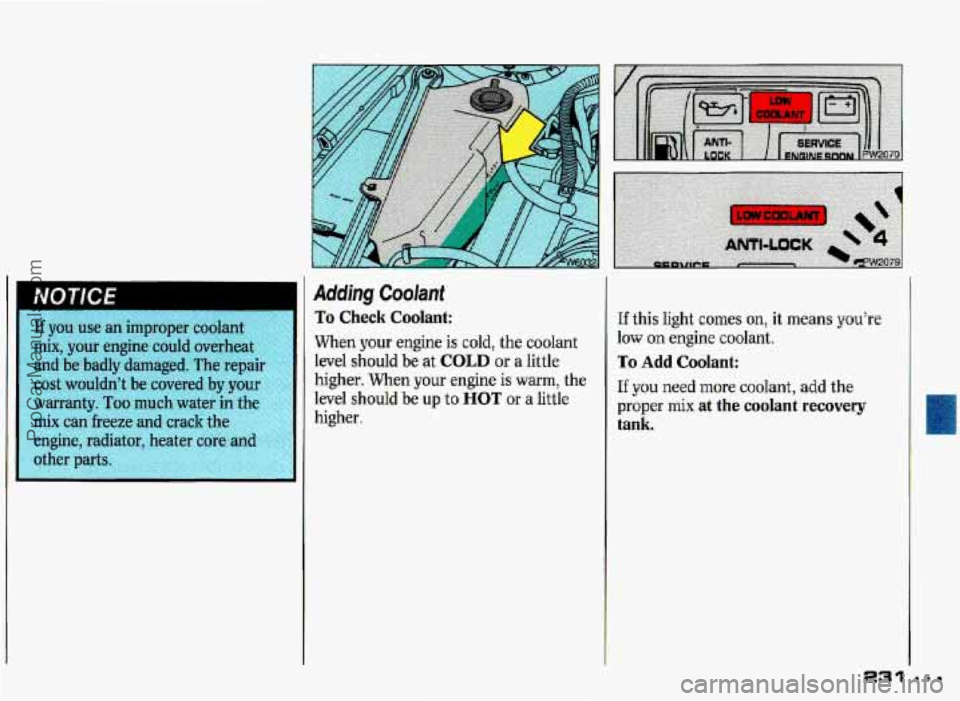
Adding Coolant
To Check Coolant:
When your engine is cold, the coolant
level should be at
COLD or a little
higher. When your engine is warm, the
level should be up to
HOT or a little
higher.
If this light comes on, it means you’re
low on engine coolant.
To Add Coolant:
I€ you need more coolant, add the
proper mix at the coolant recovery
tank. n
ProCarManuals.com
Page 234 of 338
Power Steering Fluid
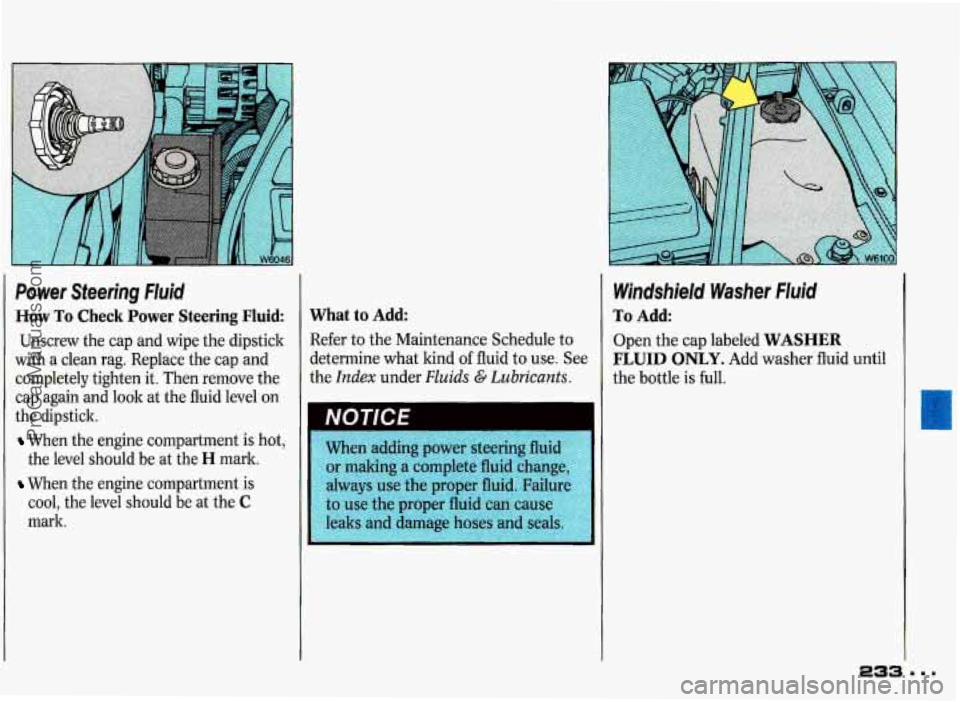
How To Check Power Steering Fluid:
Unscrew the cap and wipe the dipstick
with a clean rag. Replace the cap and
completely tighten it. Then remove the
cap again and look at the fluid level on
the dipstick.
When the engine compartment is hot,
the level should be at the
H mark.
When the engine compartment is
cool, the level should be at the
C
mark.
What to Add:
Refer to the Maintenance Schedule to
determine what kind of fluid to use. See
the
Index under Fluids G Lubricants.
When adding power steering fluid
or making a complete fluid change,
always use the proper fluid. Failure
to use the proper fluid can cause
leaks and damage hoses and seals.
Windshield Washer Fluid
To Add:
Open the cap labeled WASHER
FLUID ONLY. Add washer fluid until
the bottle is full.
ProCarManuals.com
Page 270 of 338
Engine Identification
The eighth character in your VIN is the
engine code for your
GM engine. This
code will help you identify your engine, specifications, and replacement parts in
this section.
Service Pads Identification Label I Add-on EIecfrical Equipment
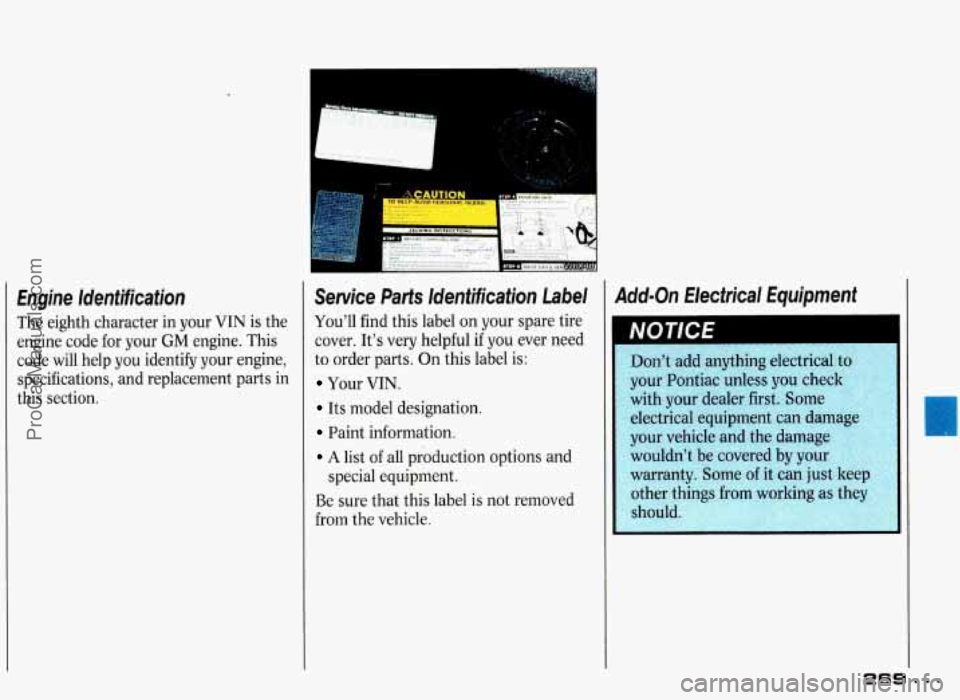
You'll find this label on your spare tire
cover. It's very helpful if you ever need
to order parts. On this label is:
Your VIN.
Its model designation.
Paint information.
A list of all production options and
special equipment.
Be sure that this label is not removed
from the vehicle.
- I
Don't add anything electrical to
your Pontiac unless
you check
with your dealer first. Some
electrical equipment can damage
your vehicle and the damage
wouldn't be covered by your
ProCarManuals.com
Page 271 of 338
Service & Appearance Care
nnm i
Fuses & Circuit Breakers
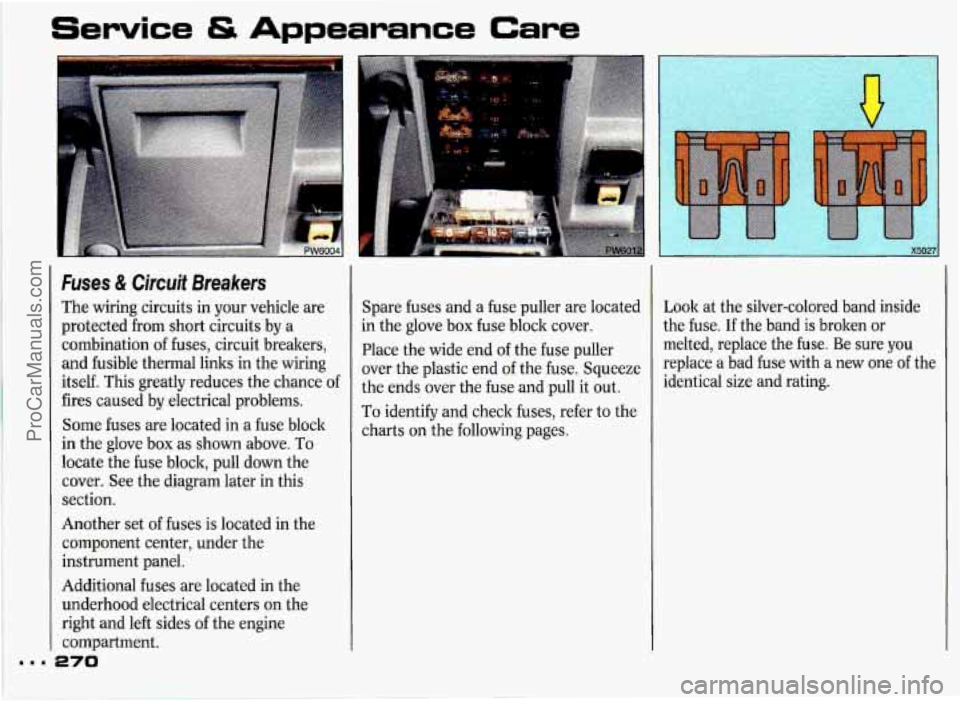
The wiring circuits in your vehicle are
protected
from short circuits by a
combination of fuses, circuit breakers,
and fusible thermal links in the wiring
itself. This greatly reduces the chance
of
fires caused by electrical problems.
Some fuses are located in a fuse block
in the glove box as shown above.
To
locate the fuse block, pull down the
cover. See the diagram later in this
section.
Another set
of fuses is located in the
component center, under the
instrument panel.
Additional fuses are located in the
underhood electrical centers on the
right and left sides of the engine
compartment.
270
Spare fuses and a fuse puller are located
in the glove box fuse block cover.
Place the wide end of the fuse puller
over the plastic end of the fuse. Squeeze
the ends over the fuse and pull it out.
To identify and check fuses, refer to the
charts on the following pages. Look at the silver-colored band inside
the fuse.
If the band is broken or
melted, replace the fuse. Be sure you
replace a bad fuse with a new one of the
identical size and rating.
ProCarManuals.com
Page 288 of 338
IMPORTANT
KEEP ENGINE OIL
AT THE PROPER
LEVEL AND CHANGE
AS
RECOMMENDED
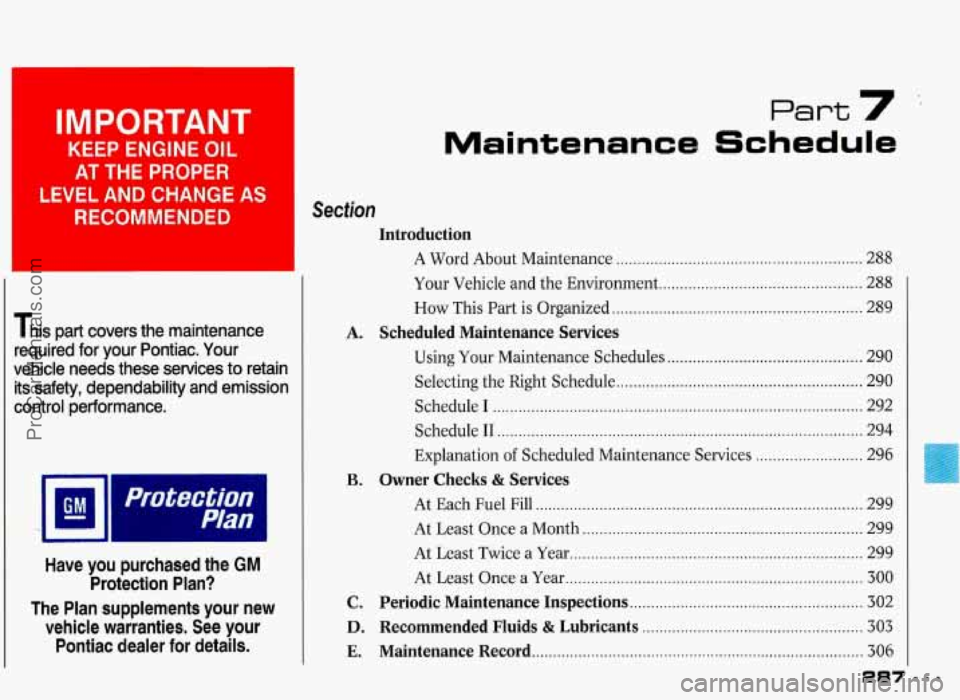
This part covers the maintenance
required for your Pontiac. Your
vehicle needs these services to retain its safety, dependability and emission
control performance.
Have you purchased the GM
Protection Plan?
The Plan supplements your new
vehicle warranties. See your Pontiac dealer for details.
Part 7 '.
Maintenance Schedule
Section
Introduction
A Word About Maintenance .......................................................... 288
Your Vehicle and the Environment
................................................ 288
How This Part is Organized
........................................................... 289
A. Scheduled Maintenance Services
Using Your Maintenance Schedules .............................................. 290
Selecting the Right Schedule
.......................................................... 290
Schedule
I ........................................................................\
............... 292
Schedule
I1 ....... .............................................................. .. ........... .... 294
Explanation
of Scheduled Maintenance Services ... ... . . . . . . . . . . . . . . . . . . . 296
B. Owner Checks & Services
At Each Fuel Fill ........................................................................\
..... 299
At Least Once a Month
.................................................................. 299
At Least Twice a Year
..................................................................... 299
At Least Once a Year
...................................................................... 300
C. Periodic Maintenance Inspections ....................................................... 302
D. Recommended Fluids & Lubricants .................................................... 303
E. Maintenance Record ........................................................................\
...... 306
ProCarManuals.com
Page 297 of 338
Maintenance Schedule
Section A: Scheduled Maintenance Services t~ont.3
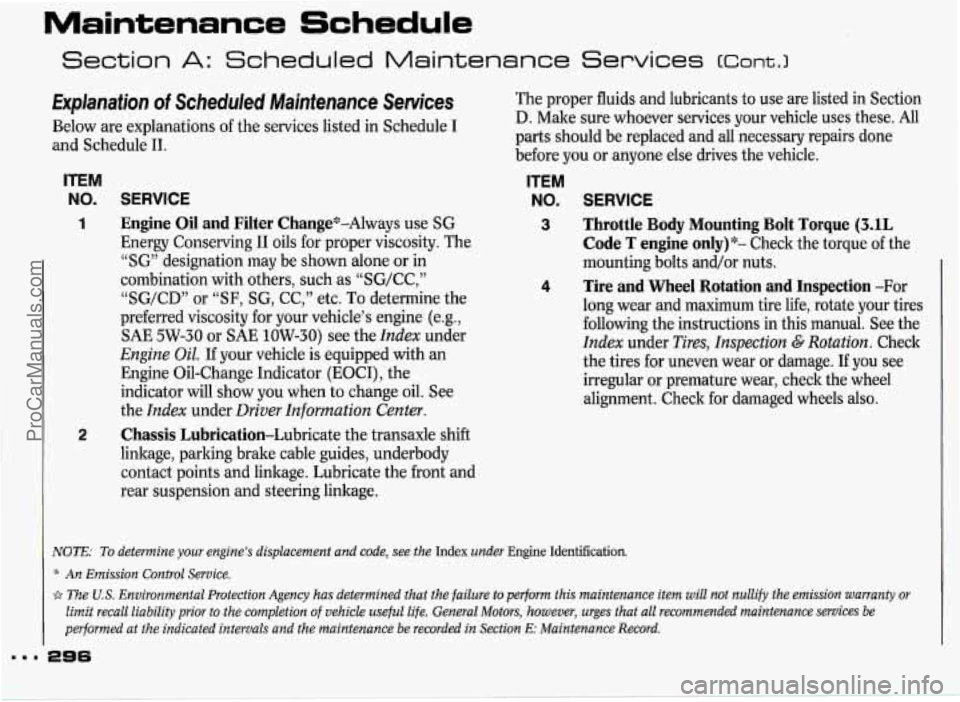
Explanation of Scheduled Maintenance Services
Below are explanations of the services listed in Schedule I
and Schedule 11.
ITEM
NO. SERVICE
1 Engine Oil and Filter Change’:-Always use SG
Energy Conserving I1 oils for proper viscosity. The
“SG” designation may be shown alone or in
combination with others, such as “SG/CC,”
“SG/CD” or
“SF, SG, CC,” etc. To determine the
preferred viscosity for your vehicle’s engine (e.g.,
SAE
5W-30 or SAE 1OW-30) see the Index under
Engine OiZ. If your vehicle is equipped with an
Engine Oil-Change Indicator (EOCI)
, the
indicator will show you when to change oil. See
the
Index under Driver Information Center.
2 Chassis Lubrication-Lubricate the transaxle shift
linkage, parking brake cable guides, underbody
contact points and linkage. Lubricate the front and
rear suspension and steering linkage. The
proper fluids and lubricants to use are listed in Section
D. Make sure whoever services your vehicle uses these. All
parts should be replaced and all necessary repairs done
before you or anyone else drives the vehicle.
ITEM
NO. SERVICE
3 Throttle Body Mounting Bolt Torque (3.1L
Code T engine only)‘x- Check the torque of the
mounting bolts and/or nuts.
Tire and Wheel Rotation and Inspection -For
long wear and maximum tire life, rotate your tires
following the instructions in this manual. See the
Index under Tires, Inspection G. Rotation. Check
the tires for uneven wear or damage.
If you see
irregular or premature wear, check the wheel alignment. Check for damaged wheels also.
4
a The U.S. Environmental Protection Agency has determined that the failure to perform this maintenance item will not nullify the emission warranty or
limit recall liability prior to the completion of vehicle useful life. General Motors, however, urges that all recommended maintenance services be
performed at the indicated intervals and the maintenance be recorded
in Section E: Maintenance Record.
296
ProCarManuals.com