ignition PONTIAC GRAND-PRIX 1993 User Guide
[x] Cancel search | Manufacturer: PONTIAC, Model Year: 1993, Model line: GRAND-PRIX, Model: PONTIAC GRAND-PRIX 1993Pages: 338, PDF Size: 17.3 MB
Page 71 of 338
Features tS Controls
m..
Windows
On a vehicle with manual windows, use
the window crank to open and close
each window.
70
Power Windows (OPTION)
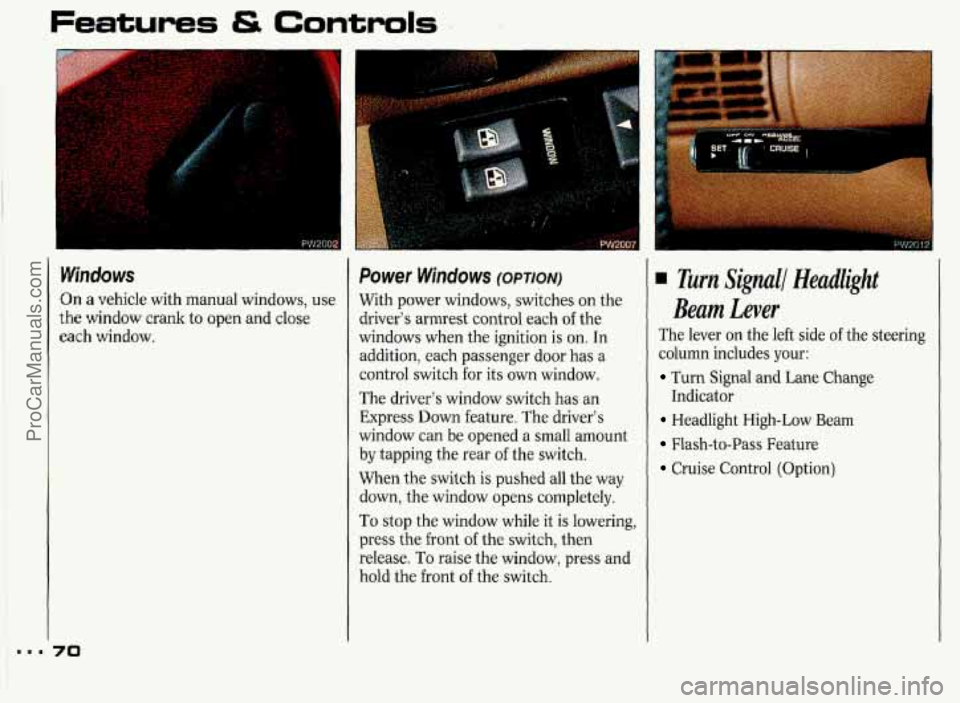
With power windows, switches on the
rlriver’s armrest control each
of the
windows when the ignition is on.
In
addition, each passenger door has a
control switch for its own window.
The driver’s window switch has an
Express Down feature. The driver’s
window can be opened
a small amount
by tapping the rear of the switch.
When the switch is pushed all the way
down, the window opens completely.
To stop the window while it is lowering,
press the front of the switch, then
release. To raise the window, press and
hold the front of the switch.
Turn Signall Headlight
Beam Lever
The lever on the left side of the steering
column includes your:
Turn Signal and Lane Change
Headlight High-Low Beam
Flash-to-Pass Feature
Cruise Control (Option)
Indicator
ProCarManuals.com
Page 76 of 338
r
Passing Another Vehicle While Using Cruise Control
Use the accelerator pedal to increase
your speed. When you take your foot
off
the pedal, your vehicle will slow down
to the cruise control speed you set
earlier.
Using Cruise Control on Hills
How well your cruise control will work
on hills depends upon your speed, load,
and the steepness
of the hills. When
going up steep hills, you may have to
step on the accelerator pedal to
maintain your speed. When going
downhill, you may have to brake or
shift
to a lower gear to keep your speed
down.
Of course, applying the brake or
clutch pedal takes you out of cruise
control. Many drivers find this to be too
much trouble and don't use cruise
control on steep hills.
To Get Out of Cruise ConW
There are two ways to turn off the
cruise control:
Step lightly on the brake pedal or push
the clutch pedal,
if you have a manual
transaxle;
OR
Move the cruise switch to OFF.
Ti Erase Cruise Speed Memory
When you turn off the cruis'e control or
the ignition, your cruise
control set
speed memory is erased.
ProCarManuals.com
Page 80 of 338
Dayfime Running lights
(CANADA ONLY)
The Canadian Federal Government has
decided that “Daytime Running Lights”
(DRL) are a useful feature, in that DRL
can make your vehicle more visible to
pedestrians and other drivers during
daylight hours. DRL are required
on
new vehicles sold in Canada.
Your DRL work with a light sensor on
top of the instrument panel. Don’t
cover it up.
The low beam headlights will come on
at reduced brightness in daylight when:
The ignition is on
The headlight switch is off, and
The parking brake is released. At
dusk, the exterior lights will come
on
automatically and the low beams will
change to full brightness. At dawn, the
exterior lights will go out and the low
beams will change to the reduced
brightness
of DRL (if the headlight
switch is off).
Of course, you may still turn on the
headlights any time you need to.
To idle your vehicle with the DRL off,
set the parking brake while the ignition
is in the
Off or Lock position. Then
start the vehicle. The DRL will stay
off
until you release the parking brake.
Headlighf High-Low Beam
Changer
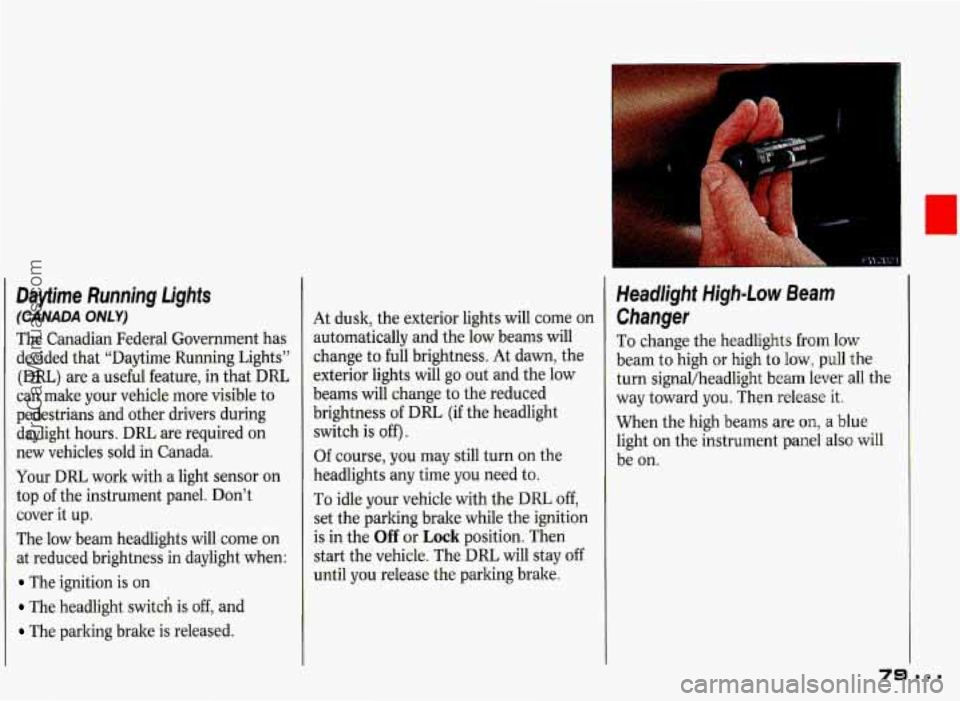
To change the headlights from low
beam to high or high to low, pull the
turn signal/headlight beam lever all the
way toward
you. Then release it.
When the high beams are on, a blue
light on the instrument panel
also will
be on.
ProCarManuals.com
Page 84 of 338
Illuminated Entry (OPTION)
If you have illuminated entry, your
interior lights will stay on for about
12
seconds after the door is closed.
The lights will go out when the ignition
key is turned to the
Run position.
Inside Manual DaylNight
Rearview Mirror
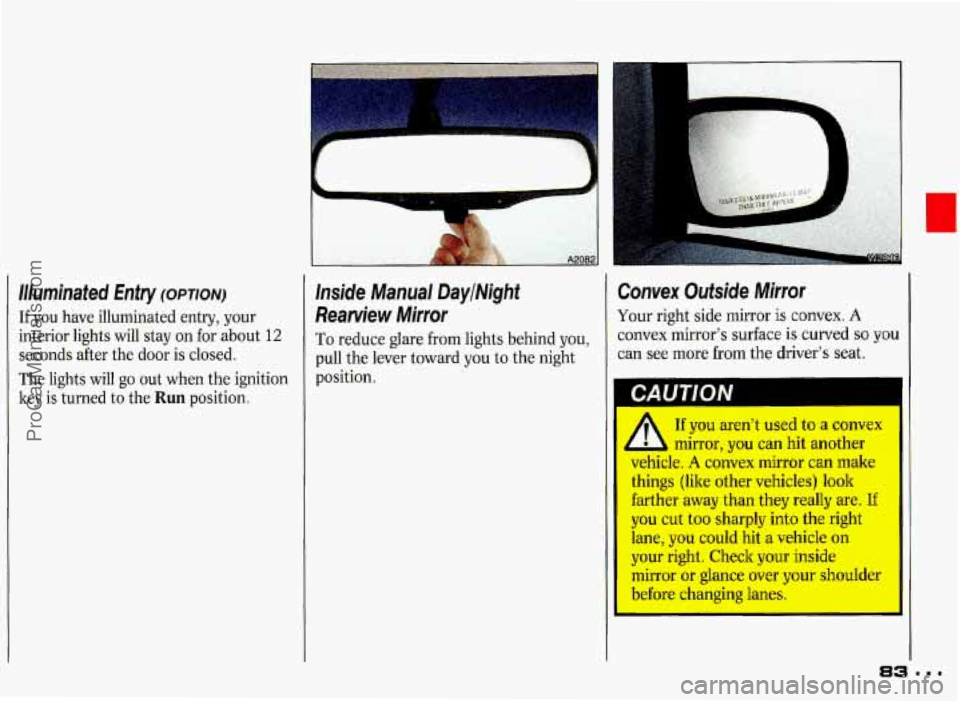
To reduce glare from lights behind you,
pull the lever toward you to the night
position.
Convex Outside Mirror
Your right side mirror is convex. A
convex mirror’s surface is curved so yo^
can see more from the driver’s seat.
A
If you aren’t used to a convex
mirror, you can hit another
vehicle.
A convex mirror can make
things (like other vehicles) look
farther away than they really are.
If
you cut too sharply into the right
lane, you could hit
a vehicle on
your right. Check your inside
mirror or glance over
your shoulder
before changing lanes.
a:
1
I
...
ProCarManuals.com
Page 91 of 338
...
Features & Controls
I
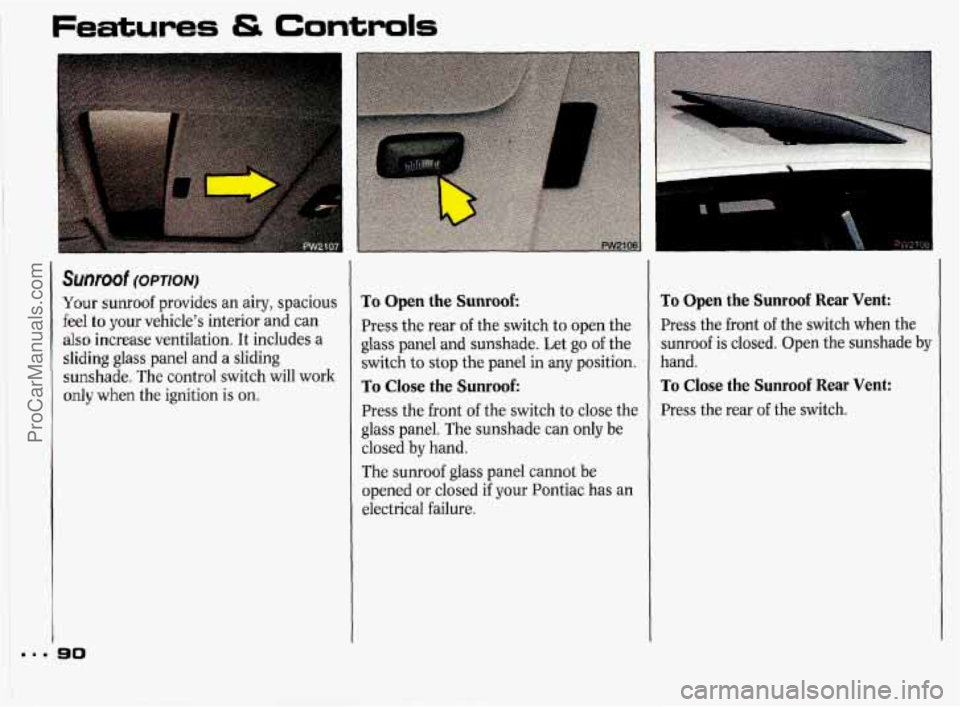
Sunroof (OPTION)
Your sunroof provides an airy, spacious
feel
to your vehicle’s interior and can
also increase ventilation. It includes a
sliding glass panel and a sliding
sunshade. The control switch will work
only when the ignition is
on.
30
To Open the Sunroof:
Press the rear of the switch to open the
glass panel and sunshade. Let
go of the
switch to stop the panel in any position.
To Close the Sunroof:
Press the front of the switch to close the
glass panel. The sunshade can only be
closed by hand.
The sunroof glass panel cannot
be
opened or closed if your Pontiac has an
electrical failure.
To Open the Sunroof Rear Vent:
Press the front of the switch when the
sunroof
is closed. Open the sunshade by
hand.
To Close the Sunroof Rear Vent:
Press the rear of the switch.
ProCarManuals.com
Page 94 of 338
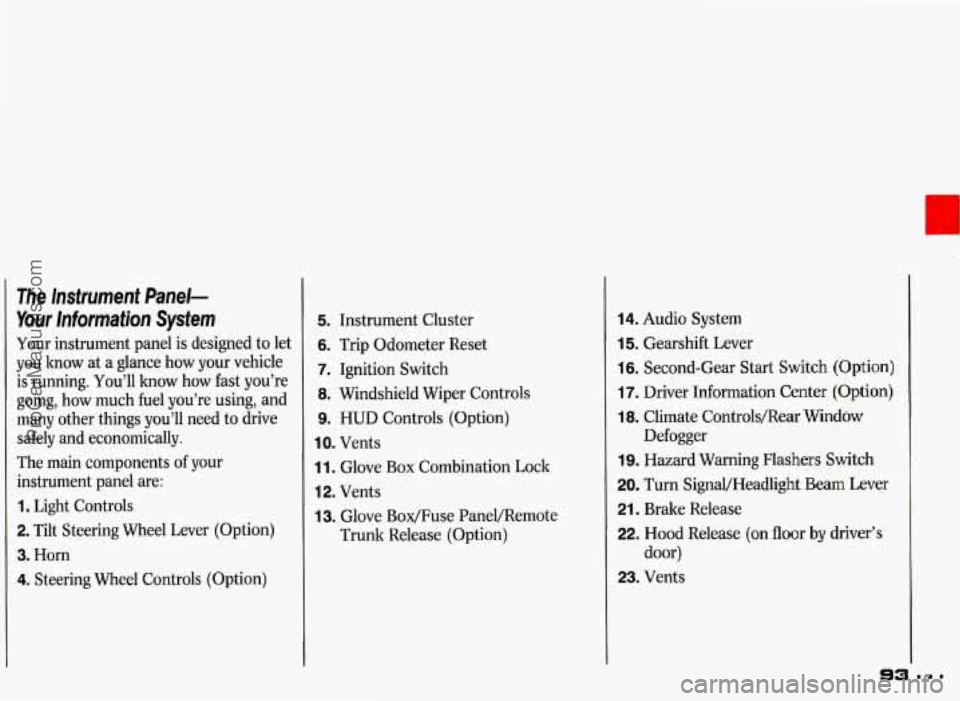
The Instrument Panel-
Your Information System
Your instrument panel is designed to let
you know at
a glance how your vehicle
is running. You’ll how how fast you’re
going, how much fuel you’re using, and
many other things you’ll need to drive
safely and economically.
The main components of your
instrument panel are:
1. Light Controls
2. Tilt Steering Wheel Lever (Option)
3. Horn
4. Steering Wheel Controls (Option)
5. Instrument Cluster
6. Trip Odometer Reset
7. Ignition Switch
8. Windshield Wiper Controls
9. HUD Controls (Option)
IO. Vents
1 1. Glove Box Combination Lock
12. Vents
13. Glove Box/Fuse PaneVRemote
Trunk Release (Option)
14. Audio System
15. Gearshift Lever
16. Second-Gear Start Switch (Option)
17. Driver Information Center (Option)
18. Climate Controls/Rear Window
19. Hazard Warning Flashers Switch
20. Turn SignaVHeadlight Beam Lever
21. Brake Release
22. Hood Release (on floor by driver’s
door)
23. Vents Defogger
ProCarManuals.com
Page 96 of 338
Warning Lights, Gages and
Indicators
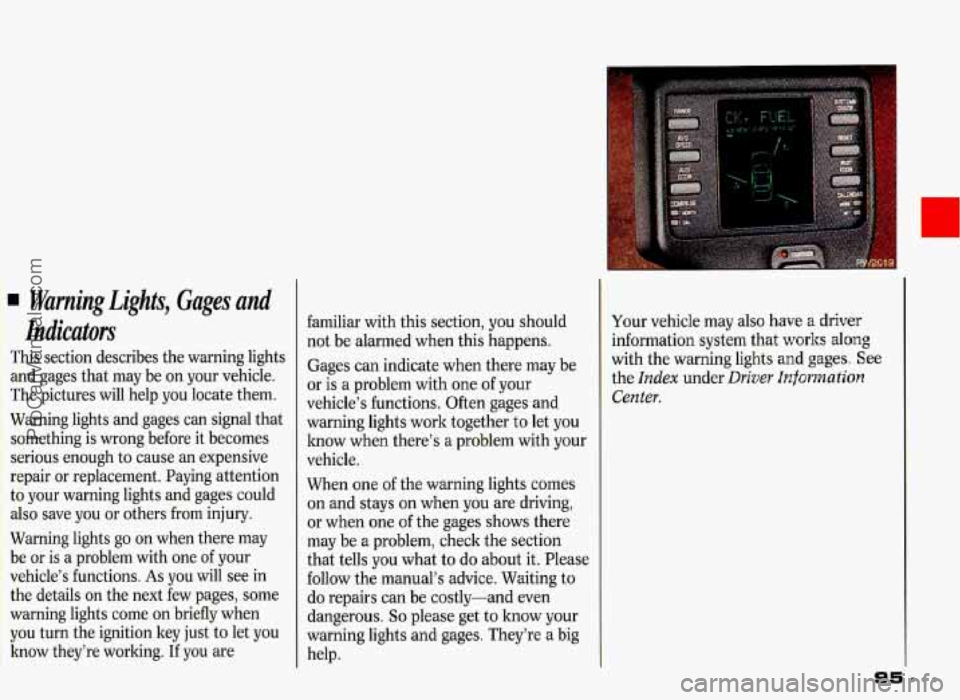
This section describes the warning lights
and gages that may be on your vehicle.
The pictures will help you locate them.
Warning lights and gages can signal that
something is wrong before it becomes
serious enough to cause an expensive
r’epair or replacement. Paying attention
to your warning lights and gages could
also save you or others from injury.
Warning lights go on when there may
be or
is a problem with one of your
vehicle’s functions.
As you will see in
the details on the next few pages, some
warning lights come on briefly when
you turn the ignition key just to let you
know they’re working.
If you are familiar
with this section, you should
not be alarmed when this happens.
Gages can indicate when there may be
or is a problem with one of your
vehicle’s functions. Often gages and
warning lights work together to let you
lmow when there’s a problem with your
vehicle.
When one of the warning lights comes
on and stays on when you are driving,
or when one of the gages shows there
may be a problem, check the section
that tells you what to
do about it. Please
follow the manual’s advice. Waiting to
do repairs can be costly-and even
dangerous.
So please get to know your
warning lights and gages. They’re a big
help. Your vehicle may also
have
a driver
information system that worlrs along
with the warning lights and gages. See
the Index under Driver Information
Center.
ProCarManuals.com
Page 98 of 338
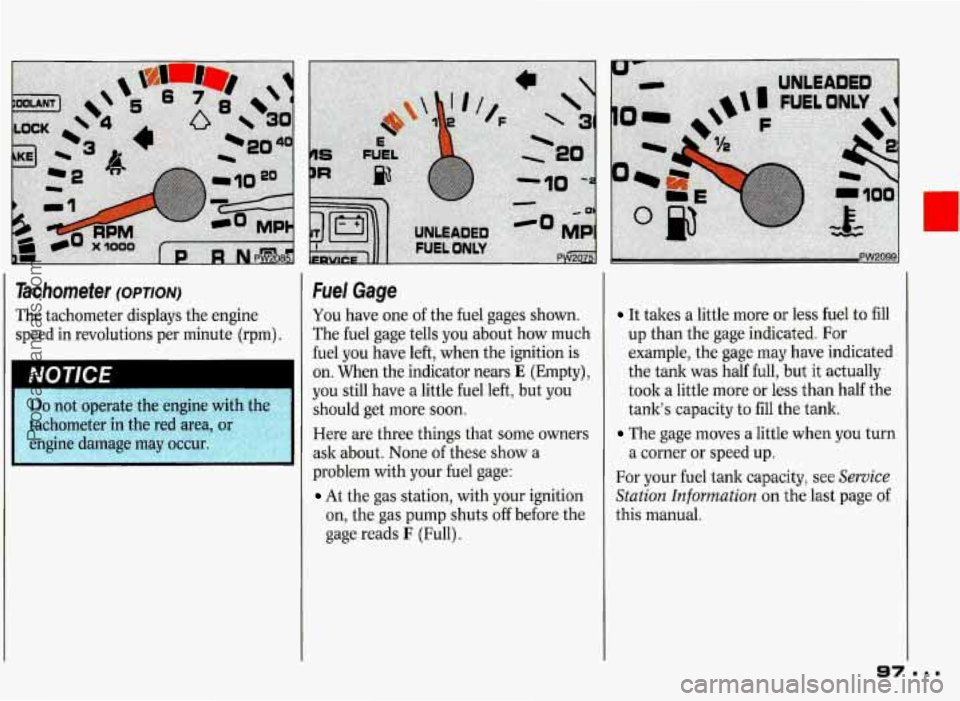
Tachometer (OPTION)
The tachometer displays the engine
speed in revolutions per minute
(rpm).
-
NU I IL't
Fuel Gage
You have one of the fuel gages shown.
The fuel gage tells you about how much
fuel you have left, when the ignition is
on. When the indicator nears E (Empty),
you still have a little fuel left, but you
should get more
soon.
Here are three things that some owners
ask about. None of these show a
problem with your fuel gage:
At the gas station, with your ignition
on, the gas pump shuts off before the
gage reads
F (Full).
It takes a little more or less fuel to fill
up than the gage indicated. For
example, the gage may have indicated
the tank was half full, but
it actually
took a little more
or less than half the
tanks capacity to fill the tank.
The gage moves a little when you turn
a corner
or speed up.
For your fuel tank capacity, see
Service
Station
Information on the last page of
this manual.
a7
ProCarManuals.com
Page 99 of 338
8..
Features & Controls
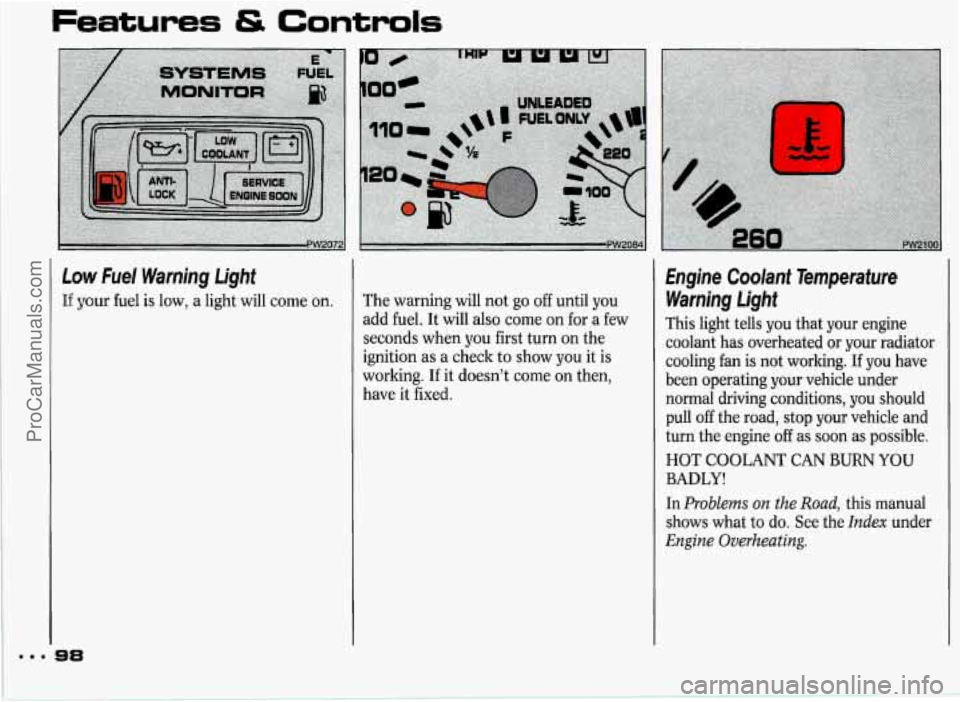
Low Fuel Warning Light
If your fuel is low, a light will come on.
98
The warning will not go off until you
add fuel. It will also come on for a few
seconds when
you first turn on the
ignition as a check to show you it is
working. If it doesn’t come on then,
have it fixed.
Engine Coolant Temperature Warning Light
This light tells you that your engine
coolant has overheated or your radiator
cooling fan is not working. If you have
been operating your vehicle under
normal driving conditions, you should
pull off the road, stop your vehicle and
turn the engine off
as soon as possible.
HOT
COOLANT CAN BURN YOU
BADLY!
In Problems on the Road, this manual
shows what to do.
See the Index under
Engine Overheating.
ProCarManuals.com
Page 101 of 338
mmm
Features & Controls
I
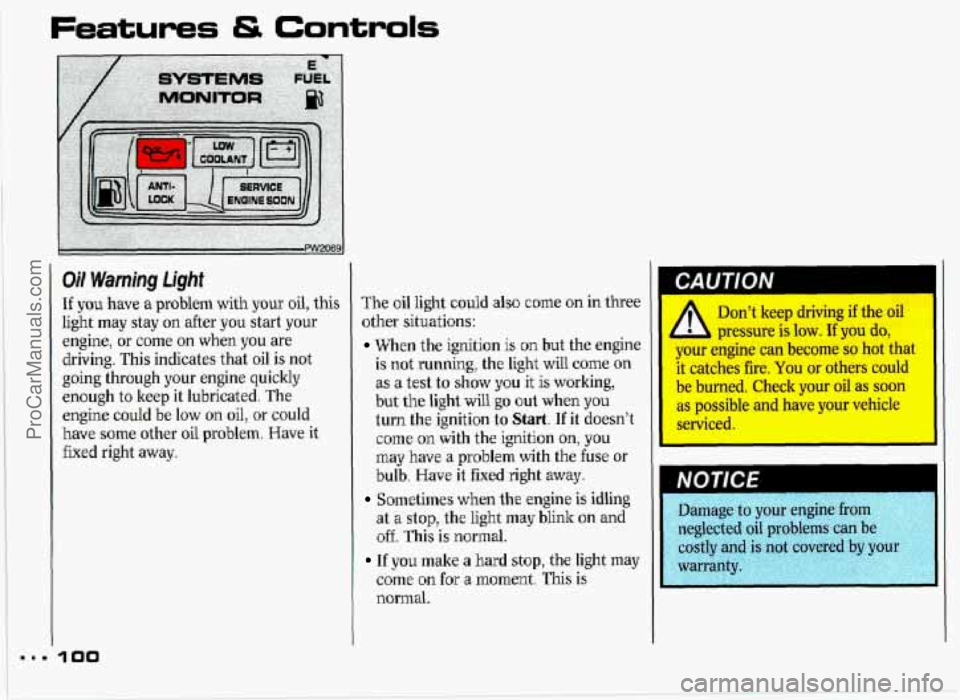
Oil Warning Light
If you have a problem with your oil, this
light may stay on after you start
your
engine, or come on when you are
driving. This indicates that oil
is not
going through your engine quickly
enough to
keep it lubricated. The
engine
could be low on oil, or could
have some other oil problem. Have it
fixed right away.
3 00
The oil light could also come on in three
other situations:
When the ignition is but the engine
is not running, the light will come on
as a test to show you it is working,
but the light
will go out when you
turn the ignition to Start. If it doesn’t
come on with the ignition on, you
may have a problem with the fuse or
bulb.
Have it fixed right away.
Sometimes when the engine is idling
at
a stop, the light may blink on and
off. This is normal.
If you make a hard stop, the light may
come on for ‘a moment. This is
normal.
Don’t keep driving if the oil
pressure is low. If you do,
your engine can become so hot that
it catches he. You or others could
be burned. Check your oil as soon
as possible and have yaw vehicle
NOTICE
ProCarManuals.com