ECU PONTIAC GRAND PRIX 2003 User Guide
[x] Cancel search | Manufacturer: PONTIAC, Model Year: 2003, Model line: GRAND PRIX, Model: PONTIAC GRAND PRIX 2003Pages: 378, PDF Size: 17.64 MB
Page 50 of 378
Securing a Child Restraint Designed
for the LATCH System
1.
2.
3.
4.
5.
Find the anchors for the seating position you want
to use, where the bottom
of the seatback meets the
back of the seat cushion.
Put the child restraint on the seat.
Attach the anchor points on the child restraint to the
anchors in the vehicle. The child restraint
instructions will show you how.
If the child restraint is forward-facing, attach the top
strap to the top strap anchor. See Top Strap on
page
1-39. Tighten the top strap according to
the child restraint instructions.
Push and pull the child restraint in different
directions to be sure it is secure.
To remove the child restraint, simply unhook the top
strap from the top tether anchor and then disconnect
the anchor points.
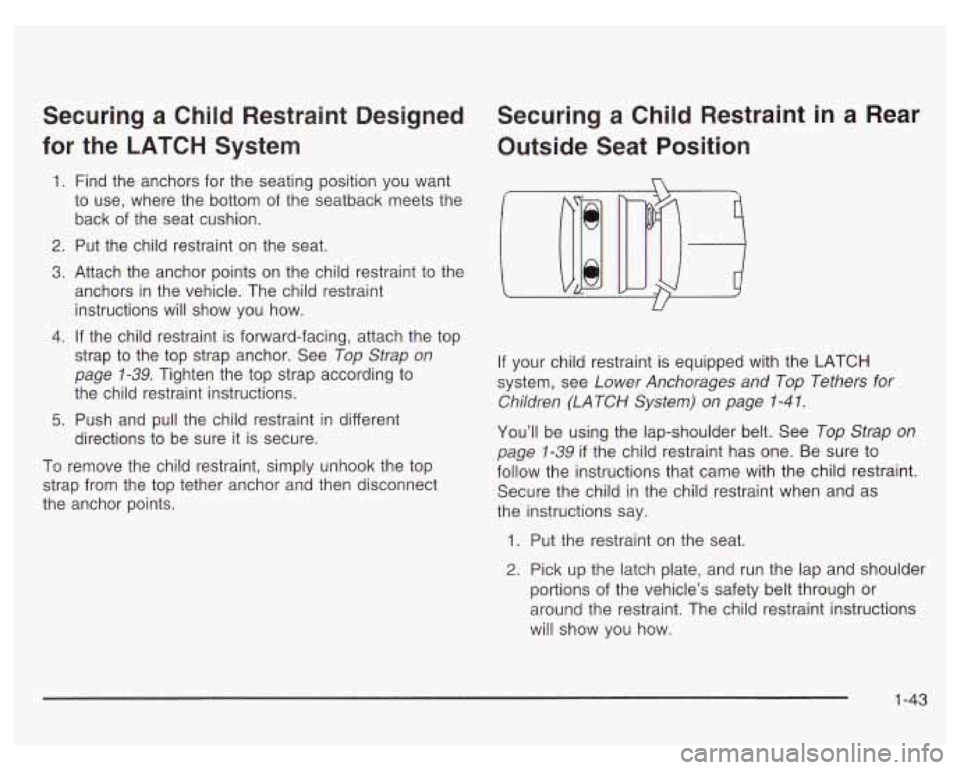
Securing a Child Restraint in a Rear
Outside Seat Position
If your child restraint is equipped with the LATCH
system, see Lower Anchorages and Top Tethers
for
Children (LATCH System) on page 1-41.
You’ll be using the lap-shoulder belt. See Top Strap on
page
1-39 if the child restraint has one. Be sure to
follow the instructions that came with the child restraint.
Secure the child in the child restraint when and as
the instructions say.
1. Put the restraint on the seat.
2. Pick up the latch plate, and run the lap and shoulder
portions
of the vehicle’s safety belt through or
around the restraint. The child restraint instructions
will show you how.
1-43
Page 52 of 378

5. To tighten the belt, feed the shoulder belt back
into the retractor while you push down on the
child restraint. If you’re using a forward-facing child
restraint, you may find
it helpful to use your
knee
to push down on the child restraint as you
tighten the belt.
directions to be sure it is secure.
6. Push and pull the child restraint in different
To remove the child restraint, just unbuckle the vehicle’s safety belt and let it go back all the way. The safety
belt will move freely again and be ready to work for an
adult or larger child passenger.
1-45
Page 53 of 378

Securing a Child Restraint in a
Center Rear Seat Position
If your child restraint is equipped with the LATCH
system, see Lower Anchorages and Top Tethers for
Children (LATCH System) on page
1-4 I.
You’ll be using the lap belt.
Be sure to follow the instructions that came with the
child restraint. Secure the child restraint when and
as the instructions say.
See Top Strap on page
1-39 if the child restraint
has one.
1. Make the belt as long as possible by tilting the latch
plate and pulling it along the belt.
2. Put the restraint on the seat.
3. Run the vehicle’s safety belt through or around the
restraint. The child restraint instructions will show
you how.
1-46
Page 54 of 378

4. Buckle the belt. Make sure the release button is
positioned
so you would be able to unbuckle the
safety belt quickly if you ever had to.
5.
To tighten the belt, pull its free end while you push
down on the chiid restraint.
if you're using a
forward-facing child restraint, you may find it helpful
to use your knee to push the child restraint
as
you tighten the belt.
directions to be sure it is secure.
6. Push and pull the child restraint in different
To remove the child restraint, just unbuckle the vehicle's
safety belt. It will be ready to work for an adult or
larger child passenger.
1 -47
Page 55 of 378

Securing a Child Restraint in the Right Front Seat Position
Your vehicle has a right front passenger air bag. Never
t a rear facing child restraint in this seat. Here’s why:
I A CAUTION:
A child in a rear-facing child restraint can be
seriously injured or killed
if the right front
passenger’s air bag inflates. This
is because
the back of the rear-facing child restraint
would be very close to the inflating air bag.
Always secure
a rear-facing child restraint in
a rear seat.
Although a rear seat is a safer place, you can secure a
forward-facing child restraint in the right front seat.
You’ll be using the lap-shoulder belt. See the earlier part
about the Top Strap on page
7-39, if the child restraint
has one. Be sure to follow the instructions that came
with the child restraint. Secure the child in the child
restraint when and as the instructions say.
1. Because your vehicle has a right front passenger’s
air bag, always move the seat as far back as it will
go before securing a forward-facing child restraint.
See Manual Seats on page
1-2.
2. Put the restraint on the seat.
3. Pick up the latch plate and run the lap and shoulder
portions of the vehicle’s safety belt through or
around the restraint. The child restraint instructions
will show you how.
1 -48
Page 57 of 378

6. To tighten the belt, feed the shoulder belt back into
the retractor while you push down on the child
restraint. You may find it helpful to use your knee to
push down on the child restraint as you tighten
the belt.
7. Push and pull the child restraint in different
directions to be sure it is secure.
To remove the child restraint, just unbuckle the vehicle’s
safety belt and let it go back all the way. The safety
belt will move freely again and be ready to work for an
adult or larger child passenger.
1 -50
Page 59 of 378

r bags inflate with great force, faster than
the blink of an eye. If you’re too close to an
inflating air bag, as you would be if you were
leaning forward,
it could seriously injure you.
Safety belts help keep you
in position before
and during a crash. Always wear your safety
belt, even with air bags. The driver should sit
as far back as possible while
still maintaining
control
of the vehicle.
I
Anyone who is up against, or very close to,
any air bag when
it inflates can be seriously
injured or killed. Air bags plus lap-shoulder
belts offer the best protection for adults, but not for young children and infants. Neither
the
vehicle’s safety belt system nor its air bag
system
is designedfor them. Young children
and infants need the protection that a child restraint system can provide. Always secure
children properly in your vehicle.
To read how,
see the parts of this manual called “Older
Children” and “Infants and Young Children”.
1-52
Page 79 of 378
Remote Trunk Release
This feature is used to unlock the trunk from inside the
vehicle.
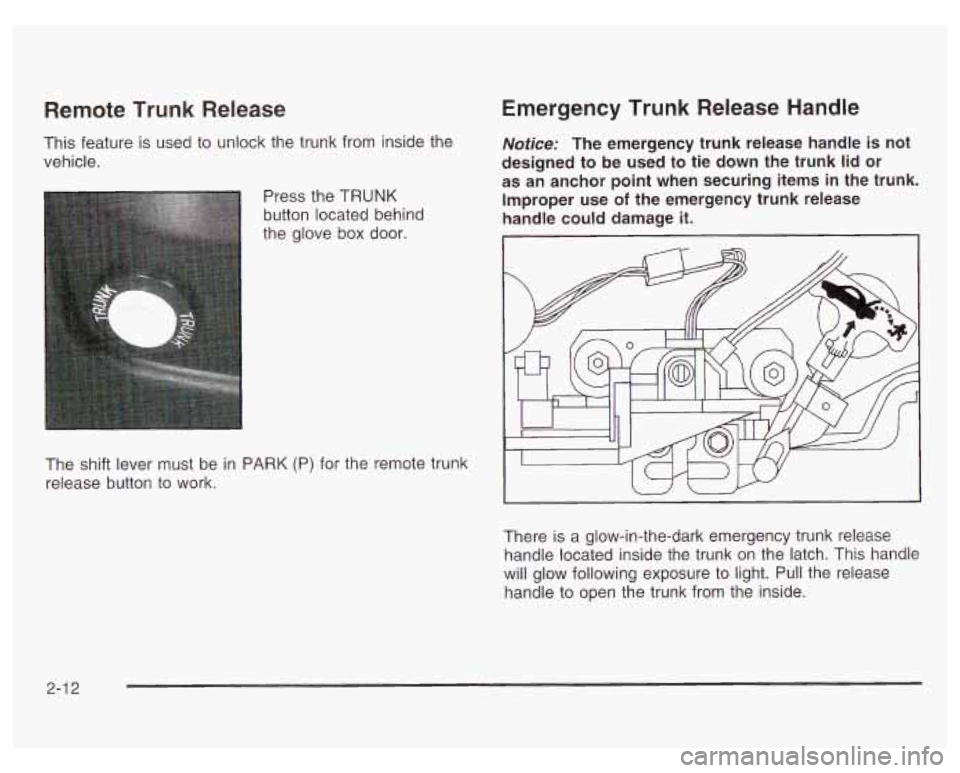
Press the TRUNK
button located behind
the glove box door.
Emergency Trunk Release Handle
Notice: The emergency trunk release handle is not
designed to be used to tie down the trunk lid or
as an anchor point when securing items in the trunk.
Improper use
of the emergency trunk release
handle could damage it.
I
The shift lever must be in PARK (P) for the remote trunk
release button to work.
There is a glow-in-the-dark emergency trunk release
handle located inside the trunk on the latch. This handle
will glow following exposure to light. Pull the release
handle to open the trunk from the inside.
2-1 2
Page 84 of 378
Changes or modifications to this system by other than
an authorized service facility could void authorization to
use this equipment.
PASS-Key@
Ill uses a radio frequency transponder in
the key that matches a decoder in your vehicle.
PASS-Key@ 111 Operation
Your vehicle is equipped with PASS-Key@ Ill
(Personalized Automotive Security System)
theft-deterrent system. PASS-Key@
Ill is a passive
theft-deterrent system. This means you don’t have to do
anything special to arm or disarm the system. It works
when you insert or remove the key from the ignition.
When the PASS-Key@
Ill system senses that someone
is using the wrong key, it shuts down the vehicle’s
starter and fuel systems. The starter will not work and
fuel will stop being delivered
to the engine. Anyone
using a trial-and-error method to start the vehicle will
be
discouraged because of the high number of electrical
key codes.
When trying to start the vehicle
if the engine does not
start and the SECURITY light comes on, the key
may have a damaged transponder. Turn the ignition
off and try again.
If the engine still does not start, and the key appears
to be undamaged, try another ignition key. At this time,
you may also want to check the fuse, see Fuses
and Circuit Breakers
on page 5-97. If the engine still
does not start with the other key, your vehicle needs
service.
If your vehicle does start, the first key may
be faulty. See your dealer who can service the
PASS-Key@
Ill to have a new key made. In an
emergency, contact Pontiac Roadside Assistance.
See Roadside Assistance Program
on page 7-5 for
more information.
It is possible for the PASS-Key@
Ill decoder to learn
the transponder value of a new or replacement key.
Up to
10 additional keys may be programmed for
the vehicle. This procedure is for learning additional
keys only.
If all the currently programmed keys are lost
or do not operate, you must see your dealer or a
locksmith who can service PASS-Key@
Ill to have keys
made and programmed to the system.
See your dealer or a locksmith who can service
PASS-Key@
Ill to get a new key blank that is cut exactly
as the ignition key that operates the system.
2-1 7
Page 85 of 378
Canadian Owners: If you lose or damage your keys,
only a
GM dealer can service PASS-Key@ Ill to
have new keys made.
To program additional keys, you
will need two current driver’s keys (black in color).
You must add a step to the following procedure. After
Step
2, repeat Steps 1 and 2 with the second current
driver’s key (black
in color). Then continue with Step 3.
To program the new key do the following:
1. Verify that the new key has PK3 stamped on it.
2. Insert the master key in the ignition and start
the engine.
If the engine will not start, see your
dealer for service.
3. After the engine has started, turn the key to
OFF,
and remove the key.
4. Insert the key to be programmed and turn it to RUN
within five seconds
of removing the original key.
5. The SECURITY light will turn off once the key has
been programmed.
It may not be apparent that the
SECURITY light went on due to how quickly the
key is programmed.
6. Repeat Steps 1 through 5 if additional keys are to
be programmed.
If you are ever driving and the SECURITY light comes
on and stays on, you will be able to restart your
engine
if you turn it off. Your PASS-Key@ Ill system,
however, is not working properly and must be serviced
by your dealer. Your vehicle is not protected by the
PASS-Key@
Ill system at this time.
If you lose or damage your PASS-Key@ Ill key, see your
dealer or a locksmith who can service PASS-Key@
Ill
to have a new key made.
2-1 8