ignition PONTIAC GRAND PRIX 2004 Owners Manual
[x] Cancel search | Manufacturer: PONTIAC, Model Year: 2004, Model line: GRAND PRIX, Model: PONTIAC GRAND PRIX 2004Pages: 432, PDF Size: 2.99 MB
Page 328 of 432
Replacing Brake System Parts
The braking system on a vehicle is complex. Its many
parts have to be of top quality and work well together if
the vehicle is to have really good braking. Your vehicle
was designed and tested with top-quality GM brake parts.
When you replace parts of your braking system Ð for
example, when your brake linings wear down and you
need new ones put in Ð be sure you get new approved
GM replacement parts. If you don't, your brakes may no
longer work properly. For example, if someone puts in
brake linings that are wrong for your vehicle, the balance
between your front and rear brakes can change Ð for the
worse. The braking performance you've come to expect
can change in many other ways if someone puts in the
wrong replacement brake parts.
Battery
Your new vehicle comes with a maintenance free
ACDelcožbattery. When it's time for a new battery, get
one that has the replacement number shown on the
original battery's label. We recommend an ACDelco
ž
battery. SeeEngine Compartment Overview on
page 5-12for battery location.
Warning:Battery posts, terminals and related
accessories contain lead and lead compounds,
chemicals known to the State of California to cause
cancer and reproductive harm. Wash hands after
handling.If your battery has a very low charge or is dead, you
may not be able to remove the ignition key from
the ignition switch or shift out of PARK (P). Refer to
Shifting Out of Park (P) on page 2-30.
Vehicle Storage
If you're not going to drive your vehicle for 25 days or
more, remove the black, negative (-) cable from the
battery. This will help keep your battery from
running down.
{CAUTION:
Batteries have acid that can burn you and gas
that can explode. You can be badly hurt if you
aren't careful. See ªJump Startingº next for
tips on working around a battery without
getting hurt.
Contact your dealer to learn how to prepare your
vehicle for longer storage periods.
Also, for your audio system, see
Theft-Deterrent
Feature on page 3-128.
5-48
Page 330 of 432
Notice:If you leave your radio on, it could be badly
damaged. The repairs wouldn't be covered by
your warranty.
3. Turn off the ignition on both vehicles. Unplug
unnecessary accessories plugged into the cigarette
lighter or in the accessory power outlet. Turn off
the radio and all lamps that aren't needed. This will
avoid sparks and help save both batteries. And it
could save your radio!
4. Open the hoods and locate the batteries. Find the
positive (+) and negative (-) terminal locations on
each vehicle. You will not need to access your
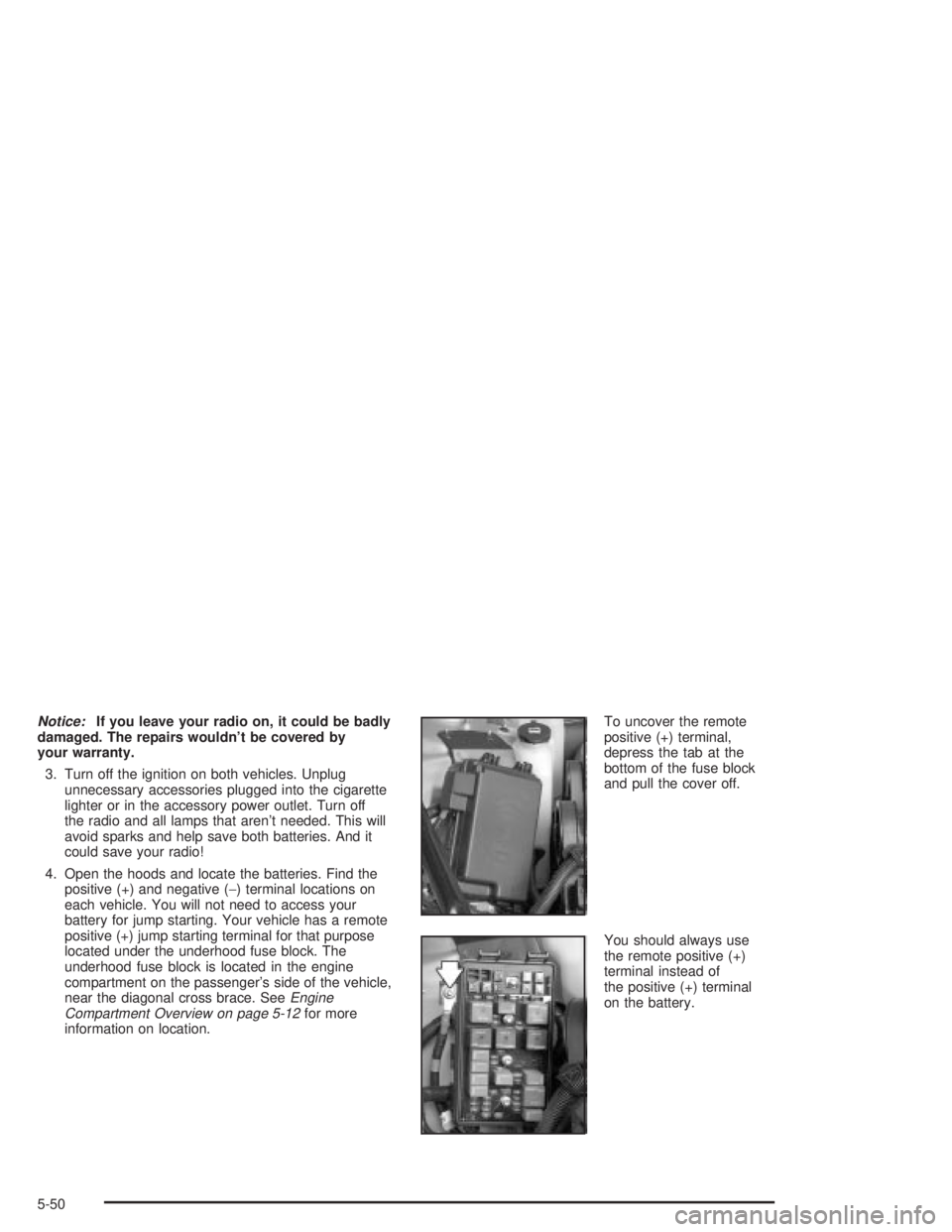
battery for jump starting. Your vehicle has a remote
positive (+) jump starting terminal for that purpose
located under the underhood fuse block. The
underhood fuse block is located in the engine
compartment on the passenger's side of the vehicle,
near the diagonal cross brace. See
Engine
Compartment Overview on page 5-12for more
information on location.To uncover the remote
positive (+) terminal,
depress the tab at the
bottom of the fuse block
and pull the cover off.
You should always use
the remote positive (+)
terminal instead of
the positive (+) terminal
on the battery.
5-50
Page 347 of 432
Windshield Wiper Blade
Replacement
Remove and replace a windshield wiper by following
these steps:
1. Put the ignition in ACCESSORY and turn the
windshield wipers on.
2. Stop the windshield wipers when they are in the
upright position by turning the key to the off position.
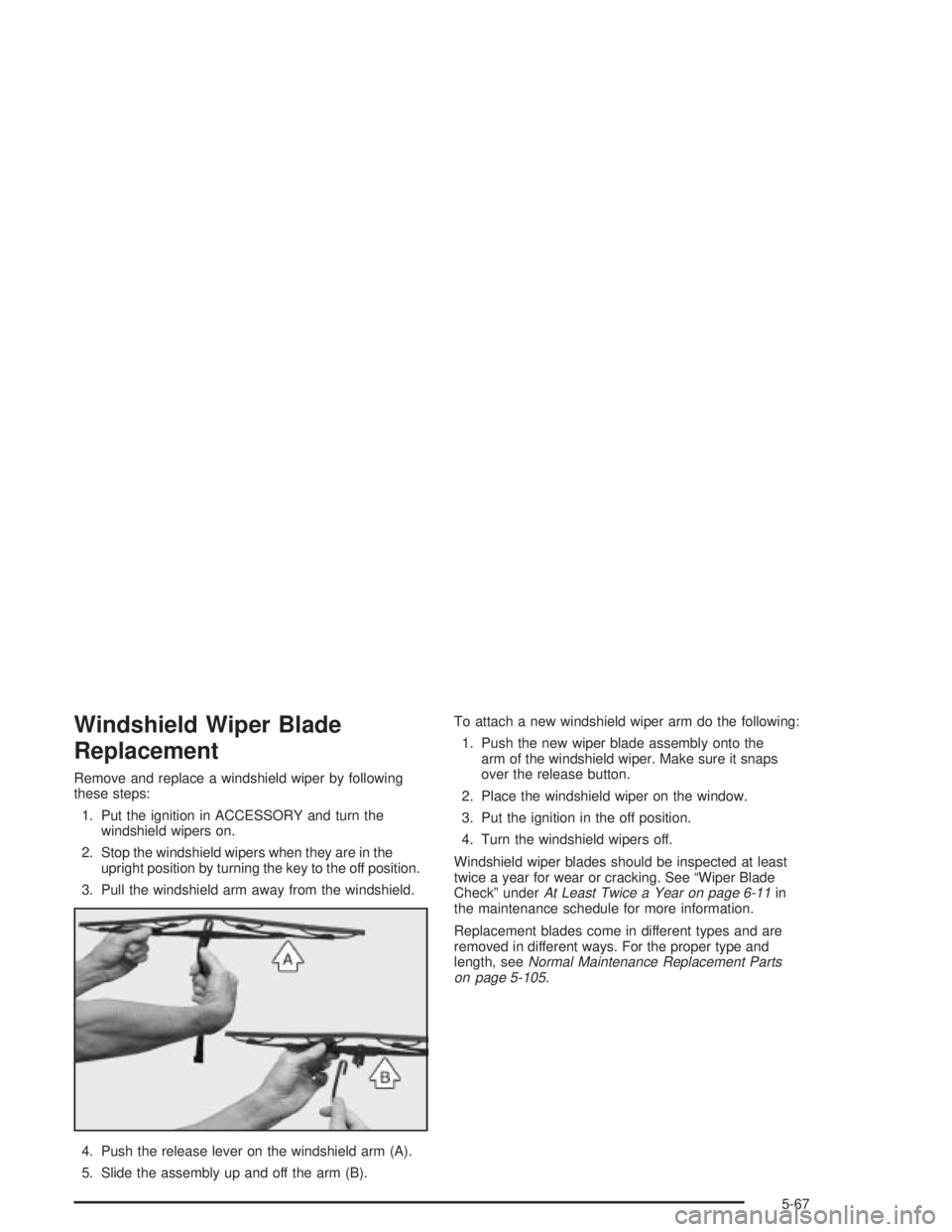
3. Pull the windshield arm away from the windshield.
4. Push the release lever on the windshield arm (A).
5. Slide the assembly up and off the arm (B).To attach a new windshield wiper arm do the following:
1. Push the new wiper blade assembly onto the
arm of the windshield wiper. Make sure it snaps
over the release button.
2. Place the windshield wiper on the window.
3. Put the ignition in the off position.
4. Turn the windshield wipers off.
Windshield wiper blades should be inspected at least
twice a year for wear or cracking. See ªWiper Blade
Checkº under
At Least Twice a Year on page 6-11in
the maintenance schedule for more information.
Replacement blades come in different types and are
removed in different ways. For the proper type and
length, see
Normal Maintenance Replacement Parts
on page 5-105.
5-67
Page 350 of 432
Tire Pressure Monitor System
This vehicle has the tire in¯ation monitor system, it can
alert you to a large change in the pressure of one
tire. The system ªlearnsº the pressure at each tire
throughout the operating speed range of your vehicle.
The system normally takes between 45 and 90 minutes
of driving to learn the tire pressures. This time may
be longer depending on your individual driving habits.
Learning need not be accumulated during a single
trip. Once learned, the system will remember the tire
pressures until the system is recalibrated.
See
DIC Warnings and Messages on page 3-65for
more information.
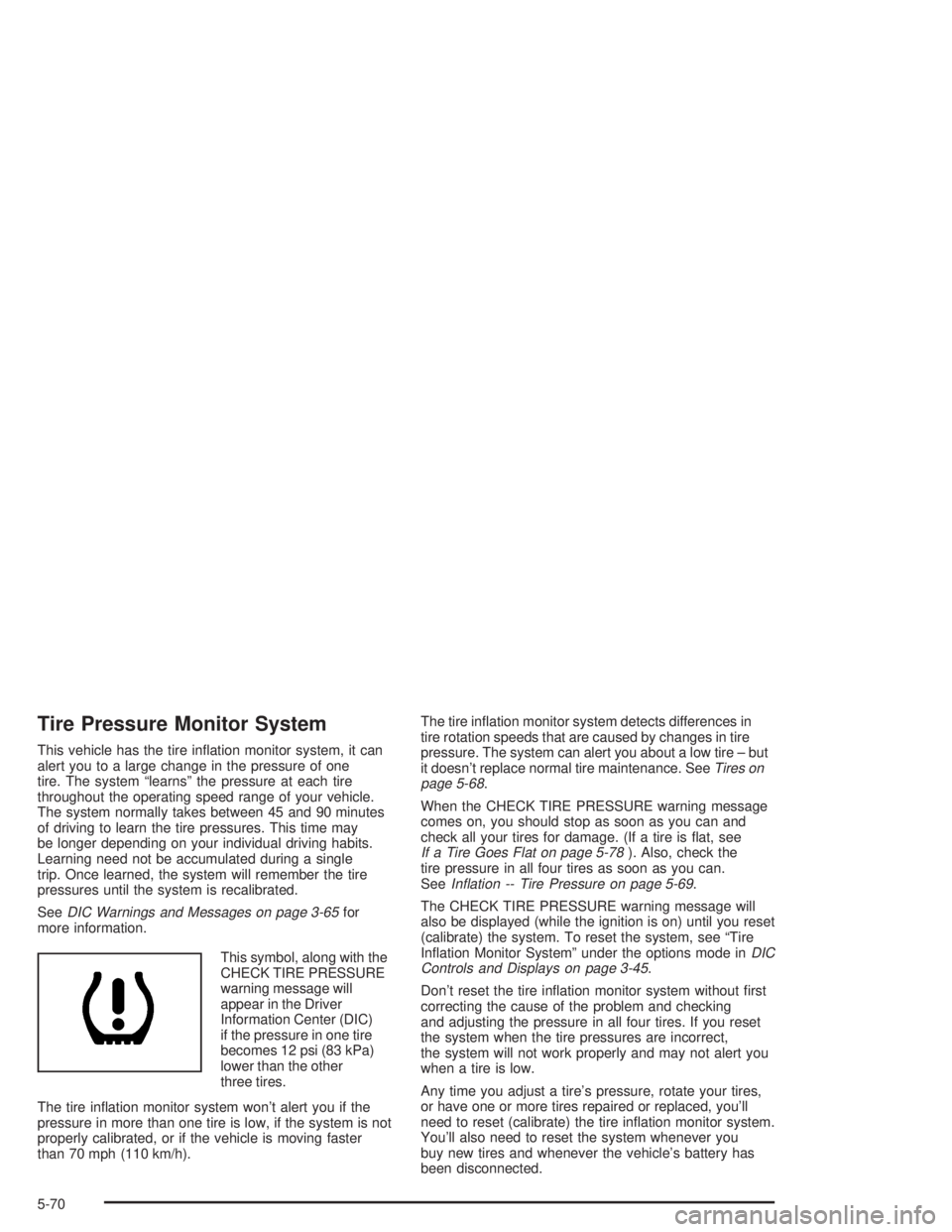
This symbol, along with the
CHECK TIRE PRESSURE
warning message will
appear in the Driver
Information Center (DIC)
if the pressure in one tire
becomes 12 psi (83 kPa)
lower than the other
three tires.
The tire in¯ation monitor system won't alert you if the
pressure in more than one tire is low, if the system is not
properly calibrated, or if the vehicle is moving faster
than 70 mph (110 km/h).The tire in¯ation monitor system detects differences in
tire rotation speeds that are caused by changes in tire
pressure. The system can alert you about a low tire ± but
it doesn't replace normal tire maintenance. See
Tires on
page 5-68.
When the CHECK TIRE PRESSURE warning message
comes on, you should stop as soon as you can and
check all your tires for damage. (If a tire is ¯at, see
If a Tire Goes Flat on page 5-78). Also, check the
tire pressure in all four tires as soon as you can.
See
In¯ation -- Tire Pressure on page 5-69.
The CHECK TIRE PRESSURE warning message will
also be displayed (while the ignition is on) until you reset
(calibrate) the system. To reset the system, see ªTire
In¯ation Monitor Systemº under the options mode in
DIC
Controls and Displays on page 3-45.
Don't reset the tire in¯ation monitor system without ®rst
correcting the cause of the problem and checking
and adjusting the pressure in all four tires. If you reset
the system when the tire pressures are incorrect,
the system will not work properly and may not alert you
when a tire is low.
Any time you adjust a tire's pressure, rotate your tires,
or have one or more tires repaired or replaced, you'll
need to reset (calibrate) the tire in¯ation monitor system.
You'll also need to reset the system whenever you
buy new tires and whenever the vehicle's battery has
been disconnected.
5-70
Page 383 of 432
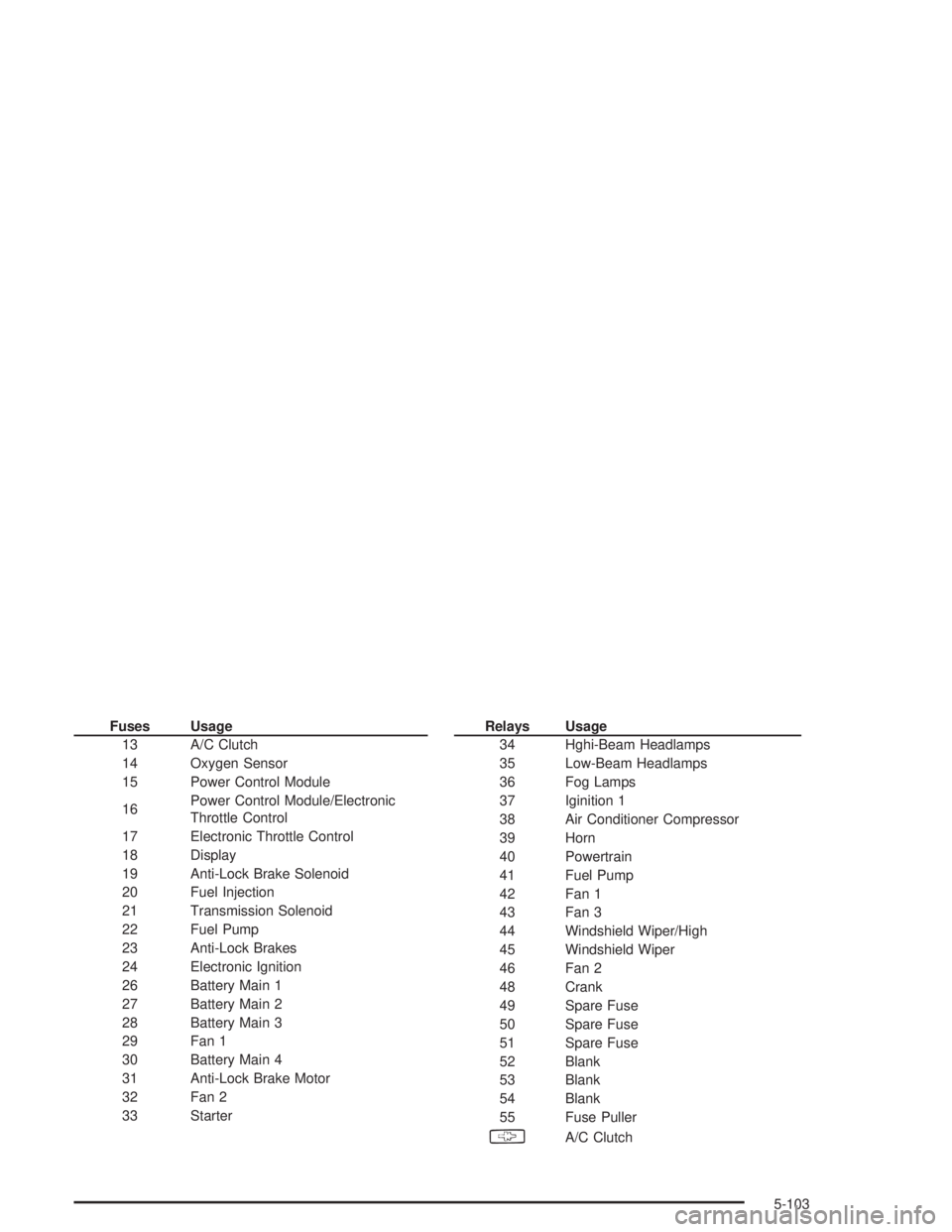
Fuses Usage
13 A/C Clutch
14 Oxygen Sensor
15 Power Control Module
16Power Control Module/Electronic
Throttle Control
17 Electronic Throttle Control
18 Display
19 Anti-Lock Brake Solenoid
20 Fuel Injection
21 Transmission Solenoid
22 Fuel Pump
23 Anti-Lock Brakes
24 Electronic Ignition
26 Battery Main 1
27 Battery Main 2
28 Battery Main 3
29 Fan 1
30 Battery Main 4
31 Anti-Lock Brake Motor
32 Fan 2
33 StarterRelays Usage
34 Hghi-Beam Headlamps
35 Low-Beam Headlamps
36 Fog Lamps
37 Iginition 1
38 Air Conditioner Compressor
39 Horn
40 Powertrain
41 Fuel Pump
42 Fan 1
43 Fan 3
44 Windshield Wiper/High
45 Windshield Wiper
46 Fan 2
48 Crank
49 Spare Fuse
50 Spare Fuse
51 Spare Fuse
52 Blank
53 Blank
54 Blank
55 Fuse Puller
§A/C Clutch
5-103
Page 399 of 432
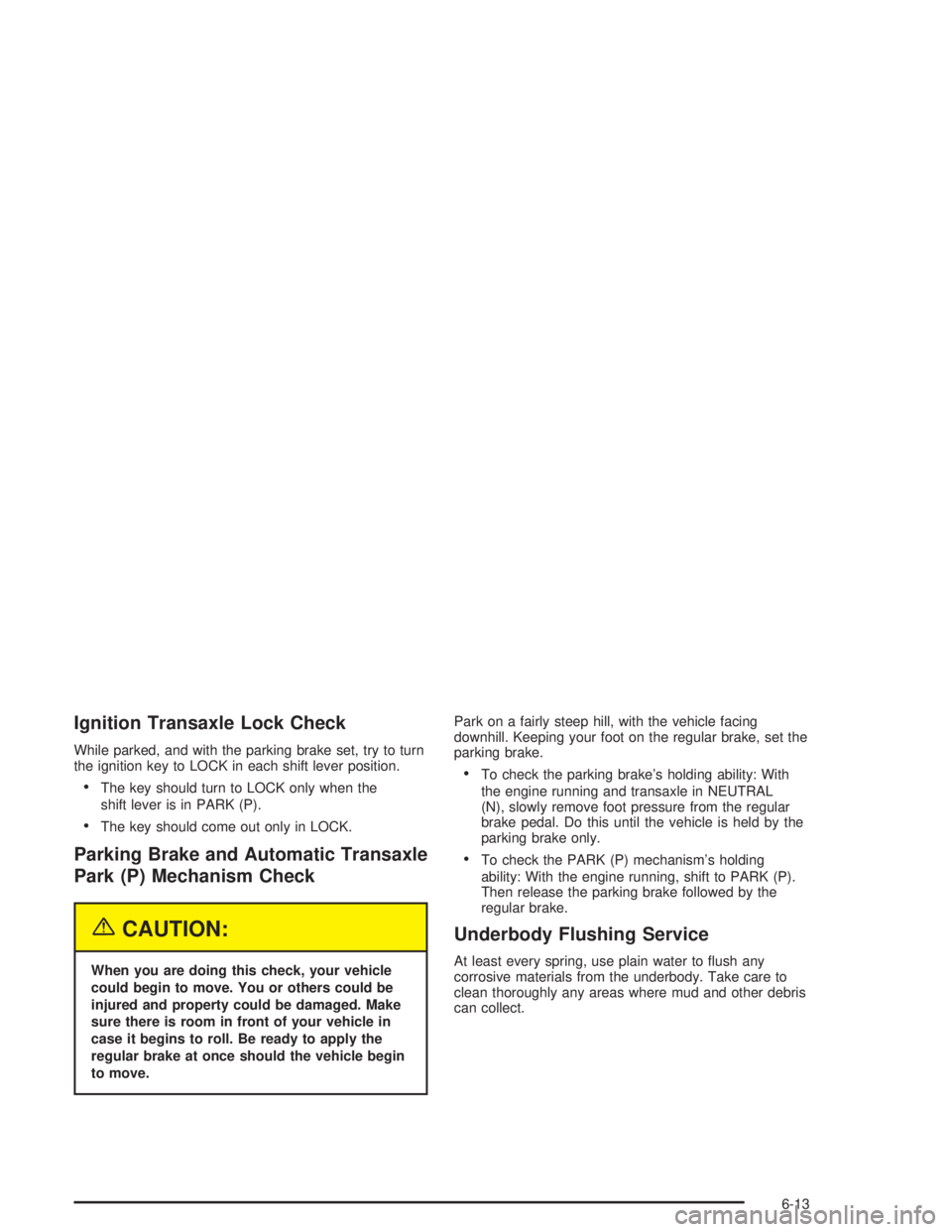
Ignition Transaxle Lock Check
While parked, and with the parking brake set, try to turn
the ignition key to LOCK in each shift lever position.
·The key should turn to LOCK only when the
shift lever is in PARK (P).
·The key should come out only in LOCK.
Parking Brake and Automatic Transaxle
Park (P) Mechanism Check
{CAUTION:
When you are doing this check, your vehicle
could begin to move. You or others could be
injured and property could be damaged. Make
sure there is room in front of your vehicle in
case it begins to roll. Be ready to apply the
regular brake at once should the vehicle begin
to move.Park on a fairly steep hill, with the vehicle facing
downhill. Keeping your foot on the regular brake, set the
parking brake.
·To check the parking brake's holding ability: With
the engine running and transaxle in NEUTRAL
(N), slowly remove foot pressure from the regular
brake pedal. Do this until the vehicle is held by the
parking brake only.
·To check the PARK (P) mechanism's holding
ability: With the engine running, shift to PARK (P).
Then release the parking brake followed by the
regular brake.
Underbody Flushing Service
At least every spring, use plain water to ¯ush any
corrosive materials from the underbody. Take care to
clean thoroughly any areas where mud and other debris
can collect.
6-13
Page 423 of 432
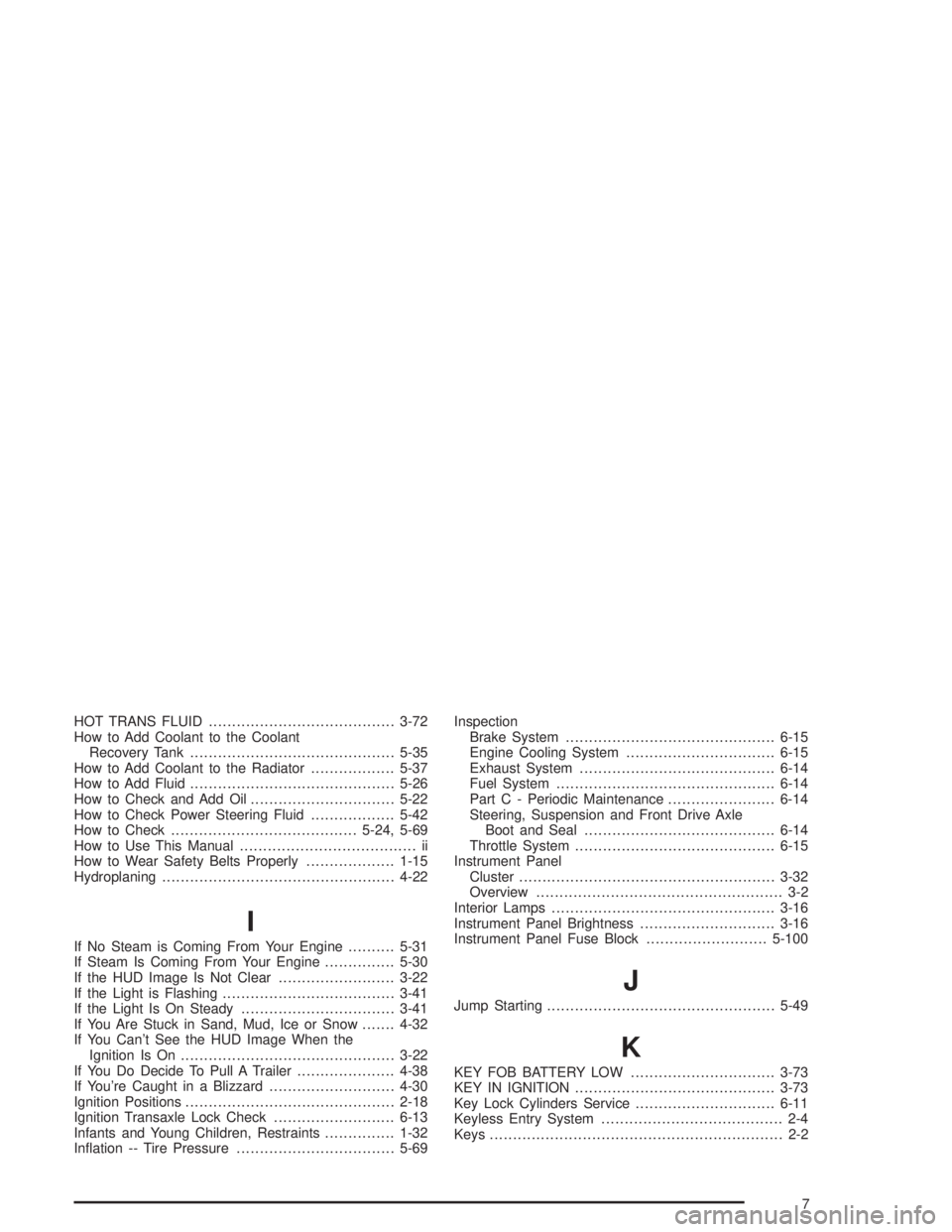
HOT TRANS FLUID........................................3-72
How to Add Coolant to the Coolant
Recovery Tank............................................5-35
How to Add Coolant to the Radiator..................5-37
How to Add Fluid............................................5-26
How to Check and Add Oil...............................5-22
How to Check Power Steering Fluid..................5-42
How to Check........................................5-24, 5-69
How to Use This Manual...................................... ii
How to Wear Safety Belts Properly...................1-15
Hydroplaning..................................................4-22
I
If No Steam is Coming From Your Engine..........5-31
If Steam Is Coming From Your Engine...............5-30
If the HUD Image Is Not Clear.........................3-22
If the Light is Flashing.....................................3-41
If the Light Is On Steady.................................3-41
If You Are Stuck in Sand, Mud, Ice or Snow.......4-32
If You Can't See the HUD Image When the
Ignition Is On..............................................3-22
If You Do Decide To Pull A Trailer.....................4-38
If You're Caught in a Blizzard...........................4-30
Ignition Positions.............................................2-18
Ignition Transaxle Lock Check..........................6-13
Infants and Young Children, Restraints...............1-32
In¯ation -- Tire Pressure..................................5-69Inspection
Brake System.............................................6-15
Engine Cooling System................................6-15
Exhaust System..........................................6-14
Fuel System...............................................6-14
Part C - Periodic Maintenance.......................6-14
Steering, Suspension and Front Drive Axle
Boot and Seal.........................................6-14
Throttle System...........................................6-15
Instrument Panel
Cluster.......................................................3-32
Overview..................................................... 3-2
Interior Lamps................................................3-16
Instrument Panel Brightness.............................3-16
Instrument Panel Fuse Block..........................5-100
J
Jump Starting.................................................5-49
K
KEY FOB BATTERY LOW...............................3-73
KEY IN IGNITION...........................................3-73
Key Lock Cylinders Service..............................6-11
Keyless Entry System....................................... 2-4
Keys............................................................... 2-2
7