lock PONTIAC GRAND PRIX 2005 User Guide
[x] Cancel search | Manufacturer: PONTIAC, Model Year: 2005, Model line: GRAND PRIX, Model: PONTIAC GRAND PRIX 2005Pages: 444, PDF Size: 2.6 MB
Page 30 of 444
Lap-Shoulder Belt
All rear seat positions have lap-shoulder belts. Here is
how to wear one properly.
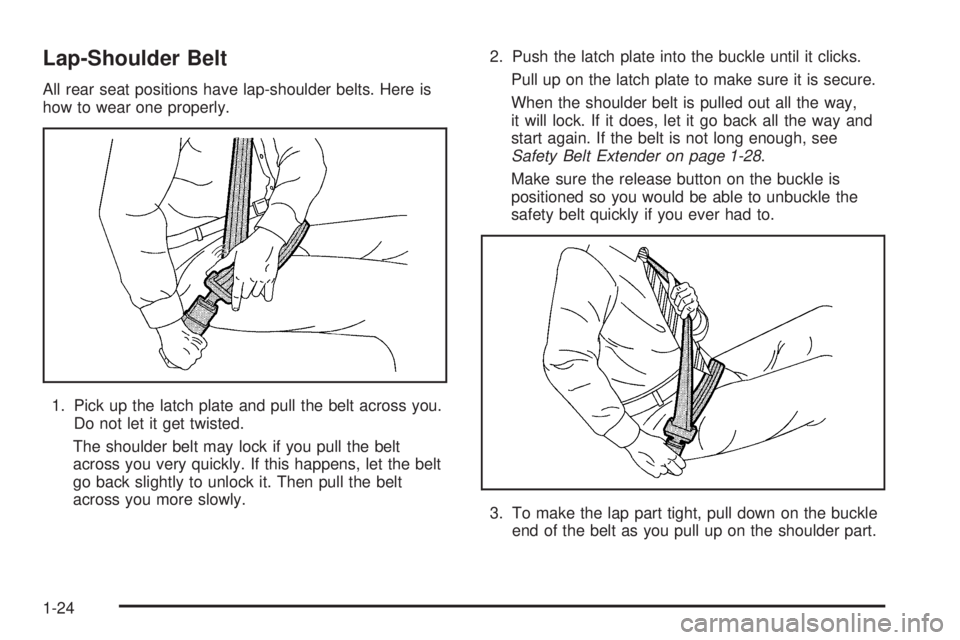
1. Pick up the latch plate and pull the belt across you.
Do not let it get twisted.
The shoulder belt may lock if you pull the belt
across you very quickly. If this happens, let the belt
go back slightly to unlock it. Then pull the belt
across you more slowly.2. Push the latch plate into the buckle until it clicks.
Pull up on the latch plate to make sure it is secure.
When the shoulder belt is pulled out all the way,
it will lock. If it does, let it go back all the way and
start again. If the belt is not long enough, see
Safety Belt Extender on page 1-28.
Make sure the release button on the buckle is
positioned so you would be able to unbuckle the
safety belt quickly if you ever had to.
3. To make the lap part tight, pull down on the buckle
end of the belt as you pull up on the shoulder part.
1-24
Page 31 of 444
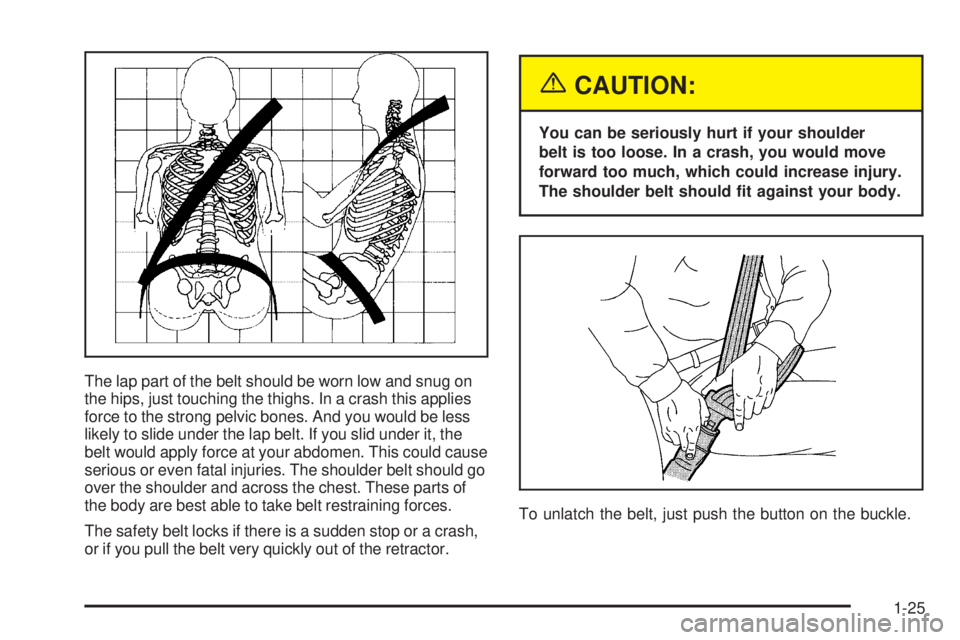
The lap part of the belt should be worn low and snug on
the hips, just touching the thighs. In a crash this applies
force to the strong pelvic bones. And you would be less
likely to slide under the lap belt. If you slid under it, the
belt would apply force at your abdomen. This could cause
serious or even fatal injuries. The shoulder belt should go
over the shoulder and across the chest. These parts of
the body are best able to take belt restraining forces.
The safety belt locks if there is a sudden stop or a crash,
or if you pull the belt very quickly out of the retractor.
{CAUTION:
You can be seriously hurt if your shoulder
belt is too loose. In a crash, you would move
forward too much, which could increase injury.
The shoulder belt should t against your body.
To unlatch the belt, just push the button on the buckle.
1-25
Page 50 of 444
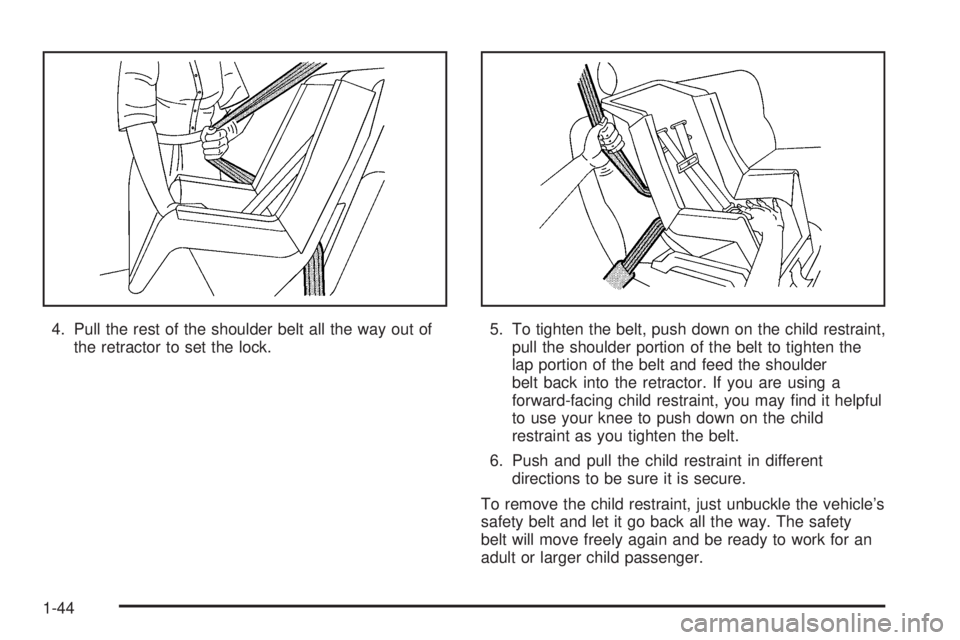
4. Pull the rest of the shoulder belt all the way out of
the retractor to set the lock.5. To tighten the belt, push down on the child restraint,
pull the shoulder portion of the belt to tighten the
lap portion of the belt and feed the shoulder
belt back into the retractor. If you are using a
forward-facing child restraint, you may nd it helpful
to use your knee to push down on the child
restraint as you tighten the belt.
6. Push and pull the child restraint in different
directions to be sure it is secure.
To remove the child restraint, just unbuckle the vehicle’s
safety belt and let it go back all the way. The safety
belt will move freely again and be ready to work for an
adult or larger child passenger.
1-44
Page 53 of 444
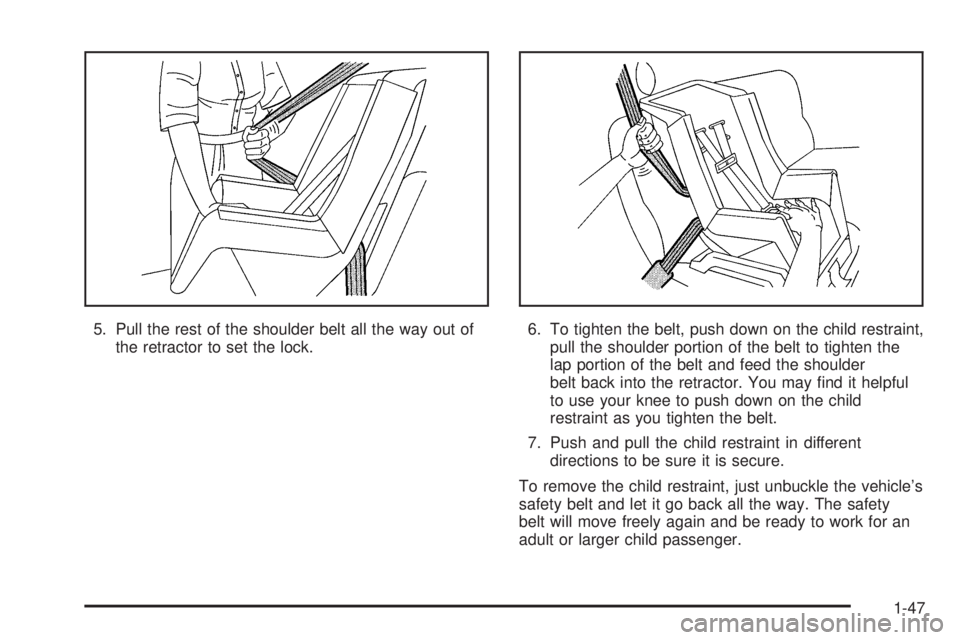
5. Pull the rest of the shoulder belt all the way out of
the retractor to set the lock.6. To tighten the belt, push down on the child restraint,
pull the shoulder portion of the belt to tighten the
lap portion of the belt and feed the shoulder
belt back into the retractor. You may nd it helpful
to use your knee to push down on the child
restraint as you tighten the belt.
7. Push and pull the child restraint in different
directions to be sure it is secure.
To remove the child restraint, just unbuckle the vehicle’s
safety belt and let it go back all the way. The safety
belt will move freely again and be ready to work for an
adult or larger child passenger.
1-47
Page 58 of 444
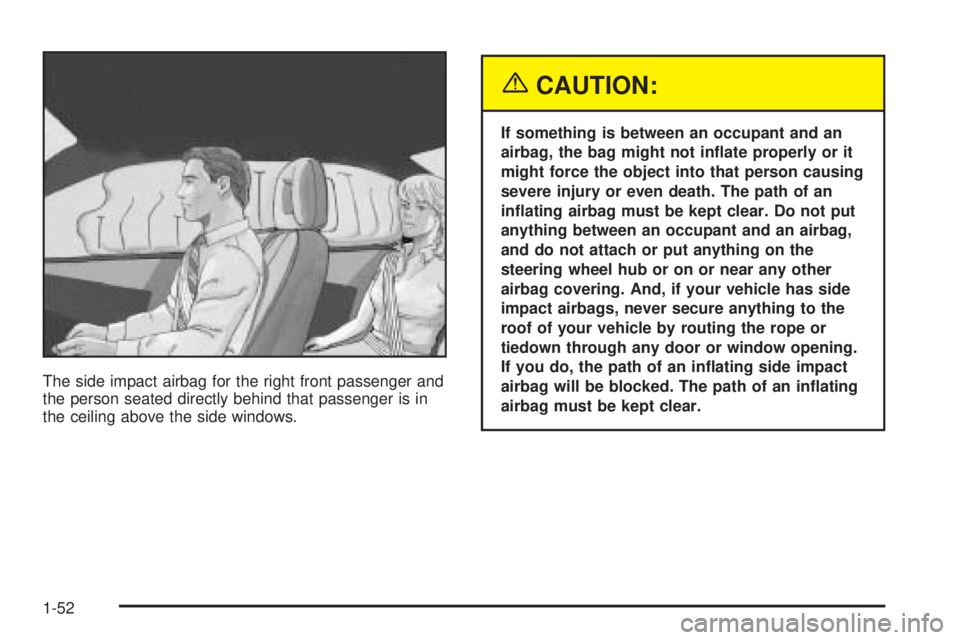
The side impact airbag for the right front passenger and
the person seated directly behind that passenger is in
the ceiling above the side windows.
{CAUTION:
If something is between an occupant and an
airbag, the bag might not inate properly or it
might force the object into that person causing
severe injury or even death. The path of an
inating airbag must be kept clear. Do not put
anything between an occupant and an airbag,
and do not attach or put anything on the
steering wheel hub or on or near any other
airbag covering. And, if your vehicle has side
impact airbags, never secure anything to the
roof of your vehicle by routing the rope or
tiedown through any door or window opening.
If you do, the path of an inating side impact
airbag will be blocked. The path of an inating
airbag must be kept clear.
1-52
Page 65 of 444
Keys...............................................................2-2
Remote Keyless Entry System.........................2-4
Remote Keyless Entry System Operation...........2-5
Doors and Locks............................................2-10
Door Locks..................................................2-10
Power Door Locks........................................2-11
Delayed Locking...........................................2-11
Programmable Automatic Door Locks..............2-12
Lockout Protection........................................2-12
Trunk..........................................................2-13
Windows........................................................2-15
Power Windows............................................2-16
Sun Visors...................................................2-16
Theft-Deterrent Systems..................................2-17
Content Theft-Deterrent.................................2-17
PASS-Key
®III ..............................................2-18
PASS-Key®III Operation...............................2-19
Starting and Operating Your Vehicle................2-21
New Vehicle Break-In....................................2-21
Ignition Positions..........................................2-22
Retained Accessory Power (RAP)...................2-22
Starting Your Engine.....................................2-23
Engine Coolant Heater..................................2-24Automatic Transaxle Operation.......................2-25
Parking Brake..............................................2-30
Shifting Into Park (P).....................................2-31
Shifting Out of Park (P).................................2-32
Parking Over Things That Burn.......................2-33
Engine Exhaust............................................2-33
Running Your Engine While You Are Parked.......2-34
Mirrors...........................................................2-35
Manual Rearview Mirror.................................2-35
Manual Rearview Mirror with OnStar
®..............2-35
Outside Power Mirrors...................................2-35
Outside Convex Mirror...................................2-36
OnStar
®System.............................................2-36
Storage Areas................................................2-38
Glove Box...................................................2-38
Cupholder(s)................................................2-38
Overhead Console........................................2-39
Front Seat Storage Net.................................2-40
Center Console Storage Area.........................2-40
Assist Handles.............................................2-40
Convenience Net..........................................2-40
Sunroof.........................................................2-41
Section 2 Features and Controls
2-1
Page 67 of 444
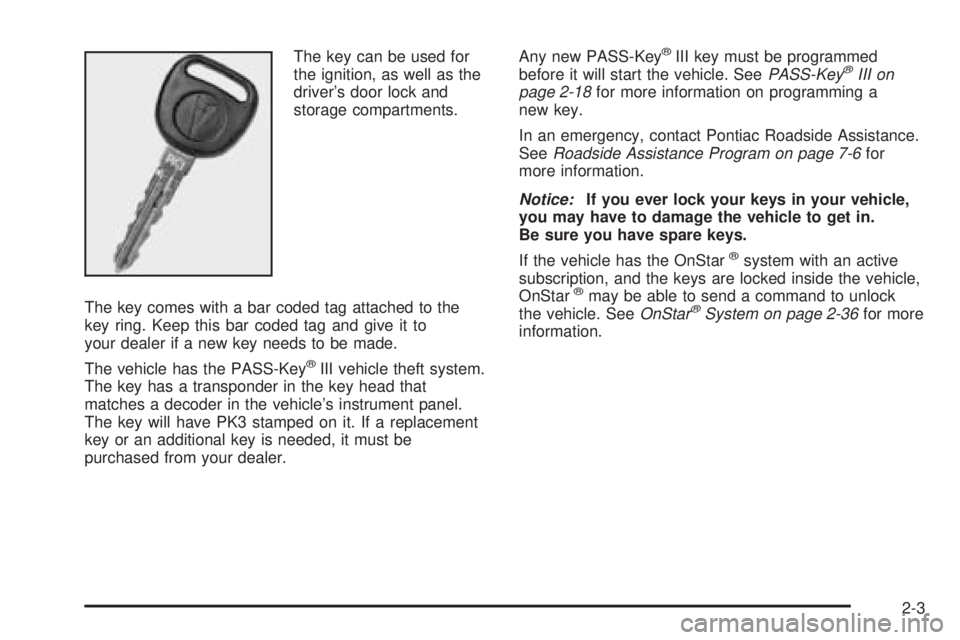
The key can be used for
the ignition, as well as the
driver’s door lock and
storage compartments.
The key comes with a bar coded tag attached to the
key ring. Keep this bar coded tag and give it to
your dealer if a new key needs to be made.
The vehicle has the PASS-Key
®III vehicle theft system.
The key has a transponder in the key head that
matches a decoder in the vehicle’s instrument panel.
The key will have PK3 stamped on it. If a replacement
key or an additional key is needed, it must be
purchased from your dealer.Any new PASS-Key
®III key must be programmed
before it will start the vehicle. SeePASS-Key®III on
page 2-18for more information on programming a
new key.
In an emergency, contact Pontiac Roadside Assistance.
SeeRoadside Assistance Program on page 7-6for
more information.
Notice:If you ever lock your keys in your vehicle,
you may have to damage the vehicle to get in.
Be sure you have spare keys.
If the vehicle has the OnStar
®system with an active
subscription, and the keys are locked inside the vehicle,
OnStar
®may be able to send a command to unlock
the vehicle. SeeOnStar®System on page 2-36for more
information.
2-3
Page 68 of 444
Remote Keyless Entry System
Your keyless entry system operates on a radio
frequency subject to Federal Communications
Commission (FCC) Rules and with Industry Canada.
This device complies with Part 15 of the FCC Rules.
Operation is subject to the following two conditions:
1. This device may not cause interference, and
2. This device must accept any interference received,
including interference that may cause undesired
operation of the device.
This device complies with RSS-210 of Industry Canada.
Operation is subject to the following two conditions:
1. This device may not cause interference, and
2. This device must accept any interference received,
including interference that may cause undesired
operation of the device.
Changes or modications to this system by other than
an authorized service facility could void authorization to
use this equipment.At times you may notice a decrease in range. This is
normal for any remote keyless entry system. If the
transmitter does not work or if you have to stand closer
to your vehicle for the transmitter to work, try this:
Check the distance. You may be too far from your
vehicle. You may need to stand closer during
rainy or snowy weather.
Check the location. Other vehicles or objects may
be blocking the signal. Take a few steps to the
left or right, hold the transmitter higher, and
try again.
Check to determine if battery replacement is
necessary. See “Battery Replacement” under
Remote Keyless Entry System Operation on
page 2-5.
If you are still having trouble, see your dealer or a
qualied technician for service.
2-4
Page 69 of 444
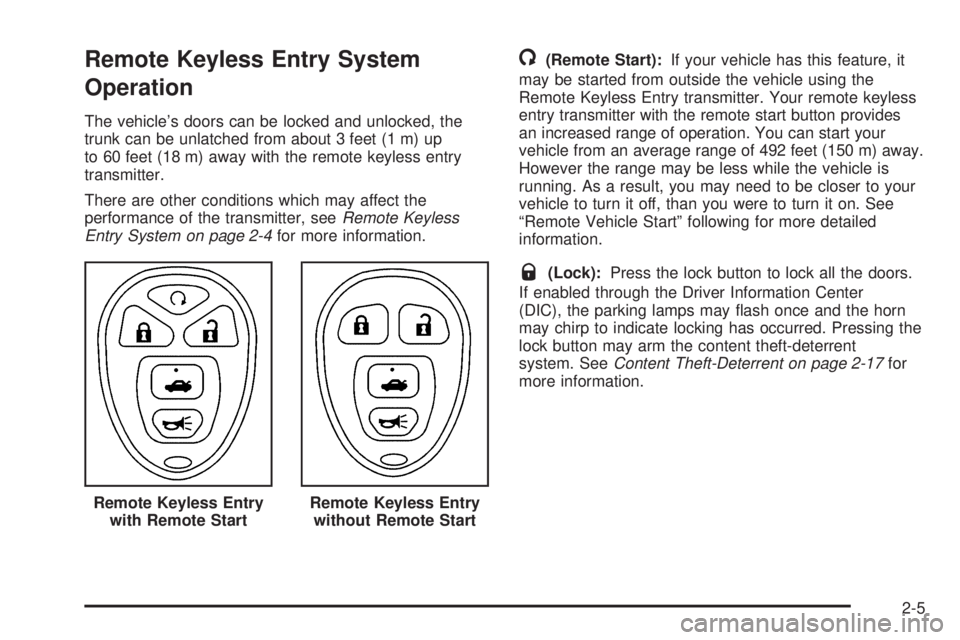
Remote Keyless Entry System
Operation
The vehicle’s doors can be locked and unlocked, the
trunk can be unlatched from about 3 feet (1 m) up
to 60 feet (18 m) away with the remote keyless entry
transmitter.
There are other conditions which may affect the
performance of the transmitter, seeRemote Keyless
Entry System on page 2-4for more information.
/(Remote Start):If your vehicle has this feature, it
may be started from outside the vehicle using the
Remote Keyless Entry transmitter. Your remote keyless
entry transmitter with the remote start button provides
an increased range of operation. You can start your
vehicle from an average range of 492 feet (150 m) away.
However the range may be less while the vehicle is
running. As a result, you may need to be closer to your
vehicle to turn it off, than you were to turn it on. See
“Remote Vehicle Start” following for more detailed
information.
Q(Lock):Press the lock button to lock all the doors.
If enabled through the Driver Information Center
(DIC), the parking lamps may ash once and the horn
may chirp to indicate locking has occurred. Pressing the
lock button may arm the content theft-deterrent
system. SeeContent Theft-Deterrent on page 2-17for
more information.
Remote Keyless Entry
with Remote Start
Remote Keyless Entry
without Remote Start
2-5
Page 70 of 444

"(Unlock):Press the unlock button one time to unlock
the driver’s door. Press the unlock button again within
ve seconds to unlock the other doors. The interior lights
will come on and stay on for 20 seconds or until the
ignition is turned on. If enabled through the DIC,
the parking lamps will ash once to indicate unlocking
has occurred. Pressing the lock button on the remote
keyless entry transmitter will disarm the content-theft
deterrent system. SeeContent Theft-Deterrent on
page 2-17for more details.
V(Trunk Release):Press this button to release the
trunk lid. The transaxle must be in PARK (P) for this
feature to operate.
L(Remote Alarm):Press the remote alarm button to
activate an alarm. The ignition must be in off or
accessory for the remote alarm to work. When the
remote alarm button is pressed the headlamps will ash
and the horn will sound repeatedly for two minutes.
The alarm will turn off when the ignition is moved to run
or the remote alarm button is pressed again.The vehicle may have Remote Lock/Unlock
Conrmation. This feature provides feedback that a
command has been received by the vehicle. The
headlamps will ash and the horn may sound briey.
See “Remote Lock Feedback” underDIC Controls and
Displays (Base Level DIC) on page 3-49orDIC
Controls and Displays (Uplevel DIC with Trip Computer)
on page 3-57for programming information.
Matching Transmitter(s) to Your
Vehicle
Each remote keyless entry transmitter is uniquely coded
to prevent another transmitter from unlocking the
vehicle. If a transmitter is lost or stolen, a replacement
can be purchased through your dealer. Remember
to bring any additional transmitters so they can also be
re-coded to match the new transmitter. Once your
dealer has coded the new transmitter, the lost
transmitter cannot unlock the vehicle. The vehicle can
have a maximum of four transmitters coded to it.
2-6