lock PONTIAC GRAND PRIX 2005 Owner's Guide
[x] Cancel search | Manufacturer: PONTIAC, Model Year: 2005, Model line: GRAND PRIX, Model: PONTIAC GRAND PRIX 2005Pages: 444, PDF Size: 2.6 MB
Page 84 of 444
When trying to start the vehicle, if the engine does not
start and the STARTING DISABLED DUE TO THEFT
SYSTEM warning message on the Driver Information
Center (DIC) comes on, the key may have a damaged
transponder. Turn the ignition off and try again.
If the engine still does not start, and the key appears to
be undamaged, try another ignition key. At this time,
you may also want to check the fuse. SeeFuses
and Circuit Breakers on page 5-103. If the engine still
does not start with the other key, the vehicle needs
service. If the vehicle does start, the rst key may
be faulty. See your dealer who can service the
PASS-Key
®III to have a new key made. In an
emergency, contact Pontiac Roadside Assistance.
SeeRoadside Assistance Program on page 7-6for
more information.
It is possible for the PASS-Key
®III decoder to accept
the transponder value of a new or replacement key.
Up to 10 additional keys may be programmed for
the vehicle. The following procedure is for programming
additional keys only. If all the programmed keys are
lost or do not operate, see your dealer or a locksmith
who can service PASS-Key
®III to have keys made
and programmed to the system.If the keys are lost or damaged, only a GM dealer can
service PASS-Key
®III to have new keys made. To
program additional keys, two driver’s keys are needed.
Canadian Owners:If you lose or damage your
keys, only a GM dealer can service PASS-Key
®III to
have new keys made. To program additional keys
you will need two current driver’s keys. You must add a
step to the following procedure. After Step 2, repeat
Steps 1 and 2 with the second current driver’s key.
Then continue with Step 3.
To program the new key do the following:
1. Verify that the new key has PK3 stamped on it.
2. Insert the master key in the ignition and start
the engine. If the engine will not start, see your
dealer for service.
3. After the engine has started, turn the key to OFF,
and remove the key.
4. Insert the key to be programmed and turn it to RUN
within ve seconds of removing the original key.
2-20
Page 85 of 444
5. The SECURITY DISABLED DUE TO THEFT
SYSTEM warning message on the DIC will turn off,
once the key has been programmed. It may not
be apparent that the SECURITY DISABLED DUE
TO THEFT SYSTEM warning message went on due
to how quickly the key is programmed.
6. Repeat Steps 1 through 5 if additional keys are to
be programmed.
If the SECURITY DISABLED DUE TO THEFT SYSTEM
warning message appears and stays on the DIC
while the vehicle is being driven, the engine will be able
to be restarted if it is turned off. Your PASS-Key
®III
system, however, is not working properly and must be
serviced by your dealer. The vehicle is not protected
by the PASS-Key
®III system at this time.
If the PASS-Key
®III key is lost or stolen, see your
dealer or a locksmith who can service PASS-Key®III
to have a new key made.
Starting and Operating
Your Vehicle
New Vehicle Break-In
Notice:Your vehicle does not need an elaborate
break-in. But it will perform better in the long run
if you follow these guidelines:
Do not drive at any one speed — fast or
slow — for the rst 500 miles (805 km).
Do not make full-throttle starts.
Avoid making hard stops for the rst
200 miles (322 km) or so. During this time
your new brake linings are not yet broken in.
Hard stops with new linings can mean
premature wear and earlier replacement.
Follow this breaking-in guideline every time
you get new brake linings.
Do not tow a trailer during break-in. SeeTowing
a Trailer on page 4-40for more information.
2-21
Page 86 of 444
Ignition Positions
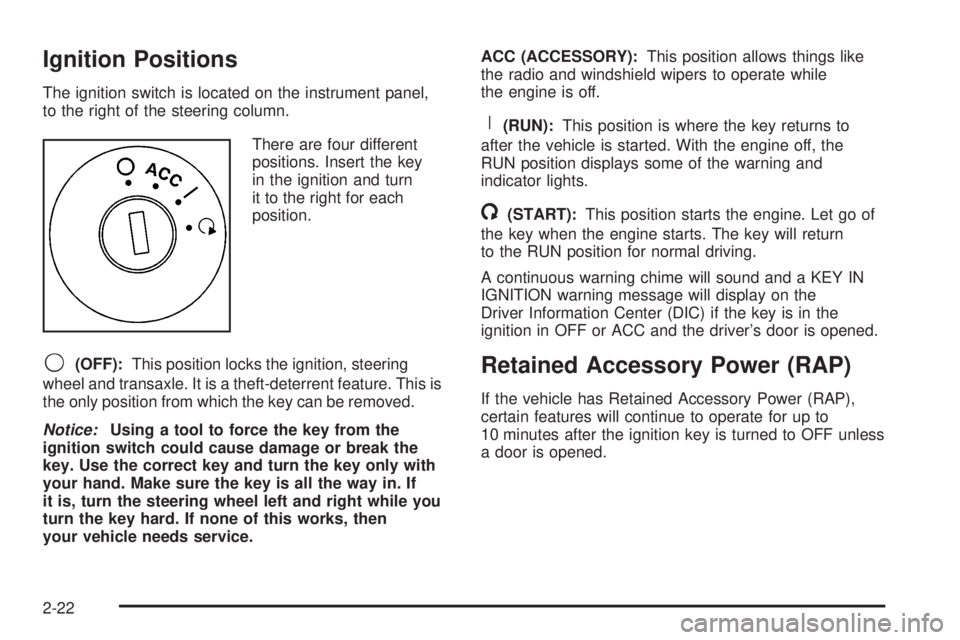
The ignition switch is located on the instrument panel,
to the right of the steering column.
There are four different
positions. Insert the key
in the ignition and turn
it to the right for each
position.
9(OFF):This position locks the ignition, steering
wheel and transaxle. It is a theft-deterrent feature. This is
the only position from which the key can be removed.
Notice:Using a tool to force the key from the
ignition switch could cause damage or break the
key. Use the correct key and turn the key only with
your hand. Make sure the key is all the way in. If
it is, turn the steering wheel left and right while you
turn the key hard. If none of this works, then
your vehicle needs service.ACC (ACCESSORY):This position allows things like
the radio and windshield wipers to operate while
the engine is off.
R(RUN):This position is where the key returns to
after the vehicle is started. With the engine off, the
RUN position displays some of the warning and
indicator lights.
/(START):This position starts the engine. Let go of
the key when the engine starts. The key will return
to the RUN position for normal driving.
A continuous warning chime will sound and a KEY IN
IGNITION warning message will display on the
Driver Information Center (DIC) if the key is in the
ignition in OFF or ACC and the driver’s door is opened.
Retained Accessory Power (RAP)
If the vehicle has Retained Accessory Power (RAP),
certain features will continue to operate for up to
10 minutes after the ignition key is turned to OFF unless
a door is opened.
2-22
Page 89 of 444
Automatic Transaxle Operation
The shift lever for the automatic transaxle is located on
the console between the seats.
Maximum engine speed is limited when the vehicle is
in PARK (P) or NEUTRAL (N) to protect driveline
components from improper operation.
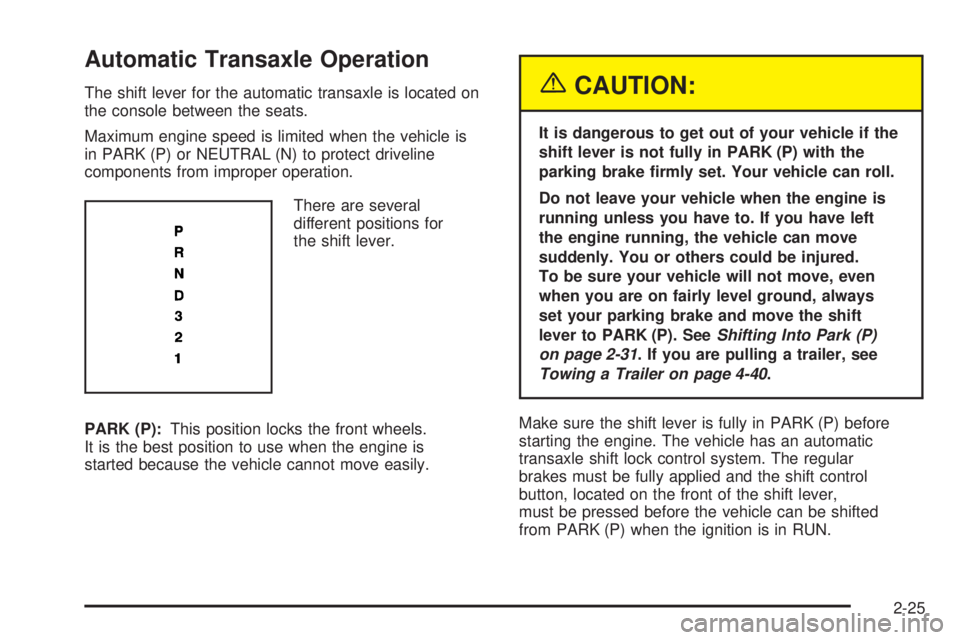
There are several
different positions for
the shift lever.
PARK (P):This position locks the front wheels.
It is the best position to use when the engine is
started because the vehicle cannot move easily.{CAUTION:
It is dangerous to get out of your vehicle if the
shift lever is not fully in PARK (P) with the
parking brake rmly set. Your vehicle can roll.
Do not leave your vehicle when the engine is
running unless you have to. If you have left
the engine running, the vehicle can move
suddenly. You or others could be injured.
To be sure your vehicle will not move, even
when you are on fairly level ground, always
set your parking brake and move the shift
lever to PARK (P). SeeShifting Into Park (P)
on page 2-31. If you are pulling a trailer, see
Towing a Trailer on page 4-40.
Make sure the shift lever is fully in PARK (P) before
starting the engine. The vehicle has an automatic
transaxle shift lock control system. The regular
brakes must be fully applied and the shift control
button, located on the front of the shift lever,
must be pressed before the vehicle can be shifted
from PARK (P) when the ignition is in RUN.
2-25
Page 95 of 444
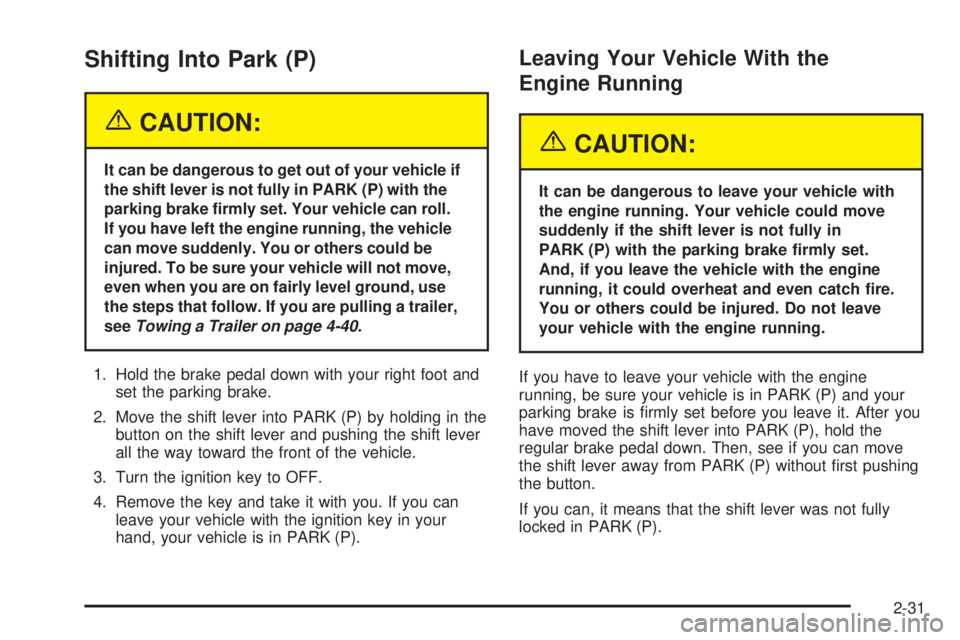
Shifting Into Park (P)
{CAUTION:
It can be dangerous to get out of your vehicle if
the shift lever is not fully in PARK (P) with the
parking brake rmly set. Your vehicle can roll.
If you have left the engine running, the vehicle
can move suddenly. You or others could be
injured. To be sure your vehicle will not move,
even when you are on fairly level ground, use
the steps that follow. If you are pulling a trailer,
seeTowing a Trailer on page 4-40.
1. Hold the brake pedal down with your right foot and
set the parking brake.
2. Move the shift lever into PARK (P) by holding in the
button on the shift lever and pushing the shift lever
all the way toward the front of the vehicle.
3. Turn the ignition key to OFF.
4. Remove the key and take it with you. If you can
leave your vehicle with the ignition key in your
hand, your vehicle is in PARK (P).
Leaving Your Vehicle With the
Engine Running
{CAUTION:
It can be dangerous to leave your vehicle with
the engine running. Your vehicle could move
suddenly if the shift lever is not fully in
PARK (P) with the parking brake rmly set.
And, if you leave the vehicle with the engine
running, it could overheat and even catch re.
You or others could be injured. Do not leave
your vehicle with the engine running.
If you have to leave your vehicle with the engine
running, be sure your vehicle is in PARK (P) and your
parking brake is rmly set before you leave it. After you
have moved the shift lever into PARK (P), hold the
regular brake pedal down. Then, see if you can move
the shift lever away from PARK (P) without rst pushing
the button.
If you can, it means that the shift lever was not fully
locked in PARK (P).
2-31
Page 96 of 444
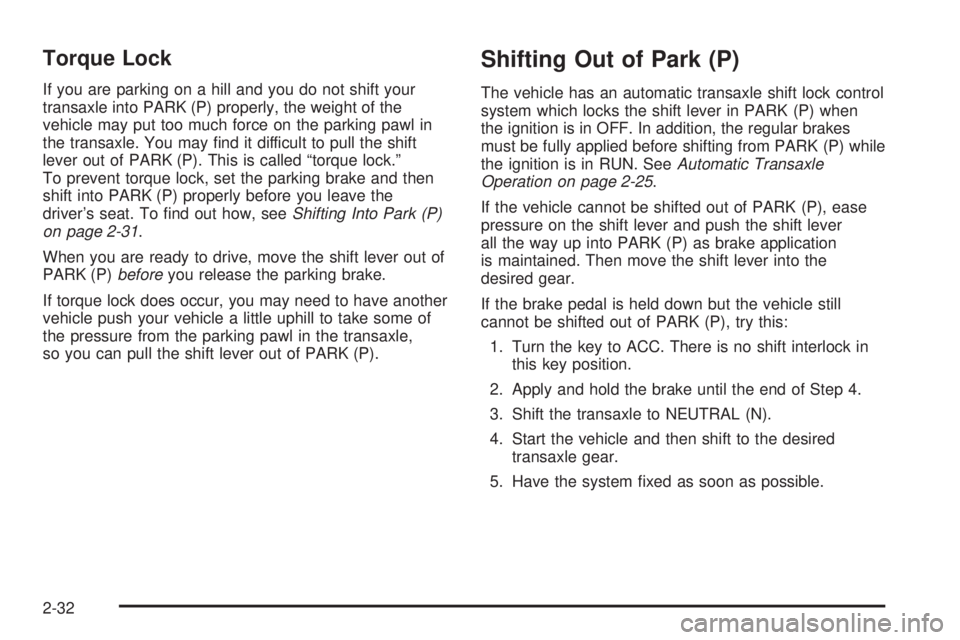
Torque Lock
If you are parking on a hill and you do not shift your
transaxle into PARK (P) properly, the weight of the
vehicle may put too much force on the parking pawl in
the transaxle. You may nd it difficult to pull the shift
lever out of PARK (P). This is called “torque lock.”
To prevent torque lock, set the parking brake and then
shift into PARK (P) properly before you leave the
driver’s seat. To nd out how, seeShifting Into Park (P)
on page 2-31.
When you are ready to drive, move the shift lever out of
PARK (P)beforeyou release the parking brake.
If torque lock does occur, you may need to have another
vehicle push your vehicle a little uphill to take some of
the pressure from the parking pawl in the transaxle,
so you can pull the shift lever out of PARK (P).
Shifting Out of Park (P)
The vehicle has an automatic transaxle shift lock control
system which locks the shift lever in PARK (P) when
the ignition is in OFF. In addition, the regular brakes
must be fully applied before shifting from PARK (P) while
the ignition is in RUN. SeeAutomatic Transaxle
Operation on page 2-25.
If the vehicle cannot be shifted out of PARK (P), ease
pressure on the shift lever and push the shift lever
all the way up into PARK (P) as brake application
is maintained. Then move the shift lever into the
desired gear.
If the brake pedal is held down but the vehicle still
cannot be shifted out of PARK (P), try this:
1. Turn the key to ACC. There is no shift interlock in
this key position.
2. Apply and hold the brake until the end of Step 4.
3. Shift the transaxle to NEUTRAL (N).
4. Start the vehicle and then shift to the desired
transaxle gear.
5. Have the system xed as soon as possible.
2-32
Page 99 of 444

Mirrors
Manual Rearview Mirror
Use the control located at the bottom to change the
mirror from the day to the night position. To reduce
the glare of headlamps from behind, turn the control
counterclockwise. To return the mirror back to the
day position, turn the control clockwise.
Manual Rearview Mirror
with OnStar
®
If the vehicle has this feature, use the control, located
at the bottom of the mirror, to change the mirror from
the day to the night position. To reduce the glare
of headlamps from behind, turn the control
counterclockwise. To return the mirror to the day
position, turn the control clockwise.
There are also three OnStar
®buttons located at the
bottom of the mirror face. See your dealer for more
information on the system and how to subscribe
to OnStar
®. SeeOnStar®System on page 2-36for
more information about the services OnStar®provides.
Outside Power Mirrors
The power mirror controls
are located near the
driver’s window, on the
driver’s door armrest.
Move the top control to the left to adjust the driver’s
side outside mirror. Move the control to the right
to adjust the passenger’s side mirror. The center
position turns the power control off and will not allow
the mirrors to move if the control pad is touched.
The round control pad adjusts the angle of the selected
outside mirror. Press the arrows on the control pad
to adjust the angle of the mirror. Adjust each mirror so
that the sides and the area behind the vehicle can
be seen.
2-35
Page 101 of 444
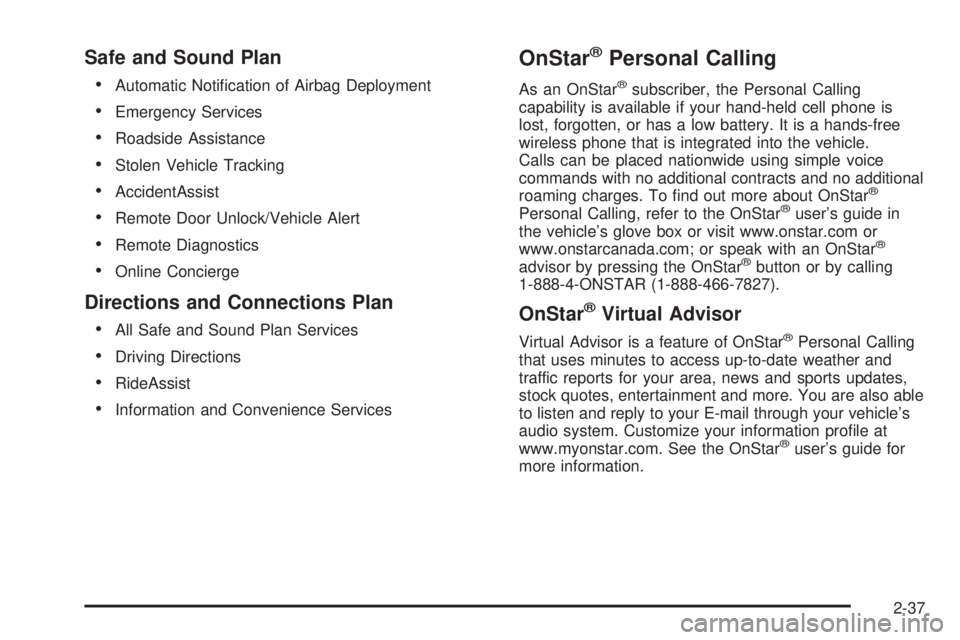
Safe and Sound Plan
Automatic Notication of Airbag Deployment
Emergency Services
Roadside Assistance
Stolen Vehicle Tracking
AccidentAssist
Remote Door Unlock/Vehicle Alert
Remote Diagnostics
Online Concierge
Directions and Connections Plan
All Safe and Sound Plan Services
Driving Directions
RideAssist
Information and Convenience Services
OnStar®Personal Calling
As an OnStar®subscriber, the Personal Calling
capability is available if your hand-held cell phone is
lost, forgotten, or has a low battery. It is a hands-free
wireless phone that is integrated into the vehicle.
Calls can be placed nationwide using simple voice
commands with no additional contracts and no additional
roaming charges. To nd out more about OnStar
®
Personal Calling, refer to the OnStar®user’s guide in
the vehicle’s glove box or visit www.onstar.com or
www.onstarcanada.com; or speak with an OnStar
®
advisor by pressing the OnStar®button or by calling
1-888-4-ONSTAR (1-888-466-7827).
OnStar®Virtual Advisor
Virtual Advisor is a feature of OnStar®Personal Calling
that uses minutes to access up-to-date weather and
traffic reports for your area, news and sports updates,
stock quotes, entertainment and more. You are also able
to listen and reply to your E-mail through your vehicle’s
audio system. Customize your information prole at
www.myonstar.com. See the OnStar
®user’s guide for
more information.
2-37
Page 107 of 444
Instrument Panel Overview...............................3-4
Hazard Warning Flashers................................3-5
Other Warning Devices...................................3-6
Horn.............................................................3-6
Tilt Wheel.....................................................3-6
Turn and Lane-Change Signals........................3-7
Headlamp High/Low-Beam Changer..................3-8
Flash-to-Pass.................................................3-8
Windshield Wiper Lever...................................3-9
Cruise Control..............................................3-10
Exterior Lamps.............................................3-14
Headlamps on Reminder................................3-15
Daytime Running Lamps (DRL).......................3-15
Fog Lamps..................................................3-16
Exterior Lighting Battery Saver........................3-17
Interior Lamps..............................................3-17
Instrument Panel Brightness...........................3-17
Courtesy Lamps...........................................3-18
Entry Lighting...............................................3-18
Delayed Entry Lighting...................................3-18
Delayed Exit Lighting.....................................3-19
Front Reading Lamps....................................3-19
Overhead Console Reading Lamps.................3-19
Rear Assist Handle Reading Lamps................3-19Battery Run-Down Protection..........................3-20
Head-Up Display (HUD).................................3-20
Accessory Power Outlets...............................3-24
Ashtrays and Cigarette Lighter........................3-25
Climate Controls............................................3-26
Climate Control System.................................3-26
Dual Automatic Climate Control System...........3-29
Outlet Adjustment.........................................3-33
Passenger Compartment Air Filter...................3-33
Warning Lights, Gages, and Indicators............3-35
Instrument Panel Cluster................................3-36
Speedometer and Odometer...........................3-37
Tachometer.................................................3-37
Safety Belt Reminder Light.............................3-38
Airbag Readiness Light..................................3-38
Up-Shift Light...............................................3-39
Brake System Warning Light..........................3-40
Anti-Lock Brake System Warning Light.............3-41
Traction Control System (TCS) Warning Light......3-42
Enhanced Traction System Warning Light.........3-42
Engine Coolant Temperature Warning Light......3-43
Engine Coolant Temperature Gage..................3-43
Malfunction Indicator Lamp.............................3-44
Section 3 Instrument Panel
3-1
Page 111 of 444
The main components of the instrument panel are the
following:
A. Side Window Defogger Outlets. SeeOutlet
Adjustment on page 3-33.
B. Air Outlets. SeeOutlet Adjustment on page 3-33.
C. Exterior Lamps Control. SeeExterior Lamps
on page 3-14.
D. TAP-Shift™ Control (If Equipped). SeeAutomatic
Transaxle Operation on page 2-25.
E. Hazard Warning Flashers Button. SeeHazard
Warning Flashers on page 3-5.
F. Instrument Panel Cluster. SeeInstrument Panel
Cluster on page 3-36.
G. Windshield Wiper Lever. SeeWindshield Wiper
Lever on page 3-9.
H. Ignition. SeeIgnition Positions on page 2-22.
I. Driver Information Center (DIC). SeeDriver
Information Center (DIC) on page 3-49.
J. Audio System. SeeAudio System(s) on page 3-92.
K. Audio Steering Wheel Controls (If Equipped).
SeeAudio Steering Wheel Controls on page 3-133.
L. Hood Release. SeeHood Release on page 5-10.
M. Tilt Steering Wheel Lever, on Steering Column.
SeeTilt Wheel on page 3-6.N. Interior Lamps Brightness Control. SeeInterior
Lamps on page 3-17.
O. Cruise Control. SeeCruise Control on page 3-10.
P. Climate Controls. SeeClimate Control System
on page 3-26.
Q. Glove Box. SeeGlove Box on page 2-38.
R. Instrument Panel Fuse Block. SeeInstrument Panel
Fuse Block on page 5-104.
Hazard Warning Flashers
Your hazard warning ashers let you warn others.
They also let police know you have a problem. Your
front and rear turn signal lamps will ash on and off.
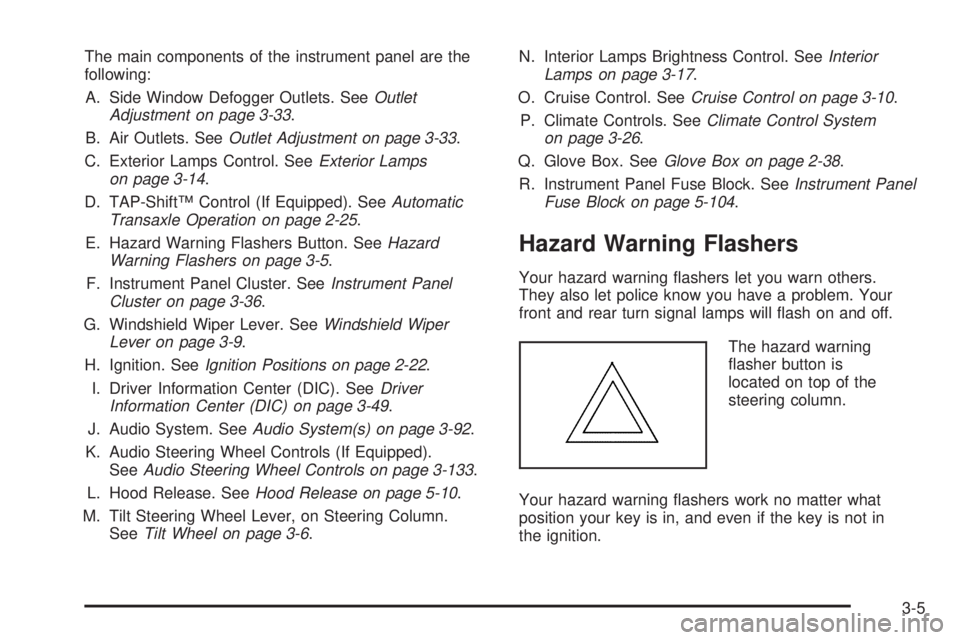
The hazard warning
asher button is
located on top of the
steering column.
Your hazard warning ashers work no matter what
position your key is in, and even if the key is not in
the ignition.
3-5