ignition PONTIAC GRAND PRIX 2006 User Guide
[x] Cancel search | Manufacturer: PONTIAC, Model Year: 2006, Model line: GRAND PRIX, Model: PONTIAC GRAND PRIX 2006Pages: 472, PDF Size: 2.82 MB
Page 83 of 472
The remote vehicle start feature will not operate if any
of the following occur:
The remote start system is disabled through
the DIC.
The vehicle’s key is in the ignition.
A door on the vehicle is open.
The vehicle’s hood is open.
The hazard warning ashers are on.
There is an emission control system malfunction.
The engine coolant temperature is too high.
The oil pressure is low.
Two remote vehicle starts have already been
provided for that ignition cycle.
If a remote start is attempted and is unsuccessful, the
Driver Information Center (DIC) will display REMOTE
START DISABLED.Vehicles that have the remote vehicle start feature are
shipped from the factory with the remote start system
enabled. The system may be enabled/disabled through
the DIC. See “REMOTE START” underDIC Controls
and Displays (Base Level DIC) on page 3-52or
DIC Controls and Displays (Uplevel DIC with Trip
Computer) on page 3-60for additional information.
Remote Start Ready
If your vehicle does not have the remote vehicle start
feature, it may have the remote start ready feature. This
feature allows your dealer to add the manufacturer’s
remote vehicle start feature.
If the keyless entry transmitter has a plus (+) symbol on
the back cover, your vehicle has the remote start
ready feature. You can lock or unlock your vehicle from
approximately 492 feet (150 m) away.
See your dealer if you would like to add the
manufacturer’s remote vehicle start feature to
your vehicle.
2-9
Page 85 of 472
Power Door Locks
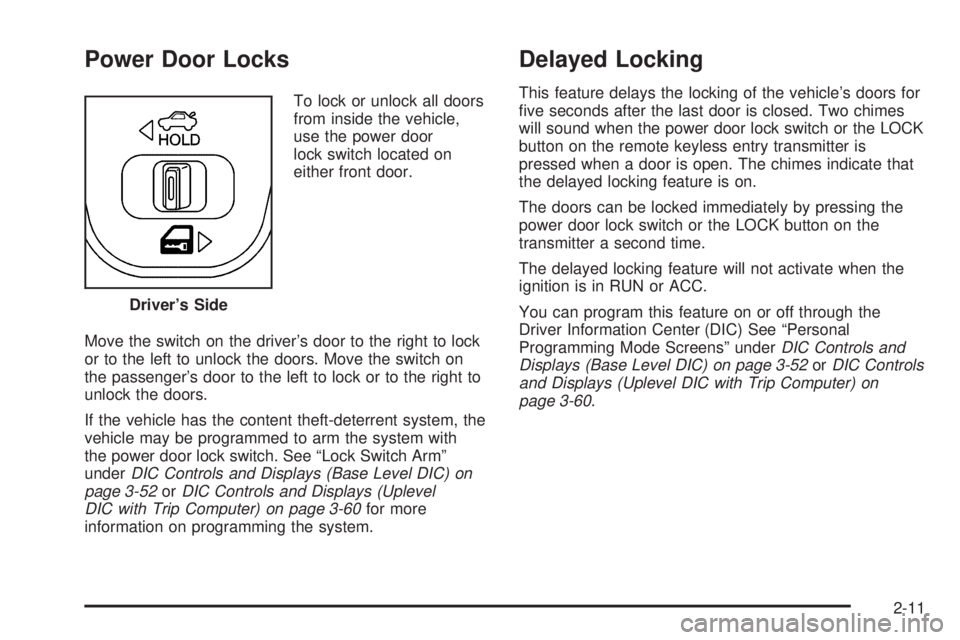
To lock or unlock all doors
from inside the vehicle,
use the power door
lock switch located on
either front door.
Move the switch on the driver’s door to the right to lock
or to the left to unlock the doors. Move the switch on
the passenger’s door to the left to lock or to the right to
unlock the doors.
If the vehicle has the content theft-deterrent system, the
vehicle may be programmed to arm the system with
the power door lock switch. See “Lock Switch Arm”
underDIC Controls and Displays (Base Level DIC) on
page 3-52orDIC Controls and Displays (Uplevel
DIC with Trip Computer) on page 3-60for more
information on programming the system.
Delayed Locking
This feature delays the locking of the vehicle’s doors for
ve seconds after the last door is closed. Two chimes
will sound when the power door lock switch or the LOCK
button on the remote keyless entry transmitter is
pressed when a door is open. The chimes indicate that
the delayed locking feature is on.
The doors can be locked immediately by pressing the
power door lock switch or the LOCK button on the
transmitter a second time.
The delayed locking feature will not activate when the
ignition is in RUN or ACC.
You can program this feature on or off through the
Driver Information Center (DIC) See “Personal
Programming Mode Screens” underDIC Controls and
Displays (Base Level DIC) on page 3-52orDIC Controls
and Displays (Uplevel DIC with Trip Computer) on
page 3-60. Driver’s Side
2-11
Page 87 of 472
When you want to open a rear door when the security
lock is on, do the following:
1. Unlock the door using the remote keyless entry
transmitter, if equipped, the power door lock
switch, or by lifting the rear door manual lock.
2. Open the door from the outside.
To cancel the rear door security lock, do the following:
1. Unlock the door and open it from the outside.
2. Insert the key into the security lock slot and turn it
so the slot is in the vertical position.
Lockout Protection
The lockout protection feature makes it more difficult to
lock the key in the vehicle. If the driver’s door is
open while the key is in the ignition, the door cannot be
locked with the power door lock switch.
This feature cannot guarantee that you will never be
locked out of the vehicle. If the key is not left in
the ignition, or, if the manual door lock pin is used, the
key could still be locked inside the vehicle. Always
remember to take the key with you.
Trunk
{CAUTION:
It can be dangerous to drive with the trunk lid
open because carbon monoxide (CO) gas can
come into your vehicle. You cannot see or
smell CO. It can cause unconsciousness and
even death. If you must drive with the trunk lid
open or if electrical wiring or other cable
connections must pass through the seal
between the body and the trunk lid:
Make sure all other windows are shut.
Turn the fan on your heating or cooling
system to its highest speed and select the
control setting that will force outside air
into your vehicle. See Climate Control
System.
If you have air outlets on or under the
instrument panel, open them all the way.
SeeEngine Exhaust on page 2-33.
To unlock and open the trunk from the outside, press the
trunk button on the remote keyless entry transmitter. See
Remote Keyless Entry System Operation on page 2-4.
2-13
Page 90 of 472
Power Windows
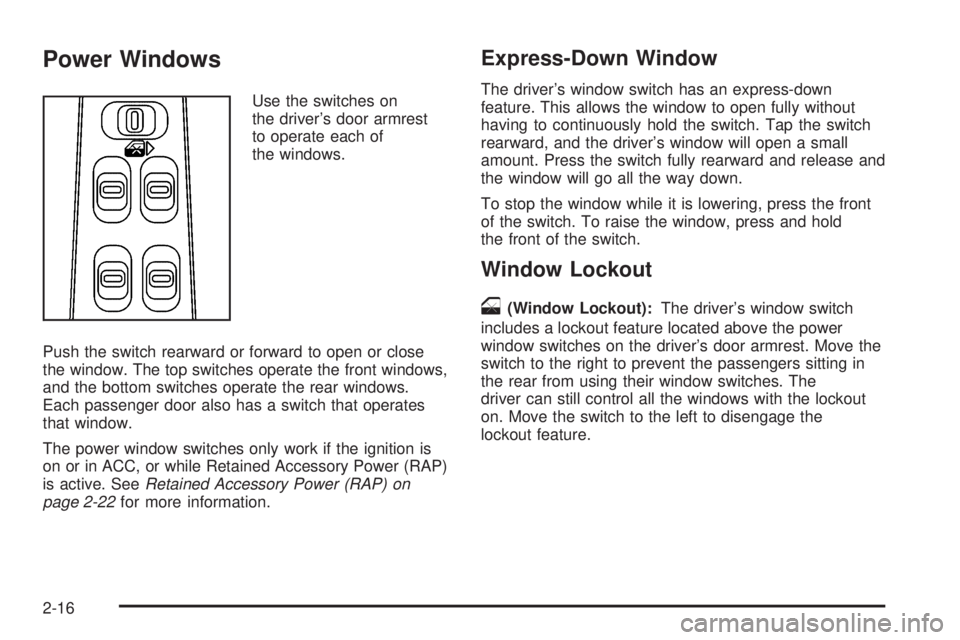
Use the switches on
the driver’s door armrest
to operate each of
the windows.
Push the switch rearward or forward to open or close
the window. The top switches operate the front windows,
and the bottom switches operate the rear windows.
Each passenger door also has a switch that operates
that window.
The power window switches only work if the ignition is
on or in ACC, or while Retained Accessory Power (RAP)
is active. SeeRetained Accessory Power (RAP) on
page 2-22for more information.
Express-Down Window
The driver’s window switch has an express-down
feature. This allows the window to open fully without
having to continuously hold the switch. Tap the switch
rearward, and the driver’s window will open a small
amount. Press the switch fully rearward and release and
the window will go all the way down.
To stop the window while it is lowering, press the front
of the switch. To raise the window, press and hold
the front of the switch.
Window Lockout
o
(Window Lockout):The driver’s window switch
includes a lockout feature located above the power
window switches on the driver’s door armrest. Move the
switch to the right to prevent the passengers sitting in
the rear from using their window switches. The
driver can still control all the windows with the lockout
on. Move the switch to the left to disengage the
lockout feature.
2-16
Page 92 of 472
Arming with the Power Lock Switch
The vehicle’s content theft-deterrent alarm system can
be activated when the key is removed from the ignition
and the power door lock switch of either the driver’s or
front passenger’s door is used to lock the vehicle. The
door needs to be in the open position when pressing the
power door lock switch. The alarm system will not
activate if the door is closed and the power door lock
switch is pressed. This system can be activated through
the Driver’s Information Center (DIC). See “Lock Switch
Arm” under the Personal Programming Mode Screens in
DIC Controls and Displays (Base Level DIC) on
page 3-52orDIC Controls and Displays (Uplevel DIC
with Trip Computer) on page 3-60.
When the doors are locked using the power door lock
switch of either front door, the red light, on top of the
instrument panel will start ashing indicating that the
system is arming. After all the doors are closed there will
be a time delay and then the red light will begin to ash at
a very slow rate indicating the system is armed.
Arming with the Remote Keyless
Entry Transmitter
The alarm system will arm when the remote keyless
entry transmitter is used to lock the doors after the key
is removed from the ignition. The red light will come
on to indicate that the system is arming. After all doors
are closed and locked, and after a time delay, the
red light will begin ashing at a very slow rate to show
the system is armed.
Arming Conrmation
A red light located on top of the instrument panel,
towards the center of the vehicle and near the
windshield, will ash slowly to conrm when the
system is armed.
2-18
Page 94 of 472
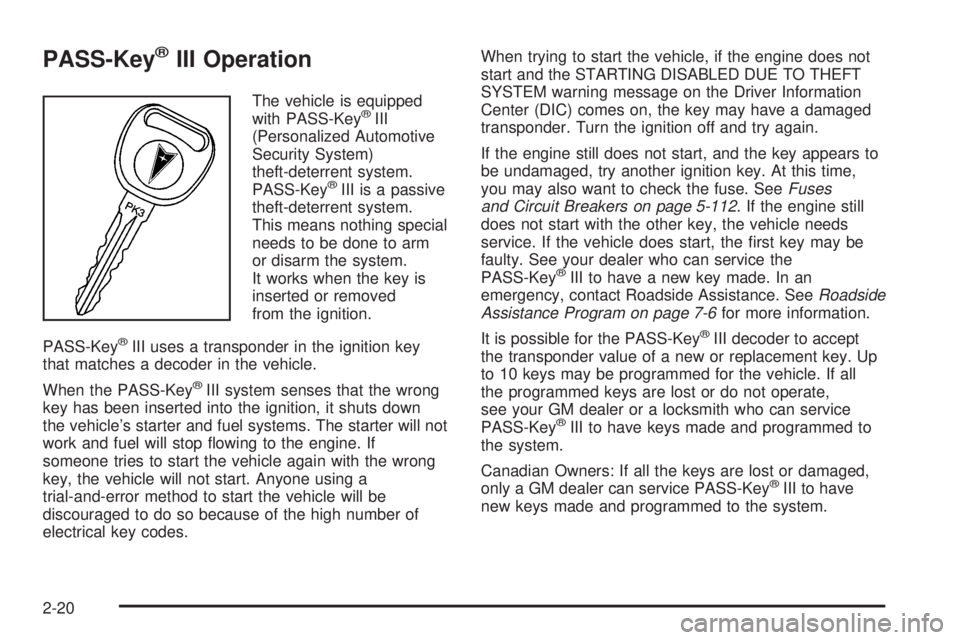
PASS-Key®III Operation
The vehicle is equipped
with PASS-Key®III
(Personalized Automotive
Security System)
theft-deterrent system.
PASS-Key
®III is a passive
theft-deterrent system.
This means nothing special
needs to be done to arm
or disarm the system.
It works when the key is
inserted or removed
from the ignition.
PASS-Key
®III uses a transponder in the ignition key
that matches a decoder in the vehicle.
When the PASS-Key
®III system senses that the wrong
key has been inserted into the ignition, it shuts down
the vehicle’s starter and fuel systems. The starter will not
work and fuel will stop owing to the engine. If
someone tries to start the vehicle again with the wrong
key, the vehicle will not start. Anyone using a
trial-and-error method to start the vehicle will be
discouraged to do so because of the high number of
electrical key codes.When trying to start the vehicle, if the engine does not
start and the STARTING DISABLED DUE TO THEFT
SYSTEM warning message on the Driver Information
Center (DIC) comes on, the key may have a damaged
transponder. Turn the ignition off and try again.
If the engine still does not start, and the key appears to
be undamaged, try another ignition key. At this time,
you may also want to check the fuse. SeeFuses
and Circuit Breakers on page 5-112. If the engine still
does not start with the other key, the vehicle needs
service. If the vehicle does start, the rst key may be
faulty. See your dealer who can service the
PASS-Key
®III to have a new key made. In an
emergency, contact Roadside Assistance. SeeRoadside
Assistance Program on page 7-6for more information.
It is possible for the PASS-Key
®III decoder to accept
the transponder value of a new or replacement key. Up
to 10 keys may be programmed for the vehicle. If all
the programmed keys are lost or do not operate,
see your GM dealer or a locksmith who can service
PASS-Key
®III to have keys made and programmed to
the system.
Canadian Owners: If all the keys are lost or damaged,
only a GM dealer can service PASS-Key
®III to have
new keys made and programmed to the system.
2-20
Page 95 of 472
The following procedure is for programming a new or
replacement key when you have at least one already
programmed key. To program the new key do the
following:
1. Verify that the new key has PK3 stamped on it.
2. Insert the master key in the ignition and start
the engine. If the engine will not start, see your
dealer for service.
3. After the engine has started, turn the key to OFF,
and remove the key.
4. Insert the key to be programmed and turn it to RUN
within ve seconds of removing the original key.
5. The STARTING DISABLED DUE TO THEFT
SYSTEM warning message on the DIC will turn off,
once the key has been programmed. It may not be
apparent that the SERVICE THEFT SYSTEM
warning message went on due to how quickly the key
is programmed.
6. Repeat Steps 1 through 5 if additional keys are to
be programmed.
If the STARTING DISABLED DUE TO THEFT SYSTEM
warning message appears and stays on the DIC while the
vehicle is being driven, the engine will be able to be
restarted if it is turned off. Your PASS-Key
®III system,
however, is not working properly and must be serviced by
your dealer. The vehicle is not protected by the
PASS-Key
®III system at this time. If the PASS-Key®III
key is lost or stolen, see your dealer or a locksmith who
can service PASS-Key
®III to have a new key made.
Starting and Operating Your
Vehicle
New Vehicle Break-In
Notice:Your vehicle does not need an elaborate
break-in. But it will perform better in the long run if
you follow these guidelines:
Do not drive at any one constant speed, fast or
slow, for the rst 500 miles (805 km). Do not
make full-throttle starts. Avoid downshifting to
brake, or slow, the vehicle.
Avoid making hard stops for the rst 200 miles
(322 km) or so. During this time your new brake
linings are not yet broken in. Hard stops with new
linings can mean premature wear and earlier
replacement. Follow this breaking-in guideline
every time you get new brake linings.
Do not tow a trailer during break-in. SeeTowing a
Trailer on page 4-40for the trailer towing
capabilities of your vehicle and more
information.
Following break-in, engine speed and load can be
gradually increased.
2-21
Page 96 of 472
Ignition Positions
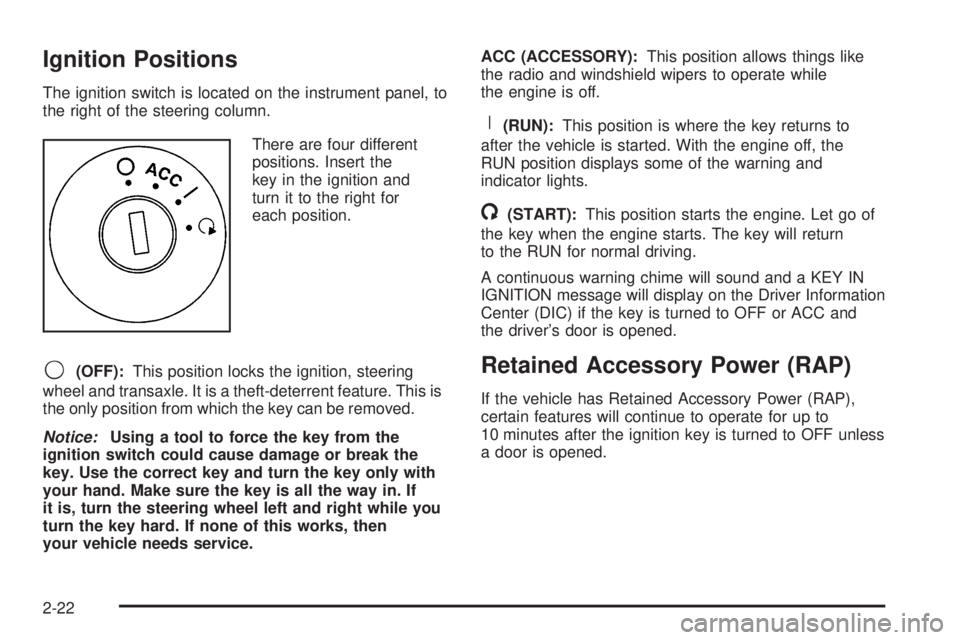
The ignition switch is located on the instrument panel, to
the right of the steering column.
There are four different
positions. Insert the
key in the ignition and
turn it to the right for
each position.
9(OFF):This position locks the ignition, steering
wheel and transaxle. It is a theft-deterrent feature. This is
the only position from which the key can be removed.
Notice:Using a tool to force the key from the
ignition switch could cause damage or break the
key. Use the correct key and turn the key only with
your hand. Make sure the key is all the way in. If
it is, turn the steering wheel left and right while you
turn the key hard. If none of this works, then
your vehicle needs service.ACC (ACCESSORY):This position allows things like
the radio and windshield wipers to operate while
the engine is off.
R(RUN):This position is where the key returns to
after the vehicle is started. With the engine off, the
RUN position displays some of the warning and
indicator lights.
/(START):This position starts the engine. Let go of
the key when the engine starts. The key will return
to the RUN for normal driving.
A continuous warning chime will sound and a KEY IN
IGNITION message will display on the Driver Information
Center (DIC) if the key is turned to OFF or ACC and
the driver’s door is opened.
Retained Accessory Power (RAP)
If the vehicle has Retained Accessory Power (RAP),
certain features will continue to operate for up to
10 minutes after the ignition key is turned to OFF unless
a door is opened.
2-22
Page 97 of 472
Starting the Engine
Move your shift lever to PARK (P) or NEUTRAL (N).
The engine will not start in any other position — that is
a safety feature. To restart when you are already
moving, use NEUTRAL (N) only.
Notice:Shifting into PARK (P) with the vehicle
moving could damage the transaxle. Shift into
PARK (P) only when your vehicle is stopped.
1. With your foot off the accelerator pedal, turn the
ignition key to START. When the engine starts,
let go of the key. The idle speed will go down as the
engine gets warm.
Notice:Holding your key in START for longer than
15 seconds at a time will cause your battery to
be drained much sooner. And the excessive heat
can damage your starter motor. Wait about
15 seconds between each try to help avoid draining
your battery or damaging your starter.
2. If the engine does not start within 10 seconds, hold
your key in START for about 10 seconds at a time
until the engine starts. Wait about 15 seconds
between each try.When your engine has run for about 10 seconds to
warm up, your vehicle is ready to be driven. Do
not race your engine when it is cold.
If the weather is below freezing (32°F or 0°C), let
the engine run for a few minutes to warm up.
3. If your engine still will not start, or starts but then
stops, it could be ooded with too much gasoline.
Try pushing your accelerator pedal all the way to the
oor and holding it there as you hold the key in
START for about three seconds. If the vehicle starts
briey but then stops again, do the same
thing. This time keep the pedal down for ve or
six seconds to clear the extra gasoline from
the engine. After waiting about 15 seconds, repeat
the normal starting procedure.
Notice:Your engine is designed to work with the
electronics in your vehicle. If you add electrical
parts or accessories, you could change the way the
engine operates. Before adding electrical equipment,
check with your dealer. If you do not, your engine
might not perform properly. Any resulting damage
would not be covered by your vehicle’s warranty.
2-23
Page 100 of 472
PARK (P):This position locks the front wheels. It is the
best position to use when the engine is started
because the vehicle cannot move easily.
{CAUTION:
It is dangerous to get out of your vehicle if the
shift lever is not fully in PARK (P) with the
parking brake rmly set. Your vehicle can roll.
Do not leave your vehicle when the engine is
running unless you have to. If you have left the
engine running, the vehicle can move
suddenly. You or others could be injured. To
be sure your vehicle will not move, even when
you are on fairly level ground, always set your
parking brake and move the shift lever to
PARK (P). SeeShifting Into Park (P) on
page 2-31. If you are pulling a trailer, see
Towing a Trailer on page 4-40.
Make sure the shift lever is fully in PARK (P) before
starting the engine. The vehicle has an automatic
transaxle shift lock control system.The regular brakes must be fully applied and the shift
control button, located on the front of the shift lever,
must be pressed before the vehicle can be shifted from
PARK (P) when the ignition is in RUN. If the vehicle
cannot be shifted out of PARK (P), ease pressure on the
shift lever by pushing it all the way into PARK (P)
while keeping the brake pedal pushed down. Release
the shift lever button. Then move the shift lever out
of PARK (P), being sure to press the shift lever button.
SeeShifting Out of Park (P) on page 2-32.
REVERSE (R):Use this gear to back up.
Notice:Shifting to REVERSE (R) while your vehicle
is moving forward could damage the transaxle. The
repairs would not be covered by your warranty. Shift
to REVERSE (R) only after your vehicle is stopped.
To rock the vehicle back and forth to get out of snow, ice
or sand without damaging the transaxle, seeIf Your
Vehicle is Stuck in Sand, Mud, Ice or Snow on
page 4-32.
NEUTRAL (N):In this position, the engine does not
connect with the wheels. To restart when the vehicle is
already moving, use NEUTRAL (N) only. Also, use
NEUTRAL (N) when the vehicle is being towed.
2-26