transmission PONTIAC GTO 2004 Owners Manual
[x] Cancel search | Manufacturer: PONTIAC, Model Year: 2004, Model line: GTO, Model: PONTIAC GTO 2004Pages: 326, PDF Size: 2.24 MB
Page 61 of 326

Keys...............................................................2-2
Remote Keyless Entry System.........................2-4
Remote Keyless Entry System Operation...........2-5
Doors and Locks.............................................2-6
Door Locks....................................................2-6
Leaving Your Vehicle......................................2-7
Trunk............................................................2-8
Windows........................................................2-10
Power Windows............................................2-11
Sun Visors...................................................2-12
Theft-Deterrent Systems..................................2-12
Theft-Deterrent System..................................2-12
Immobilizer..................................................2-12
Immobilizer Operation....................................2-13
Content Theft-Deterrent.................................2-14
Starting and Operating Your Vehicle................2-15
New Vehicle Break-In....................................2-15
Ignition Positions..........................................2-16
Starting Your Engine.....................................2-17Automatic Transmission Operation...................2-18
Manual Transmission Operation......................2-21
Parking Brake..............................................2-23
Shifting Into Park (P).....................................2-24
Shifting Out of Park (P).................................2-26
Parking Your Vehicle/Key Removal..................2-26
Parking Over Things That Burn.......................2-27
Engine Exhaust............................................2-27
Running Your Engine While You Are Parked. . . .2-28
Mirrors...........................................................2-29
Manual Rearview Mirror.................................2-29
Outside Power Mirrors...................................2-29
Outside Convex Mirror...................................2-30
Storage Areas................................................2-30
Glove Box...................................................2-30
Cupholder(s)................................................2-31
Front Storage Area.......................................2-31
Center Console Storage Area.........................2-31
Vehicle Personalization...................................2-32
Section 2 Features and Controls
2-1
Page 67 of 326

There are several ways to unlock and lock your vehicle.
To unlock the doors from inside the vehicle, pull up
on the door lock knob. To lock the doors, press the knob
down. If you use the driver’s door lock knob, both
doors will lock or unlock.
Automatic transmission vehicles have an automatic
locking in DRIVE (D) feature which locks the doors
automatically when the transmission selector is shifted
out of PARK (P). To select this feature, seeVehicle
Personalization on page 2-32.
For safety reasons, vehicles cannot be locked using the
remote key if the key is in the ignition or if the driver’s
door is open.
To lock or unlock your vehicle from the outside, use
your key or the remote buttons on the key.
To lock the doors from the outside, do the following:
1. Insert the key in the driver’s door lock.
2. Turn the key towards the rear of the vehicle.
3. Then turn the key back to the vertical position and
remove.The alarm system is not set using this method.
To unlock the doors from the outside, do the following:
1. Insert the key in the driver’s door lock.
2. Turn the key towards the front of the vehicle.
3. Then turn the key back to the vertical position and
remove.
The alarm system will go off as soon as a door is
opened. If this happens, turn the key in the ignition to
ON to shut off the alarm.
Leaving Your Vehicle
If you are leaving your vehicle, make sure that you lock
it and take the keys with you.
2-7
Page 76 of 326

Ignition Positions
With the key in the ignition switch, you can turn it to
three different positions.
A (LOCK and ACCESSORY):This is the only position
from which you can insert or remove the key. When
the key is inserted and is in this position, all accessories,
electrical systems, and engine are off. If the key is
cycled back to this position the accessories will remain
on until the key is removed. Once the key is removed
the accessories will turn off. If the key is left inserted in
this position, a chime will sound when the driver’sdoor is opened to remind you the key has been left in
the ignition. The key can only be turned to this position if
the vehicle’s automatic transmission is in PARK (P).
To help guard against theft, your vehicle’s engine
is automatically disabled shortly after turning the key to
this position. This is indicated by the flashing padlock
symbol on the bottom left corner of the instrument panel.
The steering column is automatically locked when the
key is removed. To release the steering wheel, insert the
key again and turn it towards the front of the vehicle.
Notice:Using a tool to force the key from the
ignition switch could cause damage or break the
key. Use the correct key and turn the key only with
your hand. Make sure the key is all the way in. If
it is, turn the steering wheel left and right while you
turn the key hard. If none of this works, then
your vehicle needs service.
B (ON and ACCESSORY):This position is where the
key returns to after you start your engine and release the
key. The ignition switch stays in ON when the engine
is running. But even when the engine is not running, you
can use ON to operate your electrical accessories
and to display some instrument panel warning lights.
C (START):This position starts the engine. When
the engine starts, release the key. The ignition switch
will return to ON for normal driving.
2-16
Page 77 of 326

Retained Accessory Power (RAP)
Your vehicle is equipped with a Retained Accessory
Power (RAP) feature which will allow the radio to
continue to work for one hour after the ignition is turned
to OFF. The windows will also be accessible for
15 minutes or until either door is opened.
Starting Your Engine
Automatic Transmission
Move your shift lever to PARK (P) or NEUTRAL (N).
Your engine won’t start in any other position – that’s a
safety feature. To restart when you’re already moving,
use NEUTRAL (N) only.
Notice:Do not try to shift to PARK (P) if your
vehicle is moving. If you do, you could damage the
transmission. Shift to PARK (P) only when your
vehicle is stopped.
Manual Transmission
The shift lever should be in neutral and the parking
brake engaged. Hold the clutch pedal to the floor and
start the engine. Your vehicle won’t start if the clutch
pedal is not all the way down – that’s a safety feature.
Starting Your Engine
1. With your foot off the accelerator pedal and the
parking brake firmly applied, turn your ignition
key to START. When the engine starts, let go of the
key. The idle speed will go down as your engine
gets warm.
Notice:Holding your key in START for longer than
15 seconds at a time will cause your battery to
be drained much sooner. And the excessive heat
can damage your starter motor. Wait about
15 seconds between each try to help avoid draining
your battery or damaging your starter.
2. If it doesn’t start, wait about 15 seconds and try
again to start the engine by turning the ignition
key to START. Wait about 15 seconds between
each try.
When your engine has run about 10 seconds to
warm up, your vehicle is ready to be driven. Don’t
run your engine at high speeds when it is cold.
If the weather is below freezing (32°F or 0°C), let
the engine run for a few minutes to warm up.
Notice:Your engine is designed to work with the
electronics in your vehicle. If you add electrical
parts or accessories, you could change the way the
engine operates. Before adding electrical equipment,
check with your dealer. If you do not, your engine
might not perform properly.
2-17
Page 78 of 326

Racing or Other Competitive Driving
See your warranty book before using your vehicle
for racing or other competitive driving.
Notice:If you use your vehicle for racing or other
competitive driving, the engine may use more
oil than it would with normal use. Low oil levels can
damage the engine. Be sure to check the oil level
often during racing or other competitive driving and
keep the level at or near 1 quart (1 L) above the
upper mark that shows the proper operating range
on the engine oil dipstick. For information on
how to add oil, seeEngine Oil on page 5-13. After
the competitive driving, remove excess oil so
that the level on the dipstick is not above the upper
mark that shows the proper operating range.
Automatic Transmission Operation
There are several different positions for your shift
lever. Push in the button on top of the shift lever when
shifting into position.PARK (P):The engine can be started in this position.
This position prevents the rear wheels from turning
and so should be selected, together with the parking
brake, when leaving the vehicle. Never select PARK (P)
while your vehicle is still moving.
{CAUTION:
It is dangerous to get out of your vehicle if the
shift lever is not fully in PARK (P) with the
parking brake rmly set. Your vehicle can roll.
Do not leave your vehicle when the engine is
running unless you have to. If you have left the
engine running, the vehicle can move
suddenly. You or others could be injured. To
be sure your vehicle will not move, even when
you are on fairly level ground, always set your
parking brake and move the shift lever to
PARK (P). SeeShifting Into Park (P) on
page 2-24. If you are pulling a trailer, see
Towing a Trailer on page 4-35.
2-18
Page 79 of 326

Ensure the shift lever is fully in PARK (P) before starting
the engine. Your vehicle has an automatic transmission
shift lock control system. You must have your foot
on the regular brakes before you can shift from
PARK (P) when the ignition key is in ON. The vehicle
will not shift from PARK (P) if the button is pressed
before the brake is applied. If you cannot shift out
of PARK (P), ease pressure on the shift lever, push the
shift lever all the way into PARK (P), and release the
shift lever button as you maintain brake application.
Then press the shift lever button and move the
shift lever into the desired gear. SeeShifting Out of
Park (P) on page 2-26.
REVERSE (R):Use this gear to back up. Never select
REVERSE (R) while your vehicle is still moving.
Reverse lights will operate when this position is selected
and the ignition is on. After reversing, make sure the
vehicle has fully stopped before selecting another gear
position. After selecting this position, pause for a
moment before accelerating to allow the transmission to
engage reverse gear.
Notice:Shifting to REVERSE (R) while your vehicle
is moving forward could damage the transmission.
The repairs would not be covered by your warranty.
Shift to REVERSE (R) only after your vehicle is
stopped.To rock your vehicle back and forth to get out of snow,
ice or sand without damaging your transmission,
see If You Are Stuck: In Sand, Mud, Ice or Snow on
page 4-28.
NEUTRAL (N):In this position, your engine doesn’t
connect with the wheels. To restart when you’re already
moving, use NEUTRAL (N) only. Also, use
NEUTRAL (N) when your vehicle is being towed. This is
the out-of-gear position. You may then start a stalled
engine while the vehicle is still moving or stopped.
{CAUTION:
Shifting into a drive gear while your engine is
running at high speed is dangerous. Unless
your foot is rmly on the brake pedal, your
vehicle could move very rapidly. You could
lose control and hit people or objects. Do not
shift into a drive gear while your engine is
running at high speed.
Notice:Shifting out of PARK (P) or NEUTRAL (N)
with the engine running at high speed may damage
the transmission. The repairs would not be
covered by your warranty. Be sure the engine is not
running at high speed when shifting your vehicle.
2-19
Page 80 of 326
DRIVE (D):This is the most effective position for
normal or freeway driving. This position gives maximum
fuel efficiency, as the transmission can choose the
appropriate gear (1 through 4) for the existing load and
driving conditions.
After selecting DRIVE (D) from PARK (P) or
NEUTRAL (N), pause for a moment before accelerating,
to allow the transmission to engage the forward gear.
Use this position when towing.
THIRD (3):This position is also used for normal driving.
However, it offers more power and lower fuel economy
than DRIVE (D). Here are some times you might choose
THIRD (3) instead of DRIVE (D):
•When driving on hilly, winding roads.
•When towing a trailer, so there is less shifting
between gears.
•When going down a steep hill.SECOND (2):This position gives you more power but
lower fuel economy than THIRD (3). You can use
SECOND (2) on hills. It can help control your speed as
you go down steep mountain roads, but then you
would also want to use your brakes off and on.
FIRST (1):This position gives you even more power
but lower fuel economy than SECOND (2). You can use
it on very steep hills, or in deep snow or mud. If the
shift lever is put in FIRST (1), the transmission
won’t shift into first gear until the vehicle is going slowly
enough.
Remember to move the shift lever back to DRIVE(D) so
that the transmission again upshifts into higher gears.
Even though the shift lever may be in FIRST (1),
the transmission does not select first gear until vehicle
speed is less that 35 mph (56 km/h).
2-20
Page 81 of 326

Manual Transmission Operation
This is the shift pattern for
the six-speed manual
transmission.
Here is how to operate your transmission:
FIRST (1):Press the clutch pedal and shift into
FIRST (1). Then slowly let up on the clutch pedal as
you press the accelerator pedal.
You can shift into FIRST (1) when you’re going less
than 40 mph (64 km/h). If you come to a complete stop
and it’s hard to shift into FIRST (1), put the shift
lever in NEUTRAL and let up on the clutch. Press the
clutch pedal back down. Then shift into FIRST (1).SECOND (2):Press the clutch pedal as you let up on
the accelerator pedal and shift into SECOND (2).
Then, slowly let up on the clutch pedal as you press the
accelerator pedal.
THIRD (3), FOURTH (4), FIFTH (5) and
SIXTH (6):Shift into THIRD (3), FOURTH (4), FIFTH (5)
and SIXTH (6) the same way you do for SECOND (2).
Slowly let up on the clutch pedal as you press the
accelerator pedal.
To stop, let up on the accelerator pedal and press the
brake pedal. Just before the vehicle stops, press
the clutch pedal and the brake pedal, and shift to
NEUTRAL.
NEUTRAL:Use this position when you start or idle
your engine. Your shift lever is in NEUTRAL when it is
centered in the shift pattern, not in any gear.
REVERSE (R):To back up, press down the clutch
pedal and shift into REVERSE (R). Just apply pressure
to get the lever past FIFTH (5) and SIXTH (6) into
REVERSE (R). Let up on the clutch pedal slowly while
pressing the accelerator pedal.
2-21
Page 82 of 326
Shift Speeds
{CAUTION:
If you skip a gear when you downshift, you
could lose control of your vehicle. You could
injure yourself or others. Don’t shift down
more than one gear at a time when you
downshift.
This chart shows when to shift to the next gear for the
best fuel economy.
Manual Transmission Recommended
Shift Speeds
1to2 2to3 3to4 4to5 5to6
16 mph
(25 km/h)22 mph
(35 km/h)30 mph
(48 km/h)40 mph
(65 km/h)50 mph
(80 km/h)
If your speed drops below 20 mph (32 km/h), or if the
engine is not running smoothly, you should downshift to
the next lower gear.
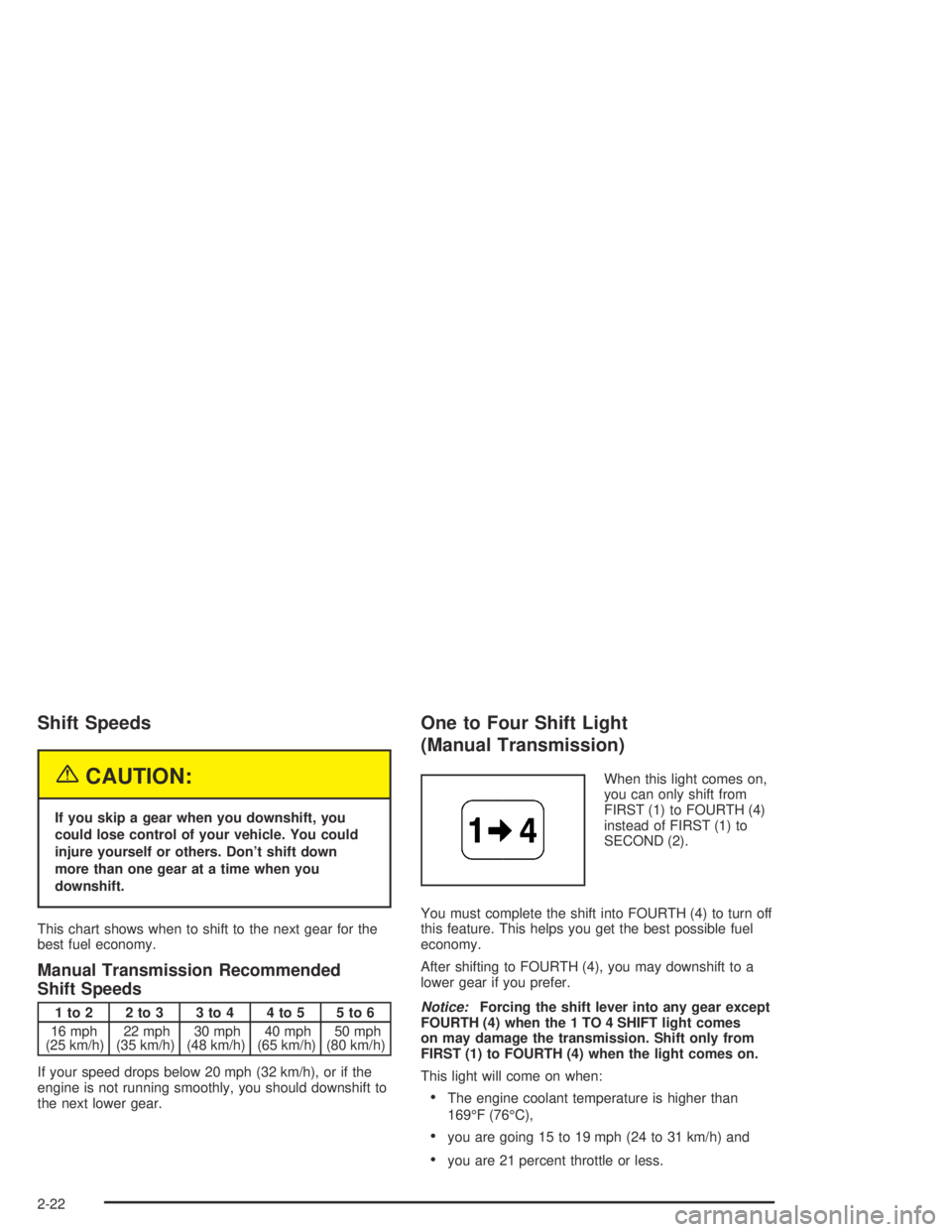
One to Four Shift Light
(Manual Transmission)
When this light comes on,
you can only shift from
FIRST (1) to FOURTH (4)
instead of FIRST (1) to
SECOND (2).
You must complete the shift into FOURTH (4) to turn off
this feature. This helps you get the best possible fuel
economy.
After shifting to FOURTH (4), you may downshift to a
lower gear if you prefer.
Notice:Forcing the shift lever into any gear except
FOURTH (4) when the 1 TO 4 SHIFT light comes
on may damage the transmission. Shift only from
FIRST (1) to FOURTH (4) when the light comes on.
This light will come on when:
•The engine coolant temperature is higher than
169°F (76°C),
•you are going 15 to 19 mph (24 to 31 km/h) and
•you are 21 percent throttle or less.
2-22
Page 85 of 326

Leaving Your Vehicle With the Engine
Running
{CAUTION:
It can be dangerous to leave your vehicle with
the engine running. Your vehicle could move
suddenly if the shift lever is not fully in
PARK (P) with the parking brake rmly set.
And, if you leave the vehicle with the engine
running, it could overheat and even catch re.
You or others could be injured. Do not leave
your vehicle with the engine running.
If you have to leave your vehicle with the engine
running, be sure the vehicle is in PARK (P) and the
parking brake is firmly set before you leave it. After
you’ve moved the shift lever into PARK (P), hold the
regular brake pedal down. Then, see if you can
move the shift lever away from PARK (P), without first
pushing the shift lever button. If you can, it means
that the shift lever wasn’t fully locked into PARK (P).
Torque Lock
If you are parking on a hill and you don’t shift your
transmission into PARK (P) properly, the weight of the
vehicle may put too much force on the parking pawl
in the transmission. You may find it difficult to move the
shift lever out of PARK (P). This is called torque
lock. To prevent torque lock, set the parking brake and
then shift into PARK (P) properly before you leave
the driver’s seat. To find out how, seeShifting
Into Park (P) on page 2-24.
When you are ready to drive, move the shift lever out of
PARK (P) before you release the parking brake.
If torque lock does occur, you may need to have another
vehicle push your vehicle uphill. This should take
some of the pressure from the parking pawl in the
transmission, so you can move the shift lever out
of PARK (P).
2-25