ignition PONTIAC GTO 2005 Workshop Manual
[x] Cancel search | Manufacturer: PONTIAC, Model Year: 2005, Model line: GTO, Model: PONTIAC GTO 2005Pages: 318, PDF Size: 2.06 MB
Page 175 of 318

{CAUTION:
Coasting downhill in NEUTRAL (N) or with the
ignition off is dangerous. Your brakes will have
to do all the work of slowing down. They could
get so hot that they would not work well. You
would then have poor braking or even none
going down a hill. You could crash. Always
have your engine running and your vehicle in
gear when you go downhill.
•Know how to go uphill. You may want to shift down
to a lower gear. The lower gears help cool your
engine and transmission, and you can climb the
hill better.
•Stay in your own lane when driving on two-lane
roads in hills or mountains. Do not swing wide
or cut across the center of the road. Drive at speeds
that let you stay in your own lane.
•As you go over the top of a hill, be alert. There
could be something in your lane, like a stalled car or
an accident.
•You may see highway signs on mountains that
warn of special problems. Examples are long
grades, passing or no-passing zones, a falling rocks
area, or winding roads. Be alert to these and take
appropriate action.
4-23
Page 203 of 318

If the system is ever reset accidentally, you must
change the oil at 3,000 miles (5 000 km) since your last
oil change. Remember to reset the oil life system
whenever the oil is changed.
After changing the engine oil, reset the system by
performing the following steps:
How to Reset the Engine Oil Life
System
The Engine Oil Life System calculates when to change
the engine oil and filter based on vehicle use. Anytime
engine oil is changed, reset the system so it can
calculate when the next oil change is required. If a
situation occurs where you change your oil prior to
the Service Engine Oil light being turned on, reset
the system.
1. With the engine off, turn the ignition key to ON.
2. Fully press and release the accelerator pedal slowly
two times within five seconds.
3. Turn the key to LOCK.
If the Service Engine Oil light comes back on when
you start your vehicle, the engine oil life system
has not reset. Repeat the procedure.
What to Do with Used Oil
Used engine oil contains certain elements that may be
unhealthy for your skin and could even cause cancer.
Do not let used oil stay on your skin for very long. Clean
your skin and nails with soap and water, or a good
hand cleaner. Wash or properly dispose of clothing or
rags containing used engine oil. See the manufacturer’s
warnings about the use and disposal of oil products.
Used oil can be a threat to the environment. If you
change your own oil, be sure to drain all the oil from the
filter before disposal. Never dispose of oil by putting it
in the trash, pouring it on the ground, into sewers, or into
streams or bodies of water. Instead, recycle it by
taking it to a place that collects used oil. If you have a
problem properly disposing of used oil, ask your
dealer, a service station, or a local recycling center
for help.
5-17
Page 214 of 318

2. If the fan is working and the temperature gage
needle has not returned to its normal position
within a few minutes, stop the engine and remove
the ignition key.
Look for leaks at the radiator hoses and
connections, heater hoses and connections,
radiator, and water pump. Be careful when checking
these areas as they will probably still be hot. If
you find a major leak or other problems that may
have caused the engine to overheat, do not run the
engine until these problems have been corrected.
If you do not find anything wrong, you should check
the engine coolant level. SeeEngine Coolant on
page 5-23. You should also check the air intake
area below the front bumper to ensure that it is clear
of leaves and road grime.3. Turn off your air conditioning and turn on your
heater to full hot at the highest fan speed and
open the windows as necessary.
If you no longer have the overheat warning, you can
drive. Just to be safe, drive slower for about 10 minutes.
If the warning does not come back on, you can drive
normally.
If the warning continues and you have not stopped, pull
over, stop, and park your vehicle right away.
If there is still no sign of steam, you can idle the engine
for three minutes while you are parked. If you still
have the warning, turn off the engine and get everyone
out of the vehicle until it cools down.
You may decide not to lift the hood but to get service
help right away.
5-28
Page 227 of 318

Notice:If you leave your radio or other accessories
on during the jump starting procedure, they could
be damaged. The repairs would not be covered
by your warranty. Always turn off your radio and
other accessories when jump starting your vehicle.
3. Turn off the ignition on both vehicles. Unplug
unnecessary accessories plugged into the cigarette
lighter. Turn off the radio and all lamps that are
not needed. This will avoid sparks and help save
both batteries. And it could save the radio!
4. Open the hoods and locate the batteries. Find the
positive (+) and negative (−) terminal locations on
each vehicle. SeeEngine Compartment Overview
on page 5-12for more information on location.
{CAUTION:
An electric fan can start up even when the
engine is not running and can injure you. Keep
hands, clothing and tools away from any
underhood electric fan.
{CAUTION:
Using a match near a battery can cause battery
gas to explode. People have been hurt doing
this, and some have been blinded. Use a
ashlight if you need more light. Be sure the
battery has enough water. You do not need to
add water to the battery installed in your new
vehicle. But if a battery has ller caps, be sure
the right amount of uid is there. If it is low,
add water to take care of that rst. If you don’t,
explosive gas could be present.
Battery uid contains acid that can burn you.
Do not get it on you. If you accidentally get it
in your eyes or on your skin, ush the place
with water and get medical help immediately.
5-41
Page 273 of 318

Fuses Usage
POWER
SEATSPower Seat Controls
FRONT WIPER
WASHERFront Windshield Wiper Washer
PARK LAMPS Parking Lamps
STOP LAMPS Stop Lamps
INTERIOR
ILLUM.Interior light Controls
HAZARD
WARNINGHazard Warning Flashers
SPARE Spare
HORN Horn
IGNITION Ignition Switch
INSTRUMENT
ILLUM.Instrument Panel Lighting
TURN SIGNAL,
BACK UP
LAMPSTurn Signal Lamp, Back-Up Lamps
HVAC CONT.
HEAT, REAR
WINDOW,
INSTRUMENTSHeater Controls, Rear Window, Trip
Computer
CIGAR
LIGHTERCigarette LighterFuses Usage
CRUISE CONT.
POWER
MIRRORSCruise Control, Power Mirror
RADIO, CELL
PHONERadio System, Cell Phone
ACC. SOCKET Accessory Power Outlet
SPARE Spare
ENG. CONT.
SIGNALEngine Control Signal
POWER DOOR
LOCKS,
WINDOWS &
THEFT HORNPower Door Locks, Power Windows,
Theft System, Horn
INSTRUMENTS Instruments
SPARE Spare
RADIO & CELL
PHONERadio System, Cell Phone
SUB WOOFER
& AMPLIFIERSub Woofer and Amplifier
SPARE Spare
AIRBAG Airbag
ABS &
TRACTION
CONT.Anti-Lock Brake System, Traction
Control System
5-87
Page 274 of 318
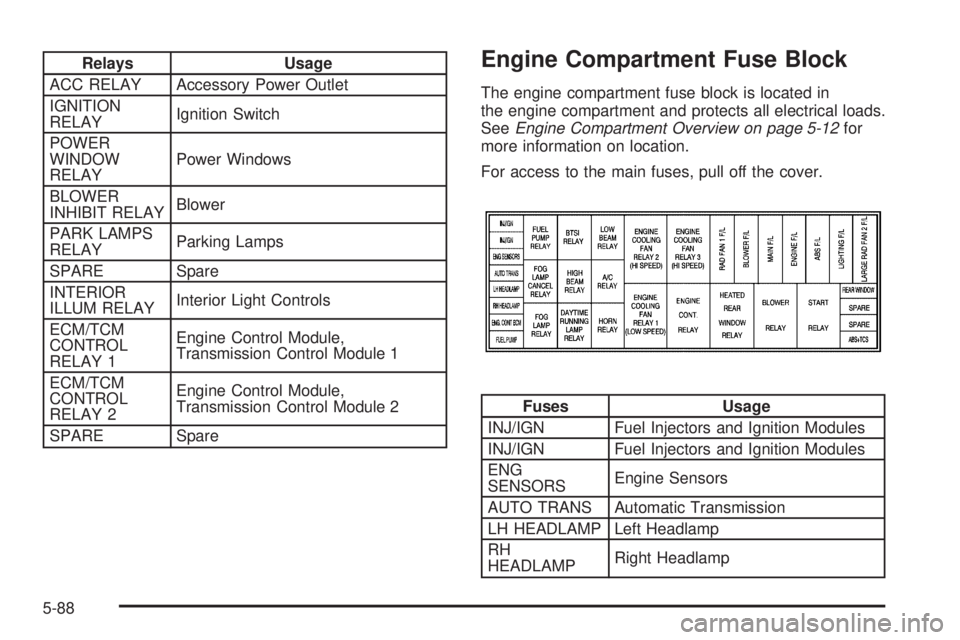
Relays Usage
ACC RELAY Accessory Power Outlet
IGNITION
RELAYIgnition Switch
POWER
WINDOW
RELAYPower Windows
BLOWER
INHIBIT RELAYBlower
PARK LAMPS
RELAYParking Lamps
SPARE Spare
INTERIOR
ILLUM RELAYInterior Light Controls
ECM/TCM
CONTROL
RELAY 1Engine Control Module,
Transmission Control Module 1
ECM/TCM
CONTROL
RELAY 2Engine Control Module,
Transmission Control Module 2
SPARE SpareEngine Compartment Fuse Block
The engine compartment fuse block is located in
the engine compartment and protects all electrical loads.
SeeEngine Compartment Overview on page 5-12for
more information on location.
For access to the main fuses, pull off the cover.
Fuses Usage
INJ/IGN Fuel Injectors and Ignition Modules
INJ/IGN Fuel Injectors and Ignition Modules
ENG
SENSORSEngine Sensors
AUTO TRANS Automatic Transmission
LH HEADLAMP Left Headlamp
RH
HEADLAMPRight Headlamp
5-88
Page 286 of 318
Automatic Transmission Shift Lock
Control System Check
{CAUTION:
When you are doing this inspection, the
vehicle could move suddenly. If the vehicle
moves, you or others could be injured.
1. Before you start, be sure you have enough room
around the vehicle. It should be parked on a level
surface.
2. Firmly apply the parking brake. SeeParking Brake
on page 2-23.
Be ready to apply the regular brake immediately if
the vehicle begins to move.
3. With the engine off, turn the ignition to ON, but do
not start the engine. Without applying the regular
brake, try to move the shift lever out of PARK (P)
with normal effort. If the shift lever moves out
of PARK (P), contact your GM Goodwrench
®dealer
for service.
Ignition Transmission Lock Check
While parked, and with the parking brake set, try to turn
the ignition to LOCK in each shift lever position.
•With an automatic transmission, the ignition should
turn to LOCK only when the shift lever is in
PARK (P). The key should come out only in LOCK.
•With a manual transmission, the key should
come out only in LOCK.
Contact your GM Goodwrench
®dealer if service is
required.
6-10
Page 312 of 318

Hood
Checking Things Under................................5-10
Release.....................................................5-11
Horn............................................................... 3-6
How to Use This Manual...................................... ii
How to Wear Safety Belts Properly...................1-11
Hydraulic Clutch.............................................5-22
I
Ignition Positions.............................................2-16
Immobilizer....................................................2-13
Immobilizer Operation......................................2-13
Infants and Young Children, Restraints...............1-28
Inflation -- Tire Pressure..................................5-59
Instrument Panel
Brightness..................................................3-15
Cluster.......................................................3-23
Overview..................................................... 3-4
J
Jump Starting.................................................5-40
K
Keyless Entry System....................................... 2-4
Keys............................................................... 2-2
L
Labelling, Tire Sidewall....................................5-54
Lamps
Battery Run-Down Protection.........................3-16
Courtesy....................................................3-15
Dome........................................................3-16
Exterior......................................................3-13
Fog ...........................................................3-15
Front Reading.............................................3-16
Trunk.........................................................3-16
LATCH System
Child Restraints...........................................1-37
Securing a Child Restraint Designed for the
LATCH System........................................1-39
Latches, Seatback............................................ 1-4
Light
Airbag Readiness........................................3-25
Anti-Lock Brake System Warning...................3-27
Brake System Warning.................................3-27
6