low beam PONTIAC GTO 2006 Owners Manual
[x] Cancel search | Manufacturer: PONTIAC, Model Year: 2006, Model line: GTO, Model: PONTIAC GTO 2006Pages: 326, PDF Size: 1.62 MB
Page 99 of 326
Instrument Panel Overview...............................3-4
Hazard Warning Flashers................................3-6
Other Warning Devices...................................3-6
Horn.............................................................3-6
Tilt Wheel.....................................................3-6
Turn Signal/Multifunction Lever.........................3-7
Turn and Lane-Change Signals........................3-8
Headlamp High/Low-Beam Changer..................3-8
Flash-to-Pass.................................................3-9
Windshield Wipers..........................................3-9
Windshield Washer.......................................3-10
Cruise Control..............................................3-10
Exterior Lamps.............................................3-13
Headlamps..................................................3-13
Daytime Running Lamps (DRL).......................3-14
Automatic Headlamp System..........................3-14
Fog Lamps..................................................3-15
Instrument Panel Brightness...........................3-15
Courtesy Lamps...........................................3-15
Dome Lamp.................................................3-16
Entry Lighting...............................................3-16
Front Reading Lamps....................................3-16
Trunk Lamp.................................................3-16Battery Run-Down Protection..........................3-16
Accessory Power Outlet(s).............................3-17
Ashtray(s) and Cigarette Lighter......................3-18
Climate Controls............................................3-19
Climate Control System.................................3-19
Outlet Adjustment.........................................3-21
Warning Lights, Gages, and Indicators............3-22
Instrument Panel Cluster................................3-23
Speedometer...............................................3-24
Tachometer.................................................3-24
Safety Belt Reminder Light.............................3-24
Airbag Readiness Light..................................3-25
Charging System Light..................................3-26
One-to-Four Shift Light (Manual Transmission). . . .3-26
Brake System Warning Light..........................3-27
Anti-Lock Brake System Warning Light.............3-27
Engine Coolant Temperature Gage..................3-28
Malfunction Indicator Lamp.............................3-28
Security Light...............................................3-31
Fog Lamp Light............................................3-31
Highbeam On Light.......................................3-31
Daytime Running Lamps (DRL) Indicator Light.....3-32
Fuel Gage...................................................3-32
Section 3 Instrument Panel
3-1
2006 - Pontiac GTO Owner Manual
Page 105 of 326

To tilt the wheel, pull the lever down. Then move the
wheel to a comfortable position and release the lever to
lock the wheel in place.
Telescopic Steering Column
The steering column also has a telescopic function
which allows the steering wheel to move closer or further
away from the driver.
Turn Signal/Multifunction Lever
The lever on the left side of the steering column
includes the following:
·Turn and Lane-Change Signals. SeeTurn
Signal/Multifunction Lever on page 3-7
.
·Headlamp High/Low-Beam Changer. SeeHeadlamp
High/Low-Beam Changer on page 3-8
.
·Flash-to-Pass. SeeFlash-to-Pass on page 3-9.
·Cruise Control. SeeCruise Control on page 3-10.
3-7
2006 - Pontiac GTO Owner Manual
Page 106 of 326
Turn and Lane-Change Signals
To signal a turn, move the lever all the way up to signal
right turn and all the way down to signal a left turn.
When the turn is ®nished, the lever will return
automatically.
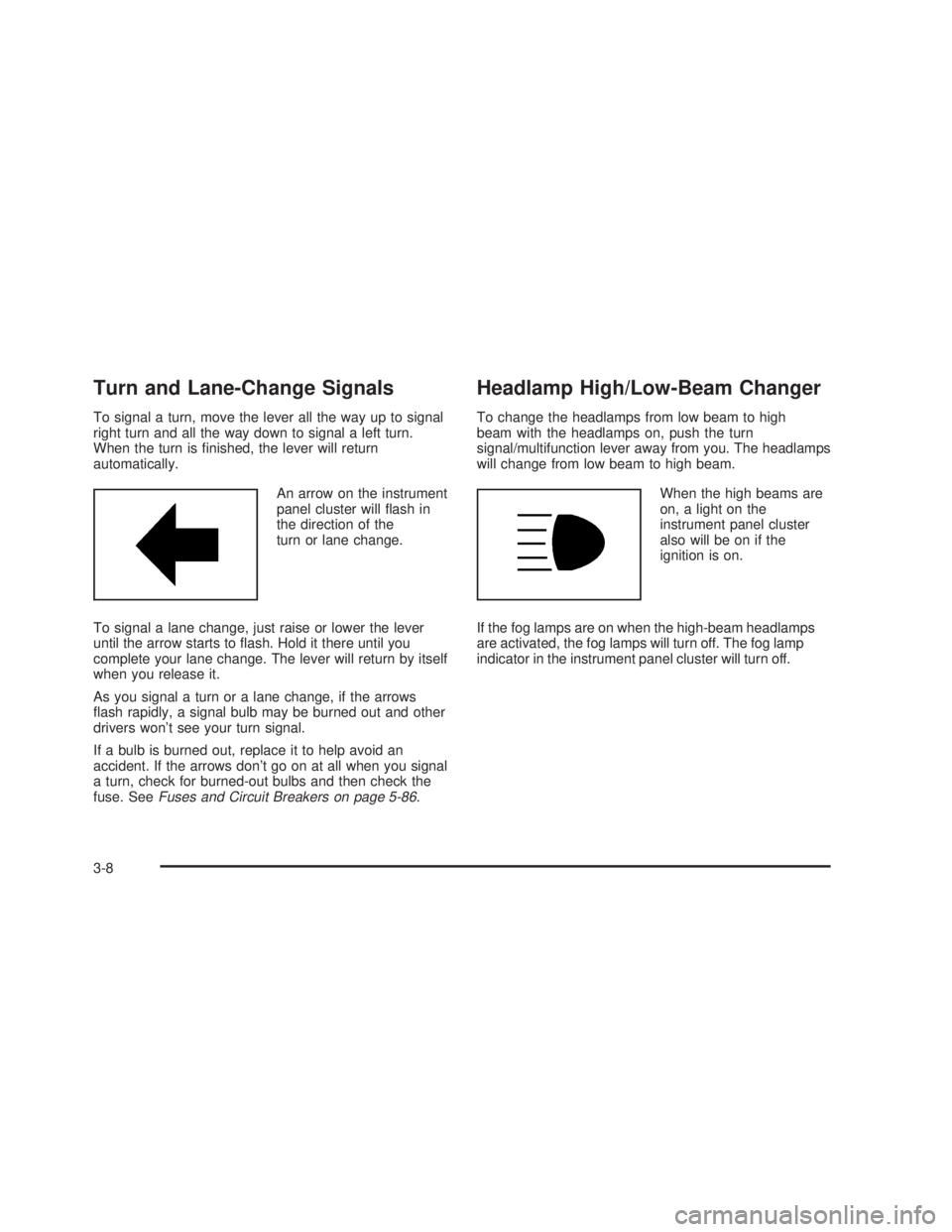
An arrow on the instrument
panel cluster will ¯ash in
the direction of the
turn or lane change.
To signal a lane change, just raise or lower the lever
until the arrow starts to ¯ash. Hold it there until you
complete your lane change. The lever will return by itself
when you release it.
As you signal a turn or a lane change, if the arrows
¯ash rapidly, a signal bulb may be burned out and other
drivers won't see your turn signal.
If a bulb is burned out, replace it to help avoid an
accident. If the arrows don't go on at all when you signal
a turn, check for burned-out bulbs and then check the
fuse. See
Fuses and Circuit Breakers on page 5-86.
Headlamp High/Low-Beam Changer
To change the headlamps from low beam to high
beam with the headlamps on, push the turn
signal/multifunction lever away from you. The headlamps
will change from low beam to high beam.
When the high beams are
on, a light on the
instrument panel cluster
also will be on if the
ignition is on.
If the fog lamps are on when the high-beam headlamps
are activated, the fog lamps will turn off. The fog lamp
indicator in the instrument panel cluster will turn off.
3-8
2006 - Pontiac GTO Owner Manual
Page 107 of 326

Flash-to-Pass
This feature lets you use your high-beam headlamps to
signal a driver in front of you that you want to pass,
even if the headlamps and ignition are turned off.
To use it, pull the turn signal/multifunction lever toward
you until the high-beam headlamps come on, then
release the lever to turn them off.
If ¯ash-to-pass is activated, then the headlamp
high/low-beam changer indicator will display on the
instrument panel cluster. The fog lamps are turned off
while this feature is active.
Windshield Wipers
The lever on the right side of the steering column
operates the windshield wipers and washer.These functions operate when the ignition is turned to
ON, LOCK, or when the Retained Accessory Power is in
operation. See
Retained Accessory Power (RAP) on
page 2-17.
INT (Intermittent):Push the lever up to turn on the
wipers. Put the lever in the ®rst position for intermittent
wiping cycles. The delay will change as your vehicle's
speed changes. The delay will decrease as you go
faster and increase as you go slower.
1 (Low Speed):Put the lever in the second position for
slow, steady wiping cycles.
2 (High Speed):Put the lever in the third position for
rapid wiping cycles.
L(Mist):Move the lever to this position for a single
wiping cycle. Hold it there until the windshield wipers
start; then let go. The windshield wipers will stop after
one wipe. If you want more wipes, hold the lever
down longer.
0 (Off):Turn the lever to this position to turn off the
wipers.
Be sure to clear ice and snow from the wiper blades
before using them. If they're frozen to the windshield,
gently loosen or thaw them. If the blades do become
damaged, install new blades or blade inserts.
Heavy snow or ice can overload the wiper motor. A
circuit breaker will stop the motor until it cools down.
Clear away snow or ice to prevent an overload.
3-9
2006 - Pontiac GTO Owner Manual
Page 112 of 326
Daytime Running Lamps (DRL)
Daytime Running Lamps (DRL) can make it easier for
others to see the front of your vehicle during the
day. DRL can be helpful in many different driving
conditions, but they can be especially helpful in the short
periods after dawn and before sunset.
The DRL system will make your low-beam headlamps
come on at a reduced brightness when the following
conditions are met:
·The ignition is on.
·The exterior lamp control is turned to AUTO and
the light sensor detects daytime light.
·The exterior lamp control is turned to the off position.
·The parking brake is released.
·For vehicles with automatic transmissions, the shift
lever is not in PARK (P).
When the DRL system is on, the taillamps, sidemarker
lamps, parking lamps, and instrument panel lights will not
be illuminated unless you have turned the exterior lamps
control to the parking lamp or headlamp position.
The DRL system will remain off any time your vehicle is
in PARK (P) or the parking brake is engaged the ®rst
time the ignition is turned on.
As with any vehicle, you should turn on the regular
headlamp system when you need it.
Automatic Headlamp System
When it is dark enough outside, your Automatic
Headlamp System will turn on your headlamps at the
normal brightness along with other lamps such as
the taillamps, sidemarker, parking lamps, and the
instrument panel lights. The radio lights will also be dim.
Your vehicle is equipped with a light sensor on the
top of the instrument panel under the defroster
grill. Make sure it is not covered, which will cause the
system to be on whenever the ignition is on.
The system may also be on when driving through a
parking garage, heavy overcast weather, or a tunnel.
This is normal.
If you start your vehicle in a dark garage, the automatic
headlamp system will come on immediately.
As with any vehicle, you should turn on the regular
headlamps when you need them.
The headlamps can be set to come on at different
levels. The sensitivity can be adjusted to Early, Normal,
or Late. See
Vehicle Personalization on page 2-31.
Leaving the headlamps and parking lamps on when the
engine is not running will eventually drain the battery.
To prevent the battery from draining, the headlamp and
parking lamps will turn off when the ignition has been
turned off and the driver's door is opened, because the
vehicle senses that the driver has forgotten to turn
off the lights.
3-14
2006 - Pontiac GTO Owner Manual
Page 113 of 326
The lights stay off until the ignition is again turned on, or
the lights are turned back on manually by the headlamp
switch. The headlamps can be set to automatically
turn off after you have locked the vehicle and walked
away. To set or adjust the time delay from when
the driver's door is opened to when the lights
automatically turn off, see
Vehicle Personalization on
page 2-31. If you wish to have the lights on when leaving
the vehicle, wait until they have been automatically
turned off, then turn the light control ®rst to off, then to
parking lamps or headlamps.
Fog Lamps
The control to the left of the steering wheel on the
instrument panel also controls the fog lamps.
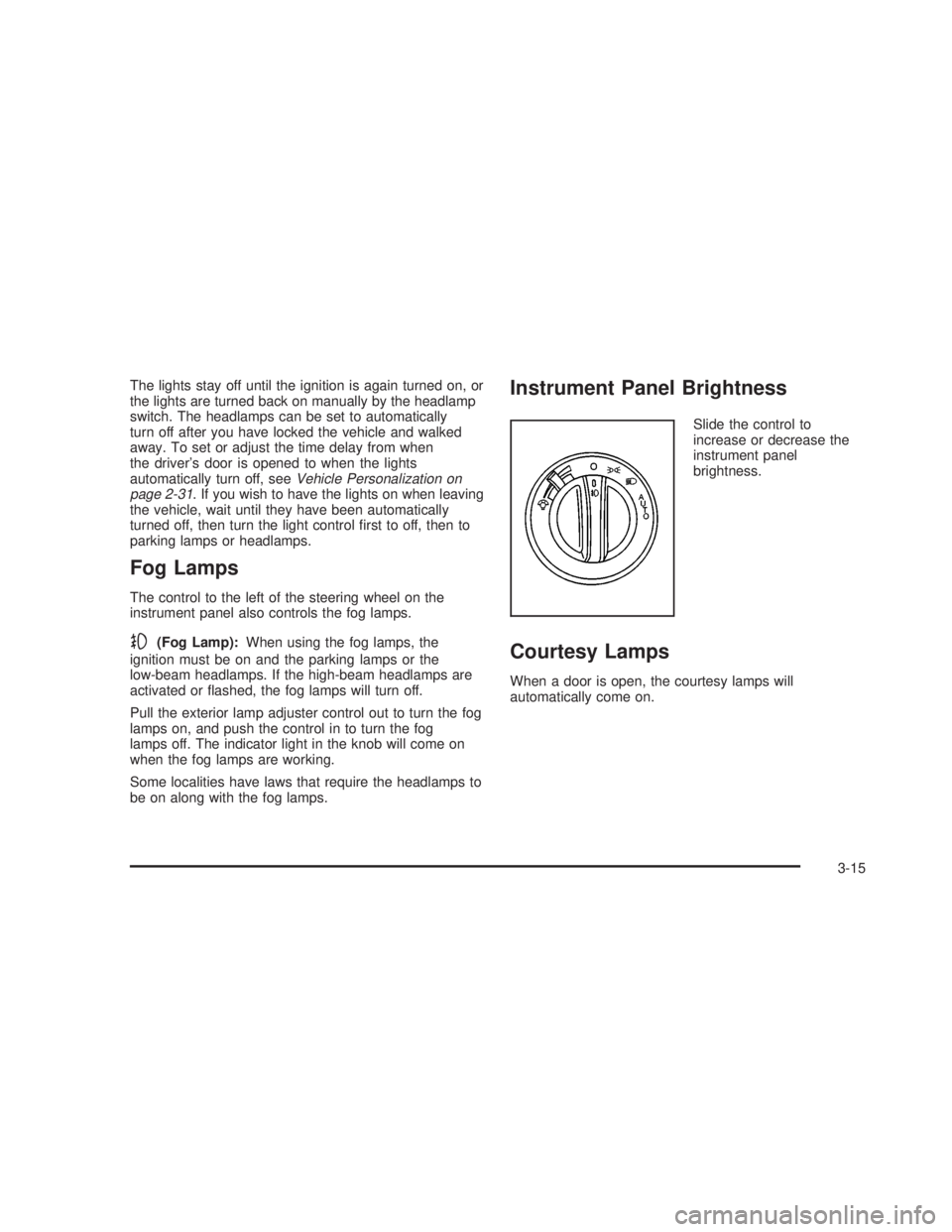
-(Fog Lamp):When using the fog lamps, the
ignition must be on and the parking lamps or the
low-beam headlamps. If the high-beam headlamps are
activated or ¯ashed, the fog lamps will turn off.
Pull the exterior lamp adjuster control out to turn the fog
lamps on, and push the control in to turn the fog
lamps off. The indicator light in the knob will come on
when the fog lamps are working.
Some localities have laws that require the headlamps to
be on along with the fog lamps.
Instrument Panel Brightness
Slide the control to
increase or decrease the
instrument panel
brightness.
Courtesy Lamps
When a door is open, the courtesy lamps will
automatically come on.
3-15
2006 - Pontiac GTO Owner Manual
Page 129 of 326
Your vehicle will not pass this inspection if the OBD
(on-board diagnostic) system determines that critical
emission control systems have not been completely
diagnosed by the system. The vehicle would be
considered not ready for inspection. This can happen if
you have recently replaced your battery or if your
battery has run down. The diagnostic system is
designed to evaluate critical emission control systems
during normal driving. This may take several days
of routine driving. If you have done this and your vehicle
still does not pass the inspection for lack of OBD
system readiness, your GM dealer can prepare the
vehicle for inspection.
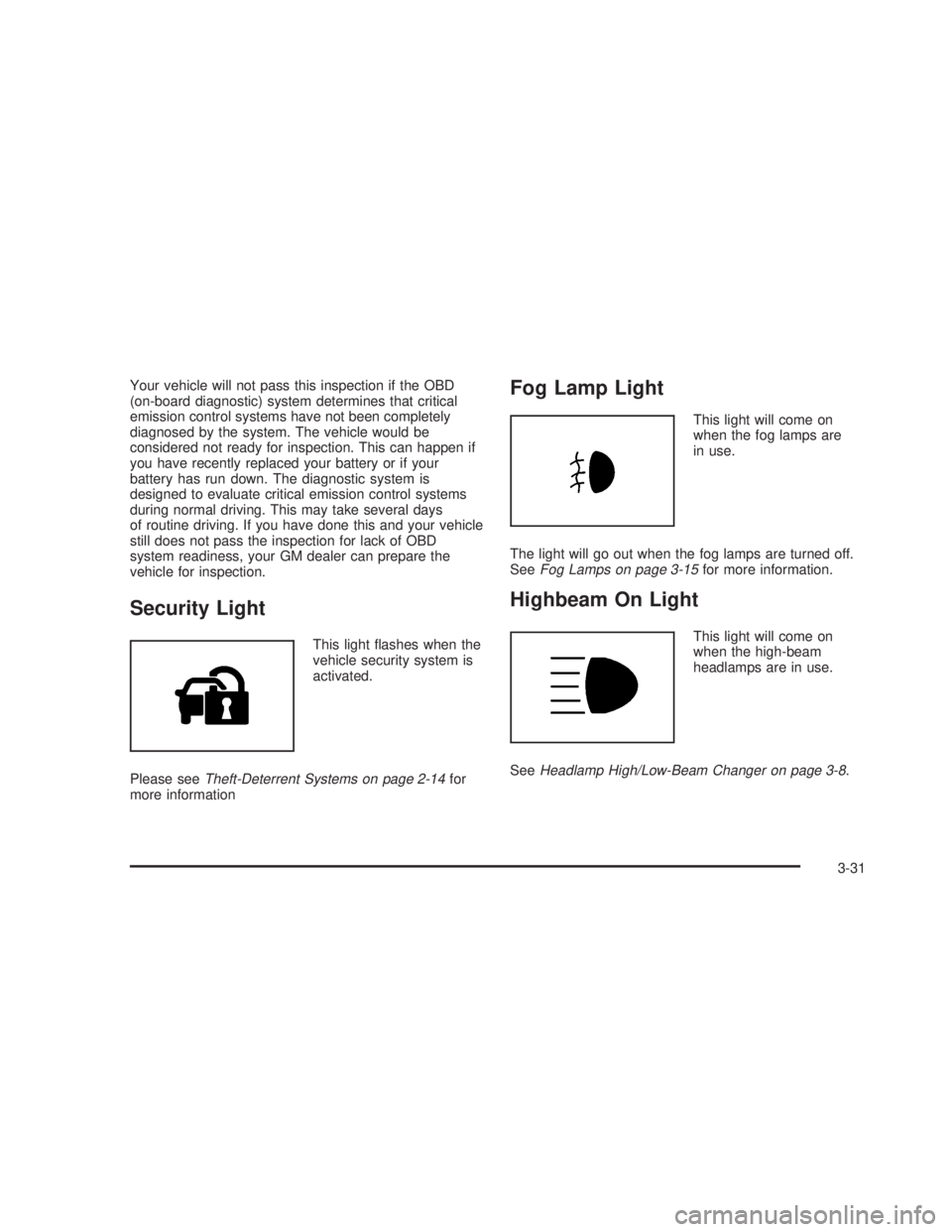
Security Light
This light ¯ashes when the
vehicle security system is
activated.
Please see
Theft-Deterrent Systems on page 2-14for
more information
Fog Lamp Light
This light will come on
when the fog lamps are
in use.
The light will go out when the fog lamps are turned off.
See
Fog Lamps on page 3-15for more information.
Highbeam On Light
This light will come on
when the high-beam
headlamps are in use.
See
Headlamp High/Low-Beam Changer on page 3-8.
3-31
2006 - Pontiac GTO Owner Manual
Page 172 of 326

Driving at Night
Night driving is more dangerous than day driving.
One reason is that some drivers are likely to be
impaired Ð by alcohol or drugs, with night vision
problems, or by fatigue.
Here are some tips on night driving.
·Drive defensively.
·Do not drink and drive.
·Adjust the inside rearview mirror to reduce the
glare from headlamps behind you.
·Since you cannot see as well, you may need to
slow down and keep more space between you
and other vehicles.
·Slow down, especially on higher speed roads. Your
vehicle's headlamps can light up only so much
road ahead.
·In remote areas, watch for animals.
·If you are tired, pull off the road in a safe place
and rest.
No one can see as well at night as in the daytime. But
as we get older these differences increase. A
50-year-old driver may require at least twice as much
light to see the same thing at night as a 20-year-old.What you do in the daytime can also affect your night
vision. For example, if you spend the day in bright
sunshine you are wise to wear sunglasses. Your eyes
will have less trouble adjusting to night. But if you
are driving, do not wear sunglasses at night. They may
cut down on glare from headlamps, but they also
make a lot of things invisible.
You can be temporarily blinded by approaching
headlamps. It can take a second or two, or even several
seconds, for your eyes to re-adjust to the dark. When
you are faced with severe glare, as from a driver
who does not lower the high beams, or a vehicle with
misaimed headlamps, slow down a little. Avoid
staring directly into the approaching headlamps.
Keep the windshield and all the glass on your vehicle
clean Ð inside and out. Glare at night is made much
worse by dirt on the glass. Even the inside of the glass
can build up a ®lm caused by dust. Dirty glass makes
lights dazzle and ¯ash more than clean glass would,
making the pupils of your eyes contract repeatedly.
Remember that the headlamps light up far less of a
roadway when you are in a turn or curve. Keep
your eyes moving; that way, it is easier to pick out dimly
lighted objects. Just as the headlamps should be
checked regularly for proper aim, so should your eyes
be examined regularly. Some drivers suffer from
night blindness Ð the inability to see in dim light Ð and
are not even aware of it.
4-16
2006 - Pontiac GTO Owner Manual
Page 233 of 326
Headlamp Aiming
The vehicle has a visual optical headlamp aiming
system. The aim has been preset at the factory and
should need no further adjustment
However, if the vehicle is damaged in an accident, the
headlamp aim may be affected and adjustment may
be necessary.
If oncoming vehicles ¯ash their high beams at you, this
may also mean the vertical aim needs to be adjusted.
It is recommended that the vehicle is taken to your
dealer for service if the headlamps need to be re-aimed.
It is possible however, to re-aim the headlamps as
described in the following procedure.
The vehicle should be properly prepared as follows:
·The vehicle should be placed so the headlamps
are 15 ft. (4.6 m) from a light colored wall or
other ¯at surface.
·The vehicle must have all four tires on a perfectly
level surface which is level all the way to the wall
or other ¯at surface.
·The vehicle should be placed so it is perpendicular
to the wall or other ¯at surface.
·The vehicle should not have any snow, ice, or mud
on it.
·The vehicle should be fully assembled and all other
work stopped while headlamp aiming is being
performed.
·The vehicle should be normally loaded with a full
tank of fuel and one person or 160 lbs (75 kg)
sitting on the driver's seat.
·Tires should be properly in¯ated.
·The spare tire is in its original location in
the vehicle.
Headlamp aiming is done with the vehicle's low-beam
headlamps. The high-beam headlamps will be correctly
aimed if the low-beam headlamps are aimed properly.
5-43
2006 - Pontiac GTO Owner Manual
Page 234 of 326

To adjust the vertical aim on the headlamps, do the
following:
1. Open the hood. See
Hood Release on page 5-11for more information.
2. Find the aim dot on the lens of the low-beam
headlamp.
3. Measure the distance from the ground to the aim
dot on the low-beam headlamp. Record the
distance.
4. At the wall or other ¯at surface, measure from the
ground upward the recorded distance from Step 2
and mark it.
5. Draw or tape a horizontal line the width of the
vehicle at the wall or other ¯at surface where it
was marked it Step 4.
Notice:Do not cover a headlamp to improve beam
cut-off when aiming. Covering a headlamp may
cause excessive heat build-up which may cause
damage to the headlamp.
6. Turn on the low-beam headlamps and place a
piece of cardboard or equivalent in front of the
headlamp not being aimed. This should allow only
the beam of light from the headlamp being
aimed to be seen on the ¯at surface.
7. Locate the vertical headlamp aiming screws, which
are under the hood near each headlamp assembly.
The adjustment screw can be turned with a
No. 2 Phillips head screwdriver.
5-44
2006 - Pontiac GTO Owner Manual