airbag PONTIAC GTO 2006 Owners Manual
[x] Cancel search | Manufacturer: PONTIAC, Model Year: 2006, Model line: GTO, Model: PONTIAC GTO 2006Pages: 326, PDF Size: 1.62 MB
Page 1 of 326
Seats and Restraint Systems........................... 1-1
Front Seats
............................................... 1-2
Safety Belts
.............................................. 1-6
Child Restraints
.......................................1-25
Airbag System
.........................................1-46
Restraint System Check
............................1-53
Features and Controls..................................... 2-1
Keys
........................................................ 2-2
Doors and Locks
....................................... 2-7
Windows
.................................................2-12
Theft-Deterrent Systems
............................2-14
Starting and Operating Your Vehicle
...........2-16
Mirrors
....................................................2-29
Storage Areas
.........................................2-30
Vehicle Personalization
.............................2-31
Instrument Panel............................................. 3-1
Instrument Panel Overview
.......................... 3-4
Climate Controls
......................................3-19
Warning Lights, Gages, and Indicators
........3-22
Trip Computer
.........................................3-33
Audio System(s)
.......................................3-44Driving Your Vehicle....................................... 4-1
Your Driving, the Road, and Your Vehicle
..... 4-2
Towing
...................................................4-34
Service and Appearance Care.......................... 5-1
Service
..................................................... 5-3
Fuel
......................................................... 5-5
Checking Things Under the Hood
...............5-10
Headlamp Aiming
.....................................5-43
Bulb Replacement
....................................5-45
Windshield Wiper Blade Replacement
.........5-50
Tires
......................................................5-51
Appearance Care
.....................................5-76
Vehicle Identi®cation
.................................5-85
Electrical System
......................................5-85
Capacities and Speci®cations
.....................5-90
Maintenance Schedule..................................... 6-1
Maintenance Schedule
................................ 6-2
Customer Assistance and Information.............. 7-1
Customer Assistance and Information
........... 7-2
Reporting Safety Defects
...........................7-13
Index................................................................ 1
2006 Pontiac GTO Owner ManualM
2006 - Pontiac GTO Owner Manual
Page 7 of 326

Front Seats......................................................1-2
Power Seats..................................................1-2
Manual Lumbar..............................................1-2
Reclining Seatbacks........................................1-3
Head Restraints.............................................1-4
Seatback Latches...........................................1-5
Safety Belts.....................................................1-6
Safety Belts: They Are for Everyone.................1-6
Questions and Answers About Safety Belts......1-11
How to Wear Safety Belts Properly.................1-11
Driver Position..............................................1-12
Shoulder Belt Height Adjustment.....................1-18
Safety Belt Use During Pregnancy..................1-19
Right Front Passenger Position.......................1-19
Rear Seat Passengers..................................1-19
Rear Safety Belt Comfort Guides....................1-22
Safety Belt Pretensioners...............................1-24
Child Restraints.............................................1-25
Older Children..............................................1-25
Infants and Young Children............................1-28
Child Restraint Systems.................................1-31Where to Put the Restraint.............................1-36
Lower Anchors and Tethers for
Children (LATCH)......................................1-37
Securing a Child Restraint in a
Rear Seat Position....................................1-41
Securing a Child Restraint in the
Right Front Seat Position............................1-43
Airbag System...............................................1-46
Where Are the Airbags?................................1-48
When Should an Airbag In¯ate?.....................1-49
What Makes an Airbag In¯ate?.......................1-50
How Does an Airbag Restrain?.......................1-50
What Will You See After an Airbag In¯ates?.....1-50
Servicing Your Airbag-Equipped Vehicle...........1-52
Adding Equipment to Your Airbag-Equipped
Vehicle....................................................1-52
Restraint System Check..................................1-53
Checking the Restraint Systems......................1-53
Replacing Restraint System Parts
After a Crash............................................1-53
Section 1 Seats and Restraint Systems
1-1
2006 - Pontiac GTO Owner Manual
Page 17 of 326
Questions and Answers About
Safety Belts
Q:Will I be trapped in the vehicle after an accident
if I am wearing a safety belt?
A:Youcouldbe Ð whether you are wearing a safety
belt or not. But you can unbuckle a safety belt,
even if you are upside down. And your chance of
being conscious during and after an accident,
so you
canunbuckle and get out, ismuchgreater if
you are belted.
Q:If my vehicle has airbags, why should I have to
wear safety belts?
A:Airbags are in many vehicles today and will be in
most of them in the future. But they are
supplemental systems only; so they work
with
safety belts Ð not instead of them. Every airbag
system ever offered for sale has required the use of
safety belts. Even if you are in a vehicle that has
airbags, you still have to buckle up to get the most
protection. That is true not only in frontal collisions,
but especially in side and other collisions.
Q:If I am a good driver, and I never drive far from
home, why should I wear safety belts?
A:You may be an excellent driver, but if you are in an
accident Ð even one that is not your fault Ð you
and your passengers can be hurt. Being a good
driver does not protect you from things beyond your
control, such as bad drivers.
Most accidents occur within 25 miles (40 km) of
home. And the greatest number of serious injuries
and deaths occur at speeds of less than 40 mph
(65 km/h).
Safety belts are for everyone.
How to Wear Safety Belts Properly
This part is only for people of adult size.
Be aware that there are special things to know about
safety belts and children. And there are different
rules for smaller children and babies. If a child will be
riding in your vehicle, see
Older Children on page 1-25orInfants and Young Children on page 1-28. Follow
those rules for everyone's protection.
First, you will want to know which restraint systems your
vehicle has.
We will start with the driver position.
1-11
2006 - Pontiac GTO Owner Manual
Page 35 of 326
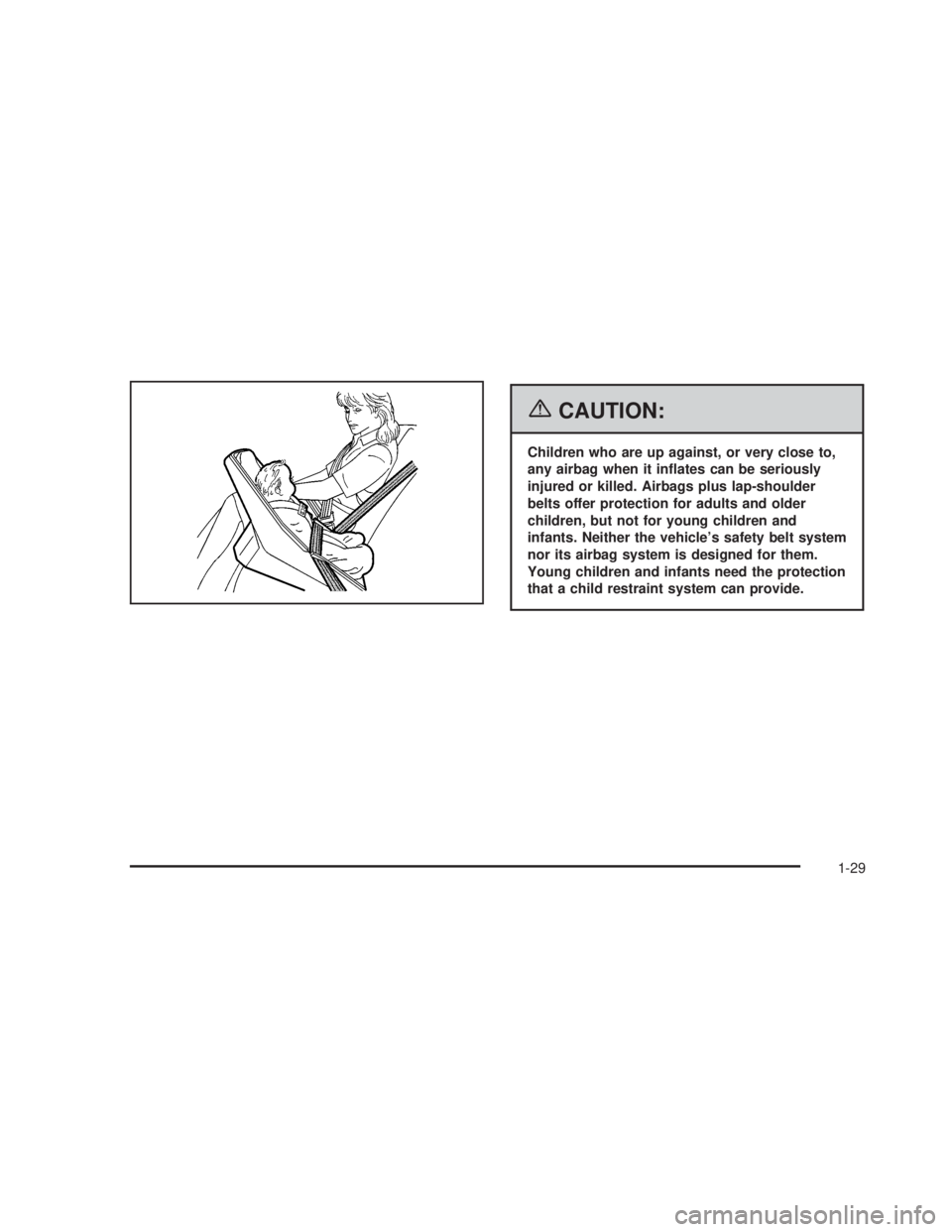
{CAUTION:
Children who are up against, or very close to,
any airbag when it in¯ates can be seriously
injured or killed. Airbags plus lap-shoulder
belts offer protection for adults and older
children, but not for young children and
infants. Neither the vehicle's safety belt system
nor its airbag system is designed for them.
Young children and infants need the protection
that a child restraint system can provide.
1-29
2006 - Pontiac GTO Owner Manual
Page 42 of 326
Where to Put the Restraint
Accident statistics show that children are safer if they are
restrained in the rear rather than the front seat. We,
therefore, recommend that child restraints be secured in
a rear seat, including an infant riding in a rear-facing
infant seat, a child riding in a forward-facing child seat
and an older child riding in a booster seat.
Neverput a
rear-facing child restraint in the front passenger seat.
Here is why:
{CAUTION:
A child in a rear-facing child restraint can be
seriously injured or killed if the right front
passenger's airbag in¯ates. This is because
the back of the rear-facing child restraint
would be very close to the in¯ating airbag.
Always secure a rear-facing child restraint in a
rear seat.
CAUTION: (Continued)
CAUTION: (Continued)
If you need to secure a forward-facing child
restraint in the right front seat, always move
the front passenger seat as far back as it will
go. It is better to secure the child restraint in a
rear seat.
Wherever you install a child restraint, be sure to secure
the child restraint properly.
Keep in mind that an unsecured child restraint can move
around in a collision or sudden stop and injure people in
the vehicle. Be sure to properly secure any child restraint
in your vehicle Ð even when no child is in it.
1-36
2006 - Pontiac GTO Owner Manual
Page 50 of 326
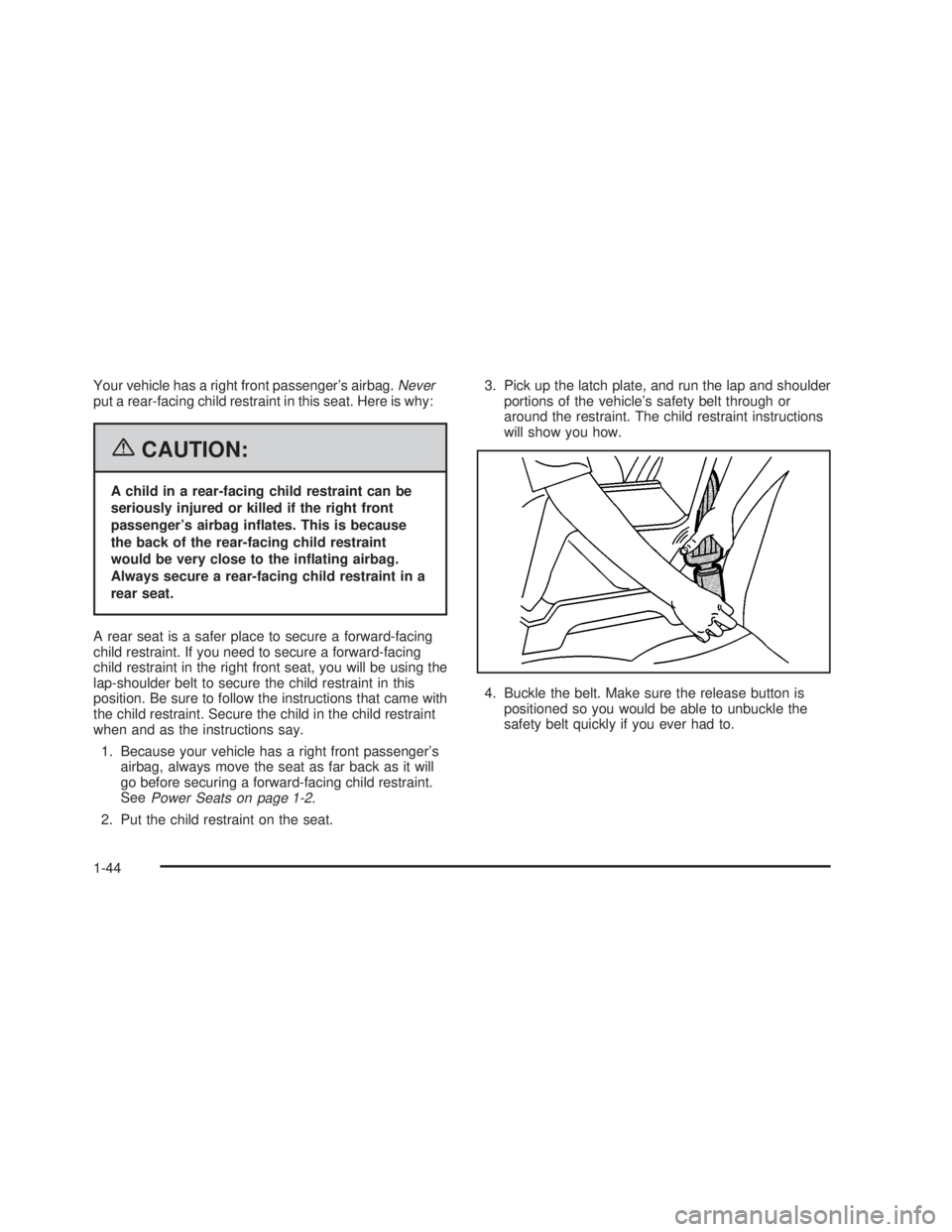
Your vehicle has a right front passenger's airbag.Neverput a rear-facing child restraint in this seat. Here is why:
{CAUTION:
A child in a rear-facing child restraint can be
seriously injured or killed if the right front
passenger's airbag in¯ates. This is because
the back of the rear-facing child restraint
would be very close to the in¯ating airbag.
Always secure a rear-facing child restraint in a
rear seat.
A rear seat is a safer place to secure a forward-facing
child restraint. If you need to secure a forward-facing
child restraint in the right front seat, you will be using the
lap-shoulder belt to secure the child restraint in this
position. Be sure to follow the instructions that came with
the child restraint. Secure the child in the child restraint
when and as the instructions say.
1. Because your vehicle has a right front passenger's
airbag, always move the seat as far back as it will
go before securing a forward-facing child restraint.
See
Power Seats on page 1-2.
2. Put the child restraint on the seat.3. Pick up the latch plate, and run the lap and shoulder
portions of the vehicle's safety belt through or
around the restraint. The child restraint instructions
will show you how.
4. Buckle the belt. Make sure the release button is
positioned so you would be able to unbuckle the
safety belt quickly if you ever had to.
1-44
2006 - Pontiac GTO Owner Manual
Page 52 of 326
Airbag System
Your vehicle has an airbag for the driver and an airbag
for the right front passenger.
Frontal airbags are designed to help reduce the risk of
injury from the force of an in¯ating frontal airbag.
But these airbags must in¯ate very quickly to do their
job and comply with federal regulations.
Here are the most important things to know about the
airbag system:
{CAUTION:
You can be severely injured or killed in a crash
if you are not wearing your safety belt Ð even if
you have airbags. Wearing your safety belt
during a crash helps reduce your chance of
hitting things inside the vehicle or being ejected
from it. Airbags are ªsupplemental restraintsº to
the safety belts. Airbags are designed to work
with safety belts, but do not replace them.
CAUTION: (Continued)
CAUTION: (Continued)
Airbags are designed to deploy in moderate to
severe frontal and near frontal crashes. They
are not designed to in¯ate in rollover, rear
crashes, or in many side crashes. And, for
some unrestrained occupants, airbags may
provide less protection in frontal crashes than
more forceful airbags have provided in the
past. Everyone in your vehicle should wear a
safety belt properly Ð whether or not there is
an airbag for that person.
1-46
2006 - Pontiac GTO Owner Manual
Page 53 of 326
{CAUTION:
Airbags in¯ate with great force, faster than the
blink of an eye. If you are too close to an
in¯ating airbag, as you would be if you were
leaning forward, it could seriously injure you.
Safety belts help keep you in position before
and during a crash. Always wear your safety
belt, even with airbags. The driver should sit
as far back as possible while still maintaining
control of the vehicle.
{CAUTION:
Anyone who is up against, or very close to,
any airbag when it in¯ates can be seriously
injured or killed. Airbags plus lap-shoulder
belts offer the best protection for adults, but
not for young children and infants. Neither the
CAUTION: (Continued)
CAUTION: (Continued)
vehicle's safety belt system nor its airbag
system is designed for them. Young children
and infants need the protection that a child
restraint system can provide. Always secure
children properly in your vehicle. To read how,
see
Older Children on page 1-25andInfants
and Young Children on page 1-28
.
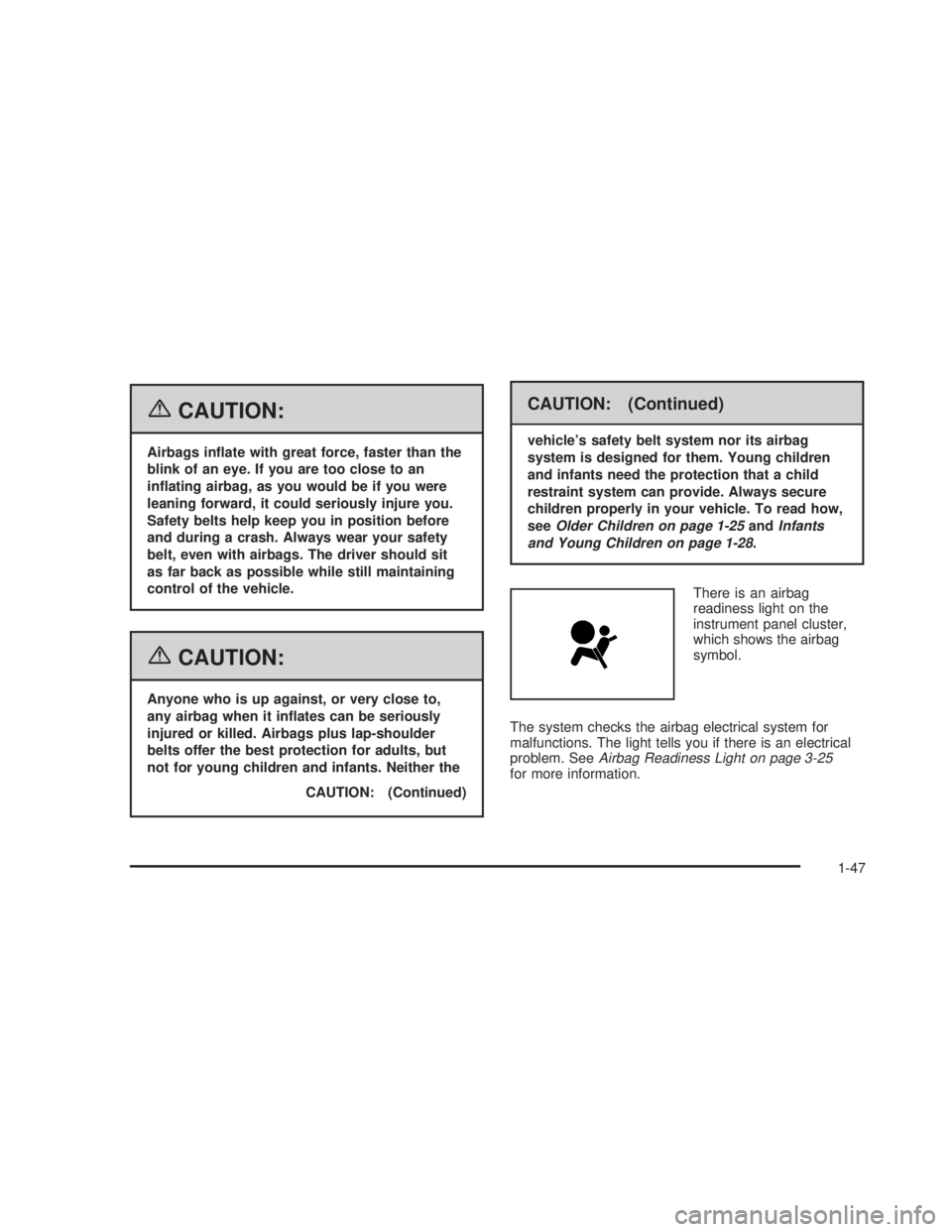
There is an airbag
readiness light on the
instrument panel cluster,
which shows the airbag
symbol.
The system checks the airbag electrical system for
malfunctions. The light tells you if there is an electrical
problem. See
Airbag Readiness Light on page 3-25for more information.
1-47
2006 - Pontiac GTO Owner Manual
Page 54 of 326
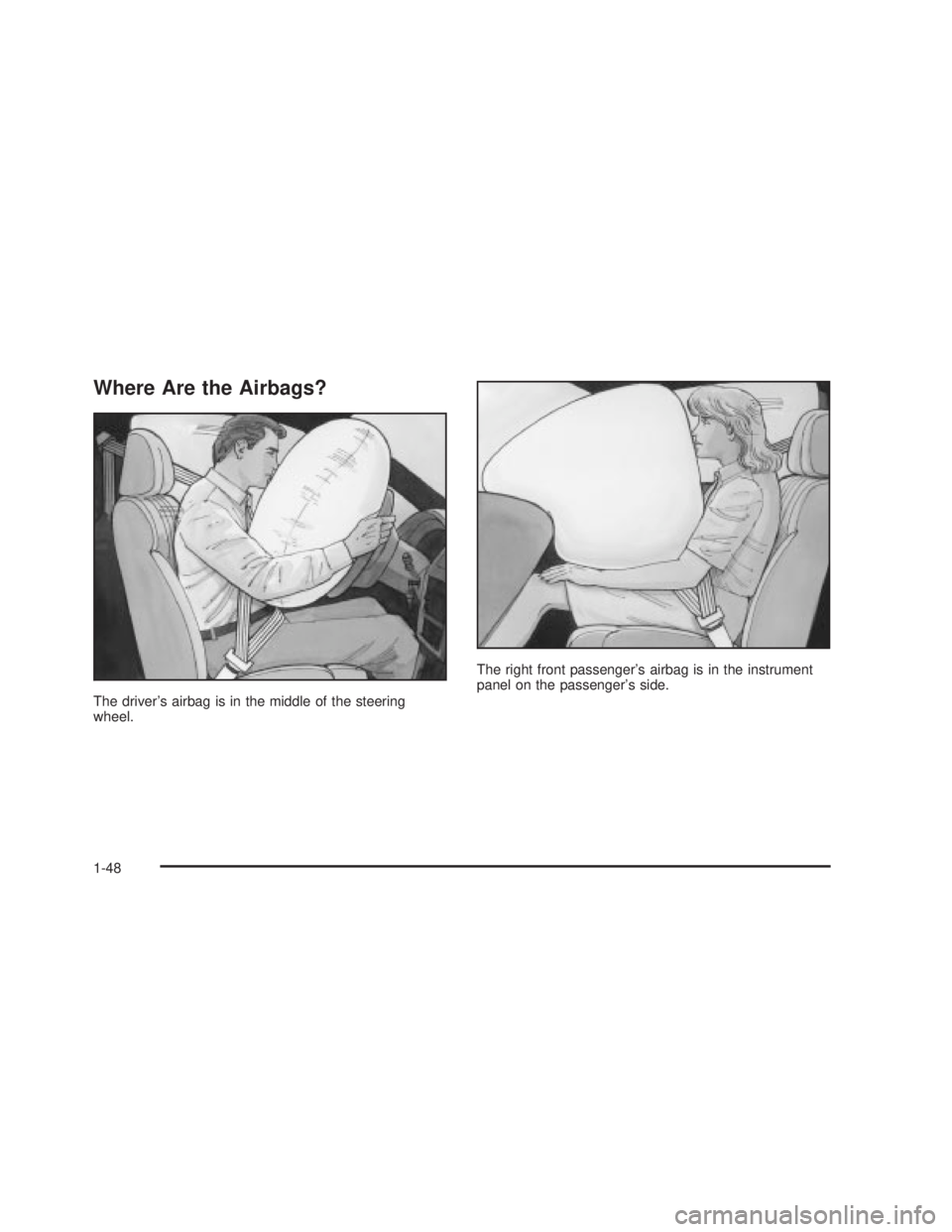
Where Are the Airbags?
The driver's airbag is in the middle of the steering
wheel.The right front passenger's airbag is in the instrument
panel on the passenger's side.
1-48
2006 - Pontiac GTO Owner Manual
Page 55 of 326
{CAUTION:
If something is between an occupant and an
airbag, the bag might not in¯ate properly or it
might force the object into that person causing
severe injury or even death. The path of an
in¯ating airbag must be kept clear. Do not put
anything between an occupant and an airbag,
and do not attach or put anything on the
steering wheel hub or on or near any other
airbag covering.
When Should an Airbag In¯ate?
The driver's and right front passenger's frontal airbags
are designed to in¯ate in moderate to severe frontal
or near-frontal crashes. But they are designed to in¯ate
only if the impact exceeds a predetermined deployment
threshold. Deployment thresholds take into account
a variety of desired deployment and non-deployment
events and are used to predict how severe a crash
is likely to be in time for the airbags to in¯ate and help
restrain the occupants. Whether your frontal airbags
will or should deploy is not based on how fast yourvehicle is traveling. It depends largely on what you hit,
the direction of the impact and how quickly your
vehicle slows down.
If your vehicle goes straight into a wall that does not
move or deform, the threshold level is about 11 to
17 mph (18 to 28 km/h). (The threshold level can vary,
however, with speci®c vehicle design, so that it can
be somewhat above or below this range.)
Frontal airbags may in¯ate at different crash speeds.
For example:
·If the vehicle hits a stationary object, the airbags
could in¯ate at a different crash speed than if the
vehicle hits a moving object.
·If the vehicle hits an object that deforms, the
airbags could in¯ate at a different crash speed than
if the vehicle hits an object that does not deform.
·If the vehicle hits a narrow object (like a pole) the
airbags could in¯ate at a different crash speed
than if the vehicle hits a wide object (like a wall).
·If the vehicle goes into an object at an angle the
airbags could in¯ate at a different crash speed
than if the vehicle goes straight into the object.
The frontal airbags (driver and right front passenger) are
not intended to in¯ate during vehicle rollovers, rear
impacts, or in many side impacts.
1-49
2006 - Pontiac GTO Owner Manual