warning PONTIAC PONTIAC 1995 Owner's Manual
[x] Cancel search | Manufacturer: PONTIAC, Model Year: 1995, Model line: PONTIAC, Model: PONTIAC PONTIAC 1995Pages: 354, PDF Size: 17.27 MB
Page 193 of 354

If you get the overheat warning with no sign of steam,
try this for
a minute or so:
1. Turn off your air conditioner.
2. Turn on your heater to full hot at the highest fan
3. If you’re in a traffic jam, shift to NEUTRAL (N);
speed and open the window as necessary.
otherwise, shift to the highest gear while
driving
-- DRIVE (D) or THIRD (3).
If you no longer have the overheat warning, you can
drive.
Just to be safe, drive slower for about ten minutes.
If the warning doesn’t come back on, you can drive
normally.
If the warning continues, pull over, stop, and park your
vehicle right away.
If there’s still no sign of steam, you can idle the engine
for two or three minutes while you’re parked, to see
if
the warning stops. But then, if you still have the
warning,
turn ofSthe engine and get everyone out
of the vehicle until it cools down.
You may decide not to lift the hood but to get service
help right away.
3.1L L82 (Code M) Engine
When you decide it’s safe to lift the hood, here’s what \
you’ll see:
A. Coolant Recovery Tank
B. Radiator Pressure Cap
C. Electric Engine Fans
5-14
ProCarManuals.com
Page 196 of 354

NOTICE:
In cold weather, water can kreeze and crack the
engine, radiator, heater core and other parts. Use
the recommended coolant.
When the coolant in the coolant recovery tank is at the
COLD mark, start your vehicle.
If the overheat warning continues, there’s one more
thing you can
try. You can add the proper coolant mix
directly to the radiator, but be sure the cooling system is
cool before you do
it.
5-17
ProCarManuals.com
Page 227 of 354

When to Change Engine OiI
See if any one of these is true for you:
Most trips are less than 5 to 10 miles (8 to 16 km).
This is particularly important when outside
temperatures are below freezing.
driving in stop and go traffic).
0 Most trips include extensive idling (such as frequent
Most trips are through dusty areas.
You frequently tow a trailer or use a carrier on top of
If any one of these is true for your vehicle, then you
need to change your
oil and filter every 3,000 miles
(5 000 km) or 3 months -- whichever comes first.
your
vehicle.
If none of them is true, change the oil and filter every
7,500 miles (12 500 km) or 12 months -- whichever
comes first.
Engine Coolant Heater
An engine coolant heater can be a big help if you have
to park outside in very cold weather,
0°F (-18°C) or
colder. If your vehicle has
this option, see “Engine
Coolant Heater” in the Index.
What to Do with Used Oil
Did you know that used engine oil contains certain
elements that may be unhealthy for your skin and could
even cause cancer? Don’t let used oil stay on your skin
for very long. Clean your skin and nails with soap and
water, or a good hand cleaner. Wash or properly throw
away clothing or rags containing used engine oil. (See
the manufacturer’s warnings about the use and disposal
of oil products.)
Used oil can be a real threat to the environment.
If you
change your own oil, be sure to drain all free-flowing oil
from the filter before disposal. Don’t ever dispose of oil
by putting
it in the trash, pouring it on the ground, into
sewers, or into streams or bodies of water. Instead,
recycle it by taking it to a place that collects used oil.
If
you have a problem properly disposing of your used oil,
ask your dealer, a service station
or a local recycling
center for help.
6-14
ProCarManuals.com
Page 232 of 354
Engine Coolant
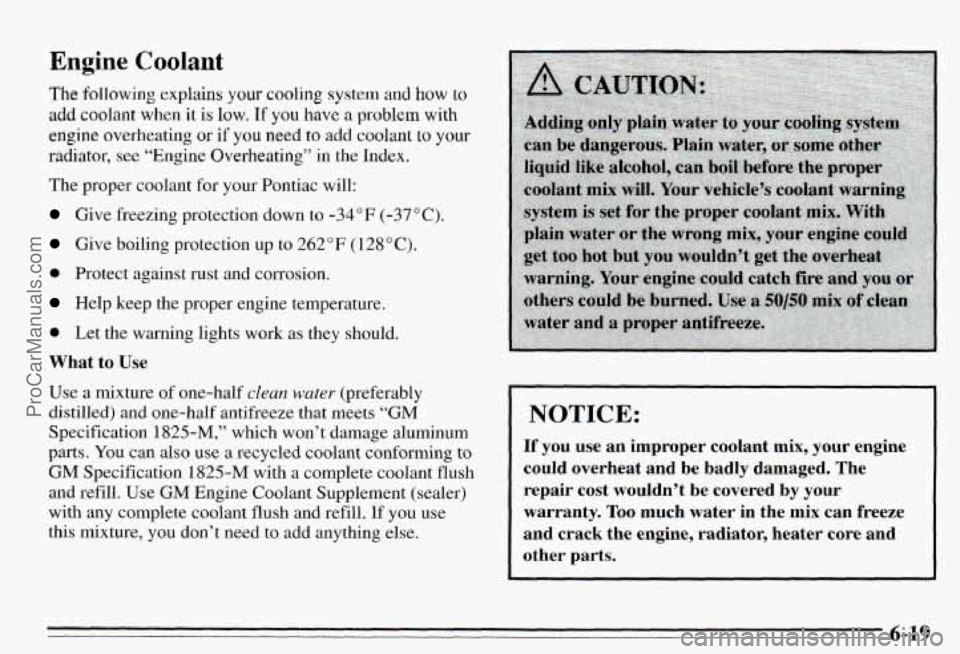
The following explains your cooling system and how to
add coolant when it is low. If you have a problem with
engine overheating
or if you need to add coolant to your
radiator, see “Engine Overheating” in the Index.
The proper coolant for your Pontiac will:
Give freezing protection down to -34°F (-37°C).
Give boiling protection up to 262°F (128 “C).
0 Protect against rust and corrosion.
Help keep the proper engine temperature.
0 Let the warning lights work as they should.
What to Use
Use a mixture of one-half
clean water (preferably
distilled) and one-half antifreeze that meets “GM Specification 1825-M,” which won’t damage aluminum
parts. You can also use a recycled coolant conforming to
GM Specification 1825-M with
a complete coolant flush
and refill. Use GM Engine Coolant Supplement (sealer)
with any complete coolant flush and refill.
If you use
this mixture, you don’t need to add anything else.
I NOTICE:
If you use an improper coolant mix, your engine
could overheat and be badly damaged. The
repair cost wouldn’t be covered by your
warranty.
Too much water in the mix can freeze
and crack the engine, radiator, heater core and
other parts.
6-19 ProCarManuals.com
Page 238 of 354
Brakes
Brake Master Cylinder
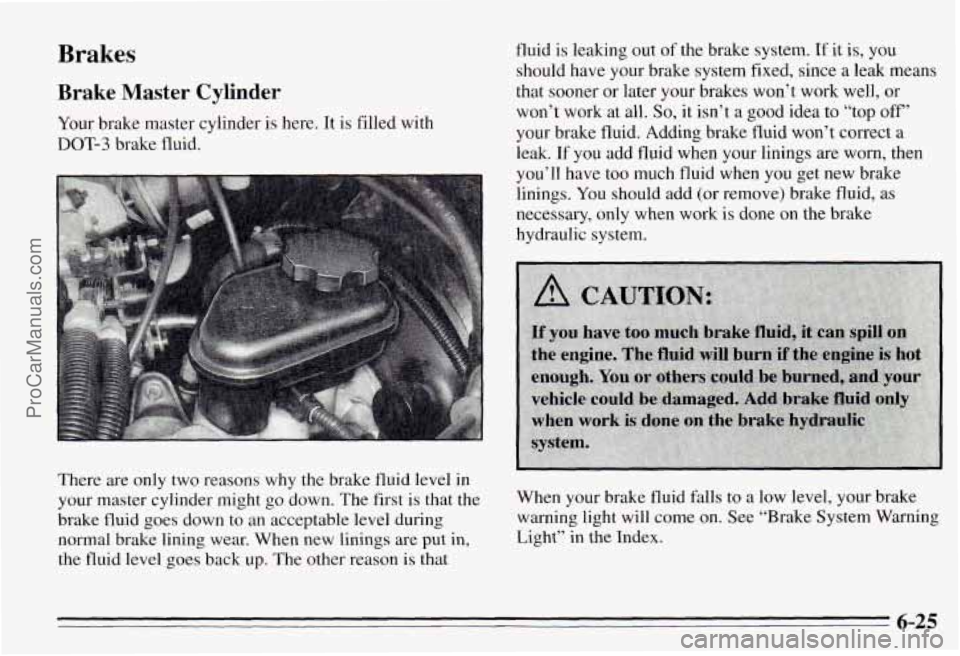
Your brake master cylinder is here. It is filled with
DOT-3 brake fluid.
There are only two reasons why the brake fluid level
in
your master cylinder might go down. The first is that the
brake fluid goes down to an acceptable level during
normal brake lining wear. When new linings are put in,
the fluid level goes back up. The other reason is that fluid is leaking out
of the brake system. If
it is, you
should have your brake system fixed, since a leak means
that sooner or later your brakes won’t work well, or
won’t work at all.
So, it isn’t a good idea to “top off’
your brake fluid. Adding brake fluid won’t correct a
leak.
If you add fluid when your linings are worn, then
you’ll have
too much fluid when you get new brake
linings.
You should add (or remove) brake fluid, as
necessary, only when work
is done on the brake
hydraulic system.
When your brake fluid falls
to a low level, your brake
warning light will come on. See “Brake System Warning
Light” in the Index.
6-25
ProCarManuals.com
Page 239 of 354
What to Add Brake Wear
When you do need brake fluid, use only DOT-3 brake
fluid
-- such as Delco Supreme 11 @ (GM Part
No. 1052535). Use new brake fluid from a sealed
container only, and always clean the brake fluid
reservoir cap before removing it.
NOTICE:
@ Don’t let someone put in the wrong kind of
fluid. For example, just a few drops of
mineral-based oil, such as engine oil, in
your brake system can damage brake
system parts
so badly that they’ll have to be
replaced.
0 Brake fluid can damage paint, so be careful
not to spill brake fluid on your vehicle.
If
you do, wash it off immediately. See
“Appearance Care” in the Index. Your
Pontiac has four-wheel disc brakes.
Disc brake pads have built-in wear indicators that make a high-pitched warning sound when the brake pads are
worn and new pads are needed. The sound may come
and
go or be heard all the time your vehicle is moving
(except when you are pushing on
the brake pedal
firmly).
NOTICE:
Continuing to drive with worn-out brake pads
could result in costly brake repair.
6-26
ProCarManuals.com
Page 264 of 354
Treadwear Temperature - A, B, C
The treadwear grade is a comparative rating based on
the wear rate of the tire when tested under controlled
conditions on a specified government test course. For
example, a tire graded
150 would wear one and a half
(1 1/2) times as well on the government course as a tire
graded
100. The relative performance of tires depends
upon the actual conditions of their use, however, and
may depart significantly from the norm due to variations
in driving habits, service practices and differences in
road characteristics and climate.
Traction - A, B, C
The traction grades, from highest to lowest are: A, B,
and C. They represent the tire’s ability to stop on wet
pavement as measured under controlled conltions on
specified government test surfaces of asphalt and
concrete.
A tire marked C may have poor traction
performance.
Warning: The traction grade assigned to
this tire is based
on braking (straight-ahead) traction tests and does not
include cornering (turning) traction. The temperature grades are
A (the highest), B, and C,
representing the
tire’s resistance to the generation of
heat and its ability to dissipate heat when tested under
controlled conditions on a specified indoor laboratory
test wheel. Sustained high temperature can cause the
material of the tire to degenerate and reduce tire life, and
excessive temperature can lead to sudden tire failure.
The grade
C corresponds to a level of performance
which
all passenger car tires must meet under the
Federal Motor Vehicle Safety Standard
No. 109. Grades
B and A represent higher levels of performance on the
laboratory test wheel than the minimum required by law.
Warning: The temperature grade for this tire
is
established for a tire that is properly inflated and not
overloaded. Excessive speed, underinflation, or
excessive loading, either separately or
in combination,
can cause heat buildup and possible tire failure.
These grades are molded on the sidewalls of passenger
car tires.
ProCarManuals.com
Page 267 of 354
!
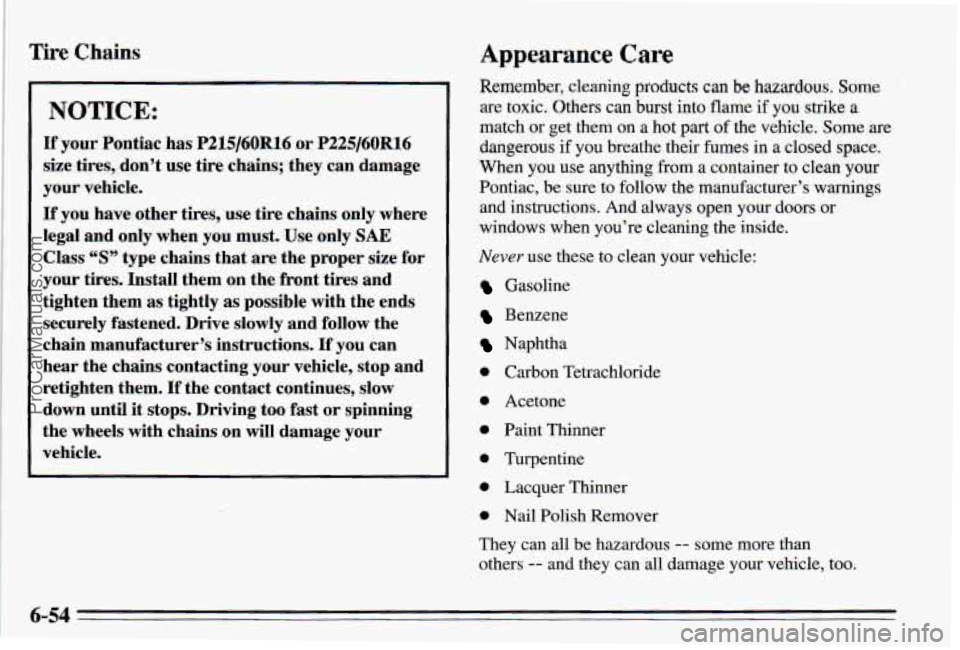
i Tire Chains
NOTICE:
If your Pontiac has P215/60R16 or P225/60R16
size tires, don’t use tire chains; they can damage
your vehicle.
If you have other tires, use tire chains only where
legal and only when
you must. Use only SAE
Class “S” type chains that are the proper size for
your
tires. Install them on the front tires and
tighten them
as tightly as possible with the ends
securely fastened. Drive slowly and follow the
chain manufacturer’s instructions. If you can
hear the chains contacting your vehicle, stop and
retighten them. If the contact continues, slow
down until
it stops. Driving too fast or spinning
the wheels with chains on will damage your
vehicle.
Appearance Care
Remember, cleaning products can be haza )us, Some
are toxic. Others can burst into flame if you strike a
match or get them on a hot part of the vehicle. Some are
dangerous if you breathe their fumes
in a closed space.
When you use anything from a container to clean your
Pontiac, be sure to follow the manufacturer’s warnings
and instructions. And always open your doors or
windows when you’re cleaning the inside.
Never use these to clean your vehicle:
Gasoline
Benzene
Naphtha
0 Carbon Tetrachloride
0 Acetone
0 Paint Thinner
0 Turpentine
0 Lacquer Thinner
0 Nail Polish Remover
They can all be hazardous
-- some more than
others
-- and they can all damage your vehicle, too.
ProCarManuals.com
Page 342 of 354
Section 9 Index
.
ABS ......................................... 4-6
Accessory Outlet
............................... 2-42
Adding Automatic Transaxle Fluid
..................... 6- 18
BrakeFluid
................................. 6-26
Electrical Equipment
............... 2-14,3-14, 6-63
Engine Coolant
............................... 6-20
Engineoil
.................................. 6-12
Power Steering Fluid
......................... 6-23
Windshield Washer Fluid
...................... 6-24
AimingHeadlamps
............................. 6-29
AirBag
....................................... 1-23
How Does It Restrain
......................... 1-26
How It Works
............................... 1-25
Location
................................... l-28
Readiness Light ........................ 1-24, 2-51
Servicing
................................... 1-28
What Makes It Inflate
......................... 1-26
What Will You See After It Inflates
.............. 1-27
When Should It Inflate
........................ 1-26
Aircleaner
.................................... 6-15
Air Conditioning
................................ 3-3
Air Conditioning Refrigerants
..................... 6-72
Air Conditioning with Electronic Controls ............ 3-1
SoundEquipment
............................ 3-14
Alignment and Balance. Tires
..................... 6-52
Aluminum Wheels. Cleaning
...................... 6-60
Antenna. Fixed Mast
............................ 3-16
Antenna. Power Mast Care
....................... 3-16
Antifreeze
..................................... 6-19
Anti-Lock Brake System Active Light
.............. 2-54
Anti-Lock Brake System Warning Light
......... 2-53. 4.7
Anti-Lock Brakes
............................... 4-6
Anti-Theft Feature. Theftlock
..................... 3-15
Appearance Care and Materials
.................... 6-62
Armrest. Storage
............................... 2-41
Ashtrays, Rear
................................. 2-45
Audio System, Steering Wheel Touch Controls
....... 3-17
Audio Systems
.................................. 3-5
Auto-Down Window ............................ 2-27
Automatic Door Locks
............................ 2-4
Automatic Transaxle
............................ 2-16
First Gear (1) Position
........................ 2-19
Neutral
(N) Position .......................... 2-17
Overdrive (D) Position
........................ 2-18
Park (P) Position
........................ 2-16. 7-38
Reverse (R) Position
.......................... 2-17
Second Gear (2) Position
...................... 2-19
Appearancecare
............................... 6-54
Ashtrays. Front
................................. 2-44
9-1 ProCarManuals.com
Page 343 of 354
Shifting .................................... 2- 16
Third Gear (3) Position
........................ 2-18
Automatic Transaxle Fluid
........................ 6- 16
Adding
.................................... 6-18
Checking ................................... 6-16
Battery
...................................... 6-28
Charge Light
................................ 2-50
Jump Starting
................................ 5-2
Replacement. Remote Lock Control
............... 2-7
Saver
...................................... 2-36
Warnings
.................................... 5-2
BBB Auto Line
................................. 8-3
Blizzard
...................................... 4-25
Brake Adiustment
................................. 6-27
Fliid. Adding
............................... 6-26
Master Cylinder
............................. 6-25
System Parts, Replacing
....................... 6-27
System Warning Light
........................ 2-52
Trailer
..................................... 4-33
Transaxle Shift Interlock
....................... 2-24
Transaxle Shift Interlock, Maintenance
........... 7-37
Brakes, Anti-Lock
............................... 4-6
Braking
........................................ 4-5
Braking, In Emergencies
.......................... 4-9
Break-In,
New Vehicle .......................... 2-12
Parking
.................................... 2-21
PedalTravel
................................ 6-27
Wear
...................................... 6-26 BTSI (Brake Transaxle Shift Interlock)
.............. 2-24
Bulb Replacement
.............................. 6-70
BTSI (Brake Transaxle Shift InterIock). Maintenance . . 7-37
Canada. Vehicles First Sold In
11 .. .......................
Canadian Roadside Assistance ...................... 8-7
Capacities and Specifications
...................... 6-71
Carbon Monoxide
.................... 2.25.4.26. 4.32
Care
of the Head-Up Display ..................... 3-15
Cassette Tape Player
............................. 3-9
Cassette Tape Player Care ........................ 3-15
CDPlayer
..................................... 3-10
Center Console
................................. 2-41
Center High-Mounted Stoplamp Bulb Replacement
.... 6-42
Center Passenger Position
........................ 1-29
Certification Label
.............................. 4-27
Chains, Safety
................................. 4-32
Chains, Tire ................................... 6-54
Changing
a Flat Tire ............................. 5-23
Charging System Light
.......................... 2-50
Checking Your Restraint Systems
.................. 1-54
Automatic Transaxle Fluid
..................... 6-16
Engine Coolant
.............................. 6-20
EngineOil
.................................. 6-11
Power Steering Fluid
......................... 6-22
Restraint Systems
............................ 1-54
Chemical Paint Spotting
.......................... 6-61
Checking
BrakeFluid
................................. 6-25
Things Under the Hood
......................... 6-7
ProCarManuals.com