steering PONTIAC PONTIAC 1996 Owner's Manual
[x] Cancel search | Manufacturer: PONTIAC, Model Year: 1996, Model line: PONTIAC, Model: PONTIAC PONTIAC 1996Pages: 370, PDF Size: 17.69 MB
Page 201 of 370
/r\, CAUTION:
A vehicle can fall from a car carrier if it isn’t
adequately secured. This can cause
a collision,
serio’us personal injury and vehicle damage. The
vehicle should be tightly secured with chains or
steel cables before it
is trapported.
Don’t
use substitutes (ropes, leather straps,
canvas webbing, etc.)
that can be cut by sharp
edges underneath the towed vehicle. Always use
T-hooks inserted in the T-hook slots. Never use
J-hooks. They will damage drivetrain and
suspension components.
~~
When your vehicle is being towed, have the ignition
turned
to the OFF position. The steering wheel should
be clamped in a straight-ahead position, with a
clamping device designed
for towing service. Do not
use the vehicle’s steering column lock for ths The
transaxle should be
in NEUTRAL (N) and the
parking brake released.
Don’t have your vehicle towed on the drive wheels,
unless you must. If the vehicle must be towed on the
drive wheels, be
sure to follow the speed and distance
restrictions later in this section or
your transaxle will be
damaged.
If these limitations must be exceeded, then the
drive wheels have to be supported on a dolly.
ProCarManuals.com
Page 216 of 370
If a Tire Goes Flat
It’s unusual for a tire to “blow out” while you’re driving,
especially if you maintain your tires properly. If air goes
out of a tire, it’s much more likely to leak out slowly.
But
if you should ever have a “blowout,” here are a few
tips about what to expect and what to do:
If a front tire fails, the flat tire will create
a drag that
pulls the vehicle toward that side. Take your foot
off the
accelerator pedal and grip the steering wheel firmly.
I
Steer to maintain lane position, and then gently brake to
a stop well out
of the traffic lane.
A rear blowout, particularly on a curve, acts much like a
skid and may require the same correction you’d; use in a
skid. In any rear blowout, remove your foot from the
accelerator pedal. Get
the vehicle under control by
steering the way you want the vehicle to
go. It may be
very bumpy and noisy, but you can still steer. Gently
brake
to a stop -- well off the road if possible.
If a tire goes flat, the next part shows how to use your
jacking equipment to change a flat tire safely.
Changing a Flat Tire
If a tire goes flat, avoid further tire and wheel damage
by driving slowly to a level place. Turn
on your hazard
warning flashers.
Changing a tire can cause an injury. The vehicle
can slip off the jack and roll over you or other
people. You and they could be badly injured.
Find a level place to change your tire.
To help
prevent the vehicle from moving:
1. Set the parking brake firmly.
2. Put the shift lever in PARK (P).
3. nrn off the engine.
To be even more certain the vehicle won’t move,
you can put blocks at the front and rear of the
tire farthest away from the one being changed.
That would be the tire
on the other side of the
vehicle, at the opposite end.
ProCarManuals.com
Page 227 of 370
If You’re Stuck: In Sand, Mud,
Ice or Snow
What you don’t want to do when your vehicle is stuck is
to spin your wheels too fast. The method known as
“rocking” can help you get out when you’re stuck, but
you must use caution.
If you let your tires spin at high speed, they can
explode, and you or others could be injured. .And,
the transaxle or other parts of the vehicle can
overheat. That could cause an engine
compartment
fire or other damage. When you’re
stuck, spin the wheels as little as possible. Don’t
spin the wheels above
35 mph (55 M) as shown
on the speedometer.
NOTICE:
Spinning your wheels can destroy parts of your
vehicle
as well as the tires. If you spin the wheels
too
fast while shifting your transaxle back and
forth, you can destroy your transaxle.
For information about using tire chains on your vehicle,
see “Tire Chains” in the Index.
Rocking Your Vehicle to Get it Out
First, turn your steering wheel left and right. That will
clear the area around your front wheels. Then shift back
and forth between REVERSE (R) and a forward gear,
spinning the wheels as little as possible. Release
the
accelerator pedal while you shift, and press lightly on
the ‘accelerator pedal when the transaxle is in gear. If
that doesn’t get you out after a few tries, you may need
to be towed out.
If you do need to be towed out, see
“Towing Your Vehicle” in
the Index.
ProCarManuals.com
Page 235 of 370
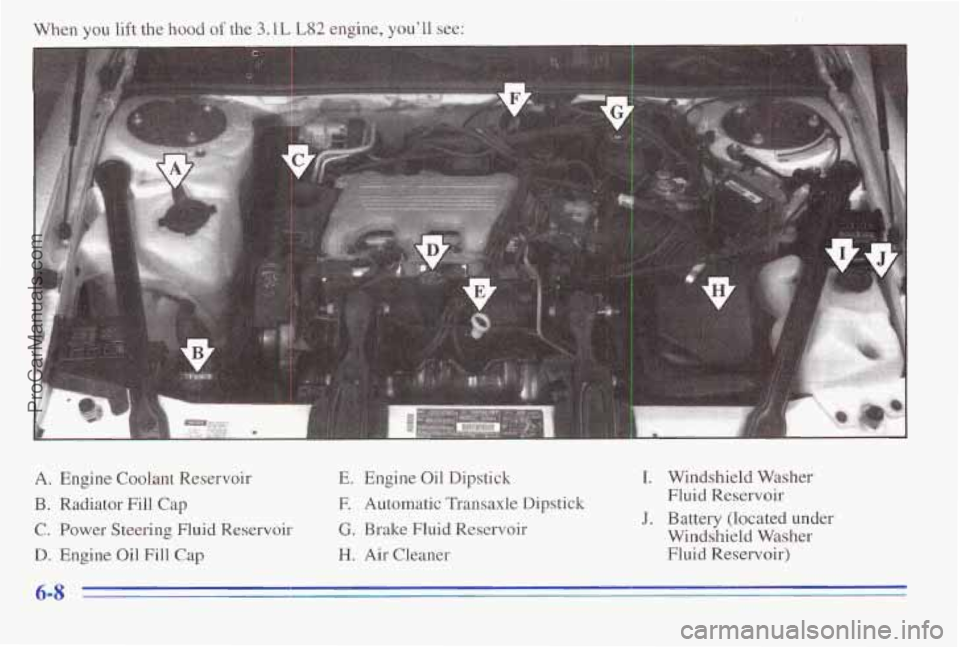
When you lift the hood of the 3.1L L82 engine, you’ll see:
A. Engine Coolant Reservoir
B. Radiator Fill Cap
C. Power Steering Fluid Reservoir
D. Engine Oil Fill Cap
E. Engine Oil Dipstick
E Automatic Transaxle Dipstick
G. Brake Fluid Reservoir
H. Air Cleaner
I. Windshield Washer
Fluid Reservoir
J. Battery (located under
Windshield Washer
Fluid Reservoir)
6-8
ProCarManuals.com
Page 236 of 370
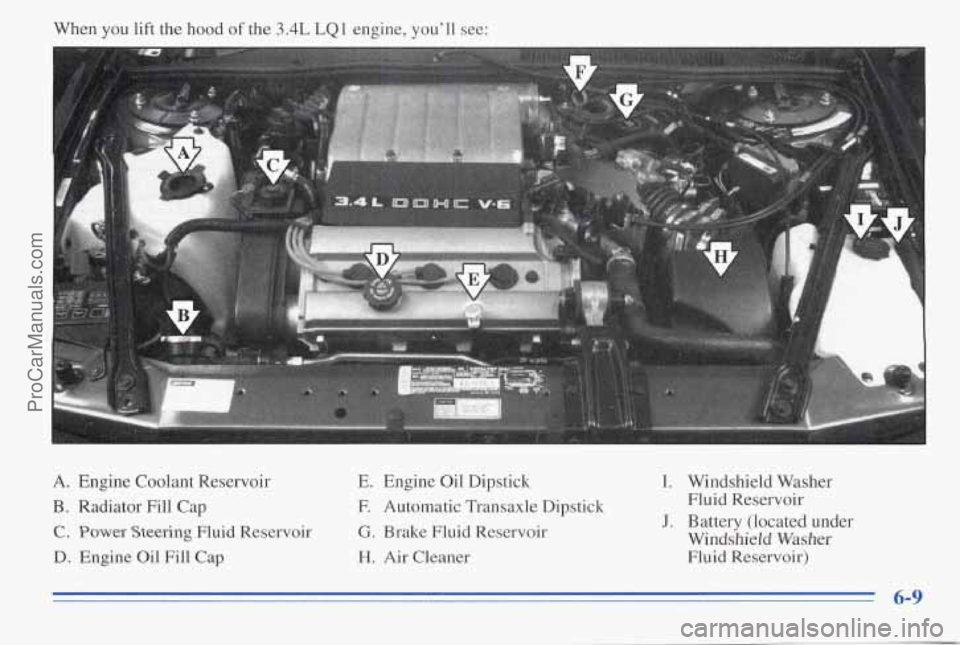
When you lift the hood of the 3.4L LQl engine, you’ll see:
1
A. Engine Coolant Reservoir
B. Radiator Fill Cap
C. Power Steering Fluid Reservoir
D. Engine Oil Fill Cap E.
Engine Oil Dipstick
F. Automatic Transaxle Dipstick
G. Brake Fluid Reservoir
H. Air Cleaner
I. Windshield Washer
Fluid Reservoir
J. Battery (located under
Windshield
Washer
Fluid Reservoir)
6-9
ProCarManuals.com
Page 251 of 370
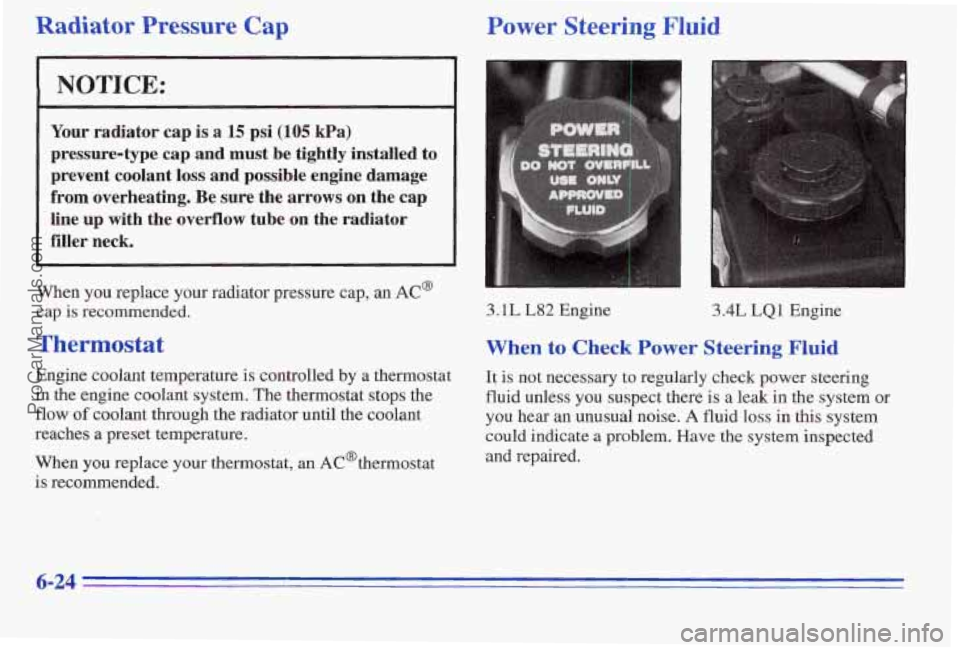
Radiator Pressure Cap Power Steering Fluid
NOTICE:
Your radiator cap is a 15 psi (105 kPa)
pressure-type cap and must
be tightly installed to
prevent coolant loss and possible engine damage
from overheating.
Be sure the arrows on the cap
line up with the overflow.tube on the radiator
filler neck.
When you replace your radiator pressure cap, an AC@
cap is recommended.
Thermostat
Engine coolant temperature is controlled by a thermostat
in the engine coolant system. The thermostat stops the
flow
of coolant through the radiator until the coolant
reaches a preset temperature.
When you replace your thermostat,
an AC'thermostat
is recommended.
3.1L L82 Engine 3.4L LQ1 Engine
When to Check Power Steering Fluid
It is not necessary to regularly check power steering
fluid unless
you suspect there is a leak in the system or
you hear an unusual noise.
A fluid loss in this system
could indicate
a problem. Have the system inspected
and repaired.
6-24 -
ProCarManuals.com
Page 252 of 370
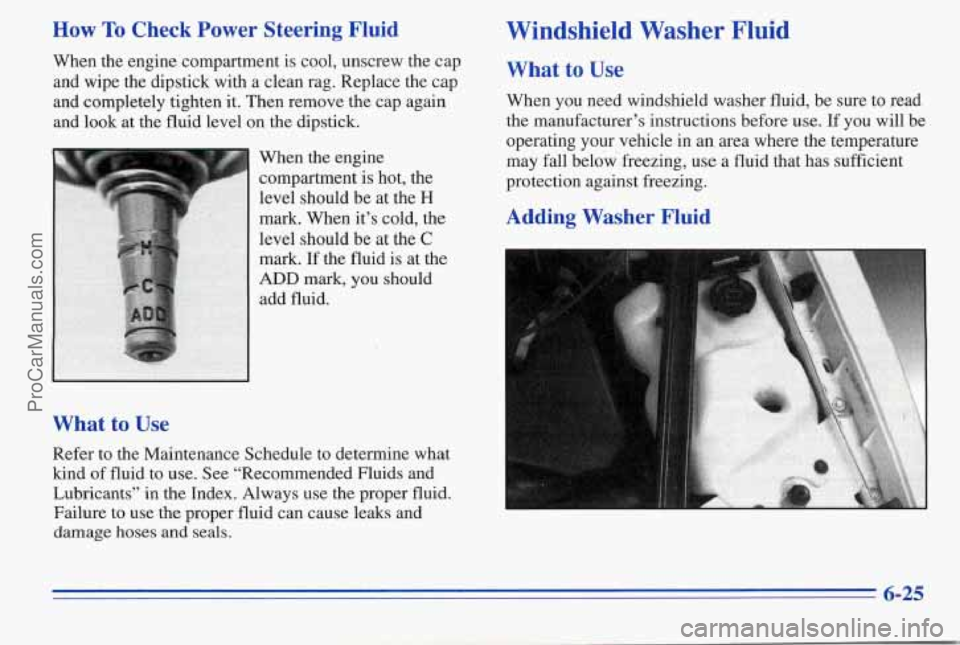
How To Check Power Steering Fluid
When the engine compartment is cool, unscrew the cap
and wipe the dipstick with a clean rag. Replace the cap
and completely tighten it. Then remove the cap again
and
look at the fluid level on the dipstick.
When the engine compartment is hot, the
level should be at the
H
mark. When it’s cold, the
level should be at the
C
mark. If the fluid is at the
ADD mark, you should
add fluid.
What to Use
Refer to the Maintenance Schedule to determine what
kind of fluid to use. See “Recommended Fluids and
Lubricants”
in the Index. Always use the proper fluid.
Failure to use the proper fluid can cause leaks and
damage hoses
and seals.
Windshield Washer Fluid
What to Use
When you need windshield washer fluid, be sure to read
the manufacturer’s instructions before use. If you will be
operating your vehicle in an area where the temperature
may fall below..freezing, use a fluid that has sufficient
protection against freezing.
Adding Washer Fluid
ProCarManuals.com
Page 294 of 370

Fuse
15
Description
HVAC #I -- Air Temperature Valve
Motor, Trip Computer, Daytime Running
Lamps (DRL) Module, HVAC Control
Assembly, Multifunction Lever Cruise
Control Switch
16 REAR DEFOG. -- HVAC Control
Assembly Rear Window
Defogger Switch
19 POWER ACCESSORY
#1 -- Antenna Relay, Power Mirror
Switch, Door Lock Switches, Door
Handle Switches
21 AIR BAG
-- Air Bag System
23 STOPLAMPS
-- TCCBrake Switch
, 24 CRUISE CONTROL
I 28 CTSY LAMPS -- Vanity Mirrors,
I/P Courtesy Lamps, UP Compartment
Lamp, Trunk Courtesy Lamp, Header Courtesy and Reading Lamp,
US Lighted
Rearview Mirror, Dome and Reading
Lamp, Quarter Courtesy Lamps
Fuse Description
29 WIPER -- Wiper Switch
30 TURN SIGNAL -- Turn Signal Flasher
32 POWER LOCKS -- Door Lock Relay
38 RADIO -- Radio, Steering Wheel
39 I/P ELECTRONICS IGNITION
37 ' AUXILIARY POWER
Radio Switches
FEED
-- Headlamp Switch, Cruise
Control Cut-Out Switch, Air Bag System, TCC/Brake Switch, Instrument
Cluster, Chime. Module, Second-Gear
Start Switch, Head-Up Display (HUD)
Switch, Daytime Running
Lamps (Dm) Module
ProCarManuals.com
Page 310 of 370
I Short TriplCity Maintenance Schedule I
.6,000 Miles (10 000 km)
0 Change engine oil and filter (or every
3 months, whichever occurs first).
An Emission Control Sewice.
0 Lubricate steering ball joints (or every
6 months, whichever occurs first).
0 Rotate tires. See “Tire Inspection and
Rotation”
in the Index for proper rotation
pattern and additional information. During
tire rotation, check brake calipers for
freedom
of movement. Refer to the
appropriate
GM service manual for proper
caliper service procedures.
1
~
ACTUAL MILEAGE SERVICED BY:
9,000 Miles (15 000 km)
0 Change engine oil and filter (or every
3 months, whichever occurs first).
An Emission Control Service.
I DATE I ACTUAL MILEAGE [SERVICED BY: I
7-7
ProCarManuals.com
Page 311 of 370
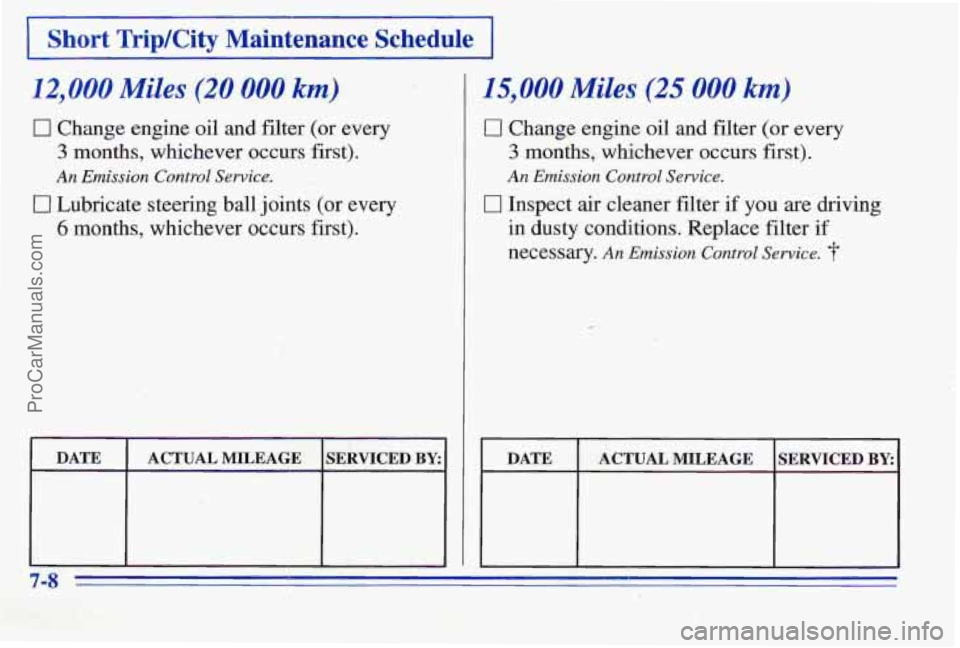
12,000 Miles (20 000 km)
0 Change engine oil and filter (or every
3 months, whichever occurs first).
An Emission Control Service.
0 Lubricate steering ball joints (or every
6 months, whichever occurs' first).
DATE ACTUAL MILEAGE SERVICED BY:
___~
15,000 Miles (25 00.0 km)
Cl Change engine oil and filter (or every
3 months, whicheyer occurs first).
An Emission Control Service.
0 Inspect air cleaner filter if you 'are driving
in dusty conditions. Replace filter if
necessary.
An Emission Control Service.
DATE ACTUAL MILEAGE ~ SERVICED BY:
7-8
ProCarManuals.com