engine PONTIAC PONTIAC 1996 Workshop Manual
[x] Cancel search | Manufacturer: PONTIAC, Model Year: 1996, Model line: PONTIAC, Model: PONTIAC PONTIAC 1996Pages: 370, PDF Size: 17.69 MB
Page 208 of 370
An electric fan under the hood can start up even
when
the engine is not running and can injure
you. Keep hands, clothing and tools away from
any underhood electric fan.
If the coolant inside the coolant recovery tank is boiling,
don’t do anything else until
it cools down.
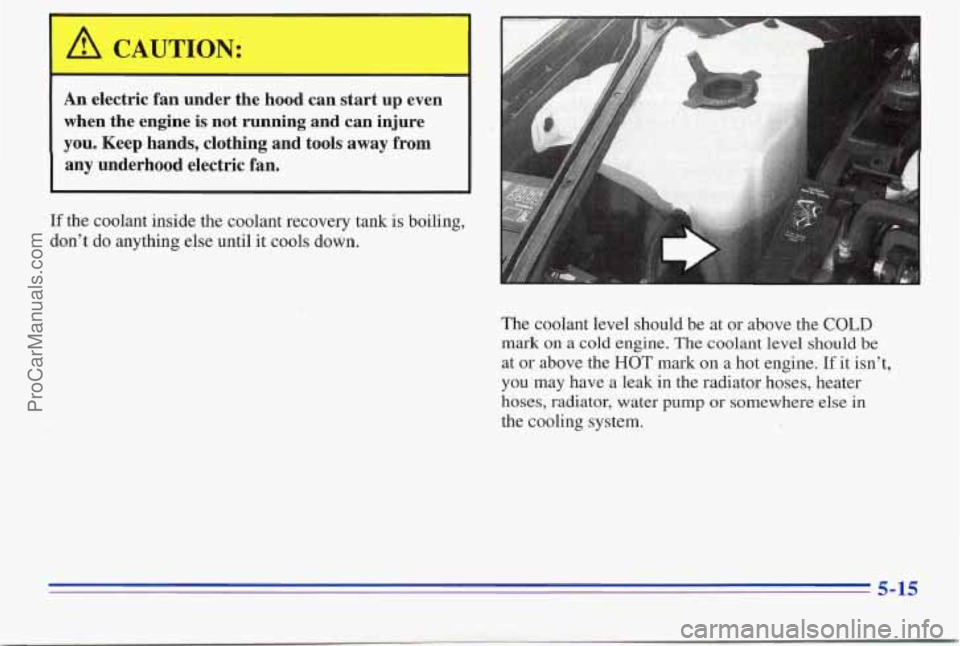
The coolant level should be
at or above the COLD
mark on a cold engine. The coolant level should be
at or above the HOT mark on a hot engine. If it isn’t,
you may have a leak
in the radiator hoses, heater
hoses, radiator, water pump or somewhere else in
the cooling system.
5-15
ProCarManuals.com
Page 209 of 370
A CAUTION:
I
Heater and radiator hoses, and other engine
parts,
can be very hot. Don’t touch them. If you
do, you can
be burned.
Don’t run the engine
if there is a leak. If you run
the engine,
it could lose all coolant. That could
cause
an engine fie, and you could be burned.
Get
any ‘leak fixed before you drive the, vehicle.
I NOTICE:
I
Engine damage from running your engine
without coolant isn’t covered by your warranty.
I
If there seems to be no leak, with the engine on, check to
see if the electric engine fan@) are running. If the engine
is overheating, both fan(s) should be running. If they
aren’t, your vehicle needs service.
How to Add Coolant to the Coolant
Recovery Tank
If you haven’t found a problem yet, but the coolant level
isn’t at the COLD mark, add a 50/50 mixture of ckm
water (preferably distilled) and DEX-COOL”
(orange-colored, silicate-free) antifreeze at the coolant
recovery
tank. (See “Engine Coolant” in the Index for
more information.)
Adding only plain water to your cooling system
can be
dangerous. Plain water, or some other
liquid Eke alcohol, can boil before the proper
coolant
mix will. Your vehicle’s coolant warning
system
is set for the proper coolant mix. With
plain water or the wrong mix, your engine could
get too hot but you wouldn’t get the overheat
warning.
Your engine ‘could catch fire and you or
others could be burned. Use a
50/50 mix Q€ clean
water and
DEX-COOL antifreeze.
5-16
,LC !
ProCarManuals.com
Page 210 of 370
NOTICE:
In cold weather, water can freeze and crack the
engine, radiator, heater core and other parts.
Use the recommended coolant and the proper
coolant
mix.
You can be burned if you spill coolant on hot
engine parts. Coolant contains ethylene glycol
and
it will burn if the engine parts are hot
enough. Don't spill coolant on a hot engine.
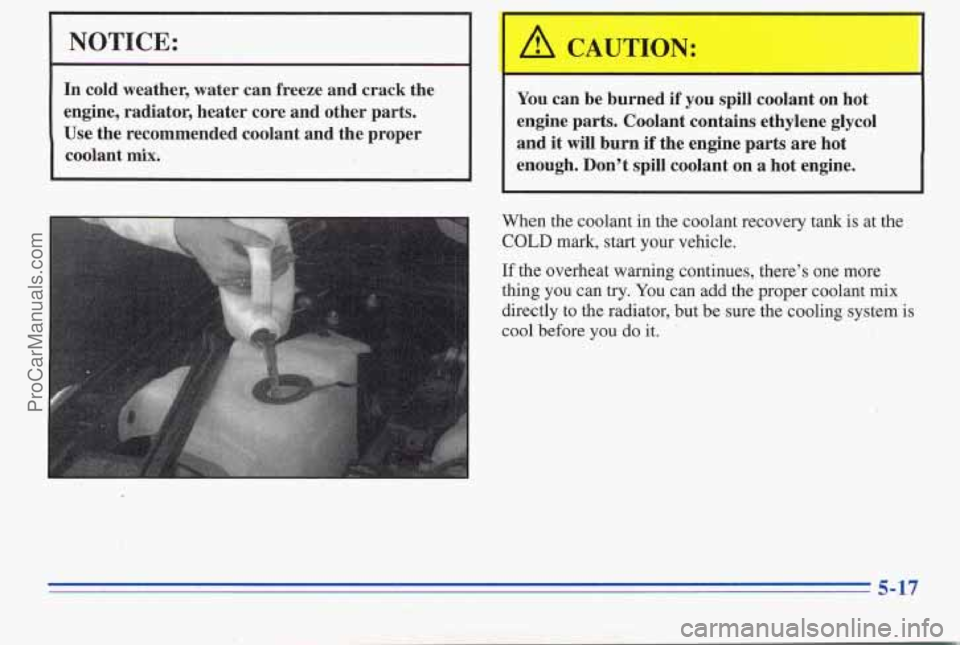
When the coolant in the coolant recovery tank is at the
COLD mark, start your vehicle.
If the overheat warning continues, there's one more
thing you can
try. You can add the proper coolant mix
directly to the radiator,. but be sure the cooling system is
cool before
you do it.
5-17
ProCarManuals.com
Page 212 of 370
How to Add Coolant to the Radiator
I NOTICE:
~~
Your engine has a specific radiator fill procedure.
Failure to follow this procedure could cause your
engine to overheat and be severely damaged.
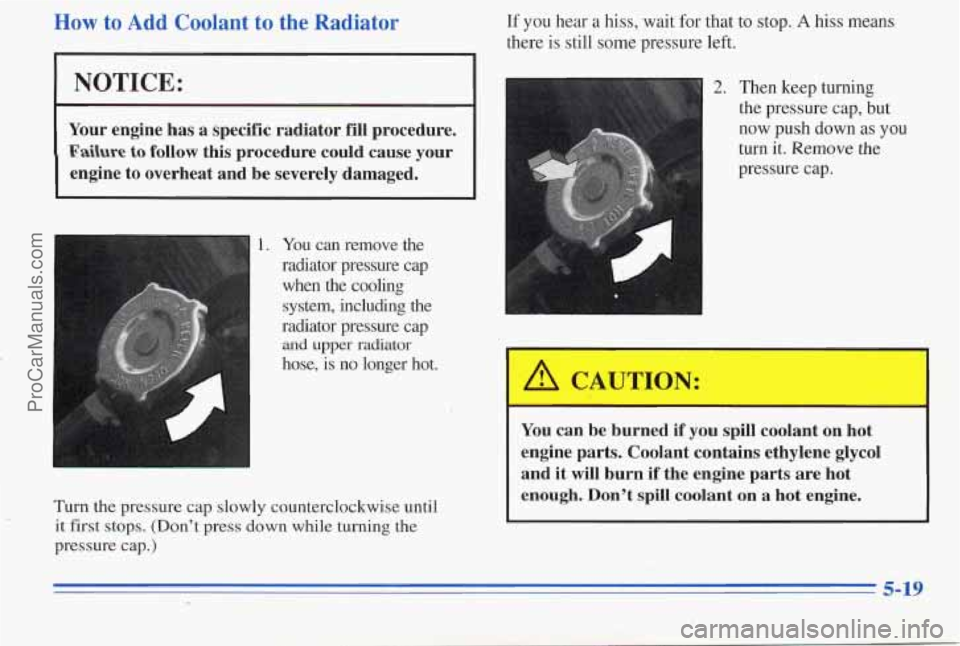
1. You can remove the
radiator pressure cap when the cooling system, including the
radiator pressure cap
and upper radiator
hose, is no longer hot.
If you hear a hiss, .wait for that to stop. A hiss means
there is still some pressure left.
Turn the pressure cap slowly counterclockwise until
it first stops. (Don't press down while turning the
pressure cap.)
I
Then keep turning
the pressure cap, but
now push down as
you
turn it. Remove the
pressure cap.
You can be burned if you spill coolant on hot
engine parts. Coolant contains ethylene glycol
and it will burn if the engine parts are hot
enough. Don't spill coolant
on a hot engine.
5-19
ProCarManuals.com
Page 213 of 370
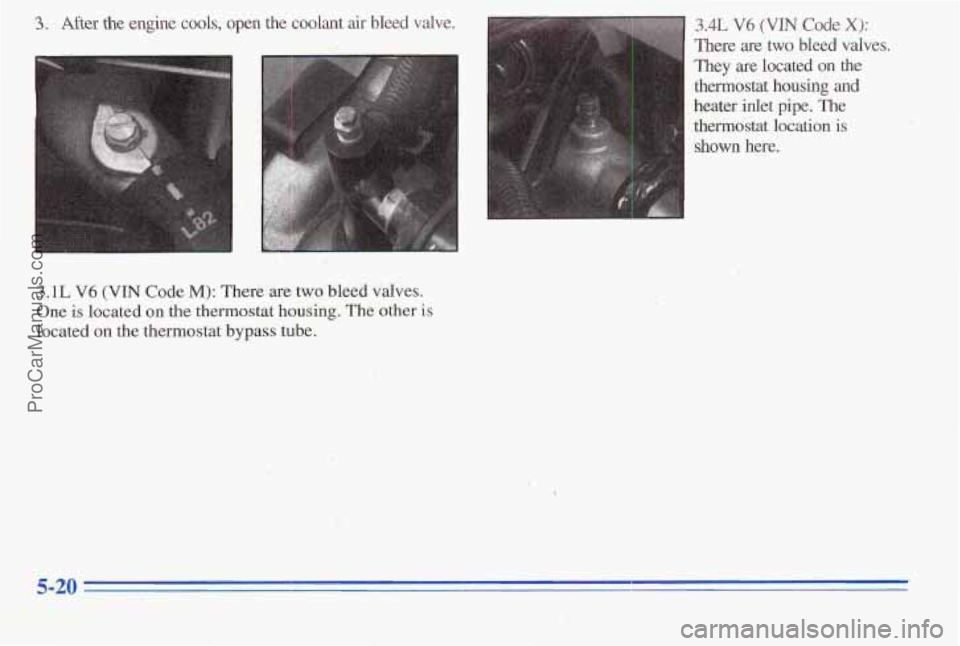
3. After the engine cools, open the coolant air bleed valve.
I 3.4L V6 (VIN Code X):
There are two bleed valves.
They
are located on the
thermostat
housing and
heater inlet pipe. The
.thermostat location is
shown here.
3.1L V6 (VIN Code M): There are two bleed valves.
One is located on the thermostat housing. The other is
located on the thermostat bypass tube.
i
5-20
ProCarManuals.com
Page 214 of 370
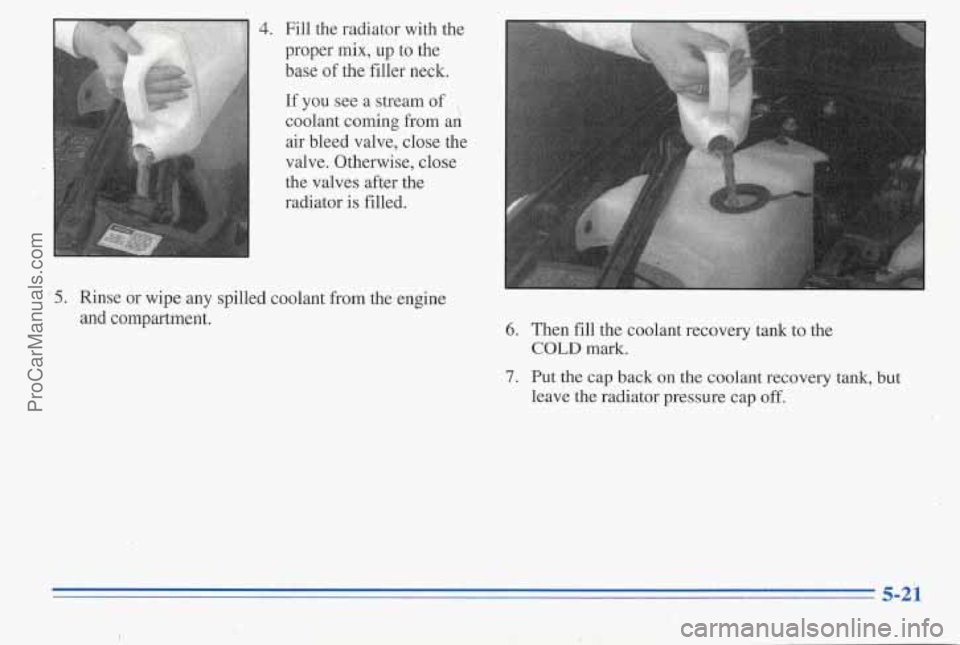
4. Fill the radiator with the
proper
mix, up to the
base of the filler neck.
If you see a stream
of ,
coolant co.ming from an
air bleed valve, close the
valve. Otherwise, close
the valves after the
radiator
is filled.
5. Rinse or wipe any spilled coolant from the engine
and compartmept.
6. Then fill the coolant recovery tank to the
7. Put the cap back on the coolant recovery tank, but
COLD mark.
leave the radiator pressure cap off.
ProCarManuals.com
Page 215 of 370

8. Start the engine and let it run until you can feel the
upper radiator hose getting hot. Watch
out for the
engine fans.
9. By this time the coolant level inside the radiator
filler neck may be lower.
If the level is lower, add
more
of the proper mix through the filler neck until
the level reaches the base of the filler neck.
10. Then replace the
pressure cap. At any
time during this
procedure
if coolant
begins to flow out of
the filler neck, reinstall
the pressure cap. Be
sure the arrows on the
pressure cap line
up
like this.
11. Check the coolant in the recovery tank. The level in
the coolant recovery tank
should be at the HOT
mark when the engine is hot or at the COLD mark
when the engine is cold.
5-22
ProCarManuals.com
Page 216 of 370
If a Tire Goes Flat
It’s unusual for a tire to “blow out” while you’re driving,
especially if you maintain your tires properly. If air goes
out of a tire, it’s much more likely to leak out slowly.
But
if you should ever have a “blowout,” here are a few
tips about what to expect and what to do:
If a front tire fails, the flat tire will create
a drag that
pulls the vehicle toward that side. Take your foot
off the
accelerator pedal and grip the steering wheel firmly.
I
Steer to maintain lane position, and then gently brake to
a stop well out
of the traffic lane.
A rear blowout, particularly on a curve, acts much like a
skid and may require the same correction you’d; use in a
skid. In any rear blowout, remove your foot from the
accelerator pedal. Get
the vehicle under control by
steering the way you want the vehicle to
go. It may be
very bumpy and noisy, but you can still steer. Gently
brake
to a stop -- well off the road if possible.
If a tire goes flat, the next part shows how to use your
jacking equipment to change a flat tire safely.
Changing a Flat Tire
If a tire goes flat, avoid further tire and wheel damage
by driving slowly to a level place. Turn
on your hazard
warning flashers.
Changing a tire can cause an injury. The vehicle
can slip off the jack and roll over you or other
people. You and they could be badly injured.
Find a level place to change your tire.
To help
prevent the vehicle from moving:
1. Set the parking brake firmly.
2. Put the shift lever in PARK (P).
3. nrn off the engine.
To be even more certain the vehicle won’t move,
you can put blocks at the front and rear of the
tire farthest away from the one being changed.
That would be the tire
on the other side of the
vehicle, at the opposite end.
ProCarManuals.com
Page 227 of 370
If You’re Stuck: In Sand, Mud,
Ice or Snow
What you don’t want to do when your vehicle is stuck is
to spin your wheels too fast. The method known as
“rocking” can help you get out when you’re stuck, but
you must use caution.
If you let your tires spin at high speed, they can
explode, and you or others could be injured. .And,
the transaxle or other parts of the vehicle can
overheat. That could cause an engine
compartment
fire or other damage. When you’re
stuck, spin the wheels as little as possible. Don’t
spin the wheels above
35 mph (55 M) as shown
on the speedometer.
NOTICE:
Spinning your wheels can destroy parts of your
vehicle
as well as the tires. If you spin the wheels
too
fast while shifting your transaxle back and
forth, you can destroy your transaxle.
For information about using tire chains on your vehicle,
see “Tire Chains” in the Index.
Rocking Your Vehicle to Get it Out
First, turn your steering wheel left and right. That will
clear the area around your front wheels. Then shift back
and forth between REVERSE (R) and a forward gear,
spinning the wheels as little as possible. Release
the
accelerator pedal while you shift, and press lightly on
the ‘accelerator pedal when the transaxle is in gear. If
that doesn’t get you out after a few tries, you may need
to be towed out.
If you do need to be towed out, see
“Towing Your Vehicle” in
the Index.
ProCarManuals.com
Page 229 of 370
Your vehicle has an air bag system. Before attempting to
do your own service
work, see “Servicing Your Air
Bag-Equipped Pontiac” in the Index.
You should keep a ,record with .all parts receipts and list
the mifeage and the date
of any service work you
perform. See “Maintenance Record” in the
Index.
Yon can be injured and your vehicle could Be
damaged if you try to do service work on a
vehicle
without knowing enough about it.
Be sure you have sufficient knowledge,
experience, and the proper replacement
parts and tools before
you attempt any
vehicle maintenance task,
Be sure to use the proper nuts, bolts and
other fasteners, “English”
and 6’Metrics’
fasteners can be easily confused. If you use
the wrong fasteners, parts Can later break
m &dl ~ff, You could be hurt.
Fuel
Use regular unleaded gasoline rated at 87 octane or
higher.
At a minimum, it should meet specifications
ASTM
D4814 in the. United States and CGSB 35-M93
in Canada. Improved gasoline specifications have been
developed
by the American Automobile Manufacturers
Association
(AAMA) for better vehicle performance
and engine protection. Gasolines meeting the
AAMA
specification could provide improved driveability and
emission control system protection compared
to
ofier gasolines.
Be sure
the posted octane is at least 87. If the octane is
less than 87, you may get a heavy knocking noise when
you drive. slf it’s bad enough, it can damage your engine.
If you’re using fuel rated at 87 octane or higher and you
still hear heavy knocking, your engine needs service.
But don’t worry if you hear a little pinging noise when
you’re accelerating or driving up a hill. That’s normal,
and you don’t have to buy a higher octane
he1 to get rid
of pinging. It’s the heavy, constant knock that means
you have
a problem.
ProCarManuals.com