light PONTIAC PONTIAC 1996 Workshop Manual
[x] Cancel search | Manufacturer: PONTIAC, Model Year: 1996, Model line: PONTIAC, Model: PONTIAC PONTIAC 1996Pages: 370, PDF Size: 17.69 MB
Page 191 of 370
Turn Signals When Towing a Wailer
When you tow a trailer, your vehicle may need a
different turn signal flasher and/or extra wiring. Check
with your Pontiac dealer. The green arrows on your
instrument panel will
flash whenever you signal a turn
or lane change. Properly hooked up, the trailer lamps
will also flash, telling other drivers you’re about to
turn,
change lanes or stop.
When towing a trailer, the green arrows on your
instrument panel will, flash for turns even if the bulbs
on
the trailer are burned out. Thus, you may think drivers
behind you are seeing your signal when they are not.
It’s important to check occasionally
to be sure the trailer
bulbs are still working.
Your vehicle has bulb warning lights. When you plug a
trailer lighting system into your vehicle’s lighting
system, its bulb warning lights may not let you
know if
one
of your lamps goes out. So, when you have a trailer
lighting system plugged
in, be sure to check your
vehicle and trailer lamps from time to time to be
sure
they’re all working. Once you disconnect the trailer
lhmps,
the bulb warning lights again can tell you if one
of your vehicle lamps is out.
Driving On Grades
Reduce speed and shift to a lower gear before you start
down a long or steep downgrade. If you don’t shift
down, you might have to use your
brakes so much that
they wouJd get hot and no longer work well.
On a long uphill grade, shift down and reduce your
speed to around
45 mph (70 km/h) to reduce the
possibility
of engine and transaxle overheating.
If you have overdrive, you may want to drive in
THIRD (3), instead of DRIVE (D).
4-36
ProCarManuals.com
Page 197 of 370
~~ Using a match
near a battery can cause battery
gas
to explode. People have been hurt doing this,
and some have been blinded. Use a flashlight if
you need more light.
Be sure the battery has enough water.
You don’t
need
to add water to the Delco Freedom@ battery
battery has filler caps, be sure the right amount
of fluid is there. If it-is low, add water to take
care
of that first. If you don’t, explosive gas could
be present.
Battery
fluid contains a&d that can burn you.
Don’t get
it on you. If you accidentally get it in
your eyes or
on your skin, flush the place with
water
and get medical help ibediately.
~ installed in every new GM vehicle. But if a
5. Check that the jumper cables don’t have loose or
missing insulation. If they do, you could get a shock.
The vehicles could be damaged, too.
Before you connect the cables, here are some basic
things you should know. Positive (+) will go to
positive
(+) and negative (-) will go to negative (-)
or a metal engine part. Don’t connect positive (+) to
negative (-), or you’ll get a short that would damage
the battery and maybe other parts too.
Fans or other moving engine parts can injure you
badly. Keep your
hands away from moving parts
once the engines are running.
5-4
ProCarManuals.com
Page 205 of 370
Engine Overheating
You will find a coolant temperature gage and a warning
light about a hot engine on your instrument panel. See
“Engine Coolant Temperature Gage” and “Engine
Coolant Temperature Warning Light” in the Index. You
also have
a LOW COOLANT light on your instrument
panel. See
“Low Coolant Light” in the Index.
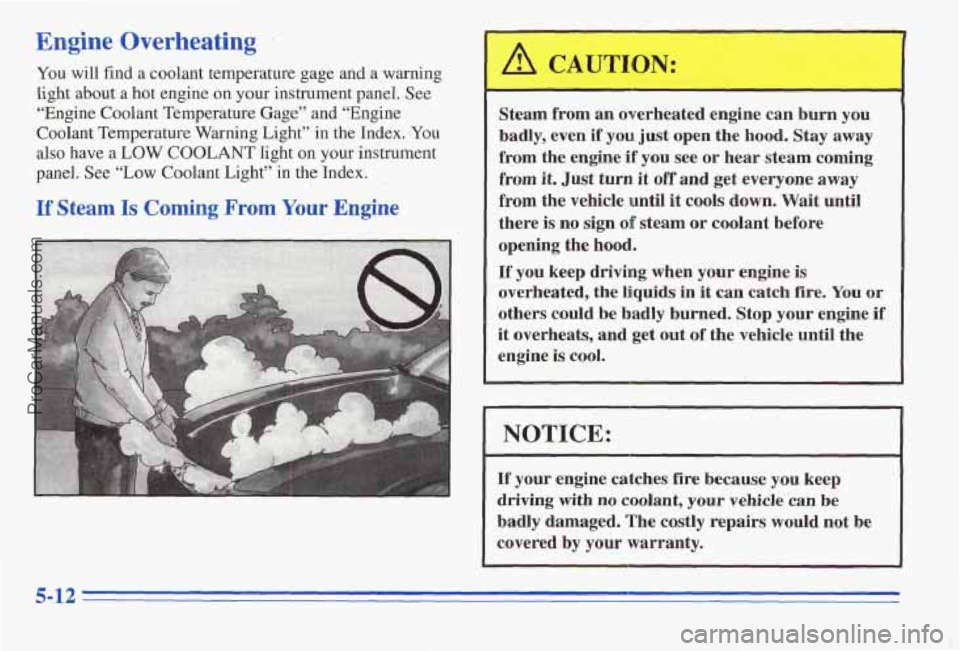
If Steam Is Coming From Your Engine
Steam from an overheated engine can burn you
badly, even if you just open the hood. Stay away
from the engine
if you see or hear steam coming
from it. Just turn it off and get everyone away
from the vehicle until
it cools clown. Wait until
there
is no sign of steam or coolant before
opening the
hood.
If you keep driving when your engine is
overheated, the liquids in it can catch fire, You or
others could be badly burned. Stop your engine if
it overheats, and get out of the vehicle until the
engine
is cool.
I I
NOTICE:
If your engine catches fire because you keep
driving with no coolant, your vehicle can be
badly damaged. The costly repairs would not be
covered by
your warranty.
5-12
ProCarManuals.com
Page 227 of 370
If You’re Stuck: In Sand, Mud,
Ice or Snow
What you don’t want to do when your vehicle is stuck is
to spin your wheels too fast. The method known as
“rocking” can help you get out when you’re stuck, but
you must use caution.
If you let your tires spin at high speed, they can
explode, and you or others could be injured. .And,
the transaxle or other parts of the vehicle can
overheat. That could cause an engine
compartment
fire or other damage. When you’re
stuck, spin the wheels as little as possible. Don’t
spin the wheels above
35 mph (55 M) as shown
on the speedometer.
NOTICE:
Spinning your wheels can destroy parts of your
vehicle
as well as the tires. If you spin the wheels
too
fast while shifting your transaxle back and
forth, you can destroy your transaxle.
For information about using tire chains on your vehicle,
see “Tire Chains” in the Index.
Rocking Your Vehicle to Get it Out
First, turn your steering wheel left and right. That will
clear the area around your front wheels. Then shift back
and forth between REVERSE (R) and a forward gear,
spinning the wheels as little as possible. Release
the
accelerator pedal while you shift, and press lightly on
the ‘accelerator pedal when the transaxle is in gear. If
that doesn’t get you out after a few tries, you may need
to be towed out.
If you do need to be towed out, see
“Towing Your Vehicle” in
the Index.
ProCarManuals.com
Page 237 of 370
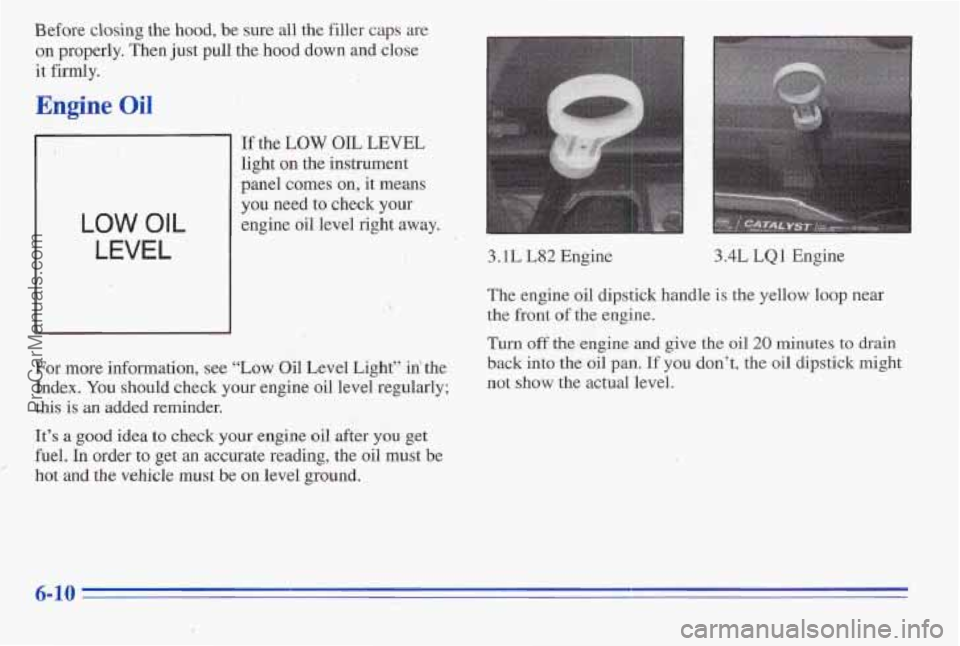
Before closing the hood, be sure all the filler caps are
on properly. Then just pull the hood down and close
it firmly.
Engine Oil
I
LOW OIL
LEVEL
If the LOW OIL LEVEL
light on the instrument
panel comes on, it means
you need to check your
engine oil level right away.
3.1L L82 Engine 3.4L LQl Engine
For .more information, see
“Low Oil Level Light” in‘ the
Index. You should check
your engine oil level regularly;
this is
an added reminder.
It’s
a good idea to check your engine oil after you get
fuel.
In order to get an accurate reading, the oil must be
hot
and the vehicle must be on level ground, I-
The engine oil dipstick handle is the yellow loop near
the front of the engine.
Turn off the engine and give the oil 20 minutes to drain
back into the oil pan. If you don’t, the oil dipstick might
not
show the actual level.
6-10
ProCarManuals.com
Page 247 of 370

How to Add Fluid
Refer to the Maintenance Schedule to determine what
kind of transaxle fluid to use. See “Recommended
Fluids
and Lubricants” in the Index.
If the fluid level is low, add only enough of the proper
fluid to bring the level into the cross-hatched area on
the dipstick.
1. Pull out the dipstick.
2. Using a long-neck funnel, add enough fluid at the
It doesn’t take much fluid, generally less than a pint
(0.5 L). Don’t oveflll. We recommend you use only
fluid /labeled DEXRON@-HI, because fluid with that
label
is made especially for your automatic transaxle.
Damage caused by fluid other than
DEXRON-111 is
not covered by your new vehicle warranty.
0 After adding fluid, recheck the fluid level as
0 When the correct fluid level is obtained, push the
dipstick hole to bring
it to the
proper level.
described under “How to Check.”
dipstick
back in all the way.
Engine Coolant
The cooling system in your vehicle is filled with new
DEX-COOL (orange-colored, silicate-free) engine
coolant. This coolant is designed
to remain in your
vehicle for 5 years or 100,000 miles (166 000 km), ,
whichever occurs first.
The following explains your cooling system and how to
add coolant when it is low.
If you have a problem with
engine overheating or
if you need to add coolant to your
radiator, see “Engine Overheating” in the Index.
A 50/50 mixture of water and the proper coolant for
your Pontiac will:
0
0
0
0
0
Give freezing protection down to -34°F (-37°C).
Give boiling protection up to 265 “F (129°C).
Protect against rust
and corrosion.
Help keep the proper engine temperature.
Let the warning lights lights and gages work as
they should.
ProCarManuals.com
Page 250 of 370
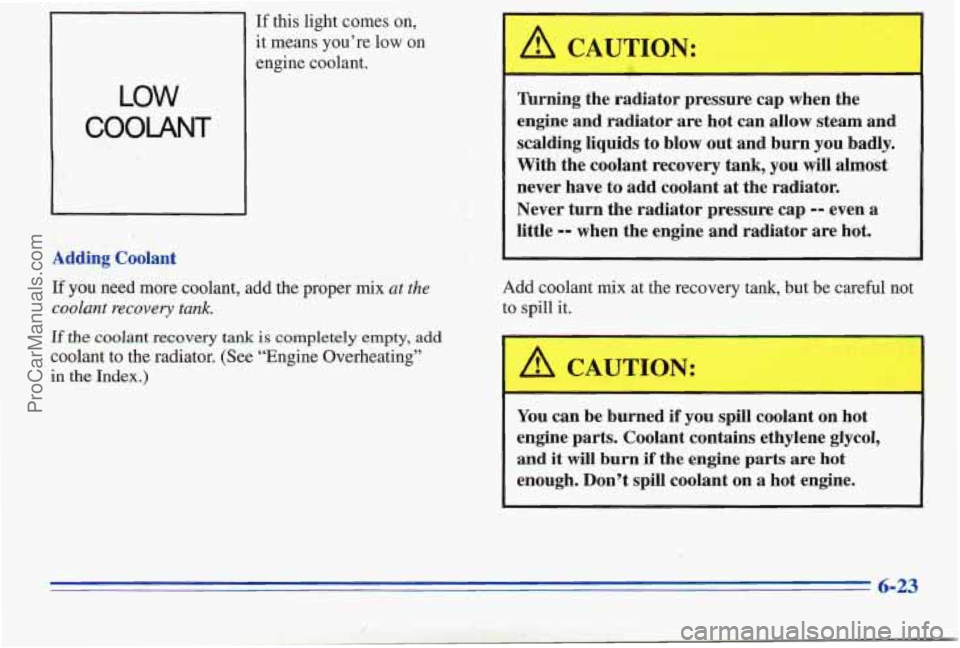
If this light comes on,
it means you’re low on
engine coolant.
LOW
COOLANT
L
Adding Coolant
A CAUTION:
lhrning the radiator pressure cap when the
engine and radiator are hot can allow steam and
scalding liquids to blow out and burn you badly.
With the coolant recovery tank, you will almost
never have.to add coolant
at the radiator.
Never turn the radiator pressure cap
-- even a
little -- when the engine and radiator are hot.
If you need more coolant, add the proper mix at the Add
coolant mix at the recovery tank, but be careful not
coolant recovery tank. to
spill it.
If the coolant recovery tank is completely empty, add
coolant to the radiator. (See “Engine Overheating”
in the Index.) ’ A CAUTION:
You can be burned if you spill coolant on hot
engine parts. Coolant contains ethylene glycol,
and it
will burn if the engine parts are hot
, enough. Don’t spill coolant on a hot engine.
ProCarManuals.com
Page 254 of 370
There are only two reasons why the brake fluid level in the
reservoir might go down. The first is that the brake fluid
goes down to an acceptable level during normal brake
lining wear. When new linings are put
in, the fluid level
goes back
up. The other reason is that fluid is leaking out
of the brake system. If it is, you should have your brake
system fixed, since
a leak means that sooner or later your
brakes
won’t work well, or won’t work at all.
So, it isn’t a good idea to “top off’ your brake fluid.
Adding brake fluid won’t correct a leak. If you add ‘fluid
when your linings are worn, then you’ll have too much
fluid when you get new brake linings. You should add
(or remove) brake fluid, as necessary,
only when work is
done on the brake hydraulic system.
’ A CAUT-ON:
I
- I
If you have too much brake fluid, it can spill on
the engine. The fluid will burn if the engine is
hot enough. You or others could be burned, and your vehicle could be damaged. Add brake
fluid only when work is done on the brake
hydraulic system.
When your brake fluid falls to a low level, your brake
warning light will come on. See “Brake System
Warning
Light” in the Index.
6-27
i _. ProCarManuals.com
Page 256 of 370
Brake Wear
Your Pontiac has four-wheel disc brakes.
Disc brake pads have built-in wear indicators that make a
high-pitched warning sound when the brake pads
are worn
and new pads
are needed. The sound may come and go or
be heard all the time your vehicle is moving (except when
you are pushing on the brake pedal
fldy).
The brake wear warning sound means that sooner
or later
your brakes won't work well. That could
lead to an accident. When you hear the brake wear
warning sound, have
your vehicle serviced.
I NOTICE:
Continuing to drive with worn-out brake pads
could
result in costly brake repair.
Some driving conditions or climates may cause a brake
squeal when the brakes are first applied or lightly
applied. This does not mean something
is wrong with
your brakes.
Free movement
of brake calipers and properly torqued
wheel nuts are necessary to help prevent brake
pulsation. When tires are rotated, inspect brake calipers
for movement, brake pads for wear, and evenly torque
wheel nuts in the proper sequence to
GM specifications.
Brake linings should always be replaced as complete
axle sets.
Brake Pedal navel
See your dealer if the brake pedal does not return to
normal height,
or if there is a rapid increase in pedal
travel. This could be a sign
of brake trouble.
Brake Adjustment
Every time you apply the brakes, with or without the
vehicle moving, your brakes adjust for wear.
6-29
ProCarManuals.com
Page 280 of 370
Uniform Tire Quality Grading
The following information relates to the system developed by the United States National Highway
Traffic Safety Administration, which grades tires by
treadwear, traction and temperature performance. (This
applies only to vehicles sold in the United States.) The
grades are molded on the sidewalls of most passenger
car tires. The Uniform Tire Quality Grading system does
not apply to deep tread, winter-type snow tires,
space-saver or temporary use spare tires, tires with
nominal rim diameters of
10 to 12 inches (25 to 30 cm),
Treadwear
The treadwear grade is a comparative rating based on
the wear rate
of the tire when tested under controlled
conditions
on a specified government test course. For
example, a tire graded
150 would wear one and a half 1
(1 1/2) times as well on the-government course as a tire
graded 100. The relative performance of tires depends
upon the actual conditions of their use, however, and
may depart significantly from the norm due to variations
in driving habits, service practices and differences in
road characteristics and climate.
I.
or to some limited-production tires. ;,*?;;x.,< .
. .'-I '.'Traction -- A, B, C
While the tires available on General Motors passenger 1
cars and light trucks may vary with respect to these The traction grades, from highest to lowest, are A, B, and
grades,, they must also conform to Federal safety
C, and they represent the tire's' ability to stop on wet
requirements and additional General Motors Tire pavement as measured under controlled conditioa
on
Peiformance Criteria (TPC) standards. specified government test surfaces of asphalt and concrete. A tire marked C may have poor traction performance.
Warning: The traction grade assigned
to this tire is based
on braking (straightahead) traction tests and does not
include cornering (turning) traction.
6-53
ProCarManuals.com