tires PONTIAC SOLSTICE 2006 Owner's Guide
[x] Cancel search | Manufacturer: PONTIAC, Model Year: 2006, Model line: SOLSTICE, Model: PONTIAC SOLSTICE 2006Pages: 328, PDF Size: 1.92 MB
Page 249 of 328

If you need to replace any of your wheels, wheel bolts
or wheel nuts, replace them only with new GM
original equipment parts. This way, you will be sure to
have the right wheel, wheel bolts and wheel nuts
for your vehicle.
{CAUTION:
Using the wrong replacement wheels, wheel
bolts or wheel nuts on your vehicle can be
dangerous. It could affect the braking and
handling of your vehicle, make your tires lose
air and make you lose control. You could have
a collision in which you or others could be
injured. Always use the correct wheel, wheel
bolts and wheel nuts for replacement.
Notice:The wrong wheel can also cause problems
with bearing life, brake cooling, speedometer or
odometer calibration, headlamp aim, bumper height,
vehicle ground clearance and tire clearance to the
body and chassis.
{CAUTION:
Rust or dirt on a wheel, or on the parts to
which it is fastened, can make wheel nuts
become loose after a time. The wheel could
come off and cause a crash. When you change
a wheel, remove any rust or dirt from places
where the wheel attaches to the vehicle. In an
emergency, you can use a cloth or a paper
towel to do this; but be sure to use a scraper
or wire brush later, if you need to, to get all the
rust or dirt off.
{CAUTION:
Never use oil or grease on studs or the
threads of the wheel nuts. If you do, the wheel
nuts might come loose and the wheel could
fall off, causing a crash.
5-57
Page 251 of 328

Tire Chains
{CAUTION:
Do not use tire chains. There is not enough
clearance. Tire chains used on a vehicle
without the proper amount of clearance can
cause damage to the brakes, suspension or
other vehicle parts. The area damaged by the
tire chains could cause you to lose control of
your vehicle and you or others may be injured
in a crash. Use another type of traction device
only if its manufacturer recommends it for use
on your vehicle and tire size combination and
road conditions. Follow that manufacturer’s
instructions. To help avoid damage to your
vehicle, drive slowly, re-adjust or remove the
device if it is contacting your vehicle, and
do not spin your wheels. If you do nd
traction devices that will t, install them on
the rear tires.
If a Tire Goes Flat
Your vehicle has a tire inator kit. There is no spare
tire, no tire changing equipment, and no place to store
a tire.
It is unusual for a tire to blow out while you are driving,
especially if you maintain your tires properly. See
Tires on page 5-44. If air goes out of a tire, it is much
more likely to leak out slowly. But, if you should
ever have a blow out, here are a few tips about what to
expect and what to do:
If a front tire fails, the at tire will create a drag that
pulls the vehicle toward that side. Take your foot off the
accelerator pedal and grip the steering wheel rmly.
Steer to maintain lane position, and then gently brake to
a stop well out of the traffic lane.
A rear blow out, particularly on a curve, acts much like
a skid and may require the same correction you
would use in a skid. In any rear blow out, remove your
foot from the accelerator pedal. Get the vehicle
under control by steering the way you want the vehicle
to go. It may be very bumpy and noisy, but you can
still steer. Gently brake to a stop, well off the road
if possible.
5-59
Page 267 of 328
Notice:If you drive your vehicle through an
automatic car wash that has silicone carbide tire
cleaning brushes, you could damage the aluminum
or chrome-plated wheels. The repairs would not
be covered by your warranty. Never drive a vehicle
equipped with aluminum or chrome-plated wheels
through an automatic car wash that uses silicone
carbide tire cleaning brushes.
Do not take your vehicle through an automatic car wash
that has silicone carbide tire cleaning brushes. These
brushes can also damage the surface of these wheels.
Tires
To clean the tires, use a stiff brush with tire cleaner.
Notice:Using petroleum-based tire dressing
products on your vehicle may damage the paint
nish and/or tires. When applying a tire dressing,
always wipe off any overspray from all painted
surfaces on your vehicle.
Sheet Metal Damage
If the vehicle is damaged and requires sheet metal
repair or replacement, make sure the body repair shop
applies anti-corrosion material to parts repaired or
replaced to restore corrosion protection.
Original manufacturer replacement parts will provide the
corrosion protection while maintaining the warranty.
Finish Damage
Any stone chips, fractures or deep scratches in the
nish should be repaired right away. Bare metal
will corrode quickly and may develop into major
repair expense.
Minor chips and scratches can be repaired with touch-up
materials available from your GM dealer. Larger areas of
nish damage can be corrected in your GM dealer’s body
and paint shop.
Underbody Maintenance
Chemicals used for ice and snow removal and dust
control can collect on the underbody. If these are not
removed, corrosion and rust can develop on the
underbody parts such as fuel lines, frame, oor pan,
and exhaust system even though they have corrosion
protection.
At least every spring, ush these materials from the
underbody with plain water. Clean any areas where mud
and debris can collect. Dirt packed in close areas of
the frame should be loosened before being ushed.
Your dealer or an underbody car washing system can
do this for you.
5-75
Page 280 of 328
5,000 Miles (8 000 km)
❑Vehicles with Driver Information Center (DIC): The
Engine Oil Life System will tell you when to change the
engine oil and lter. SeeEngine Oil Life System on
page 5-16.An Emission Control Service.
(See footnote *)
❑Vehicles without Driver Information Center: Change
engine oil and lter (or every 3 months, whichever
occurs rst).An Emission Control Service.
❑Rotate tires. SeeTire Inspection and Rotation on
page 5-51for proper rotation pattern and additional
information.(See footnote +.)
10,000 Miles (16 000 km)
❑Vehicles with Driver Information Center (DIC): The
Engine Oil Life System will tell you when to change
the engine oil and lter. SeeEngine Oil Life
System on page 5-16.An Emission Control Service.
(See footnote *)
❑Vehicles without Driver Information Center: Change
engine oil and lter (or every 3 months, whichever
occurs rst).An Emission Control Service.
❑Rotate tires. SeeTire Inspection and Rotation on
page 5-51for proper rotation pattern and additional
information.(See footnote +.)
15,000 Miles (24 000 km)
❑Vehicles with Driver Information Center (DIC): The
Engine Oil Life System will tell you when to change
the engine oil and lter. SeeEngine Oil Life
System on page 5-16.An Emission Control Service.
(See footnote *)
❑Vehicles without Driver Information Center: Change
engine oil and lter (or every 3 months, whichever
occurs rst).An Emission Control Service.
❑Inspect engine air cleaner lter. If necessary, replace
the lter. If vehicle is driven in dusty/dirty conditions,
inspect lter at every engine oil change. See
Engine Air Cleaner/Filter on page 5-18for more
information.
❑Rotate tires. SeeTire Inspection and Rotation on
page 5-51for proper rotation pattern and additional
information.(See footnote +.)
6-6
Page 281 of 328
20,000 Miles (32 000 km)
❑Vehicles with Driver Information Center (DIC): The
Engine Oil Life System will tell you when to change
the engine oil and lter. SeeEngine Oil Life
System on page 5-16.An Emission Control Service.
(See footnote *)
❑Vehicles without Driver Information Center: Change
engine oil and lter (or every 3 months, whichever
occurs rst).An Emission Control Service.
❑Rotate tires. SeeTire Inspection and Rotation on
page 5-51for proper rotation pattern and additional
information.(See footnote +.)
25,000 Miles (40 000 km)
❑Vehicles with Driver Information Center (DIC): The
Engine Oil Life System will tell you when to change
the engine oil and lter. SeeEngine Oil Life
System on page 5-16.An Emission Control Service.
(See footnote *)
❑Vehicles without Driver Information Center: Change
engine oil and lter (or every 3 months, whichever
occurs rst).An Emission Control Service.
❑Rotate tires. SeeTire Inspection and Rotation on
page 5-51for proper rotation pattern and additional
information.(See footnote +.)
30,000 Miles (48 000 km)
❑Vehicles with Driver Information Center (DIC): The
Engine Oil Life System will tell you when to change
the engine oil and lter. SeeEngine Oil Life
System on page 5-16.An Emission Control Service.
(See footnote *)
❑Vehicles without Driver Information Center: Change
engine oil and lter (or every 3 months, whichever
occurs rst).An Emission Control Service.
❑Inspect engine air cleaner lter. If necessary, replace
the lter. If vehicle is driven in dusty/dirty conditions,
inspect lter at every engine oil change. See
Engine Air Cleaner/Filter on page 5-18for more
information.
❑Rotate tires. SeeTire Inspection and Rotation on
page 5-51for proper rotation pattern and additional
information.(See footnote +.)
6-7
Page 282 of 328
35,000 Miles (56 000 km)
❑Vehicles with Driver Information Center (DIC): The
Engine Oil Life System will tell you when to change
the engine oil and lter. SeeEngine Oil Life
System on page 5-16.An Emission Control Service.
(See footnote *)
❑Vehicles without Driver Information Center: Change
engine oil and lter (or every 3 months, whichever
occurs rst).An Emission Control Service.
❑Rotate tires. SeeTire Inspection and Rotation on
page 5-51for proper rotation pattern and additional
information.(See footnote +.)
40,000 Miles (64 000 km)
❑Vehicles with Driver Information Center (DIC): The
Engine Oil Life System will tell you when to change
the engine oil and lter. SeeEngine Oil Life
System on page 5-16.An Emission Control Service.
(See footnote *)
❑Vehicles without Driver Information Center: Change
engine oil and lter (or every 3 months, whichever
occurs rst).An Emission Control Service.
❑Rotate tires. SeeTire Inspection and Rotation on
page 5-51for proper rotation pattern and additional
information.(See footnote +.)
45,000 Miles (72 000 km)
❑Vehicles with Driver Information Center (DIC): The
Engine Oil Life System will tell you when to change
the engine oil and lter. SeeEngine Oil Life
System on page 5-16.An Emission Control Service.
(See footnote *)
❑Vehicles without Driver Information Center: Change
engine oil and lter (or every 3 months, whichever
occurs rst).An Emission Control Service.
❑Replace engine air cleaner lter. SeeEngine Air
Cleaner/Filter on page 5-18for more information.
50,000 Miles (80 000 km)
❑Vehicles with Driver Information Center (DIC): The
Engine Oil Life System will tell you when to change
the engine oil and lter. SeeEngine Oil Life
System on page 5-16.An Emission Control Service.
(See footnote *)
❑Vehicles without Driver Information Center: Change
engine oil and lter (or every 3 months, whichever
occurs rst).An Emission Control Service.
❑Rotate tires. SeeTire Inspection and Rotation on
page 5-51for proper rotation pattern and additional
information.(See footnote +.)
6-8
Page 283 of 328
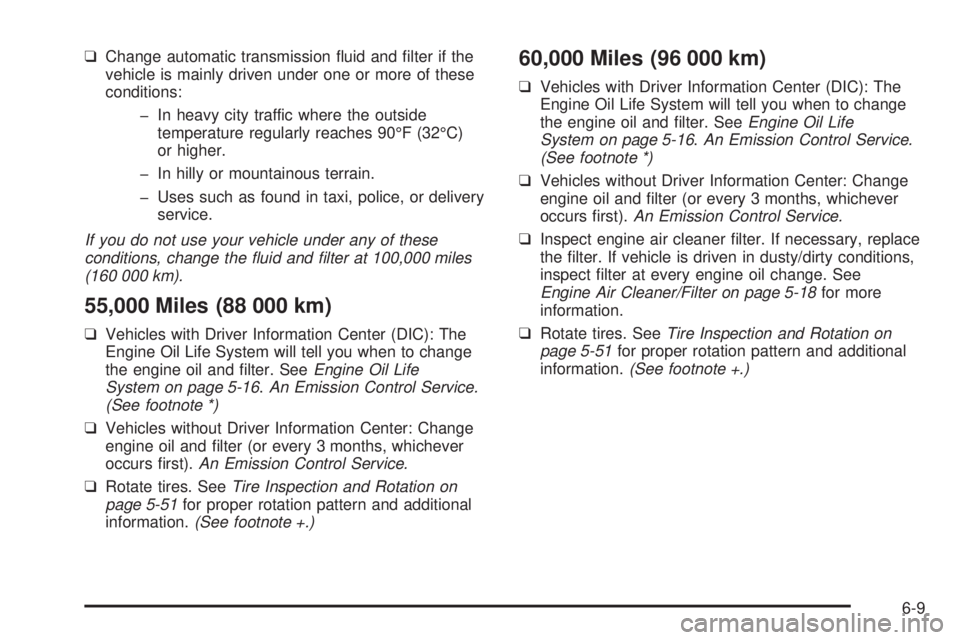
❑Change automatic transmission uid and lter if the
vehicle is mainly driven under one or more of these
conditions:
In heavy city traffic where the outside
temperature regularly reaches 90°F (32°C)
or higher.
In hilly or mountainous terrain.
Uses such as found in taxi, police, or delivery
service.
If you do not use your vehicle under any of these
conditions, change the uid and lter at 100,000 miles
(160 000 km).
55,000 Miles (88 000 km)
❑Vehicles with Driver Information Center (DIC): The
Engine Oil Life System will tell you when to change
the engine oil and lter. SeeEngine Oil Life
System on page 5-16.An Emission Control Service.
(See footnote *)
❑Vehicles without Driver Information Center: Change
engine oil and lter (or every 3 months, whichever
occurs rst).An Emission Control Service.
❑Rotate tires. SeeTire Inspection and Rotation on
page 5-51for proper rotation pattern and additional
information.(See footnote +.)
60,000 Miles (96 000 km)
❑Vehicles with Driver Information Center (DIC): The
Engine Oil Life System will tell you when to change
the engine oil and lter. SeeEngine Oil Life
System on page 5-16.An Emission Control Service.
(See footnote *)
❑Vehicles without Driver Information Center: Change
engine oil and lter (or every 3 months, whichever
occurs rst).An Emission Control Service.
❑Inspect engine air cleaner lter. If necessary, replace
the lter. If vehicle is driven in dusty/dirty conditions,
inspect lter at every engine oil change. See
Engine Air Cleaner/Filter on page 5-18for more
information.
❑Rotate tires. SeeTire Inspection and Rotation on
page 5-51for proper rotation pattern and additional
information.(See footnote +.)
6-9
Page 284 of 328
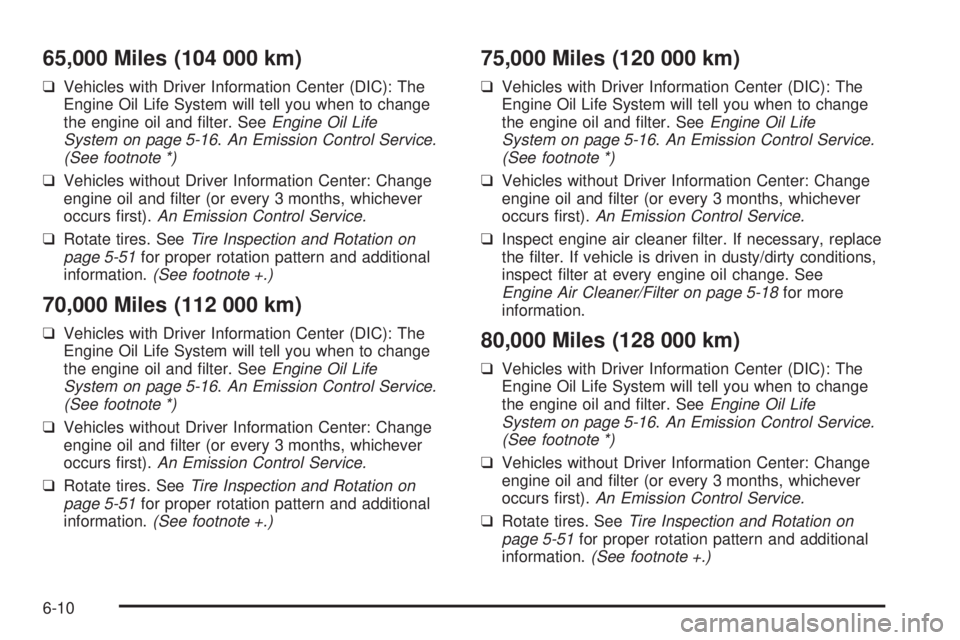
65,000 Miles (104 000 km)
❑Vehicles with Driver Information Center (DIC): The
Engine Oil Life System will tell you when to change
the engine oil and lter. SeeEngine Oil Life
System on page 5-16.An Emission Control Service.
(See footnote *)
❑Vehicles without Driver Information Center: Change
engine oil and lter (or every 3 months, whichever
occurs rst).An Emission Control Service.
❑Rotate tires. SeeTire Inspection and Rotation on
page 5-51for proper rotation pattern and additional
information.(See footnote +.)
70,000 Miles (112 000 km)
❑Vehicles with Driver Information Center (DIC): The
Engine Oil Life System will tell you when to change
the engine oil and lter. SeeEngine Oil Life
System on page 5-16.An Emission Control Service.
(See footnote *)
❑Vehicles without Driver Information Center: Change
engine oil and lter (or every 3 months, whichever
occurs rst).An Emission Control Service.
❑Rotate tires. SeeTire Inspection and Rotation on
page 5-51for proper rotation pattern and additional
information.(See footnote +.)
75,000 Miles (120 000 km)
❑Vehicles with Driver Information Center (DIC): The
Engine Oil Life System will tell you when to change
the engine oil and lter. SeeEngine Oil Life
System on page 5-16.An Emission Control Service.
(See footnote *)
❑Vehicles without Driver Information Center: Change
engine oil and lter (or every 3 months, whichever
occurs rst).An Emission Control Service.
❑Inspect engine air cleaner lter. If necessary, replace
the lter. If vehicle is driven in dusty/dirty conditions,
inspect lter at every engine oil change. See
Engine Air Cleaner/Filter on page 5-18for more
information.
80,000 Miles (128 000 km)
❑Vehicles with Driver Information Center (DIC): The
Engine Oil Life System will tell you when to change
the engine oil and lter. SeeEngine Oil Life
System on page 5-16.An Emission Control Service.
(See footnote *)
❑Vehicles without Driver Information Center: Change
engine oil and lter (or every 3 months, whichever
occurs rst).An Emission Control Service.
❑Rotate tires. SeeTire Inspection and Rotation on
page 5-51for proper rotation pattern and additional
information.(See footnote +.)
6-10
Page 285 of 328
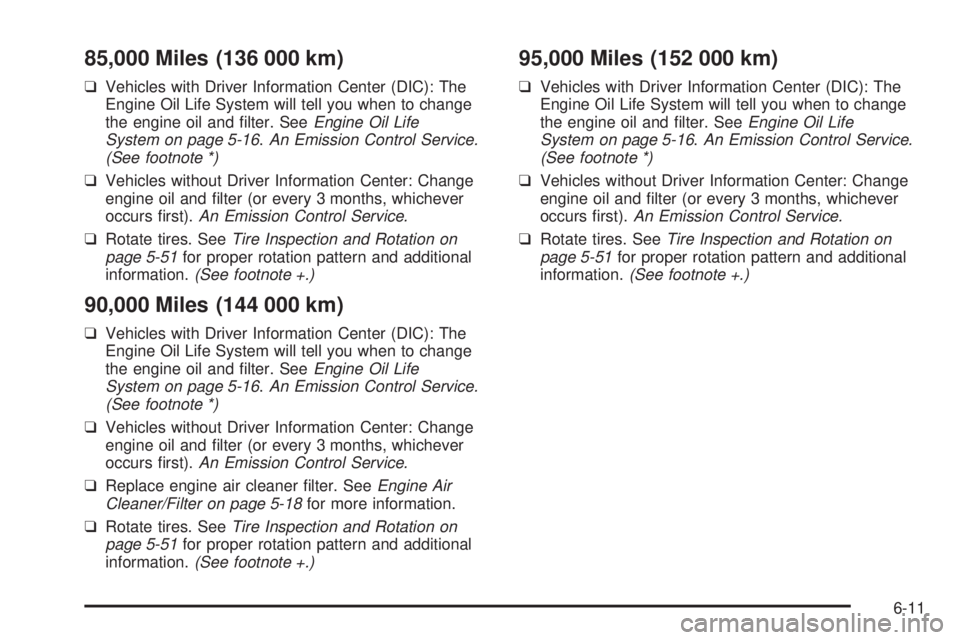
85,000 Miles (136 000 km)
❑Vehicles with Driver Information Center (DIC): The
Engine Oil Life System will tell you when to change
the engine oil and lter. SeeEngine Oil Life
System on page 5-16.An Emission Control Service.
(See footnote *)
❑Vehicles without Driver Information Center: Change
engine oil and lter (or every 3 months, whichever
occurs rst).An Emission Control Service.
❑Rotate tires. SeeTire Inspection and Rotation on
page 5-51for proper rotation pattern and additional
information.(See footnote +.)
90,000 Miles (144 000 km)
❑Vehicles with Driver Information Center (DIC): The
Engine Oil Life System will tell you when to change
the engine oil and lter. SeeEngine Oil Life
System on page 5-16.An Emission Control Service.
(See footnote *)
❑Vehicles without Driver Information Center: Change
engine oil and lter (or every 3 months, whichever
occurs rst).An Emission Control Service.
❑Replace engine air cleaner lter. SeeEngine Air
Cleaner/Filter on page 5-18for more information.
❑Rotate tires. SeeTire Inspection and Rotation on
page 5-51for proper rotation pattern and additional
information.(See footnote +.)
95,000 Miles (152 000 km)
❑Vehicles with Driver Information Center (DIC): The
Engine Oil Life System will tell you when to change
the engine oil and lter. SeeEngine Oil Life
System on page 5-16.An Emission Control Service.
(See footnote *)
❑Vehicles without Driver Information Center: Change
engine oil and lter (or every 3 months, whichever
occurs rst).An Emission Control Service.
❑Rotate tires. SeeTire Inspection and Rotation on
page 5-51for proper rotation pattern and additional
information.(See footnote +.)
6-11
Page 286 of 328

100,000 Miles (160 000 km)
❑Vehicles with Driver Information Center (DIC): The
Engine Oil Life System will tell you when to change
the engine oil and lter. SeeEngine Oil Life
System on page 5-16.An Emission Control Service.
(See footnote *)
❑Vehicles without Driver Information Center: Change
engine oil and lter (or every 3 months, whichever
occurs rst).An Emission Control Service.
❑Rotate tires. SeeTire Inspection and Rotation on
page 5-51for proper rotation pattern and additional
information.(See footnote +.)
❑Replace spark plugs.An Emission Control Service.
❑Change automatic transmission uid and lter if
the vehicle is mainly driven under one or more
of these conditions:
In heavy city traffic where the outside
temperature regularly reaches 90°F (32°C)
or higher.
In hilly or mountainous terrain.
Uses such as found in taxi, police, or delivery
service.
If you have not used your vehicle under severe service
conditions listed previously and, therefore, have not
changed your automatic transmission uid, change both
the uid and lter.
150,000 Miles (240 000 km)
❑Drain, ush, and rell cooling system (or every
60 months since last service, whichever occurs rst).
This service can be complex; you should have
your dealer perform this service. SeeEngine Coolant
on page 5-19for what to use. Inspect hoses.
Clean radiator, condenser, pressure cap, and neck.
Pressure test the cooling system and pressure
cap.An Emission Control Service.
❑Inspect engine accessory drive belt. Visually inspect
belt for fraying, excessive cracks, or obvious damage.
Replace belt if necessary.An Emission Control
Service.
6-12