brake PONTIAC SOLSTICE 2007 User Guide
[x] Cancel search | Manufacturer: PONTIAC, Model Year: 2007, Model line: SOLSTICE, Model: PONTIAC SOLSTICE 2007Pages: 396, PDF Size: 2.27 MB
Page 88 of 396

Leaving Your Vehicle With the
Engine Running
{CAUTION:
It can be dangerous to leave your vehicle
with the engine running. Your vehicle
could move suddenly if the shift lever is
not fully in PARK (P) with the parking
brake rmly set. And, if you leave the
vehicle with the engine running, it could
overheat and even catch re. You or
others could be injured. Do not leave your
vehicle with the engine running.
If you have to leave your vehicle with the engine
running, be sure your vehicle is in PARK (P) and
your parking brake is rmly set before you leave it.
After you have moved the shift lever into PARK (P),
hold the regular brake pedal down. If the vehicle
has an automatic transmission, see if you can move
the shift lever away from PARK (P) without rst
pushing the shift lock release button. If you can, it
means that the shift lever was not fully locked into
PARK (P).
Torque Lock
If you are parking on a hill and you do not shift
your transmission into PARK (P) properly,
the weight of the vehicle may put too much force
on the parking pawl in the transmission. You
may nd it difficult to pull the shift lever out
of PARK (P). This is called “torque lock.” To
prevent torque lock, set the parking brake and then
shift into PARK (P) properly before you leave
the driver’s seat. To nd out how, seeShifting Into
Park (P) (Automatic Transmission) on page 87.
When you are ready to drive, move the shift
lever out of PARK (P)beforeyou release the
parking brake.
If torque lock does occur, you may need to have
another vehicle push yours a little uphill to
take some of the pressure from the parking pawl
in the transmission, so you can pull the shift
lever out of PARK (P).
88
Page 89 of 396
Shifting Out of Park (P)
Your vehicle has an automatic transmission shift
lock control system.
To shift out of PARK (P):
1. Apply the regular brake pedal.
2. Then press the shift lever button.
3. Move the shift lever to the desired gear.
If you are still unable to shift out of PARK (P):
1. Fully release the shift lever button.
2. While holding down the brake pedal, press
the shift lever button again.
3. Move the shift lever to the desired gear.
If you still cannot move the shift lever from
PARK (P), consult your dealer.
Parking Your Vehicle
(Manual Transmission)
Before leaving your manual transmission vehicle,
fully press the clutch pedal in, move the shift
lever in either FIRST (1) gear or REVERSE (R),
and rmly apply the parking brake. SeeManual
Transmission Operation on page 85.
89
Page 92 of 396
Running the Engine While Parked
It is better not to park with the engine running. But if
you ever have to, here are some things to know.
{CAUTION:
Idling the engine with the climate control
system off could allow dangerous exhaust
into your vehicle. See the earlier caution
underEngine Exhaust on page 91.
Also, idling in a closed-in place can let
deadly carbon monoxide (CO) into your
vehicle even if the climate control fan is at
the highest setting. One place this can
happen is a garage. Exhaust — with
CO — can come in easily. NEVER park in
a garage with the engine running.
Another closed-in place can be a blizzard.
SeeWinter Driving on page 220.
{CAUTION:
It can be dangerous to get out of your
vehicle if the automatic transmission shift
lever is not fully in PARK (P) with the
parking brake rmly set. Your vehicle can
roll. Do not leave your vehicle when the
engine is running unless you have to.
If you have left the engine running, the
vehicle can move suddenly. You or others
could be injured. To be sure your vehicle
will not move, even when it is on fairly
level ground, always set the parking brake
and move the automatic transmission
shift lever to PARK (P), or the manual
transmission shift lever to NEUTRAL.
Follow the proper steps to be sure your vehicle
will not move. SeeShifting Into Park (P)
(Automatic Transmission) on page 87andParking
Your Vehicle (Manual Transmission) on page 89.
92
Page 100 of 396
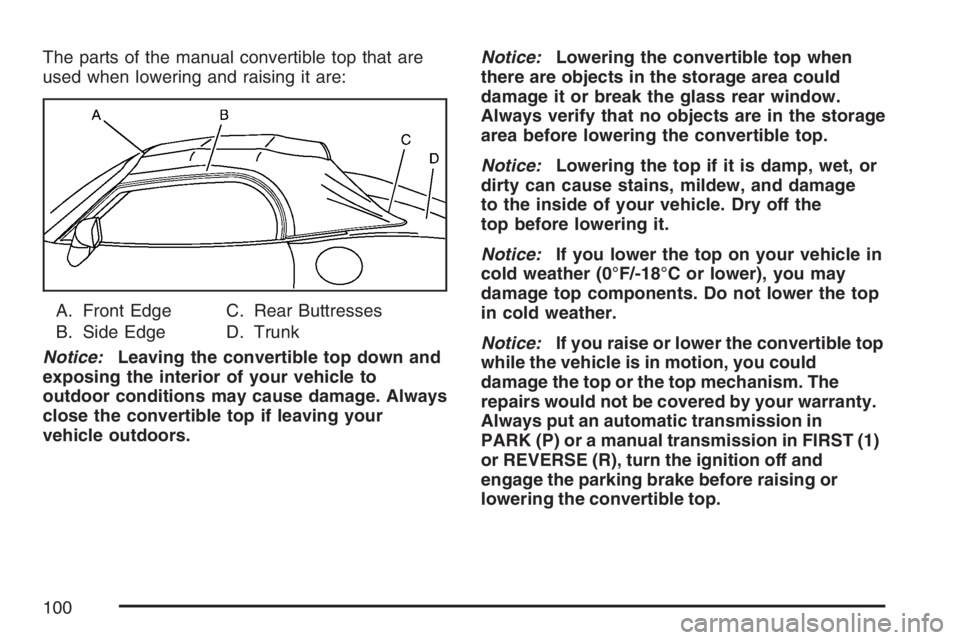
The parts of the manual convertible top that are
used when lowering and raising it are:
A. Front Edge
B. Side EdgeC. Rear Buttresses
D. Trunk
Notice:Leaving the convertible top down and
exposing the interior of your vehicle to
outdoor conditions may cause damage. Always
close the convertible top if leaving your
vehicle outdoors.Notice:Lowering the convertible top when
there are objects in the storage area could
damage it or break the glass rear window.
Always verify that no objects are in the storage
area before lowering the convertible top.
Notice:Lowering the top if it is damp, wet, or
dirty can cause stains, mildew, and damage
to the inside of your vehicle. Dry off the
top before lowering it.
Notice:If you lower the top on your vehicle in
cold weather (0°F/-18°C or lower), you may
damage top components. Do not lower the top
in cold weather.
Notice:If you raise or lower the convertible top
while the vehicle is in motion, you could
damage the top or the top mechanism. The
repairs would not be covered by your warranty.
Always put an automatic transmission in
PARK (P) or a manual transmission in FIRST (1)
or REVERSE (R), turn the ignition off and
engage the parking brake before raising or
lowering the convertible top.
100
Page 101 of 396
{CAUTION:
Moving parts of the convertible top can be
dangerous. People can be injured by the
convertible top and its mechanism. Keep
people away from your vehicle when you
are lowering or raising the top.
Lowering the Manual Convertible Top
1. Park on a level surface and set the parking
brake. Shift an automatic transmission into
PARK (P). Shift a manual transmission
into FIRST (1) or REVERSE (R).
2. Make sure the ignition is turned off.
3. Push the trunk release button located in the
glove box, or on the remote keyless entry,
if equipped.
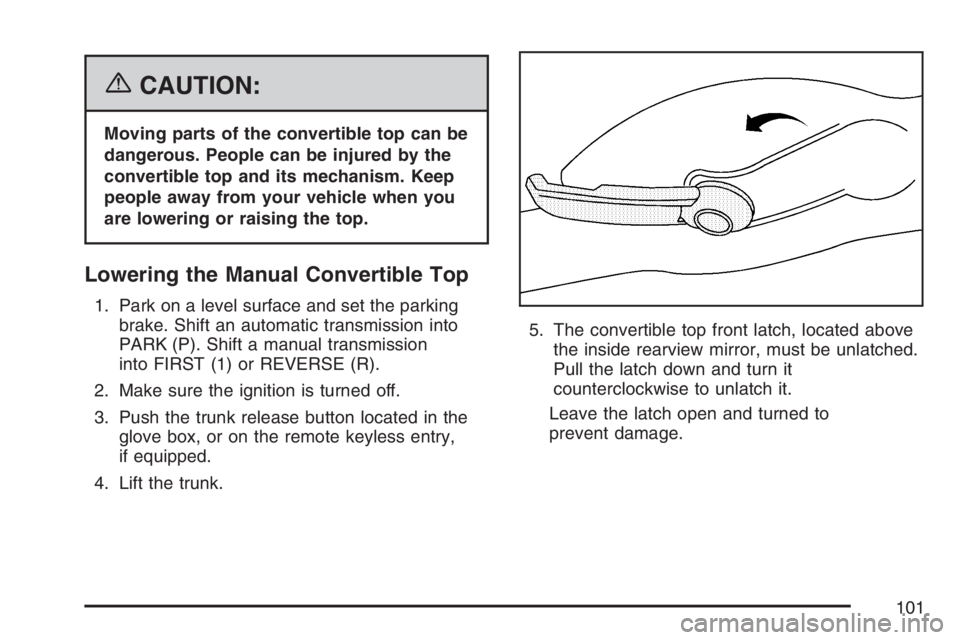
4. Lift the trunk.5. The convertible top front latch, located above
the inside rearview mirror, must be unlatched.
Pull the latch down and turn it
counterclockwise to unlatch it.
Leave the latch open and turned to
prevent damage.
101
Page 102 of 396
6. Pull rearward on the side edge (B) of the
convertible top and pull it off of the windshield
frame.
7. Push the convertible top down into the
trunk (D).
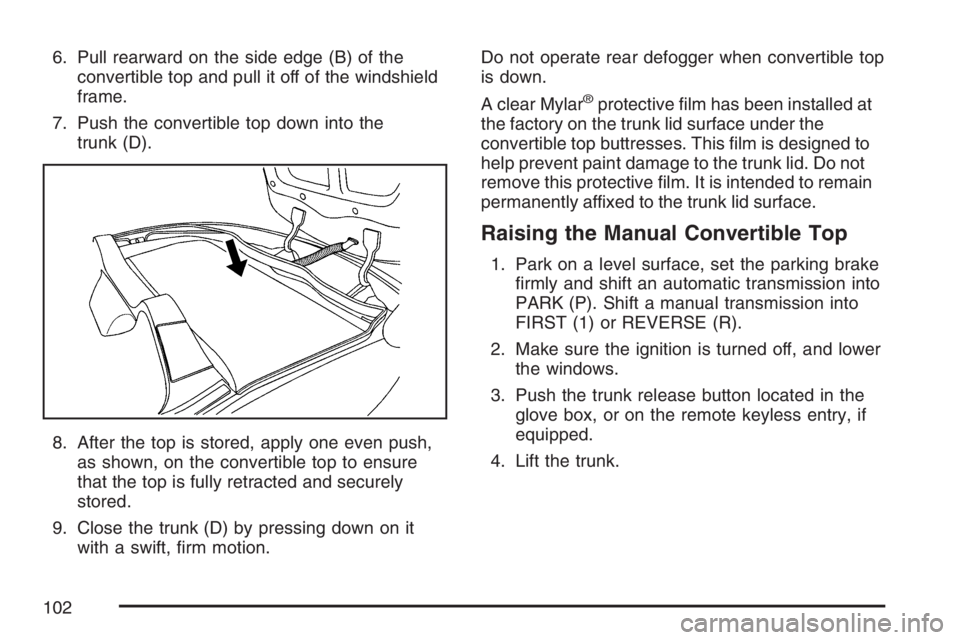
8. After the top is stored, apply one even push,
as shown, on the convertible top to ensure
that the top is fully retracted and securely
stored.
9. Close the trunk (D) by pressing down on it
with a swift, rm motion.Do not operate rear defogger when convertible top
is down.
A clear Mylar
®protective lm has been installed at
the factory on the trunk lid surface under the
convertible top buttresses. This lm is designed to
help prevent paint damage to the trunk lid. Do not
remove this protective lm. It is intended to remain
permanently affixed to the trunk lid surface.
Raising the Manual Convertible Top
1. Park on a level surface, set the parking brake
rmly and shift an automatic transmission into
PARK (P). Shift a manual transmission into
FIRST (1) or REVERSE (R).
2. Make sure the ignition is turned off, and lower
the windows.
3. Push the trunk release button located in the
glove box, or on the remote keyless entry, if
equipped.
4. Lift the trunk.
102
Page 105 of 396
Instrument Panel Overview........................ 108
Hazard Warning Flashers.......................... 110
Other Warning Devices............................. 110
Horn.......................................................... 110
Tilt Wheel.................................................. 111
Turn Signal/Multifunction Lever.................. 111
Turn and Lane-Change Signals................. 112
Headlamp High/Low-Beam Changer.......... 112
Flash-to-Pass............................................ 113
Windshield Wipers..................................... 113
Windshield Washer.................................... 114
Cruise Control........................................... 115
Headlamps................................................ 118
Headlamps on Reminder........................... 119
Daytime Running Lamps (DRL)................. 119
Fog Lamps................................................ 120
Instrument Panel Brightness...................... 120
Entry/Exit Lighting...................................... 120
Mirror Reading Lamps............................... 120
Battery Run-Down Protection..................... 121
Accessory Power Outlet(s)........................ 121
Ashtray(s) and Cigarette Lighter................ 122Climate Controls......................................... 122
Climate Control System............................. 122
Outlet Adjustment...................................... 126
Warning Lights, Gages, and Indicators..... 127
Instrument Panel Cluster........................... 128
Speedometer and Odometer...................... 129
Tachometer............................................... 129
Safety Belt Reminder Light........................ 130
Passenger Safety Belt Reminder Light....... 130
Airbag Readiness Light............................. 131
Passenger Airbag Status Indicator............. 132
Charging System Light.............................. 134
Brake System Warning Light..................... 134
Anti-Lock Brake System Warning Light...... 135
Electronic Stability Control (ESC)/
Traction Control System (TCS)
Indicator/Warning Light
(2.0L Engine Only).................................. 136
Engine Coolant Temperature
Warning Light........................................ 137
Low Coolant Warning Light....................... 138
Malfunction Indicator Lamp........................ 138
Section 3 Instrument Panel
105
Page 109 of 396
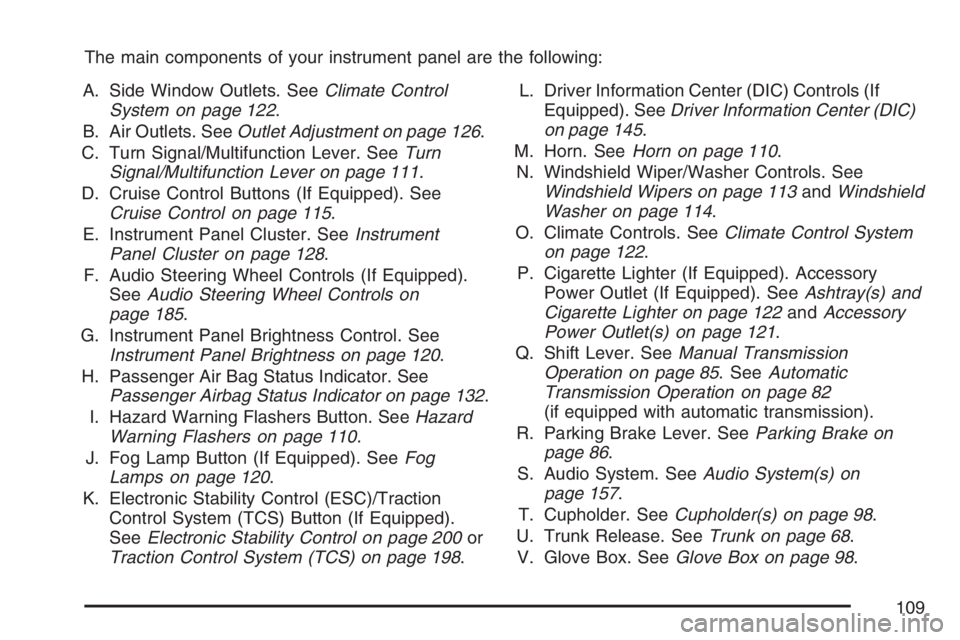
The main components of your instrument panel are the following:
A. Side Window Outlets. SeeClimate Control
System on page 122.
B. Air Outlets. SeeOutlet Adjustment on page 126.
C. Turn Signal/Multifunction Lever. SeeTurn
Signal/Multifunction Lever on page 111.
D. Cruise Control Buttons (If Equipped). See
Cruise Control on page 115.
E. Instrument Panel Cluster. SeeInstrument
Panel Cluster on page 128.
F. Audio Steering Wheel Controls (If Equipped).
SeeAudio Steering Wheel Controls on
page 185.
G. Instrument Panel Brightness Control. See
Instrument Panel Brightness on page 120.
H. Passenger Air Bag Status Indicator. See
Passenger Airbag Status Indicator on page 132.
I. Hazard Warning Flashers Button. SeeHazard
Warning Flashers on page 110.
J. Fog Lamp Button (If Equipped). SeeFog
Lamps on page 120.
K. Electronic Stability Control (ESC)/Traction
Control System (TCS) Button (If Equipped).
SeeElectronic Stability Control on page 200or
Traction Control System (TCS) on page 198.L. Driver Information Center (DIC) Controls (If
Equipped). SeeDriver Information Center (DIC)
on page 145.
M. Horn. SeeHorn on page 110.
N. Windshield Wiper/Washer Controls. See
Windshield Wipers on page 113andWindshield
Washer on page 114.
O. Climate Controls. SeeClimate Control System
on page 122.
P. Cigarette Lighter (If Equipped). Accessory
Power Outlet (If Equipped). SeeAshtray(s) and
Cigarette Lighter on page 122andAccessory
Power Outlet(s) on page 121.
Q. Shift Lever. SeeManual Transmission
Operation on page 85. SeeAutomatic
Transmission Operation on page 82
(if equipped with automatic transmission).
R. Parking Brake Lever. SeeParking Brake on
page 86.
S. Audio System. SeeAudio System(s) on
page 157.
T. Cupholder. SeeCupholder(s) on page 98.
U. Trunk Release. SeeTrunk on page 68.
V. Glove Box. SeeGlove Box on page 98.
109
Page 116 of 396
RES+ (Resume):Press this button to resume a
set speed and to accelerate the speed.
SET−(Set):Press this button to set a speed and
to decrease the speed.
To set a speed do the following:
1. Press the on/off button to turn cruise control on.
The indicator light on the button will come on.
2. Get to the speed you want.
3. Press the SET−control button and release it.
The CRUISE ENGAGED message will appear
on the Driver Information Center (DIC) to
show the system is engaged.
4. Take your foot off the accelerator pedal.
When you apply the brakes or depress the clutch,
the cruise control will shut off.Resuming a Set Speed
Suppose you set your cruise control at a desired
speed and then you apply the brake. This
disengages the cruise control. To return to your
previously set speed, you do not need to go
through the set process again. Once you are going
about 25 mph (40 km/h) or more, you can press
the RES+ button briey.
This will take you back up to your previously
chosen speed and stay there.
Increasing Speed While Using
Cruise Control
There are two ways to increase speed.
1. Disengage the cruise control by applying the
brake pedal but do not turn it off. Accelerate
to a higher speed and reset the cruise control.
2. If the cruise control system is already
engaged, press the RES+ button. Press it until
you get up to the speed you want, and then
release the button. To increase your speed in
very small amounts, press the RES+ button
briey and then release it. Each time you
do this, your vehicle will go about 1 mph
(1.6 km/h) faster.
116
Page 117 of 396
Reducing Speed While Using
Cruise Control
If the cruise control system is already engaged,
Push and hold the SET−part of the button
until you reach the lower speed desired,
then release it.
To slow down in very small amounts, push the
SET−part of the button briey. Each time this
is done, your vehicle will go about 1 mph
(1.6 km/h) slower.
Passing Another Vehicle While Using
Cruise Control
Use the accelerator pedal to increase your speed.
When you take your foot off the pedal, your
vehicle will slow down to the cruise control speed
you set earlier.
Using Cruise Control on Hills
How well your cruise control will work on hills
depends upon the vehicle speed, load, and the
steepness of the hills. When going up steep hills,
you might have to step on the accelerator pedal
to maintain the vehicle speed. When going
downhill, you might have to brake or shift to a
lower gear to keep the vehicle speed down.
Of course, applying the brake turns off the cruise
control. Many drivers nd this to be too much
trouble and do not use cruise control on steep hills.
Ending Cruise Control
To end cruise control, step lightly on the brake
pedal or the clutch pedal if your vehicle has
a manual transmission.
Stepping on the brake pedal or clutch pedal will
only end the current cruise control session. Press
the cruise control on/off button to turn the
system completely off.
Erasing Speed Memory
When you turn off the cruise control or the
ignition, the cruise control set speed memory is
erased.
117