brake light PONTIAC SOLSTICE 2007 Owner's Manual
[x] Cancel search | Manufacturer: PONTIAC, Model Year: 2007, Model line: SOLSTICE, Model: PONTIAC SOLSTICE 2007Pages: 396, PDF Size: 2.27 MB
Page 199 of 396

It is recommended to leave the system on for
normal driving conditions, but it may be necessary
to turn the system off if your vehicle is stuck in
sand, mud, ice or snow, and you want to
“rock” your vehicle to attempt to free it. It may also
be necessary to turn off the system when driving
in extreme off-road conditions where high
wheel spin is required. SeeIf Your Vehicle is
Stuck in Sand, Mud, Ice, or Snow on page 224.
To turn the system off
or on, press and release
this button located on
the instrument panel.
The DIC will display the appropriate message as
described previously when you press the button.Traction Control Operation
Traction control limits wheel spin by reducing
engine power to the wheels (engine speed
management) and by applying brakes to each
individual wheel (brake-traction control) as
necessary.
The traction control system is enabled
automatically when you start your vehicle, and it
will activate and ash the ESC/TCS light and
display the LOW TRACTION message if it senses
that any of the wheels are spinning or beginning
to lose traction while driving. For more information
on the LOW TRACTION message, seeDriver
Information Center (DIC) on page 145.
Notice:If you allow the wheel(s) of one axle to
spin excessively while the ESC/TCS, ABS and
Brake warning lights and the SERVICE ESC
and/or SERVICE TRACTION messages are
displayed, you could damage the differential.
The repairs would not be covered by your
warranty. Reduce engine power and do not spin
the wheel(s) excessively while these lights and
this message are displayed.
199
Page 200 of 396

Notice:When traction control is turned off,
or Competitive Driving Mode is active, it is
possible to lose traction. If you attempt to shift
with the rear wheels spinning with a loss of
traction, it is possible to cause damage to the
transmission. Do not attempt to shift when the
rear wheels do not have traction. Damage
caused by misuse of the vehicle is not covered.
See your warranty book for additional
information.
The traction control system may activate on dry or
rough roads or under conditions such as heavy
acceleration while turning or abrupt upshifts/
downshifts of the transmission. When this
happens, you may notice a reduction in
acceleration, or may hear a noise or vibration.
This is normal.
If your vehicle is in cruise control when the system
activates, the ESC/TCS light will ash and the
cruise control will automatically disengage. When
road conditions allow you to use cruise control
again, you may re-engage the cruise control. See
Cruise Control on page 115.
Adding non-GM accessories can affect your
vehicle’s performance. SeeAccessories and
Modications on page 235for more information.Limited-Slip Rear Axle
Your vehicle may have a limited-slip rear
differential which provides maximum power and
performance. It is designed to give you additional
traction on snow, mud, ice, sand or gravel. It
works like a standard axle most of the time, but
when one of the rear wheels has no traction
and the other does, this feature will allow
the wheel with traction to move the vehicle.
During a sudden shift, such as shifting from
FIRST (1) to SECOND (2) gear at low engine
speeds or suddenly applying the clutch, you may
feel or hear a clunking or rattling noise. This is
normal.
Electronic Stability Control
Your vehicle may be equipped with an Electronic
Stability Control (ESC) system which combines
antilock brake, traction and stability control
systems and helps the driver maintain directional
control of the vehicle in most driving conditions.
When you rst start your vehicle and begin to drive
away, the system performs several diagnostic
checks to ensure there are no problems. You may
hear or feel the system working.
200
Page 202 of 396
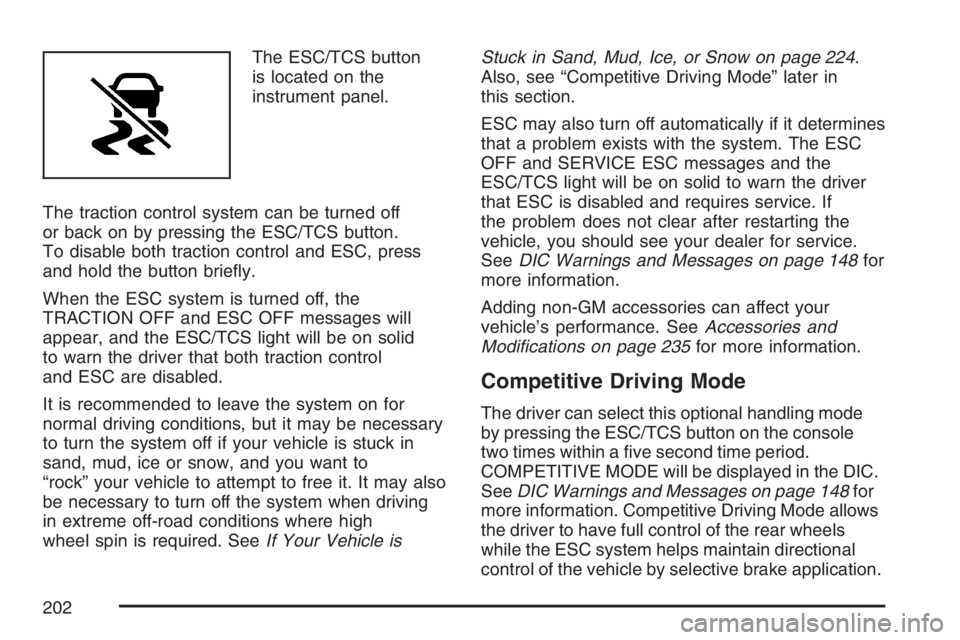
The ESC/TCS button
is located on the
instrument panel.
The traction control system can be turned off
or back on by pressing the ESC/TCS button.
To disable both traction control and ESC, press
and hold the button briey.
When the ESC system is turned off, the
TRACTION OFF and ESC OFF messages will
appear, and the ESC/TCS light will be on solid
to warn the driver that both traction control
and ESC are disabled.
It is recommended to leave the system on for
normal driving conditions, but it may be necessary
to turn the system off if your vehicle is stuck in
sand, mud, ice or snow, and you want to
“rock” your vehicle to attempt to free it. It may also
be necessary to turn off the system when driving
in extreme off-road conditions where high
wheel spin is required. SeeIf Your Vehicle isStuck in Sand, Mud, Ice, or Snow on page 224.
Also, see “Competitive Driving Mode” later in
this section.
ESC may also turn off automatically if it determines
that a problem exists with the system. The ESC
OFF and SERVICE ESC messages and the
ESC/TCS light will be on solid to warn the driver
that ESC is disabled and requires service. If
the problem does not clear after restarting the
vehicle, you should see your dealer for service.
SeeDIC Warnings and Messages on page 148for
more information.
Adding non-GM accessories can affect your
vehicle’s performance. SeeAccessories and
Modications on page 235for more information.
Competitive Driving Mode
The driver can select this optional handling mode
by pressing the ESC/TCS button on the console
two times within a ve second time period.
COMPETITIVE MODE will be displayed in the DIC.
SeeDIC Warnings and Messages on page 148for
more information. Competitive Driving Mode allows
the driver to have full control of the rear wheels
while the ESC system helps maintain directional
control of the vehicle by selective brake application.
202
Page 209 of 396

Of course, traction is reduced when water,
snow, ice, gravel, or other material is on the
road. For safety, you will want to slow down and
adjust your driving to these conditions. It is
important to slow down on slippery surfaces
because stopping distance will be longer and
vehicle control more limited.
While driving on a surface with reduced traction,
try your best to avoid sudden steering, acceleration,
or braking, including reducing vehicle speed by
shifting to a lower gear. Any sudden changes could
cause the tires to slide. You may not realize the
surface is slippery until your vehicle is skidding.
Learn to recognize warning clues — such as
enough water, ice, or packed snow on the road to
make a mirrored surface — and slow down when
you have any doubt.
If you have the Anti-Lock Brake System (ABS),
remember: It helps avoid only the braking skid.
If you do not have ABS, then in a braking skid,
where the wheels are no longer rolling, release
enough pressure on the brakes to get the wheels
rolling again. This restores steering control. Push
the brake pedal down steadily when you have to
stop suddenly. As long as the wheels are rolling,
you will have steering control.Driving at Night
Night driving is more dangerous than day driving.
One reason is that some drivers are likely to
be impaired — by alcohol or drugs, with night
vision problems, or by fatigue.
Here are some tips on night driving.
Drive defensively.
Do not drink and drive.
Adjust the inside rearview mirror to reduce the
glare from headlamps behind you.
Since you cannot see as well, you may need
to slow down and keep more space between
you and other vehicles.
Slow down, especially on higher speed roads.
Your vehicle’s headlamps can light up only so
much road ahead.
In remote areas, watch for animals.
If you are tired, pull off the road in a safe
place and rest.
209
Page 212 of 396

{CAUTION:
Wet brakes can cause accidents. They
may not work as well in a quick stop and
may cause pulling to one side. You could
lose control of the vehicle.
After driving through a large puddle of
water or a car wash, apply your brake pedal
lightly until your brakes work normally.
Driving too fast through large water puddles or
even going through some car washes can cause
problems, too. The water may affect your
brakes. Try to avoid puddles. But if you cannot,
try to slow down before you hit them.
Hydroplaning
Hydroplaning is dangerous. So much water can
build up under your tires that they can actually ride
on the water. This can happen if the road is wet
enough and you are going fast enough. When your
vehicle is hydroplaning, it has little or no contact
with the road.Hydroplaning does not happen often. But it can
if your tires do not have much tread or if the
pressure in one or more is low. It can happen if a
lot of water is standing on the road. If you can
see reections from trees, telephone poles,
or other vehicles, and raindrops dimple the water’s
surface, there could be hydroplaning.
Hydroplaning usually happens at higher speeds.
There just is not a hard and fast rule about
hydroplaning. The best advice is to slow down
when it is raining.
Driving Through Deep Standing Water
Notice:If you drive too quickly through deep
puddles or standing water, water can come in
through your engine’s air intake and badly
damage your engine. Never drive through water
that is slightly lower than the underbody of your
vehicle. If you cannot avoid deep puddles or
standing water, drive through them very slowly.
212
Page 270 of 396
Brakes
Brake Fluid
Your brake master
cylinder reservoir is
lled with DOT-3 brake
uid. SeeEngine
Compartment Overview
on page 244for the
location of the reservoir.
There are only two reasons why the brake uid
level in the reservoir might go down. The rst
is that the brake uid goes down to an acceptable
level during normal brake lining wear. When
new linings are put in, the uid level goes back
up. The other reason is that uid is leaking out
of the brake and/or clutch hydraulic system.
If it is, you should have your brake and/or clutch
system xed, since a leak means that sooner
or later your brakes and/or clutch will not
work well, or will not work at all.So, it is not a good idea to top off your brake/clutch
uid. Adding uid will not correct a leak. If you
add uid when your brake linings are worn, then
you will have too much uid when you get
new brake linings. You should add or remove
uid, as necessary, only when work is done on the
brake/clutch hydraulic system.
{CAUTION:
If your vehicle has too much brake uid, it
can spill on the engine. The uid will burn
if the engine is hot enough. You or others
could be burned, and your vehicle could
be damaged. Add brake uid only when
work is done on the brake and/or clutch
hydraulic system.
When your brake uid falls to a low level, your
brake warning light will come on. SeeBrake
System Warning Light on page 134.
270
Page 272 of 396

Brake Wear
Your vehicle has four-wheel disc brakes.
Front disc brake pads have built-in wear indicators
that make a high-pitched warning sound when
the brake pads are worn and new pads are
needed. The sound may come and go or be heard
all the time your vehicle is moving, except when
you are pushing on the brake pedal rmly.
{CAUTION:
The brake wear warning sound means that
soon the brakes will not work well. That
could lead to an accident. When you hear
the brake wear warning sound, have your
vehicle serviced.
Notice:Continuing to drive with worn-out
brake pads could result in costly brake repair.Some driving conditions or climates may cause a
brake squeal when the brakes are rst applied
or lightly applied. This does not mean something
is wrong with your brakes.
Properly torqued wheel nuts are necessary to help
prevent brake pulsation. When tires are rotated,
inspect brake pads for wear and evenly tighten
wheel nuts in the proper sequence to GM torque
specications.
Brake linings should always be replaced as
complete axle sets.
Brake Pedal Travel
See your dealer if the brake pedal does not return
to normal height, or if there is a rapid increase
in pedal travel. This could be a sign of brake
trouble.
Brake Adjustment
Every time you apply the brakes, with or without
the vehicle moving, your brakes adjust for wear.
272
Page 347 of 396
At Least Twice a Year
Restraint System Check
Make sure the safety belt reminder light and all
your belts, buckles, latch plates, retractors
and anchorages are working properly. Look for
any other loose or damaged safety belt system
parts. If you see anything that might keep a safety
belt system from doing its job, have it repaired.
Have any torn or frayed safety belts replaced.
Also look for any opened or broken airbag
coverings, and have them repaired or replaced.
The airbag system does not need regular
maintenance.
Wiper Blade Check
Inspect wiper blades for wear or cracking. Replace
blade inserts that appear worn or damaged or
that streak or miss areas of the windshield. Also
seeWindshield and Wiper Blades on page 320.
Weatherstrip Lubrication
Silicone grease on weatherstrips will make them
last longer, seal better, and not stick or squeak.
Apply silicone grease with a clean cloth.During very cold, damp weather more frequent
application may be required. SeePart D:
Recommended Fluids and Lubricants on page 353.
Manual Transmission Check
It is not necessary to check the transmission uid
level. Check for leaks. A uid leak is the only
reason for uid loss. Have the system inspected
and repaired if needed.
Automatic Transmission Inspection
It is not necessary to check the transmission uid
level. A transmission uid leak is the only
reason for uid loss. Check for leaks. If a leak
occurs, take the vehicle to your dealer and have it
repaired as soon as possible.
Hydraulic Clutch System Check
Check the uid level in the brake system and
clutch system reservoir. SeeHydraulic Clutch on
page 256. A uid loss in the brake or clutch
hydraulic system could indicate a problem. Have
the system inspected and repaired at once.
347
Page 383 of 396

A
Accessories and Modications..................... 235
Accessory Power Outlet(s).......................... 121
Adding Equipment to Your Airbag-Equipped
Vehicle....................................................... 55
Additives, Fuel............................................ 238
Add-On Electrical Equipment....................... 326
Air Cleaner/Filter, Engine............................. 254
Air Conditioning........................................... 122
Airbag
Passenger Status Indicator....................... 132
Readiness Light....................................... 131
Airbag Sensing and Diagnostic
Module (SDM).......................................... 373
Airbag System............................................... 42
Adding Equipment to Your
Airbag-Equipped Vehicle......................... 55
How Does an Airbag Restrain?.................. 48
Passenger Sensing System....................... 50
Servicing Your Airbag-Equipped Vehicle..... 54
What Makes an Airbag Inate?.................. 48
What Will You See After an
Airbag Inates?...................................... 48
When Should an Airbag Inate?................. 47
Where Are the Airbags?............................. 45Antenna, Fixed Mast................................... 187
Antenna, XM™ Satellite Radio Antenna
System.................................................... 187
Anti-Lock Brake System (ABS).................... 195
Anti-Lock Brake, System Warning Light....... 135
Appearance Care
Aluminum or Chrome-Plated Wheels........ 321
Care of Safety Belts................................ 317
Chemical Paint Spotting........................... 323
Cleaning Exterior Lamps/Lenses.............. 318
Cleaning the Inside of Your Vehicle.......... 314
Convertible Top........................................ 320
Fabric/Carpet........................................... 315
Finish Care.............................................. 319
Finish Damage......................................... 322
Instrument Panel, Vinyl, and
Other Plastic Surfaces.......................... 317
Leather.................................................... 316
Sheet Metal Damage............................... 322
Tires........................................................ 322
Underbody Maintenance........................... 323
Vehicle Care/Appearance Materials.......... 324
Washing Your Vehicle .............................. 318
Weatherstrips........................................... 317
Windshield and Wiper Blades................... 320
Ashtray(s).................................................... 122
383
Page 384 of 396

Audio System(s).......................................... 157
Audio Steering Wheel Controls................. 185
Care of Your CD Player........................... 187
Care of Your CDs.................................... 187
Fixed Mast Antenna................................. 187
Radio with CD................................161, 166
Setting the Time..............................158, 159
Theft-Deterrent Feature............................ 185
Understanding Radio Reception............... 186
XM™ Satellite Radio Antenna System...... 187
Automatic Door Lock..................................... 67
Automatic Door Unlock.................................. 67
Automatic Transmission
Fluid........................................................ 256
Operation................................................... 82
B
Battery........................................................ 273
Run-Down Protection............................... 121
Before Leaving on a Long Trip.................... 216
Brake
Anti-Lock Brake System (ABS)................. 195
Emergencies............................................ 197
Parking...................................................... 86
System Inspection.................................... 352
System Warning Light.............................. 134Brakes........................................................ 270
Braking....................................................... 194
Braking in Emergencies............................... 197
Break-In, New Vehicle................................... 76
Bulb Replacement....................................... 280
Back-Up Lamps....................................... 282
Front Turn Signal, Parking and
Fog Lamps........................................... 281
Halogen Bulbs......................................... 280
Headlamps............................................... 280
License Plate Lamps................................ 282
Replacement Bulbs.................................. 283
Taillamps, Turn Signal, and Stoplamps..... 281
Buying New Tires........................................ 296
C
California Fuel............................................. 238
California Proposition 65 Warning................ 236
Canadian Owners........................................... 3
Capacities and Specications...................... 332
Carbon Monoxide.................. 68, 91,220, 231
Care of
Safety Belts............................................. 317
Your CD Player........................................ 187
Your CDs ................................................. 187
CD, MP3 ..................................................... 176
384