steering PONTIAC SOLSTICE 2008 Owner's Guide
[x] Cancel search | Manufacturer: PONTIAC, Model Year: 2008, Model line: SOLSTICE, Model: PONTIAC SOLSTICE 2008Pages: 348, PDF Size: 5.23 MB
Page 187 of 348
Remember, unless your vehicle has ABS, if you
brake so hard that the wheels stop rolling, you will just
slide. Brake so the wheels always keep rolling and
you can still steer.
Whatever your vehicle’s braking system, allow
greater following distance on any slippery road.
Watch for slippery spots. The road might be ne
until you hit a spot that is covered with ice. On an
otherwise clear road, ice patches can appear in
shaded areas where the sun cannot reach, such as
around clumps of trees, behind buildings, or under
bridges. Sometimes the surface of a curve or an
overpass can remain icy when the surrounding roads
are clear. If you see a patch of ice ahead of you,
brake before you are on it. Try not to brake while you
are actually on the ice, and avoid sudden steering
maneuvers.
If You Are Caught in a Blizzard
If you are stopped by heavy snow, you could be in a
serious situation. You should probably stay with your
vehicle unless you know for sure that you are near help
and you can hike through the snow. Here are some things
to do to summon help and keep yourself and your
passengers safe:
Turn on the hazard warning ashers.
Tie a red cloth to your vehicle to alert police that you
have been stopped by the snow.
Put on extra clothing or wrap a blanket around you.
If you do not have blankets or extra clothing, make
body insulators from newspapers, burlap bags, rags,
oor mats — anything you can wrap around yourself
or tuck under your clothing to keep warm.
4-21
Page 190 of 348
Rocking Your Vehicle to Get It Out
First, turn the steering wheel left and right to clear the
area around the front wheels. Turn off any traction or
stability system. SeeTraction Control System (TCS)
on page 4-6andElectronic Stability Control (ESC)
on page 4-9. Then shift back and forth between
REVERSE (R) and a forward gear, or with a manual
transmission between FIRST (1) or SECOND (2) and
REVERSE (R), spinning the wheels as little as possible.
To prevent transmission wear, wait until the wheels stop
spinning before shifting gears. Release the accelerator
pedal while you shift, and press lightly on the accelerator
pedal when the transmission is in gear. By slowly
spinning the wheels in the forward and reverse directions,
you will cause a rocking motion that could free your
vehicle. If that does not get your vehicle out after a few
tries, it might need to be towed out. If your vehicle does
need to be towed out, seeTowing Your Vehicle on
page 4-29.
Loading Your Vehicle
It is very important to know how much weight your
vehicle can carry. This weight is called the vehicle
capacity weight and includes the weight of all
occupants, cargo, and all nonfactory-installed
options. Two labels on your vehicle show how much
weight it may properly carry, the Tire and Loading
Information label and the Certication label.
{CAUTION:
Do not load your vehicle any heavier than
the Gross Vehicle Weight Rating (GVWR),
or either the maximum front or rear Gross
Axle Weight Rating (GAWR). If you do,
parts on your vehicle can break, and it
can change the way your vehicle handles.
These could cause you to lose control
and crash. Also, overloading can shorten
the life of your vehicle.
4-24
Page 197 of 348
Service............................................................5-3
Accessories and Modications..........................5-3
California Proposition 65 Warning.....................5-4
California Perchlorate Materials Requirements.....5-4
Doing Your Own Service Work.........................5-4
Adding Equipment to the Outside of
Your Vehicle..............................................5-5
Fuel................................................................5-5
Gasoline Octane............................................5-5
Gasoline Specications....................................5-5
California Fuel...............................................5-6
Additives.......................................................5-6
Fuels in Foreign Countries...............................5-7
Filling the Tank..............................................5-8
Filling a Portable Fuel Container.....................5-10
Checking Things Under the Hood....................5-10
Hood Release..............................................5-11
Engine Compartment Overview.......................5-12
Engine Oil...................................................5-15
Engine Oil Life System..................................5-19
Engine Air Cleaner/Filter................................5-21
Automatic Transmission Fluid.........................5-23
Manual Transmission Fluid.............................5-23Hydraulic Clutch...........................................5-23
Engine Coolant.............................................5-24
Coolant Surge Tank Pressure Cap..................5-27
Engine Overheating.......................................5-27
Cooling System............................................5-29
Power Steering Fluid.....................................5-35
Windshield Washer Fluid................................5-36
Brakes........................................................5-37
Battery........................................................5-40
Jump Starting...............................................5-41
Rear Axle.......................................................5-45
Headlamp Aiming
...........................................5-46
Bulb Replacement..........................................5-46
Halogen Bulbs..............................................5-46
Headlamps..................................................5-47
Front Turn Signal, Parking and Fog Lamps......5-47
Taillamps, Turn Signal, and Stoplamps............5-48
Back-Up Lamps............................................5-48
License Plate Lamp......................................5-49
Replacement Bulbs.......................................5-49
Windshield Wiper Blade Replacement..............5-50
Section 5 Service and Appearance Care
5-1
Page 209 of 348
A. Windshield Washer Fluid Reservoir. See “Adding
Washer Fluid” underWindshield Washer Fluid
on page 5-36.
B. Coolant Surge Tank and Pressure Cap. SeeCooling
System on page 5-29.
C. Brake Master Cylinder Reservoir. See “Brake Fluid”
underBrakes on page 5-37andHydraulic Clutch
on page 5-23.
D. Engine Oil Dipstick (Out of View). See “Checking
Engine Oil” underEngine Oil on page 5-15.
E. Engine Air Cleaner/Filter. SeeEngine Air
Cleaner/Filter on page 5-21.F. Engine Oil Fill Cap. See “When to Add Engine Oil”
underEngine Oil on page 5-15.
G. Power Steering Fluid Reservoir. SeePower Steering
Fluid on page 5-35.
H. Remote Negative (−) Ground (Out of View).
SeeJump Starting on page 5-41.
I. Battery (Out of View). SeeBattery on page 5-40.
J. Remote Positive (+) Terminal. SeeJump Starting on
page 5-41.
K. Underhood Fuse Block. SeeUnderhood Fuse Block
on page 5-97.
5-13
Page 211 of 348
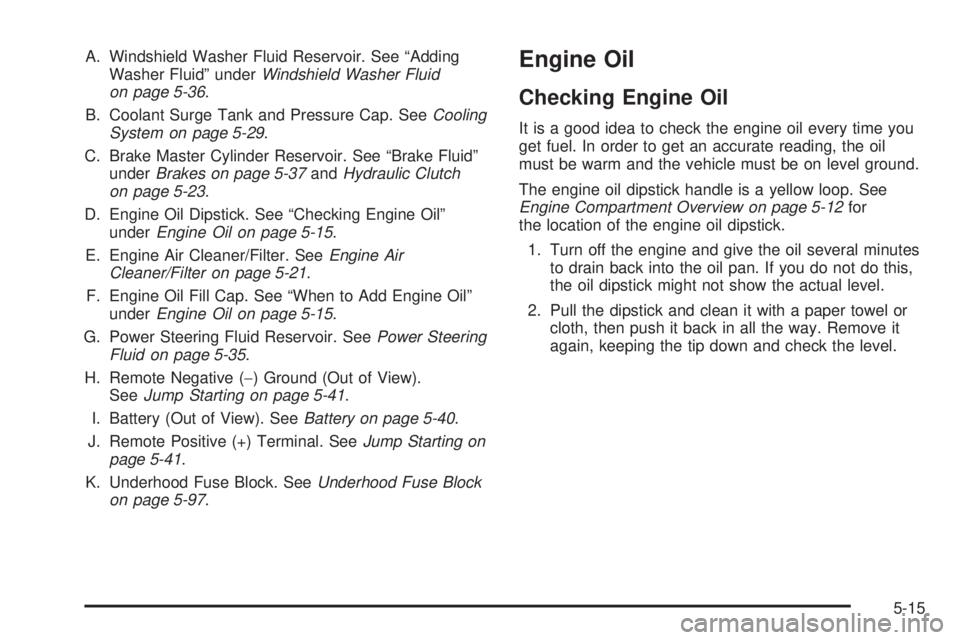
A. Windshield Washer Fluid Reservoir. See “Adding
Washer Fluid” underWindshield Washer Fluid
on page 5-36.
B. Coolant Surge Tank and Pressure Cap. SeeCooling
System on page 5-29.
C. Brake Master Cylinder Reservoir. See “Brake Fluid”
underBrakes on page 5-37andHydraulic Clutch
on page 5-23.
D. Engine Oil Dipstick. See “Checking Engine Oil”
underEngine Oil on page 5-15.
E. Engine Air Cleaner/Filter. SeeEngine Air
Cleaner/Filter on page 5-21.
F. Engine Oil Fill Cap. See “When to Add Engine Oil”
underEngine Oil on page 5-15.
G. Power Steering Fluid Reservoir. SeePower Steering
Fluid on page 5-35.
H. Remote Negative (−) Ground (Out of View).
SeeJump Starting on page 5-41.
I. Battery (Out of View). SeeBattery on page 5-40.
J. Remote Positive (+) Terminal. SeeJump Starting on
page 5-41.
K. Underhood Fuse Block. SeeUnderhood Fuse Block
on page 5-97.Engine Oil
Checking Engine Oil
It is a good idea to check the engine oil every time you
get fuel. In order to get an accurate reading, the oil
must be warm and the vehicle must be on level ground.
The engine oil dipstick handle is a yellow loop. See
Engine Compartment Overview on page 5-12for
the location of the engine oil dipstick.
1. Turn off the engine and give the oil several minutes
to drain back into the oil pan. If you do not do this,
the oil dipstick might not show the actual level.
2. Pull the dipstick and clean it with a paper towel or
cloth, then push it back in all the way. Remove it
again, keeping the tip down and check the level.
5-15
Page 231 of 348
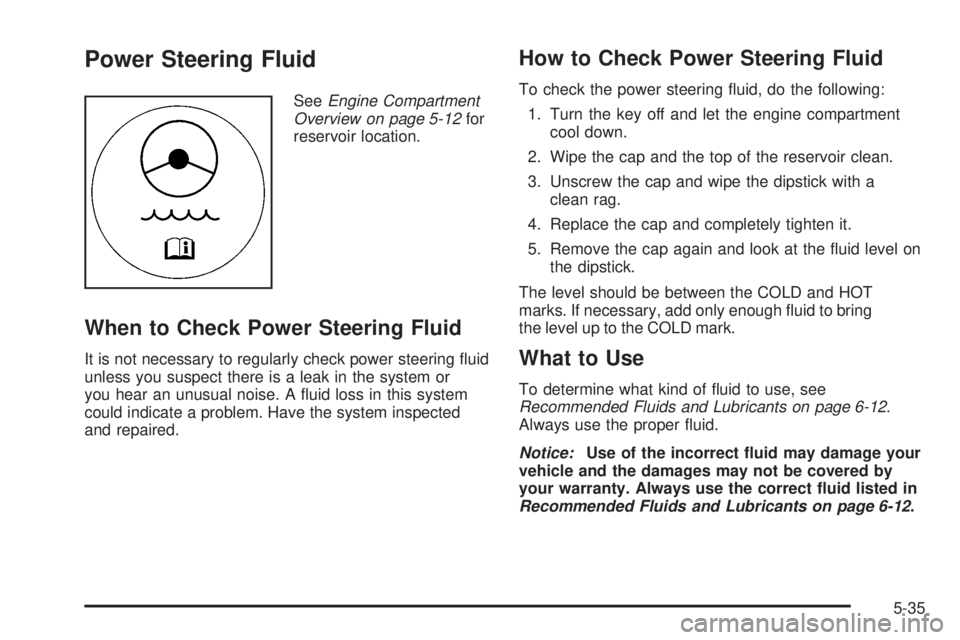
Power Steering Fluid
SeeEngine Compartment
Overview on page 5-12for
reservoir location.
When to Check Power Steering Fluid
It is not necessary to regularly check power steering uid
unless you suspect there is a leak in the system or
you hear an unusual noise. A uid loss in this system
could indicate a problem. Have the system inspected
and repaired.
How to Check Power Steering Fluid
To check the power steering uid, do the following:
1. Turn the key off and let the engine compartment
cool down.
2. Wipe the cap and the top of the reservoir clean.
3. Unscrew the cap and wipe the dipstick with a
clean rag.
4. Replace the cap and completely tighten it.
5. Remove the cap again and look at the uid level on
the dipstick.
The level should be between the COLD and HOT
marks. If necessary, add only enough uid to bring
the level up to the COLD mark.
What to Use
To determine what kind of uid to use, see
Recommended Fluids and Lubricants on page 6-12.
Always use the proper uid.
Notice:Use of the incorrect uid may damage your
vehicle and the damages may not be covered by
your warranty. Always use the correct uid listed in
Recommended Fluids and Lubricants on page 6-12.
5-35
Page 251 of 348
Tire Terminology and Denitions
Air Pressure:The amount of air inside the
tire pressing outward on each square inch of
the tire. Air pressure is expressed in pounds
per square inch (psi) or kilopascal (kPa).
Accessory Weight
:This means the combined
weight of optional accessories. Some examples of
optional accessories are, automatic transmission,
power steering, power brakes, power windows,
power seats, and air conditioning.
Aspect Ratio
:The relationship of a tire’s height
to its width.
Belt
:A rubber coated layer of cords that is
located between the plies and the tread. Cords
may be made from steel or other reinforcing
materials.
Bead
:The tire bead contains steel wires wrapped
by steel cords that hold the tire onto the rim.
Bias Ply Tire
:A pneumatic tire in which the plies
are laid at alternate angles less than 90 degrees
to the centerline of the tread.Cold Tire Pressure
:The amount of air pressure in
a tire, measured in pounds per square inch (psi) or
kilopascals (kPa) before a tire has built up heat
from driving. SeeInflation - Tire Pressure on
page 5-58.
Curb Weight
:The weight of a motor vehicle with
standard and optional equipment including the
maximum capacity of fuel, oil, and coolant,
but without passengers and cargo.
DOT Markings
:A code molded into the sidewall
of a tire signifying that the tire is in compliance
with the U.S. Department of Transportation (DOT)
motor vehicle safety standards. The DOT code
includes the Tire Identication Number (TIN),
an alphanumeric designator which can also identify
the tire manufacturer, production plant, brand,
and date of production.
GVWR
:Gross Vehicle Weight Rating.
SeeLoading Your Vehicle on page 4-24.
GAWR FRT
:Gross Axle Weight Rating for
the front axle. SeeLoading Your Vehicle on
page 4-24.
5-55
Page 271 of 348
If a Tire Goes Flat
Your vehicle has a tire sealant and compressor kit.
SeeTire Sealant and Compressor Kit on page 5-76.
There is no spare tire, no tire changing equipment,
and no place to store a tire.
It is unusual for a tire to blow out while you are driving,
especially if you maintain your tires properly. SeeTires
on page 5-51. If air goes out of a tire, it is much more
likely to leak out slowly. But, if you should ever have a
blow out, here are a few tips about what to expect and
what to do:
If a front tire fails, the at tire will create a drag that
pulls the vehicle toward that side. Take your foot off the
accelerator pedal and grip the steering wheel rmly.
Steer to maintain lane position, and then gently brake
to a stop well out of the traffic lane.
A rear blow out, particularly on a curve, acts much
like a skid and may require the same correction
you would use in a skid. In any rear blow out, remove
your foot from the accelerator pedal. Get the vehicle
under control by steering the way you want the vehicle
to go. It may be very bumpy and noisy, but you can
still steer. Gently brake to a stop, well off the road
if possible.If a tire goes at, avoid further tire and wheel damage
by driving slowly to a level place and stopping.
Then do this:
1. Turn on the hazard warning ashers. SeeHazard
Warning Flashers on page 3-6.
2. Park your vehicle. If your vehicle has an automatic
transmission, set the parking brake rmly and put the
shift lever in PARK (P). SeeShifting Into PARK (P)
(Automatic Transmission) on page 2-26. If your
vehicle has a manual transmission, move the shift
lever to REVERSE (R) and set the parking brake
rmly. SeeParking Your Vehicle (Manual
Transmission) on page 2-28for additional
information.
3. Turn off the engine.
4. Inspect the at tire.
If the tire has been separated from the wheel, has
damaged sidewalls, or has a puncture larger than a
14inch (6 mm), the tire is too severely damaged for
the tire sealant and compressor kit to be effective.
SeeRoadside Assistance Program on page 7-7.
If the tire has a puncture less than a
14inch (6 mm)
in the tread area of the tire, seeTire Sealant and
Compressor Kit on page 5-76.
5-75
Page 293 of 348
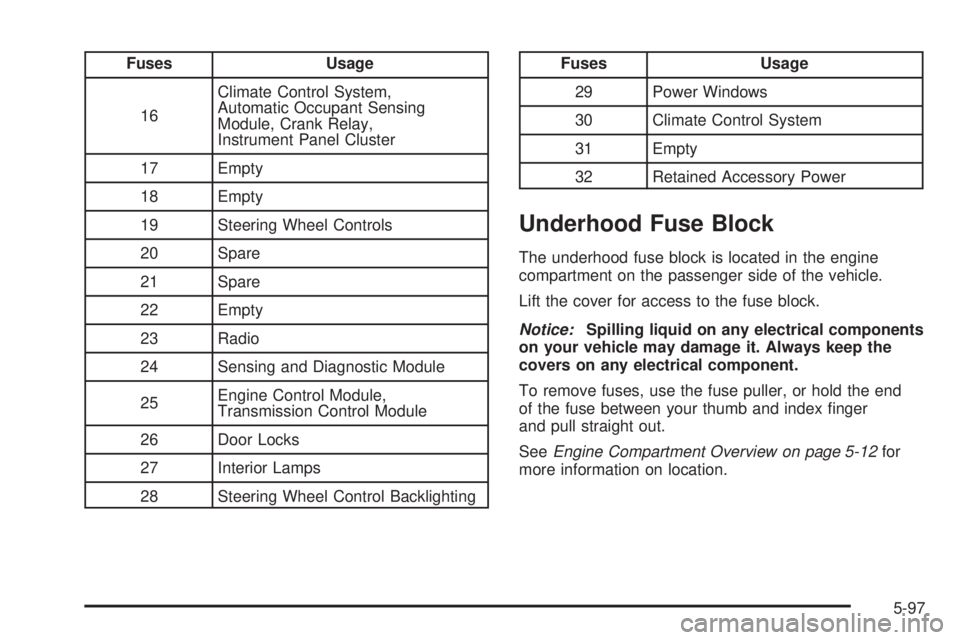
Fuses Usage
16Climate Control System,
Automatic Occupant Sensing
Module, Crank Relay,
Instrument Panel Cluster
17 Empty
18 Empty
19 Steering Wheel Controls
20 Spare
21 Spare
22 Empty
23 Radio
24 Sensing and Diagnostic Module
25Engine Control Module,
Transmission Control Module
26 Door Locks
27 Interior Lamps
28 Steering Wheel Control BacklightingFuses Usage
29 Power Windows
30 Climate Control System
31 Empty
32 Retained Accessory Power
Underhood Fuse Block
The underhood fuse block is located in the engine
compartment on the passenger side of the vehicle.
Lift the cover for access to the fuse block.
Notice:Spilling liquid on any electrical components
on your vehicle may damage it. Always keep the
covers on any electrical component.
To remove fuses, use the fuse puller, or hold the end
of the fuse between your thumb and index nger
and pull straight out.
SeeEngine Compartment Overview on page 5-12for
more information on location.
5-97
Page 303 of 348
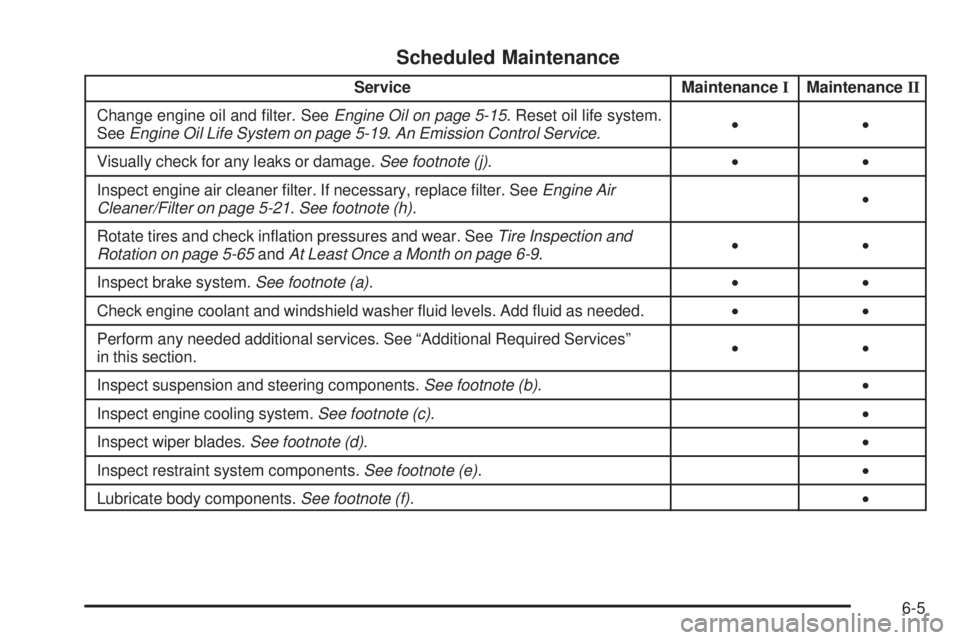
Scheduled Maintenance
Service MaintenanceIMaintenanceII
Change engine oil and lter. SeeEngine Oil on page 5-15. Reset oil life system.
SeeEngine Oil Life System on page 5-19.An Emission Control Service.••
Visually check for any leaks or damage.See footnote (j).••
Inspect engine air cleaner lter. If necessary, replace lter. SeeEngine Air
Cleaner/Filter on page 5-21.See footnote (h).•
Rotate tires and check ination pressures and wear. SeeTire Inspection and
Rotation on page 5-65andAt Least Once a Month on page 6-9.••
Inspect brake system.See footnote (a).••
Check engine coolant and windshield washer uid levels. Add uid as needed.••
Perform any needed additional services. See “Additional Required Services”
in this section.••
Inspect suspension and steering components.See footnote (b).•
Inspect engine cooling system.See footnote (c).•
Inspect wiper blades.See footnote (d).•
Inspect restraint system components.See footnote (e).•
Lubricate body components.See footnote (f).•
6-5