turn signal PONTIAC SOLSTICE 2009 User Guide
[x] Cancel search | Manufacturer: PONTIAC, Model Year: 2009, Model line: SOLSTICE, Model: PONTIAC SOLSTICE 2009Pages: 354, PDF Size: 1.98 MB
Page 174 of 354

c(End):Press to reject an incoming call, or end a
current call.
bg(Mute / Voice Recognition):Press to silence
the vehicle speakers only. Press again to turn the
sound on.
For vehicles with OnStar
®or Bluetooth systems press
and hold
bgfor longer than two seconds to
interact with those systems. SeeOnStar®System on
page 2-30andBluetooth®on page 3-68for more
information.
Radio Reception
Frequency interference and static can occur during
normal radio reception if items such as cell phone
chargers, vehicle convenience accessories, and external
electronic devices are plugged into the accessory
power outlet. If there is interference or static, unplug the
item from the accessory power outlet.
AM
The range for most AM stations is greater than for FM,
especially at night. The longer range can cause
station frequencies to interfere with each other. For
better radio reception, most AM radio stations boost the
power levels during the day, and then reduce these
levels during the night. Static can also occur when things
like storms and power lines interfere with radio
reception. When this happens, try reducing the treble on
the radio.
FM Stereo
FM signals only reach about 10 to 40 miles
(16 to 65 km). Although the radio has a built-in electronic
circuit that automatically works to reduce interference,
some static can occur, especially around tall buildings or
hills, causing the sound to fade in and out.
XM™ Satellite Radio Service
XM Satellite Radio Service gives digital radio reception
from coast-to-coast in the 48 contiguous United
States, and in Canada. Just as with FM, tall buildings or
hills can interfere with satellite radio signals, causing
the sound to fade in and out. In addition, traveling
or standing under heavy foliage, bridges, garages, or
tunnels may cause loss of the XM signal for a period
of time.
3-80
Page 195 of 354

Repeat this until help arrives but only when you feel
really uncomfortable from the cold. Moving about
to keep warm also helps.
If it takes some time for help to arrive, now and then
when you run the engine, push the accelerator
pedal slightly so the engine runs faster than the idle
speed. This keeps the battery charged to restart
the vehicle and to signal for help with the headlamps.
Do this as little as possible to save fuel.
If Your Vehicle is Stuck in Sand,
Mud, Ice, or Snow
Slowly and cautiously spin the wheels to free the
vehicle when stuck in sand, mud, ice, or snow. See
Rocking Your Vehicle to Get It Out on page 4-20.
If the vehicle has a traction system, it can often help to
free a stuck vehicle. Refer to the vehicle’s traction
system in the Index. If stuck too severely for the traction
system to free the vehicle, turn the traction system off
and use the rocking method.
{CAUTION:
If you let your vehicle’s tires spin at high speed,
they can explode, and you or others could be
injured. The vehicle can overheat, causing an
engine compartment re or other damage. Spin
the wheels as little as possible and avoid going
above 35 mph (55 km/h) as shown on the
speedometer.
For information about using tire chains on the vehicle,
seeTire Chains on page 5-70.
4-19
Page 203 of 354
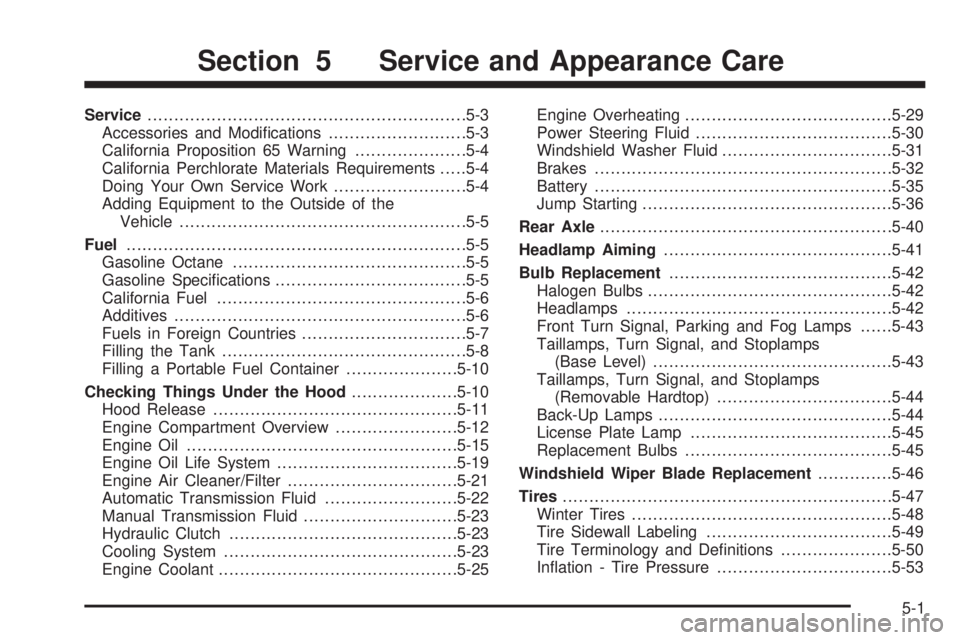
Service............................................................5-3
Accessories and Modications..........................5-3
California Proposition 65 Warning.....................5-4
California Perchlorate Materials Requirements.....5-4
Doing Your Own Service Work.........................5-4
Adding Equipment to the Outside of the
Vehicle......................................................5-5
Fuel................................................................5-5
Gasoline Octane............................................5-5
Gasoline Specications....................................5-5
California Fuel...............................................5-6
Additives.......................................................5-6
Fuels in Foreign Countries...............................5-7
Filling the Tank..............................................5-8
Filling a Portable Fuel Container.....................5-10
Checking Things Under the Hood....................5-10
Hood Release..............................................5-11
Engine Compartment Overview.......................5-12
Engine Oil...................................................5-15
Engine Oil Life System..................................5-19
Engine Air Cleaner/Filter................................5-21
Automatic Transmission Fluid.........................5-22
Manual Transmission Fluid.............................5-23
Hydraulic Clutch...........................................5-23
Cooling System............................................5-23
Engine Coolant.............................................5-25Engine Overheating.......................................5-29
Power Steering Fluid.....................................5-30
Windshield Washer Fluid................................5-31
Brakes........................................................5-32
Battery........................................................5-35
Jump Starting...............................................5-36
Rear Axle.......................................................5-40
Headlamp Aiming...........................................5-41
Bulb Replacement
..........................................5-42
Halogen Bulbs..............................................5-42
Headlamps..................................................5-42
Front Turn Signal, Parking and Fog Lamps......5-43
Taillamps, Turn Signal, and Stoplamps
(Base Level).............................................5-43
Taillamps, Turn Signal, and Stoplamps
(Removable Hardtop).................................5-44
Back-Up Lamps............................................5-44
License Plate Lamp......................................5-45
Replacement Bulbs.......................................5-45
Windshield Wiper Blade Replacement..............5-46
Tires..............................................................5-47
Winter Tires.................................................5-48
Tire Sidewall Labeling...................................5-49
Tire Terminology and Denitions.....................5-50
Ination - Tire Pressure.................................5-53
Section 5 Service and Appearance Care
5-1
Page 245 of 354

Front Turn Signal, Parking and
Fog Lamps
A. Front Turn Signal/
Parking Lamp
B. Fog Lamp (If Equipped)
To replace one of these bulbs:
1. Open the hood. SeeHood Release on page 5-11.
2. Locate the bulb assembly under the front bumper.
3. Turn the bulb socket counterclockwise and pull
out the bulb assembly.
4. Disconnect the bulb socket from the wiring harness.
5. Pull the old bulb straight out of the bulb socket.6. Push the new bulb straight into the bulb socket until
it connects.
7. Reconnect the bulb socket to the wiring harness.
8. Push the bulb socket straight into the bulb assembly
and turn it clockwise to lock it into place.
Taillamps, Turn Signal, and
Stoplamps (Base Level)
To replace one of these bulbs:
1. Open the trunk. SeeTrunk on page 2-8.
2. From inside the vehicle, remove the two screws
from the taillamp assembly.
3. Remove the taillamp assembly.
5-43
Page 246 of 354

4. Turn the bulb socket counterclockwise and pull it
straight out of the taillamp assembly.
5. Pull the old bulb straight out of the bulb socket.
6. Push the new bulb straight into the bulb socket until
it connects.
7. Push the bulb socket straight into the taillamp
assembly and turn it clockwise to lock it into
place.
8. Reinstall the taillamp assembly and the two screws
that holds the taillamp assembly from inside the
vehicle.
Taillamps, Turn Signal, and
Stoplamps (Removable Hardtop)
If your vehicle has a removable hardtop, see your
dealer/retailer to replace these bulbs.
Back-Up Lamps
The back-up lamps are
located in the rear bumper.
To replace a bulb:
1. Locate the bulb socket under and behind the rear
bumper.
2. Turn it counterclockwise and pull it straight out of
the lamp assembly.
3. Pull the old bulb straight out of the bulb socket.
4. Push the new bulb straight into the bulb socket until
it connects.
5. Reinstall the bulb socket by lining up the tabs in the
lamp assembly and turn it clockwise to secure it.
5-44
Page 247 of 354

License Plate Lamp
To replace the license plate lamp bulb:
1. Remove the license plate assembly by turning the
two screws counterclockwise.
2. Turn and pull the license plate lamp forward
through the fascia opening.
3. Turn the bulb socket counterclockwise and pull the
bulb straight out of the socket.4. Push the new bulb in and turn it clockwise to install.
5. Replace the license plate lamp by pushing it
through the fascia opening.
6. Turn the two screws that hold the license plate
lamp clockwise to reinstall.
Replacement Bulbs
Exterior Lamp Bulb Number
Back-Up Lamps 3047
Fog Lamp 898*
Front Parking/Turn Signal Lamp 3757NAK
Front Sidemarker Lamp 194
Headlamps, High/Low-Beam/
Daytime Running LightsH13
License Plate Lamp 168
Stoplamp, Taillamp and Turn
Signal Lamp3157K
* Uplevel Model
For replacement bulbs not listed here, contact your
dealer/retailer.
5-45
Page 260 of 354

Replacement tires or wheels do not match your
vehicle’s original equipment tires or wheels.
Tires and wheels other than those recommended
for your vehicle could prevent the TPMS from
functioning properly. SeeBuying New Tires on
page 5-63.
Operating electronic devices or being near facilities
using radio wave frequencies similar to the TPMS
could cause the TPMS sensors to malfunction.
If the TPMS is not functioning it cannot detect or signal
a low tire condition. See your dealer/retailer for
service if the TPMS malfunction light and DIC message
comes on and stays on.
TPMS Sensor Matching Process
Each TPMS sensor has a unique identication code.
Any time you replace one or more of the TPMS sensors
or rotate the vehicle’s tires, the identication codes
need to be matched to the new tire/wheel position. The
sensors are matched, to the tire/wheel positions, in
the following order: driver side front tire, passenger side
front tire, passenger side rear tire, and driver side
rear tire using a TPMS diagnostic tool. See your
dealer/retailer for service.
The TPMS sensors can also be matched to each
tire/wheel position by increasing or decreasing the tire’s
air pressure. When increasing the tire’s pressure, do
not exceed the maximum ination pressure indicated onthe tire’s sidewall. To decrease the tire’s air-pressure
use the pointed end of the valve cap, a pencil-style
air pressure gage, or a key.
You have two minutes to match each tire and wheel
position. If it takes longer than two minutes to match any
tire and wheel position, the matching process stops
and you need to start over.
TPMS Matching Process for Vehicles
with Remote Keyless Entry (RKE)
1. Set the parking brake.
2. Turn the ignition switch to ON/RUN with the
engine off.
3. Press and hold the Remote Keyless Entry (RKE)
transmitter’s LOCK and UNLOCK buttons, at the
same time, for about ve seconds to start the TPMS
learn mode. The horn sounds twice indicating the
TPMS receiver is ready and in learn mode.
4. Start with the driver side front tire. The driver side
front turn signal also comes on to indicate that
corner’s sensor is ready to be learned.
5. Remove the valve cap from the tire’s valve stem.
Activate the TPMS sensor by increasing or
decreasing the tire’s air pressure for about
eight seconds. The horn chirp, can take up to
30 seconds to sound. It chirps one time and then all
5-58
Page 261 of 354

the turn signals ash one time to conrm the sensor
identication code has been matched to the
tire/wheel position.
6. The passenger side front turn signal comes on to
indicate that corner sensor is ready to be learned.
Proceed to the passenger side front tire and
repeat the procedure in Step 5.
7. The passenger side rear turn signal comes on to
indicate that corner sensor is ready to be learned.
Proceed to the passenger side rear tire and
repeat the procedure in Step 5.
8. The driver side rear turn signal comes on to
indicate that corner sensor is ready to be learned.
Proceed to the driver side rear tire, and repeat
the procedure in Step 5.
9. After hearing the single horn chirp for the driver
side rear tire, two additional horn chirps sound to
indicate the tire learning process is done. Turn
the ignition switch to LOCK/OFF.
If no tires are learned after entering the TPMS learn
mode, or if communication with the receiver
stops, or if the time limit has expired, turn the
ignition switch to LOCK/OFF and start over
beginning with Step 2.10. Set all four tires to the recommended air pressure
level as indicated on the Tire and Loading
Information label.
11. Put the valve caps back on the valve stems.
TPMS Matching Process for Vehicles
without Remote Keyless Entry (RKE)
1. Set the parking brake.
2. Turn the ignition switch to ON/RUN with the
engine off.
3. Using the Driver Information Center (DIC), press
the INFO and Set/Reset buttons at the same time
for about one second. Then press and release
the INFO button until the TIRE LEARN? message
displays.
4. Press and hold the Set/Reset DIC button for
approximately three seconds to start the TPMS
learn mode. The horn sounds twice to indicate the
TPMS receiver is ready and the TIRE LEARN
ON message displays. The driver side front turn
signal also comes on to indicate that corner sensor
is ready to be learned.
5. Start with the driver side front tire.
5-59
Page 262 of 354

6. Remove the valve cap from the tire’s valve stem.
Activate the TPMS sensor by increasing or
decreasing the tire’s air pressure for about
eight seconds. The horn chirp, can take up to
30 seconds to sound. It chirps one time and then all
the turn signals ash one time to conrm the
sensor identication code has been matched to the
tire/wheel position.
7. The passenger side front turn signal comes on to
indicate that corner sensor is ready to be learned.
Proceed to the passenger side front tire and
repeat the procedure in Step 6.
8. The passenger side rear turn signal comes on to
indicate that corner sensor is ready to be learned.
Proceed to the passenger side rear tire and
repeat the procedure in Step 6.
9. The driver side rear turn signal comes on to
indicate that corner sensor is ready to be learned.
Proceed to the driver side rear tire, and repeat
the procedure in Step 6.
10. After hearing the single horn chirp for the driver
side rear tire, two additional horn chirps sound to
indicate the tire learning process is done. The
LEARN COMPLETE message displays if all four
tire positions are learned. Turn the ignition switch to
LOCK/OFF.If no tires are learned after entering the TPMS learn
mode, or if communication with the receiver
stops, or if the time limit has expired, the TIRE
LEARN? message displays on the DIC. Turn the
ignition switch to LOCK/OFF and start over
beginning with Step 2.
11. Set all four tires to the recommended air pressure
level as indicated on the Tire and Loading
Information label.
12. Put the valve caps back on the valve stems.
Tire Inspection and Rotation
We recommend that you regularly inspect your
vehicle’s tires for signs of wear or damage.
SeeWhen It Is Time for New Tires on page 5-62
for more information.
Tires should be rotated every 5,000 to 8,000 miles
(8 000 to 13 000 km). SeeScheduled Maintenance
on page 6-4.
The purpose of a regular tire rotation is to achieve
a uniform wear for all tires on the vehicle. This
will ensure that your vehicle continues to perform
most like it did when the tires were new.
5-60
Page 344 of 354
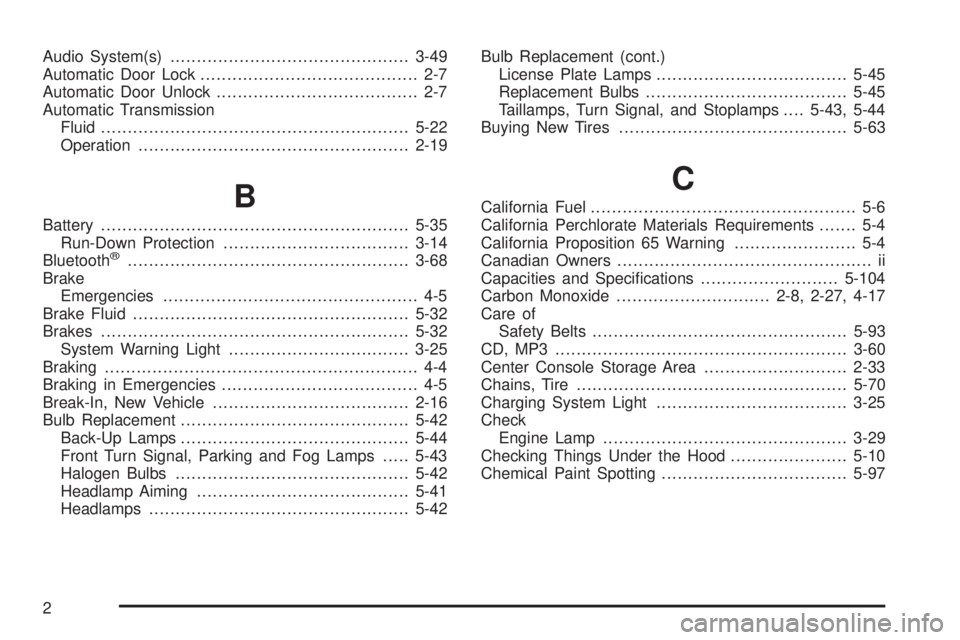
Audio System(s).............................................3-49
Automatic Door Lock......................................... 2-7
Automatic Door Unlock...................................... 2-7
Automatic Transmission
Fluid..........................................................5-22
Operation...................................................2-19
B
Battery..........................................................5-35
Run-Down Protection...................................3-14
Bluetooth
®.....................................................3-68
Brake
Emergencies................................................ 4-5
Brake Fluid....................................................5-32
Brakes..........................................................5-32
System Warning Light..................................3-25
Braking........................................................... 4-4
Braking in Emergencies..................................... 4-5
Break-In, New Vehicle.....................................2-16
Bulb Replacement...........................................5-42
Back-Up Lamps...........................................5-44
Front Turn Signal, Parking and Fog Lamps.....5-43
Halogen Bulbs............................................5-42
Headlamp Aiming........................................5-41
Headlamps.................................................5-42Bulb Replacement (cont.)
License Plate Lamps....................................5-45
Replacement Bulbs......................................5-45
Taillamps, Turn Signal, and Stoplamps....5-43, 5-44
Buying New Tires...........................................5-63
C
California Fuel.................................................. 5-6
California Perchlorate Materials Requirements....... 5-4
California Proposition 65 Warning....................... 5-4
Canadian Owners................................................ ii
Capacities and Specications..........................5-104
Carbon Monoxide.............................2-8, 2-27, 4-17
Care of
Safety Belts................................................5-93
CD, MP3 .......................................................3-60
Center Console Storage Area...........................2-33
Chains, Tire...................................................5-70
Charging System Light....................................3-25
Check
Engine Lamp..............................................3-29
Checking Things Under the Hood......................5-10
Chemical Paint Spotting...................................5-97
2