ignition PONTIAC SOLSTICE 2009 Owners Manual
[x] Cancel search | Manufacturer: PONTIAC, Model Year: 2009, Model line: SOLSTICE, Model: PONTIAC SOLSTICE 2009Pages: 354, PDF Size: 1.98 MB
Page 50 of 354

A thick layer of additional material, such as a blanket or
cushion, or aftermarket equipment such as seat
covers, seat heaters, and seat massagers can affect
how well the passenger sensing system operates.
We recommend that you not use seat covers or other
aftermarket equipment except when approved by GM for
your specic vehicle. SeeAdding Equipment to Your
Airbag-Equipped Vehicle on page 1-47for more
information about modications that can affect how the
system operates.
{CAUTION:
Stowing of articles under the passenger seat or
between the passenger seat cushion and seatback
may interfere with the proper operation of the
passenger sensing system.
Servicing Your Airbag-Equipped
Vehicle
Airbags affect how the vehicle should be serviced.
There are parts of the airbag system in several places
around the vehicle. Your dealer/retailer and the
service manual have information about servicing the
vehicle and the airbag system. To purchase a service
manual, seeService Publications Ordering Information
on page 7-14.
{CAUTION:
For up to 10 seconds after the ignition is turned off
and the battery is disconnected, an airbag can still
inate during improper service. You can be injured
if you are close to an airbag when it inates. Avoid
yellow connectors. They are probably part of the
airbag system. Be sure to follow proper service
procedures, and make sure the person performing
work for you is qualied to do so.
1-46
Page 55 of 354
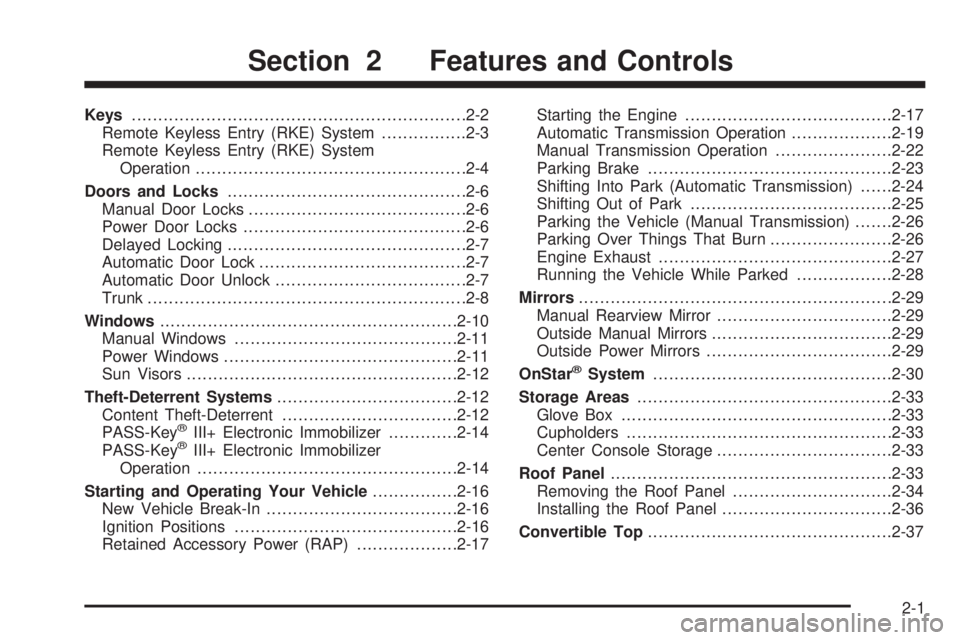
Keys...............................................................2-2
Remote Keyless Entry (RKE) System................2-3
Remote Keyless Entry (RKE) System
Operation...................................................2-4
Doors and Locks.............................................2-6
Manual Door Locks.........................................2-6
Power Door Locks..........................................2-6
Delayed Locking.............................................2-7
Automatic Door Lock.......................................2-7
Automatic Door Unlock....................................2-7
Trunk............................................................2-8
Windows........................................................2-10
Manual Windows..........................................2-11
Power Windows............................................2-11
Sun Visors...................................................2-12
Theft-Deterrent Systems..................................2-12
Content Theft-Deterrent.................................2-12
PASS-Key
®III+ Electronic Immobilizer.............2-14
PASS-Key®III+ Electronic Immobilizer
Operation.................................................2-14
Starting and Operating Your Vehicle................2-16
New Vehicle Break-In....................................2-16
Ignition Positions..........................................2-16
Retained Accessory Power (RAP)...................2-17Starting the Engine.......................................2-17
Automatic Transmission Operation...................2-19
Manual Transmission Operation......................2-22
Parking Brake..............................................2-23
Shifting Into Park (Automatic Transmission)......2-24
Shifting Out of Park......................................2-25
Parking the Vehicle (Manual Transmission).......2-26
Parking Over Things That Burn.......................2-26
Engine Exhaust............................................2-27
Running the Vehicle While Parked..................2-28
Mirrors...........................................................2-29
Manual Rearview Mirror.................................2-29
Outside Manual Mirrors..................................2-29
Outside Power Mirrors...................................2-29
OnStar
®System.............................................2-30
Storage Areas................................................2-33
Glove Box...................................................2-33
Cupholders..................................................2-33
Center Console Storage.................................2-33
Roof Panel.....................................................2-33
Removing the Roof Panel..............................2-34
Installing the Roof Panel................................2-36
Convertible Top..............................................2-37
Section 2 Features and Controls
2-1
Page 56 of 354
Keys
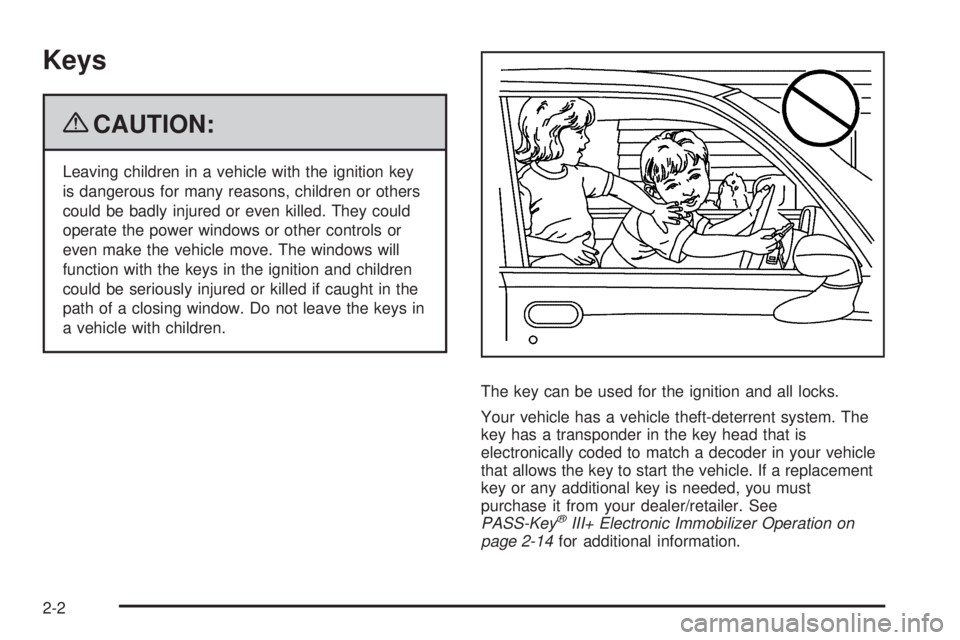
{CAUTION:
Leaving children in a vehicle with the ignition key
is dangerous for many reasons, children or others
could be badly injured or even killed. They could
operate the power windows or other controls or
even make the vehicle move. The windows will
function with the keys in the ignition and children
could be seriously injured or killed if caught in the
path of a closing window. Do not leave the keys in
a vehicle with children.
The key can be used for the ignition and all locks.
Your vehicle has a vehicle theft-deterrent system. The
key has a transponder in the key head that is
electronically coded to match a decoder in your vehicle
that allows the key to start the vehicle. If a replacement
key or any additional key is needed, you must
purchase it from your dealer/retailer. See
PASS-Key
®III+ Electronic Immobilizer Operation on
page 2-14for additional information.
2-2
Page 58 of 354

Remote Keyless Entry (RKE)
System Operation
The Remote Keyless Entry (RKE) transmitter functions
work up to 60 feet (18 m) away from the vehicle.
There are other conditions which can affect the
performance of the transmitter. SeeRemote Keyless
Entry (RKE) System on page 2-3.
Q(Lock):Press to lock all the doors. If enabled
through the Driver Information Center (DIC), the parking
lamps may ash once and the horn may chirp to
indicate locking has occurred. See “LOCK HORN” under
DIC Vehicle Personalization on page 3-41.
K(Unlock):Press once to unlock the driver door.
Press
Kagain within ve seconds to unlock the other
doors. The interior lamps come on and stay on for
20 seconds or until the ignition is turned on. If enabled
through the DIC, the parking lamps ash once to
indicate unlocking has occurred. See “UNLOCK HORN”
underDIC Vehicle Personalization on page 3-41.
V(Trunk Release):Press and hold for
approximately one second to unlock the trunk. The trunk
release only works if the ignition is off or the vehicle
speed is less than 2 mph (3 km/h).
L(Vehicle Locator/Panic Alarm):Press and release
to locate the vehicle. The horn sounds three times
and the parking lamps ash three times.
Press and hold
Lfor three seconds to sound the panic
alarm. The horn sounds and the parking lamps ash
for 30 seconds. The ignition must be off for the vehicle
locator/remote alarm to work. Press
Lagain or
turn the ignition to ACC/ACCESSORY or ON/RUN to
turn off the alarm.
The vehicle may have Remote Lock/Unlock
Conrmation. This feature provides feedback that a
command has been received by the vehicle. The parking
lamps ash and the horn may sound briey. See
“LOCK HORN” and “UNLOCK HORN” underDIC
Vehicle Personalization on page 3-41for programming
information.
2-4
Page 61 of 354

Delayed Locking
A vehicle with power door locks has the delayed locking
feature which delays the actual locking of the doors
when the Remote Keyless Entry (RKE) transmitter
is used to lock the vehicle.
If any door is open when locking the vehicle using the
RKE transmitter, three chimes will sound signaling
that the delayed locking feature is active. Five seconds
after the last door is closed, both doors will lock and
the parking lamps will ash. To cancel the delay
and lock the doors immediately, press the lock button
on the RKE a second time.
If the key is in the ignition, this feature will not lock
the doors.
Automatic Door Lock
On a vehicle with power door locks, the doors will
automatically lock when the shift lever is moved out of
(P) Park for a vehicle with an automatic transmission.
For a vehicle with a manual transmission, the speed
must be greater than 5 mph (8 km/h).
The automatic door locking feature cannot be disabled.
Automatic Door Unlock
On vehicles with an automatic transmission and power
door locks, the doors with automatically unlock when
the shift lever is moved into (P) Park.
On vehicles with a manual transmission and power door
locks, the doors will automatically unlock when the
key is removed from the ignition.
The automatic unlock feature can be disabled or
programmed in different ways if the vehicle has an
automatic transmission and a Driver Information
Center (DIC). SeeDIC Vehicle Personalization on
page 3-41for more information.
2-7
Page 63 of 354

Remote Trunk Release
To open the trunk from
inside the vehicle, press
the remote trunk release
button located in the
glovebox.
The remote trunk release will only work when either the
ignition is off or in ACC/ACCESSORY, the parking
brake is engaged, or the vehicle speed is less than
2 mph (3 km/h).
Emergency Trunk Release Handle
Notice:Do not use the emergency trunk release
handle as a tie-down or anchor point when securing
items in the trunk as it could damage the handle.
The emergency trunk release handle is only
intended to aid a person trapped in a latched trunk,
enabling them to open the trunk from the inside.
There is a glow-in-the-dark emergency trunk release
handle located inside the trunk on the driver’s side. This
handle will glow following exposure to light. If someone
is locked in the trunk, they can pull the release
handle and push the trunk lid open from the inside to
open the trunk.
2-9
Page 67 of 354

Arming the System
While the ignition is off, press the Remote Keyless Entry
(RKE) transmitter lock button, to arm the system.
The system will arm after either of these things occur:
Thirty seconds after all the doors are closed.
Sixty seconds with any door open.
If you press the lock button on the transmitter a second
time while all the doors are closed, the system will
arm immediately. The system arms in 60 seconds if a
door is open, or after the open door is closed.
If you do not want to arm the system, lock the car with
the manual door lock knobs.
Disarming the System
To disarm the system:
Press the unlock button on the RKE transmitter.
Turn the ignition on.
If the system is armed and the trunk is opened using
the trunk release button on the transmitter, the system
will temporarily disarm itself and re-arm when the
trunk has been closed. This allows you to exit the
vehicle, lock the doors using the transmitter, or open the
trunk using the transmitter without having to disarm
and re-arm the system.
Once the system is disarmed, the security light will stop
ashing.
How the System Alarm is Activated
To activate the system if it is armed:
Open the driver’s door or trunk. This causes a ten
second pre-alarm chirping noise followed by the
horn sounding and lights ashing for 30 seconds.
Open a passenger’s door. This immediately causes
a full alarm of the horn sounding and lights ashing
for 30 seconds.
After the 30 second alarm ends, the system will
re-arm itself.
How to Turn Off the System Alarm
To turn off the system alarm, do one of the following:
Press the lock button on the RKE transmitter.
The system will then re-arm itself.
Press the unlock button on the RKE transmitter.
This will also disarm the system.
Insert the key in the ignition and turn it on. This will
also disarm the system.
How to Detect a Tamper Condition
If you hear three chirps when you press the unlock, lock,
or trunk release buttons on the RKE transmitter, it
means that the content theft security system alarm was
activated previously.
2-13
Page 68 of 354

PASS-Key®III+ Electronic
Immobilizer
The PASS-Key III+ system operates on a radio
frequency subject to Federal Communications
Commission (FCC) Rules and with Industry Canada.
This device complies with Part 15 of the FCC Rules.
Operation is subject to the following two conditions:
1. This device may not cause harmful interference.
2. This device must accept any interference received,
including interference that may cause undesired
operation.
This device complies with RSS-210 of Industry Canada.
Operation is subject to the following two conditions:
1. This device may not cause interference.
2. This device must accept any interference received,
including interference that may cause undesired
operation of the device.
Changes or modications to this system by other than
an authorized service facility could void authorization to
use this equipment.
PASS-Key III+ uses a radio frequency transponder in
the key that matches a decoder in the vehicle.
PASS-Key®III+ Electronic
Immobilizer Operation
Your vehicle has PASS-Key®III+ (Personalized
Automotive Security System) theft-deterrent system.
PASS-Key
®III+ is a passive theft-deterrent system.
The system is automatically armed when the key
is removed from the ignition.
You do not have to manually arm or disarm the system.
The security light will come on if there is a problem
with arming or disarming the theft-deterrent system.
When the PASS-Key
®III+ system senses that someone
is using the wrong key, it prevents the vehicle from
starting. Anyone using a trial-and-error method to start
the vehicle will be discouraged because of the high
number of electrical key codes.
When trying to start the vehicle if the engine does not
start and the security light comes on, there may be
a problem with your theft-deterrent system. Turn
the ignition off and try again.
If the engine still does not start, and the key appears to
be undamaged, try another ignition key. At this time,
you may also want to check the fuse, seeFuses
and Circuit Breakers on page 5-99. If the engine still
does not start with the other key, your vehicle needs
service. If your vehicle does start, the rst key may be
faulty. See your dealer/retailer who can service the
2-14
Page 69 of 354

PASS-Key®III+ to have a new key made. In an
emergency, contact Roadside Assistance. SeeRoadside
Assistance Program on page 7-6, for more information.
It may be possible for the PASS-Key
®III+ decoder
to “learn” the transponder value of a new or replacement
key. Up to 10 keys may be programmed for the
vehicle. The following procedure is for programming
additional keys only. If all the currently programmed
keys are lost or do not operate, you must see your
dealer/retailer or a locksmith who can service
PASS-Key
®III+ to have keys made and programmed to
the system.
See your dealer/retailer or a locksmith who can service
PASS-Key
®III+ to get a new key blank that is cut
exactly as the ignition key that operates the system.
To program the new key:
1. Verify that the new key has a
1stamped on it.
2. Insert the already programmed key in the ignition
and start the engine. If the engine will not start,
see your dealer/retailer for service.3. After the engine has started, turn the key to
LOCK/OFF, and remove the key.
4. Insert the key to be programmed and turn it to the
ON/RUN position within ve seconds of the original
key being turned to the LOCK/OFF position.
The security light will turn off once the key has
been programmed.
5. Repeat Steps 1 through 4 if additional keys are to
be programmed.
If you are ever driving and the security light comes on
and stays on, you may be able to restart your engine if
you turn it off. Your PASS-Key
®III+ system, however,
is not working properly and must be serviced by
your dealer/retailer. Your vehicle is not protected by the
PASS-Key
®III+ system at this time.
If you lose or damage your PASS-Key
®III+ key, see
your dealer/retailer or a locksmith who can service
PASS-Key
®III+ to have a new key made.
Do not leave the key or device that disarms or
deactivates the theft deterrent system in the vehicle.
2-15
Page 70 of 354

Starting and Operating Your
Vehicle
New Vehicle Break-In
Notice:The vehicle does not need an elaborate
break-in. But it will perform better in the long run if
you follow these guidelines for the rst 500 miles
(805 km):
Do not drive at any one constant speed, fast
or slow.
Do not exceed 70 mph (113 km/h).
Do not make full-throttle starts; also refrain
from using the full throttle while driving.
Avoid downshifting to brake or slow the vehicle.
If these break-in procedures are not followed,
the vehicle’s engine, axle, or other parts could be
damaged.
Avoid making hard stops for the rst 200 miles
(322 km) or so. During this time the new brake
linings are not yet broken in. Hard stops with new
linings can mean premature wear and earlier
replacement. Follow this breaking-in guideline every
time you get new brake linings.
Following break-in, engine speed and load can be
gradually increased.
Ignition Positions
The ignition switch has
four different positions.
To shift out of P (Park), the ignition must be in ON/RUN
or ACC/ACCESSORY and the brake pedal must be
applied.
Notice:Using a tool to force the key to turn in the
ignition could cause damage to the switch or
break the key. Use the correct key, make sure it is
all the way in, and turn it only with your hand. If the
key cannot be turned by hand, see your
dealer/retailer.
9(LOCK/OFF):This position locks the ignition and
steering column. The key can only be removed in
LOCK/OFF.
2-16