seats PONTIAC VIBE 2004 User Guide
[x] Cancel search | Manufacturer: PONTIAC, Model Year: 2004, Model line: VIBE, Model: PONTIAC VIBE 2004Pages: 370, PDF Size: 2.68 MB
Page 101 of 370
Storage Areas
Glove Box
To open the glove box door, lift the latch. Always keep
the glove box door closed while driving.
Cupholder(s)
There are two ®xed cupholders located in the console
area between the two front seats. There are also
two cupholders that fold out of the rear of the console
storage unit.
Coinholder(s)
Your instrument panel has a coinholder located to the
left of the steering wheel.
Instrument Panel Storage Area
There are storage compartments located on the
instrument panel in two places. They are below the
interior/instrument panel brightness dial and below the
shift lever. Pull the top of the door toward you to open it
or for the compartment below the shift lever, push the
button to open it.
Center Console Storage Area
A storage area is located in the console between the
seats which can hold CDs, cassettes or a cell phone.
There is also an accessory power outlet located in
the storage area.
To access the upper tray of the storage area, raise the
console box lid without touching the lock release
lever. To access the lower storage area, pull up the lock
release lever while raising the lid.
Floor Mats
Your vehicle's ¯oor mat is specially designed to remain
in position under your feet and out of reach of the
accelerator pedal. The driver's side ¯oor mat is held in
place by two locator hooks.
Be sure the driver's side ¯oor mat is properly placed on
the ¯oor so that it does not block the movement of
the accelerator pedal.
2-37
Page 128 of 370

The rear window defogger will turn off automatically
approximately 15 minutes after the button is pressed.
The defogger can also be turned off by pressing
the button again or by turning off the engine.
Notice:Don't use a razor blade or something else
sharp on the inside of the rear window. If you
do, you could cut or damage the defogger and the
repairs would not be covered by your warranty.
Do not attach a temporary vehicle license, tape, a
decal or anything similar to the defogger grid.
Outlet Adjustment
Use the air outlets located
in the center and outboard
sides of the instrument
panel, to change the
direction of the air ¯owing
through the vents.
Operation Tips
·Clear away any ice, snow or leaves from the air
inlets at the base of the windshield that may
block the ¯ow of air into your vehicle.
·Use of non-GM approved hood de¯ectors may
adversely affect the performance of the system.
·Keep the path under the front seats clear of objects
to help circulate the air inside of your vehicle more
effectively.
·If the air¯ow seems low when the fan is at the
highest setting, the passenger compartment air ®lter
may need to be replaced. For more information,
see ªPassenger Compartment Air Filterº following
and
Short Trip/City Scheduled Maintenance on
page 6-7.
3-22
Page 203 of 370
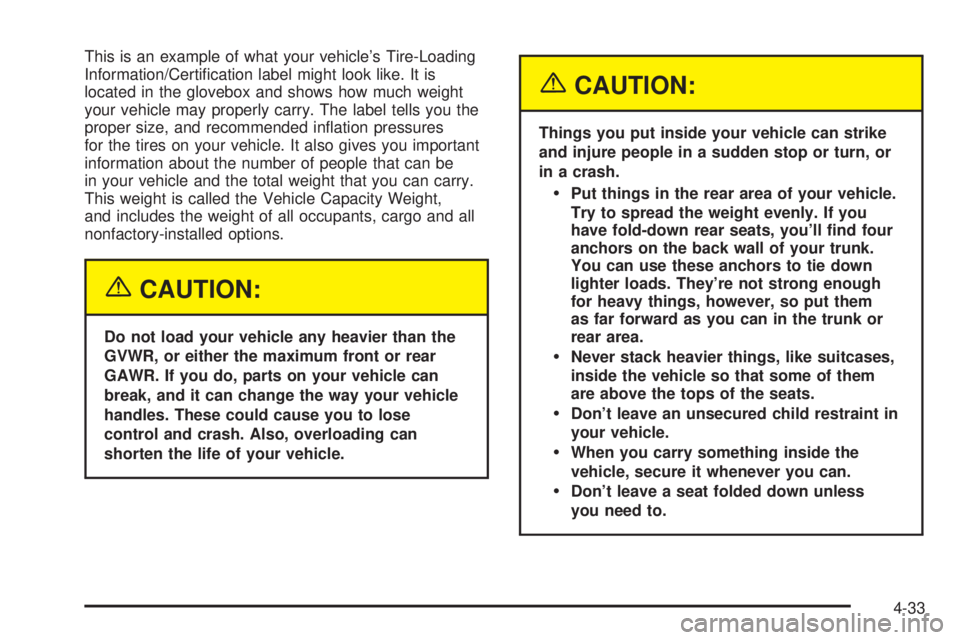
This is an example of what your vehicle's Tire-Loading
Information/Certi®cation label might look like. It is
located in the glovebox and shows how much weight
your vehicle may properly carry. The label tells you the
proper size, and recommended in¯ation pressures
for the tires on your vehicle. It also gives you important
information about the number of people that can be
in your vehicle and the total weight that you can carry.
This weight is called the Vehicle Capacity Weight,
and includes the weight of all occupants, cargo and all
nonfactory-installed options.
{CAUTION:
Do not load your vehicle any heavier than the
GVWR, or either the maximum front or rear
GAWR. If you do, parts on your vehicle can
break, and it can change the way your vehicle
handles. These could cause you to lose
control and crash. Also, overloading can
shorten the life of your vehicle.
{CAUTION:
Things you put inside your vehicle can strike
and injure people in a sudden stop or turn, or
in a crash.
·Put things in the rear area of your vehicle.
Try to spread the weight evenly. If you
have fold-down rear seats, you'll ®nd four
anchors on the back wall of your trunk.
You can use these anchors to tie down
lighter loads. They're not strong enough
for heavy things, however, so put them
as far forward as you can in the trunk or
rear area.
·Never stack heavier things, like suitcases,
inside the vehicle so that some of them
are above the tops of the seats.
·Don't leave an unsecured child restraint in
your vehicle.
·When you carry something inside the
vehicle, secure it whenever you can.
·Don't leave a seat folded down unless
you need to.
4-33
Page 275 of 370

Tire Terminology and De®nitions
Air Pressure:The amount of air inside the tire pressing
outward on each square inch of the tire. Air pressure
is expressed in pounds per square inch (psi) or
kilopascal (kPa).
Accessory Weight:This means the combined weight
of optional accessories, for example, automatic
transmission, power steering, power brakes, power
windows, power seats, radio and air conditioning.
Aspect Ratio:The relationship of a tire's height to
its width.
Belt:A rubber coated layer of cords that is located
between the plies and the tread. Cords may be made
from steel or other reinforcing materials.
Bead:The tire bead contains steel wires that hold the
tire onto the rim.
Bias Ply Tire:A pneumatic tire in which the ply cords
that extend to the beads are laid at alternate angles
substantially less than 90 degrees to the centerline of
the tread.
Cold In¯ation Pressure:The amount of air pressure in
a tire, measured in pounds per square inch (psi) or
kilopascal (kPa), before a tire has built up heat
from driving. See
In¯ation -- Tire Pressure on page 5-67.Curb Weight:This means the weight of a motor
vehicle with standard and optional equipment including
the maximum capacity of fuel, oil and coolant, without
passengers and cargo.
DOT Markings:A code molded into the sidewall of a
tire signifying that the tire is in compliance with the
U.S. Department of Transportation motor vehicle safety
standards. The DOT code includes the Tire Identi®cation
Number (TIN), an alphanumeric designator which can
also identify the tire manufacturer, production plant,
brand and date of production.
GVWR:Gross Vehicle Weight Rating, see
Loading
Your Vehicle on page 4-32.
GAWR FRT:Gross Axle Weight Rating for the front
axle, see
Loading Your Vehicle on page 4-32.
GAWR RR:Gross Axle Weight Rating for the rear axle,
see
Loading Your Vehicle on page 4-32.
Intended Outboard Sidewall:The side of an
asymmetrical tire that must always face outward when
mounted on a vehicle.
Kilopascal (kPa):The metric unit for air pressure.
There are 6.9 kPa's to one psi.
Light Truck (LT-Metric) Tire:A tire used on light duty
trucks and some multipurpose passenger vehicles.
5-65
Page 364 of 370

Light (cont.)
Safety Belt Reminder...................................3-28
Loading Your Vehicle.......................................4-32
Locks............................................................. 2-7
Door........................................................... 2-7
Leaving Your Vehicle..................................... 2-9
Power Door.................................................. 2-8
Rear Door Security Locks............................... 2-8
Long Trip/Highway De®nition.............................. 6-6
Long Trip/Highway Intervals............................... 6-6
Long Trip/Highway Scheduled Maintenance........6-14
Loss of Control...............................................4-14
Low Washer Fluid Warning Light.......................3-39
Luggage Carrier..............................................2-38
M
Maintenance, Normal Replacement Parts..........5-103
Maintenance Schedule.....................................6-19
At Each Fuel Fill.........................................6-19
At Least Once a Month................................6-19
At Least Once a Year..................................6-21
At Least Twice a Year..................................6-20
Brake System Inspection..............................6-25
Engine Cooling System Inspection.................6-25
Exhaust System Inspection...........................6-24
Fuel System Inspection................................6-24
How This Section is Organized....................... 6-3
Introduction.................................................. 6-2
Long Trip/Highway Scheduled Maintenance.....6-14Maintenance Schedule (cont.)
Maintenance Requirements............................. 6-2
Part A - Scheduled Maintenance Services......... 6-4
Part B - Owner Checks and Services.............6-19
Part C - Periodic MaintenanceInspections......6-24
Part D - Recommended Fluids and
Lubricants...............................................6-26
Part E - Maintenance Record........................6-28
Selecting the Right Schedule.......................... 6-5
Short Trip/City Scheduled Maintenance............. 6-7
Steering, Suspension and Front Drive Axle
Boot and Seal Inspection..........................6-24
Throttle System Inspection............................6-25
Using Your................................................... 6-4
Your Vehicle and the Environment................... 6-2
Maintenance When Trailer Towing.....................4-40
Making Turns.................................................4-38
Malfunction Indicator Light................................3-34
Manual Seats................................................... 1-2
Manual Transaxle............................................2-18
Fluid..........................................................5-25
Operation...................................................2-23
Manual Windows............................................2-11
Matching Transmitter(s) to Your Vehicle............... 2-6
Mexico, Central America and Caribbean
Islands/Countries (Except Puerto Rico and
U.S. Virgin Islands) ± Customer Assistance....... 7-5
Mirrors..........................................................2-35
Manual Rearview Mirror................................2-35
Outside Convex Mirror.................................2-36
8
Page 367 of 370

Restraint Systems...........................................1-56
Checking....................................................1-56
Replacing Parts...........................................1-57
Right Front Passenger Position, Safety Belts......1-22
Roadside......................................................... 7-6
Assistance Program....................................... 7-6
Rocking Your Vehicle To Get It Out...................4-28
Running Your Engine While You Are Parked.......2-34
S
Safety Belt.....................................................1-26
Pretensioners..............................................1-26
Reminder Light............................................3-28
Safety Belts...................................................5-92
Care of......................................................5-92
Driver Position............................................1-14
How to Wear Safety Belts Properly................1-14
Questions and Answers About Safety Belts.....1-13
Rear Seat Passengers.................................1-22
Right Front Passenger Position......................1-22
Safety Belt Extender....................................1-26
Safety Belt Use During Pregnancy.................1-21
Safety Belts Are for Everyone......................... 1-8
Safety Chains.................................................4-37
Safety Warnings and Symbols.............................. iii
Seat Operation Check.....................................6-21
Seatback, Folding Passenger............................. 1-5Seats.............................................................. 1-3
Driver Seat Height Adjuster............................. 1-3
Head Restraints............................................ 1-5
Manual........................................................ 1-2
Passenger Folding Seatback........................... 1-5
Rear Seat Operation...................................... 1-7
Reclining Seatbacks...................................... 1-3
Securing a Child Restraint................................1-41
Designed for the LATCH System...................1-41
Rear Seat Position......................................1-42
Right Front Seat Position..............................1-44
Security While You Travel.................................. 7-6
Selecting the Right Schedule, Maintenance.......... 6-5
Service........................................................... 5-3
Adding Equipment to the Outside of Your
Vehicle..................................................... 5-4
Doing Your Own Work................................... 5-3
Engine Soon Light.......................................3-34
Publications Ordering Information...................7-11
Service Bulletins.............................................7-12
Service Manuals.............................................7-11
Setting Preset PTYs (RDS Only)...............3-46, 3-56
Setting Preset Stations............................3-44, 3-53
Setting the Time.............................................3-41
Setting the Tone (Bass/Treble)..................3-44, 3-54
Sheet Metal Damage.......................................5-94
Shift Speeds..................................................2-26
Shifting Into Park (P).......................................2-28
11