Seat PONTIAC VIBE 2004 Owner's Guide
[x] Cancel search | Manufacturer: PONTIAC, Model Year: 2004, Model line: VIBE, Model: PONTIAC VIBE 2004Pages: 370, PDF Size: 2.68 MB
Page 50 of 370
Securing a Child Restraint in the
Right Front Seat Position
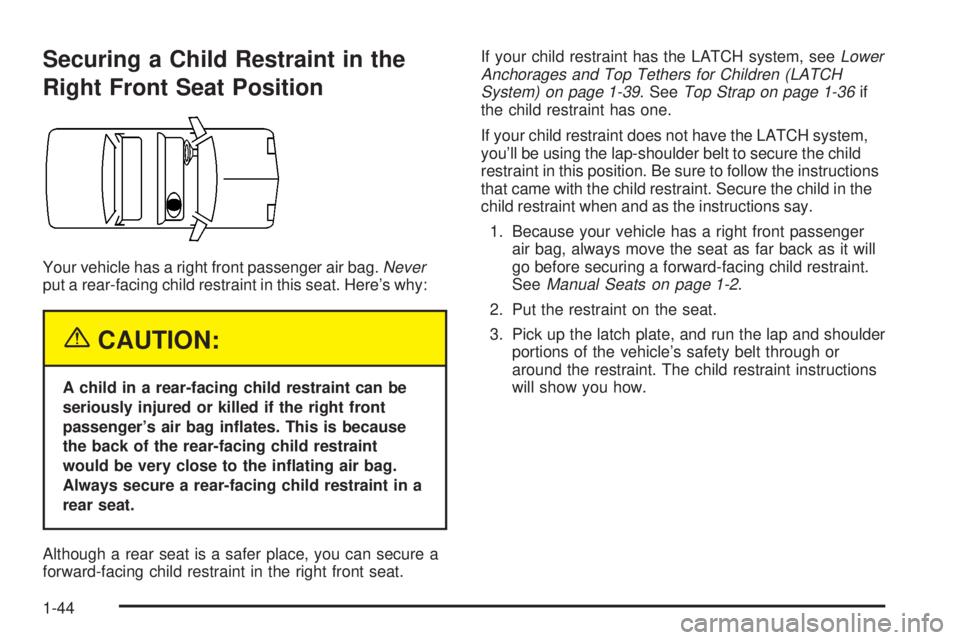
Your vehicle has a right front passenger air bag.Neverput a rear-facing child restraint in this seat. Here's why:
{CAUTION:
A child in a rear-facing child restraint can be
seriously injured or killed if the right front
passenger's air bag in¯ates. This is because
the back of the rear-facing child restraint
would be very close to the in¯ating air bag.
Always secure a rear-facing child restraint in a
rear seat.
Although a rear seat is a safer place, you can secure a
forward-facing child restraint in the right front seat.If your child restraint has the LATCH system, see
Lower
Anchorages and Top Tethers for Children (LATCH
System) on page 1-39
. SeeTop Strap on page 1-36if
the child restraint has one.
If your child restraint does not have the LATCH system,
you'll be using the lap-shoulder belt to secure the child
restraint in this position. Be sure to follow the instructions
that came with the child restraint. Secure the child in the
child restraint when and as the instructions say.
1. Because your vehicle has a right front passenger
air bag, always move the seat as far back as it will
go before securing a forward-facing child restraint.
See
Manual Seats on page 1-2.
2. Put the restraint on the seat.
3. Pick up the latch plate, and run the lap and shoulder
portions of the vehicle's safety belt through or
around the restraint. The child restraint instructions
will show you how.
1-44
Page 53 of 370
Supplemental Restraint System
(SRS)
This part explains the frontal and side impact
Supplemental Restraint Systems (SRS) or air bag
systems.
Your vehicle has air bags ± a frontal air bag for the
driver and another frontal air bag for the right front
passenger. Your vehicle may also have side impact air
bags ± a side impact air bag for the driver and
another side impact air bag for the right front passenger.
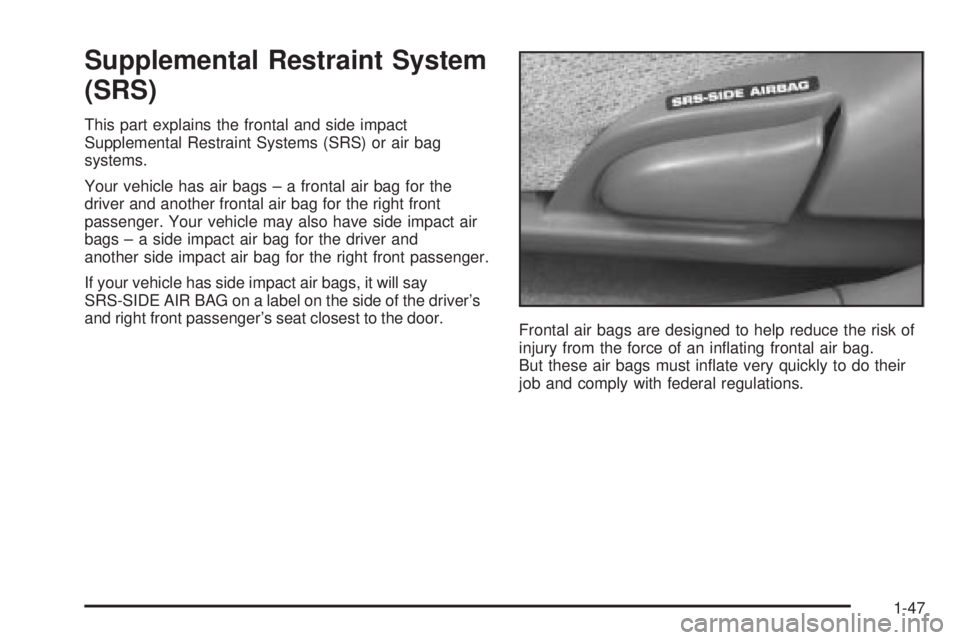
If your vehicle has side impact air bags, it will say
SRS-SIDE AIR BAG on a label on the side of the driver's
and right front passenger's seat closest to the door.
Frontal air bags are designed to help reduce the risk of
injury from the force of an in¯ating frontal air bag.
But these air bags must in¯ate very quickly to do their
job and comply with federal regulations.
1-47
Page 56 of 370
Where Are the Air Bags?
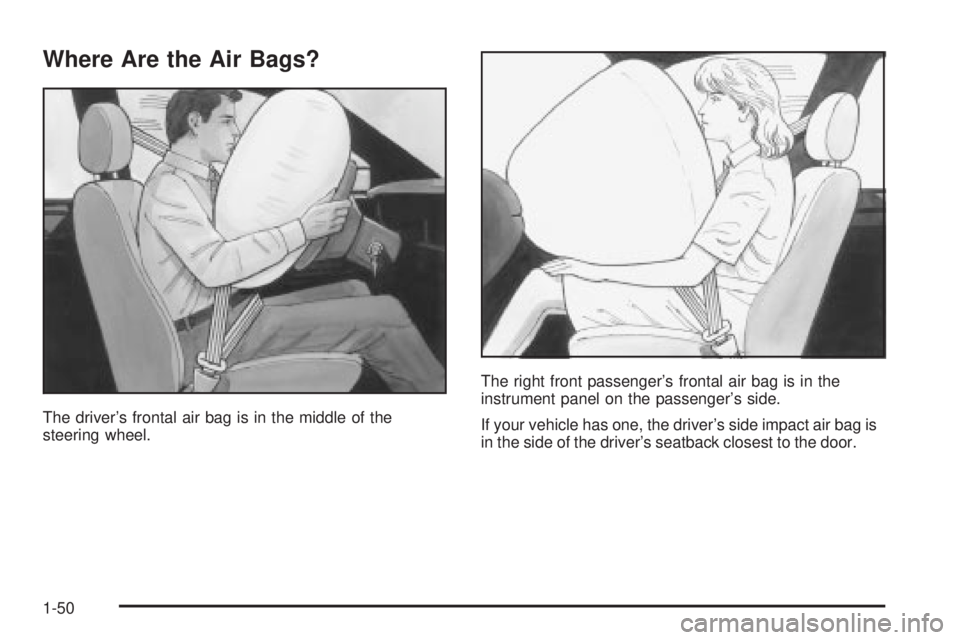
The driver's frontal air bag is in the middle of the
steering wheel.The right front passenger's frontal air bag is in the
instrument panel on the passenger's side.
If your vehicle has one, the driver's side impact air bag is
in the side of the driver's seatback closest to the door.
1-50
Page 57 of 370
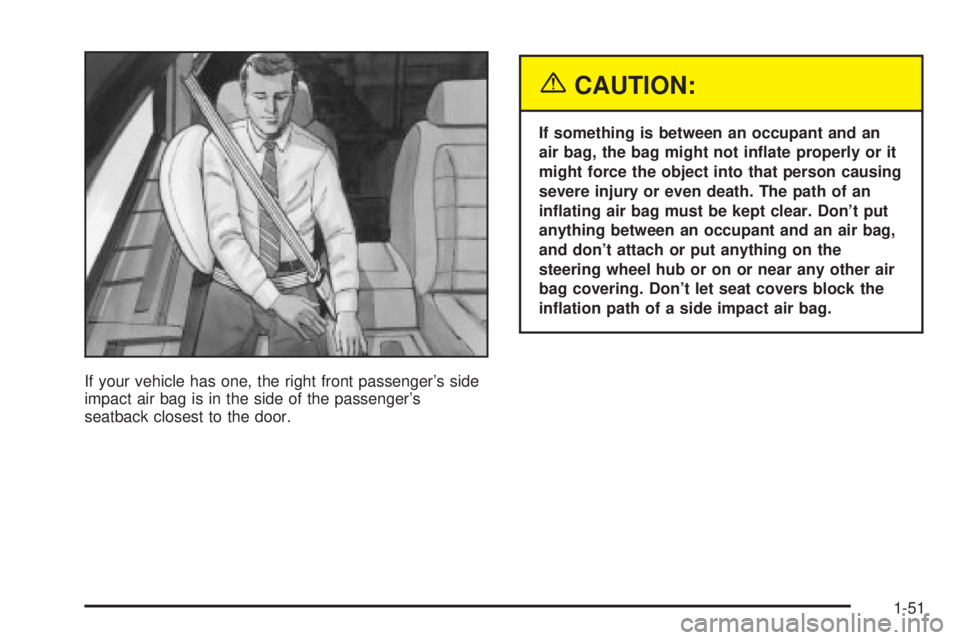
If your vehicle has one, the right front passenger's side
impact air bag is in the side of the passenger's
seatback closest to the door.
{CAUTION:
If something is between an occupant and an
air bag, the bag might not in¯ate properly or it
might force the object into that person causing
severe injury or even death. The path of an
in¯ating air bag must be kept clear. Don't put
anything between an occupant and an air bag,
and don't attach or put anything on the
steering wheel hub or on or near any other air
bag covering. Don't let seat covers block the
in¯ation path of a side impact air bag.
1-51
Page 59 of 370

What Makes an Air Bag In¯ate?
In an impact of sufficient severity, the air bag sensing
system detects that the vehicle is in a crash. For
both frontal and side impact air bags, the sensing
system triggers a release of gas from the in¯ator, which
in¯ates the air bag. The in¯ator, the air bag and
related hardware are all part of the air bag modules.
Frontal air bag modules are located inside the steering
wheel and instrument panel. For vehicles with side
impact air bags, the air bag modules are located in the
seatback closest to the driver's and/or right front
passenger's door.
How Does an Air Bag Restrain?
In moderate to severe frontal or near frontal collisions,
even belted occupants can contact the steering wheel or
the instrument panel. In moderate to severe side
collisions, even belted occupants can contact the inside
of the vehicle. The air bag supplements the protection
provided by safety belts. Air bags distribute the force of
the impact more evenly over the occupant's upper
body, stopping the occupant more gradually. But thefrontal air bags would not help you in many types of
collisions, including rollovers, rear impacts, and
many side impacts, primarily because an occupant's
motion is not toward the air bag. Side impact air bags
would not help you in many types of collisions,
including frontal or near frontal collisions, rollovers, and
rear impacts, primarily because an occupant's motion
is not toward those air bags. Air bags should never
be regarded as anything more than a supplement to
safety belts, and then only in moderate to severe frontal
or near-frontal collisions for the driver's and right front
passenger's frontal air bags, and only in moderate
to severe side collisions for the driver's and right front
passenger's side impact air bag.
1-53
Page 60 of 370

What Will You See After an Air Bag
In¯ates?
After the air bag in¯ates, it quickly de¯ates, so quickly that
some people may not even realize the air bag in¯ated.
Some components of the air bag module ± the steering
wheel hub for the driver's air bag, the instrument panel for
the right front passenger's bag, the side of the seatback
closest to the door for the driver and right passenger's
side impact air bags ± will be hot for a short time. The
parts of the bag that come into contact with you may be
warm, but not too hot to touch. There will be some smoke
and dust coming from the vents in the de¯ated air bags.
Air bag in¯ation doesn't prevent the driver from seeing or
being able to steer the vehicle, nor does it stop people
from leaving the vehicle.
{CAUTION:
When an air bag in¯ates, there is dust in the
air. This dust could cause breathing problems
for people with a history of asthma or other
breathing trouble. To avoid this, everyone in
the vehicle should get out as soon as it is safe
to do so. If you have breathing problems but
can't get out of the vehicle after an air bag
in¯ates, then get fresh air by opening a
window or a door. If you experience breathing
problems following an air bag deployment, you
should seek medical attention.
1-54
Page 61 of 370

In many crashes severe enough to in¯ate an air bag,
windshields are broken by vehicle deformation.
Additional windshield breakage may also occur from the
right front passenger air bag.
·Air bags are designed to in¯ate only once. After an
air bag in¯ates, you'll need some new parts for
your air bag system. If you don't get them, the air
bag system won't be there to help protect you
in another crash. A new system will include air bag
modules and possibly other parts. The service
manual for your vehicle covers the need to replace
other parts.
·Your vehicle is equipped with two electronic frontal
sensors, which help the sensing system distinguish
between a moderate frontal impact and a more
severe frontal impact. Additionally, your vehicle has
two sensors which detect side impacts. These
sensors signal the appropriate side air bag to in¯ate.
Your vehicle is also equipped with a crash sensing
and diagnostic module, which records information
about the frontal air bag system. The module
records information about the readiness of the
system, system status and the driver's and
passenger's safety belt usage at deployment.
·Let only quali®ed technicians work on your air bag
systems. Improper service can mean that an air
bag system won't work properly. See your dealer for
service.
Notice:If you damage the covering for the driver's
or the right front passenger's air bag, or the air
bag covering on the driver's and right front
passenger's seatback, the bag may not work
properly. You may have to replace the air bag
module in the steering wheel, both the air bag
module and the instrument panel for the right front
passenger's air bag, or both the air bag module
and seatback for the driver's and right front
passenger's side impact air bag. Do not open or
break the air bag coverings.
If your vehicle ever gets into a lot of water ± such as
water up to the carpeting or higher ± or if water enters
your vehicle and soaks the carpet, the air bag
controller can be soaked and ruined. If this ever
happens, and then you start your vehicle, the damage
could make the frontal and side impact air bags
in¯ate and safety belt pretensioners activate, even if
there's no crash. You would have to replace the
air bags, all the sensors and related parts, parts of the
safety belt system and parts of the driver and right
front passenger's seatbacks. If your vehicle is ever in a
¯ood, or if it's exposed to water that soaks the carpet,
you can avoid needless repair costs by turning off
the vehicle immediately and disconnecting the battery
cables. Don't let anyone start the vehicle under any
circumstances. See your dealer for service.
1-55
Page 63 of 370
Replacing Restraint System Parts
After a Crash
{CAUTION:
A crash can damage the restraint systems in
your vehicle. A damaged restraint system may
not properly protect the person using it,
resulting in serious injury or even death in a
crash. To help make sure your restraint
systems are working properly after a crash,
have them inspected and any necessary
replacements made as soon as possible.
If you've had a crash, do you need new belts or LATCH
system parts?
After a very minor collision, nothing may be necessary.
But if the belts were stretched, as they would be if
worn during a more severe crash, then you need
new parts.If the LATCH system was being used during a more
severe crash, you may need new LATCH system parts.
If belts are cut or damaged, replace them. Collision
damage also may mean you will need to have LATCH
system, safety belt or seat parts repaired or replaced.
New parts and repairs may be necessary even if the belt
or LATCH system wasn't being used at the time of
the collision.
If the frontal air bags in¯ate, you will also need to
replace the driver's and right front passengr's safety belt
retractor assembly. Be sure to do so. Then the new
retractor assembly will be there to help protect you in a
collision.
If an air bag in¯ates, you'll need to replace air bag
system parts. See the part on the air bag system earlier
in this section.
1-57
Page 94 of 370
Torque Lock
If you are parking on a hill and you don't shift your
automatic transaxle into PARK (P) properly, the weight
of the vehicle may put too much force on the parking
pawl in the transaxle. You may ®nd it difficult to pull the
shift lever out of PARK (P). This is called ªtorque
lock.º To prevent torque lock, set the parking brake and
then shift into PARK (P) properly before you leave
the driver's seat. To ®nd out how, see
Shifting Into Park
(P) on page 2-28.
When you are ready to drive, move the shift lever out of
PARK (P)
beforeyou release the parking brake.
If torque lock does occur, you may need to have another
vehicle push yours a little uphill to take some of the
pressure from the parking pawl in the transaxle, so you
can pull the shift lever out of PARK (P).
Shifting Out of Park (P)
If your vehicle has an automatic transaxle it has an
automatic transaxle shift lock control system. You have
to fully apply your regular brakes before you can
shift from PARK (P) when the ignition is in ON. See
Automatic Transaxle Operation on page 2-20.
If you cannot shift out of PARK (P), ease pressure on the
shift lever ± push the shift lever all the way into PARK (P)
and release the shift lever button as you maintain brake
application. Then press the shift lever button and move
the shift lever into the gear you wish.
2-30
Page 100 of 370
Outside Remote Control Mirrors
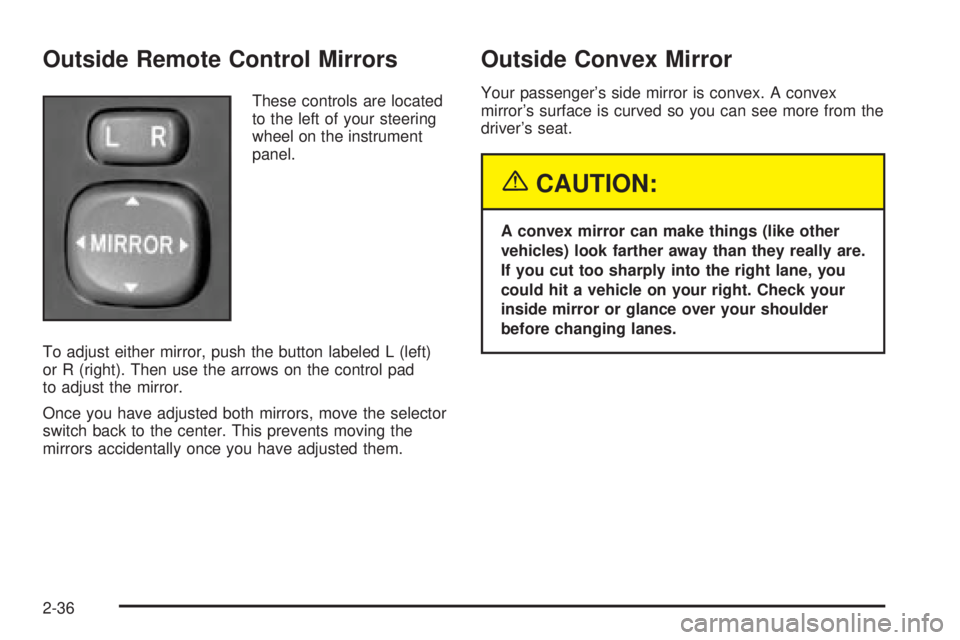
These controls are located
to the left of your steering
wheel on the instrument
panel.
To adjust either mirror, push the button labeled L (left)
or R (right). Then use the arrows on the control pad
to adjust the mirror.
Once you have adjusted both mirrors, move the selector
switch back to the center. This prevents moving the
mirrors accidentally once you have adjusted them.
Outside Convex Mirror
Your passenger's side mirror is convex. A convex
mirror's surface is curved so you can see more from the
driver's seat.
{CAUTION:
A convex mirror can make things (like other
vehicles) look farther away than they really are.
If you cut too sharply into the right lane, you
could hit a vehicle on your right. Check your
inside mirror or glance over your shoulder
before changing lanes.
2-36