change time PONTIAC VIBE 2007 User Guide
[x] Cancel search | Manufacturer: PONTIAC, Model Year: 2007, Model line: VIBE, Model: PONTIAC VIBE 2007Pages: 432, PDF Size: 2.54 MB
Page 187 of 432
4s(Reverse):Press and hold this pushbutton
to reverse quickly within a track. Sound is heard at
a reduced volume. Release the pushbutton to
play the passage. The elapsed time of the track
displays.
EQ (Equalizer):Press EQ to select an
equalization setting while playing a CD. The
equalization is set when a CD is played. See “EQ”
listed previously for more information. If you
select an EQ setting for your CD, it is activated
each time a CD is played.
wSEEKx:Press the down arrow to go to the
start of the current track if more than eight seconds
have played. Press the up arrow to go to the
next track. If either arrow is held or pressed more
than once, the player continues moving backward
or forward through the CD.
wSCANx:Press and hold either arrow for
more than two seconds until SCAN and the track
number displays and a beep sounds. The CD
goes to the next track, plays for a few seconds,
then goes to the next track. Press either arrow
again to stop scanning.RCL (Recall):Push this button to see how long
the current track has been playing. To change the
default on the display, track, and elapsed time,
push the button until the desired option displays,
then hold the button until the display ashes.
The selected display becomes the default. While
elapsed time is showing, CD TIME displays.
BAND:Press this button to listen to the radio
when a CD is playing. The inactive CD remains
inside the radio for future listening.
CD AUX (Auxiliary):Press this button to play a
CD when listening to the radio. The CD symbol
displays when a CD is loaded.
Z(Eject):Press this button to eject a CD. Eject
can be activated with either the ignition or radio
off. CDs can be loaded with the ignition and radio
off if this button is pressed rst.
187
Page 189 of 432
Radio Data System (RDS)
The audio system has a Radio Data System
(RDS). RDS features are available for use only on
FM stations that broadcast RDS information.
With RDS, the radio can do the following:
Seek to stations broadcasting the selected
type of programming
Receive announcements concerning local and
national emergencies
Display messages from radio stations
Seek to stations with traffic announcements
This system relies upon receiving specic
information from these stations and only works
when the information is available. In rare cases, a
radio station can broadcast incorrect information
that causes the radio features to work improperly.
If this happens, contact the radio station.
While the radio is tuned to an RDS station, the
station name or the call letters display instead of
the frequency. RDS stations can also provide
the time of day, a program type (PTY) for current
programming, and the name of the program
being broadcast.
Playing the Radio
PWR (Power):Push this knob to turn the system
on and off.
VOL (Volume):Turn this knob clockwise or
counterclockwise to increase or to decrease the
volume.
RCL (Recall):Push this button to switch the
display between the radio station frequency and
the time. When the ignition is turned off, push this
button to display the time.
To change the default on the display, push the
RCL button until the desired option displays, then
hold the button until the display ashes. The
selected display becomes the default.
Finding a Station
BAND:Press this button to switch between FM1,
FM2, AM, or XM1 or XM2 (if equipped). The
display shows the selection.
TUNE:Turn this knob to select radio stations.
189
Page 196 of 432
4s(Reverse):Press and hold this pushbutton
to reverse quickly within a track. Sound is heard
at a reduced volume. Release this pushbutton
to play the passage. The elapsed time of the track
displays.
6
!(Previous Folder):This button does not
have a function for non-MP3 CDs.
EQ (Equalizer):Press EQ to select the desired
customized equalization setting while playing
a CD. The equalization is automatically set
whenever a CD is played. See “EQ” listed
previously for more information.
wSEEKx:Press the up arrow to go to the
start of the next track. Press the down arrow to go
to the start of the previous track. Pressing
either arrow for more than two seconds searches
the previous or next tracks at two tracks per
second. When the desired track number displays,
release the arrow to stop searching and to play
the track.
wSCANx:Press and hold either arrow for
more than two seconds until SCAN and the track
number displays and a beep sounds. The CD
goes to the next track, plays for a few seconds,
then goes to the next track. Press either arrow
again to stop scanning.
RCL (Recall):Push this button to see how long
the current track has been playing. To change the
default on the display, track and elapsed time,
push the button until the desired option displays,
then hold the button until the display ashes.
The selected display is now the default. While
elapsed time displays, CD TIME displays.
BAND:Press this button to listen to the radio
when a CD is playing. The inactive CD remains
inside the radio for future listening.
CD AUX (Auxiliary):Press this button to play a
CD when listening to the radio. The CD symbol
displays when a CD is loaded.
Z(Eject):Press this button to eject a CD. Eject
can be activated with either the ignition or radio
off. CDs can be loaded with the radio and ignition
off if this button is pressed rst.
196
Page 198 of 432
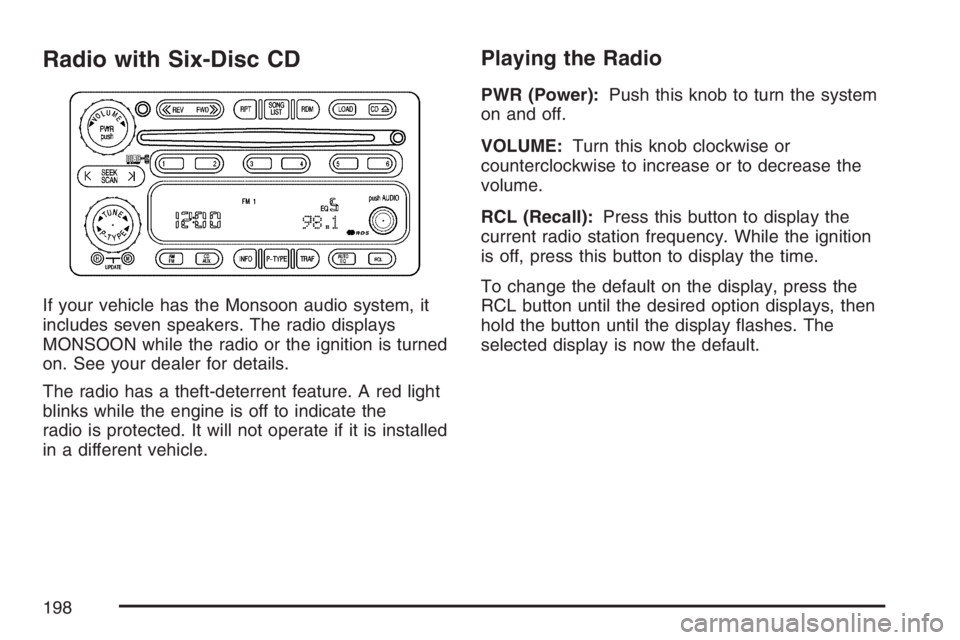
Radio with Six-Disc CD
If your vehicle has the Monsoon audio system, it
includes seven speakers. The radio displays
MONSOON while the radio or the ignition is turned
on. See your dealer for details.
The radio has a theft-deterrent feature. A red light
blinks while the engine is off to indicate the
radio is protected. It will not operate if it is installed
in a different vehicle.
Playing the Radio
PWR (Power):Push this knob to turn the system
on and off.
VOLUME:Turn this knob clockwise or
counterclockwise to increase or to decrease the
volume.
RCL (Recall):Press this button to display the
current radio station frequency. While the ignition
is off, press this button to display the time.
To change the default on the display, press the
RCL button until the desired option displays, then
hold the button until the display ashes. The
selected display is now the default.
198
Page 207 of 432
AUTO EQ (Automatic Equalization):Press
AUTO EQ to select the equalization setting while
playing a CD. The equalization is stored
whenever a CD is played. For more information on
AUTO EQ, see “AUTO EQ” listed previously in
this section.
sSEEKt:Press the left arrow to go to the
start of the current track, if more than ten seconds
have played. Press the right arrow to go to the
next track. If either arrow is held or pressed more
than once, the player continues moving backward
or forward through the CD.
sSCANt:To scan one CD, press and hold
either SCAN arrow for more than two seconds until
SCAN displays and a beep sounds. The radio
goes to the next track, plays for 10 seconds, then
goes to the next track. Press either SCAN
arrow again, to stop scanning.
To scan all loaded CDs, press and hold either
SCAN arrow for more than four seconds until CD
SCAN displays and a beep sounds. Use this
feature to listen to 10 seconds of the rst track of
each loaded CD. Press either SCAN arrow
again, to stop scanning.RCL (Recall):Press this button to see how long
the current track has been playing. To change
the default on the display, track, and elapsed time,
press the button until the desired display is
shown, then hold the button until the display
ashes. The selected display becomes the default.
AM/FM:Press this button to listen to the radio
when a CD is playing. The inactive CD(s) remains
inside the radio for future listening.
CD AUX (Auxiliary):Press this button to play a
CD when listening to the radio.Using Song List Mode
The six-disc CD changer has a feature called
song list. This feature is capable of saving 20 track
selections.
To save tracks into the song list feature, perform
the following steps:
1. Turn the CD player on and load it with at least
one CD. See “LOAD CD” listed previously in
this section for more information.
2. Check to see that the CD changer is not in
song list mode. S-LIST should not display. If
S-LIST displays, press the SONG LIST
button to turn it off.
207
Page 215 of 432
RCL (Recall):Push this button to switch between
track mode, folder, or playlist mode, and time of
day mode. The display shows only 13 characters,
but there can be up to three pages of text. If
there are more than 13 characters in the song,
folder, or playlist name pushing this button within
two seconds takes you to the next page of
text. If there are no other pages to be shown,
pushing this button within two seconds takes you
to the next display mode.
Track mode displays the current track number and
the ID3 tag song name.
Folder/playlist mode displays the current folder or
playlist number and the folder/playlist name.
Time of day mode displays the time of day and
the ID3 tag song name.
To change the default on the display, push this
button until you see the desired display, then hold
this button for two seconds. The radio produces
one beep and the selected display is now the
default.INFO (Information):INFO displays whenever a
current track has ID3 tag information. Press
this button to display the artist name and album
contained in the tag. INFO disappears from
the display when the information in the ID3 tag
has nished.
BAND:Press this button to listen to the radio
when a CD is playing. The inactive CD remains
inside the radio for future listening.
CD AUX (Auxiliary):Press this button to play a
CD when listening to the radio. The CD symbol
displays when a CD is loaded.
Z(Eject):Press this button to eject a CD. Eject
may be activated with either the ignition or radio
off. CDs can be loaded with the radio and
ignition off if this button is pressed rst.
215
Page 229 of 432
If your vehicle has the vehicle stability control
system, it includes a brake assist system which
provides more powerful braking during a sudden,
hard brake application. See “Vehicle Stability
Control System” underTraction Control System
(TCS) on page 230.
Remember: ABS does not change the time you
need to get your foot up to the brake pedal
or always decrease stopping distance. If you get
too close to the vehicle in front of you, you will not
have time to apply your brakes if that vehicle
suddenly slows or stops. Always leave enough
room up ahead to stop, even though you
have ABS.
Using ABS
Do not pump the brakes. Just hold the brake
pedal down rmly and let anti-lock work for you.
You may feel a slight brake pedal pulsation
or notice some noise, but this is normal.
Braking in Emergencies
At some time, nearly every driver gets into a
situation that requires hard braking.If you have ABS, you can steer and brake at the
same time. However, if you do not have ABS, your
rst reaction — to hit the brake pedal hard and hold
it down — may be the wrong thing to do. Your
wheels can stop rolling. Once they do, the vehicle
cannot respond to your steering. Momentum will
carry it in whatever direction it was headed when
the wheels stopped rolling. That could be off the
road, into the very thing you were trying to avoid, or
into traffic.
If you do not have ABS, use a “squeeze” braking
technique. This will give you maximum braking
while maintaining steering control. You can do this
by pushing on the brake pedal with steadily
increasing pressure.
In an emergency, you will probably want to
squeeze the brakes hard without locking the
wheels. If you hear or feel the wheels sliding, ease
off the brake pedal. This will help you retain
steering control. If you do have ABS, it is different.
SeeAnti-Lock Brake System (ABS) on page 227.
In many emergencies, steering can help you
more than even the very best braking.
229
Page 236 of 432
When it looks like a chance to pass is coming
up, start to accelerate but stay in the right
lane and do not get too close. Time your move
so you will be increasing speed as the time
comes to move into the other lane. If the way
is clear to pass, you will have a running
start that more than makes up for the distance
you would lose by dropping back. And if
something happens to cause you to cancel
your pass, you need only slow down and drop
back again and wait for another opportunity.
If other vehicles are lined up to pass a slow
vehicle, wait your turn. But take care that
someone is not trying to pass you as you pull
out to pass the slow vehicle. Remember to
glance over your shoulder and check the
blind spot.
Check your vehicle’s mirrors, glance over your
shoulder, and start your left lane change
signal before moving out of the right lane to
pass. When you are far enough ahead of
the passed vehicle to see its front in
your vehicle’s inside mirror, activate the right
lane change signal and move back into
the right lane. Remember that your vehicle’s
passenger side outside mirror is convex.
The vehicle you just passed may seem to be
farther away from you than it really is.
Try not to pass more than one vehicle at a
time on two-lane roads. Reconsider before
passing the next vehicle.
Do not overtake a slowly moving vehicle too
rapidly. Even though the brake lamps are
not ashing, it may be slowing down or starting
to turn.
If you are being passed, make it easy for the
following driver to get ahead of you. Perhaps
you can ease a little to the right.
236
Page 262 of 432

Trailering is different than just driving your vehicle
by itself. Trailering means changes in handling,
acceleration, braking, durability and fuel economy.
Successful, safe trailering takes correct
equipment, and it has to be used properly.
That’s the reason for this part. In it are many
time-tested, important trailering tips and safety
rules. Many of these are important for your safety
and that of your passengers. So please read
this section carefully before you pull a trailer.
Load-pulling components such as the engine,
transaxle, wheel assemblies and tires are forced
to work harder against the drag of the added
weight. The engine is required to operate
at relatively higher speeds and under greater
loads, generating extra heat. What’s more,
the trailer adds considerably to wind resistance,
increasing the pulling requirements.If You Do Decide To Pull A Trailer
If you do, here are some important points:
There are many different laws, including speed
limit restrictions, having to do with trailering.
Make sure your rig will be legal, not only where
you live but also where you’ll be driving. A
good source for this information can be state
or provincial police.
Consider using a sway control. You can ask a
hitch dealer about sway controls.
Don’t tow a trailer at all during the rst
1,000 miles (1 600 km) your new vehicle is
driven. Your engine, axle or other parts could
be damaged.
Then, during the rst 500 miles (800 km) that
you tow a trailer, don’t drive over 50 mph
(80 km/h) and don’t make starts at full throttle.
This helps your engine and other parts of
your vehicle wear in at the heavier loads.
Obey speed limit restrictions when towing a
trailer. Don’t drive faster than the maximum
posted speed for trailers, or no more than
55 mph (90 km/h), to save wear on your
vehicle’s parts.
262
Page 290 of 432
Automatic Transaxle Fluid
When to Check and Change Automatic
Transaxle Fluid
A good time to check your automatic transaxle
uid level is when the engine oil is changed.
Check the uid in the transaxle and differential
at the intervals listed inPart A: Scheduled
Maintenance Services on page 376, and
be sure to use the transaxle uid listed in
Part D: Recommended Fluids and Lubricants
on page 394.
How to Check Automatic Transaxle
Fluid
Because this operation can be a little difficult, you
may choose to have this done at the dealership
service department.
If you do it yourself, be sure to follow all the
instructions here, or you could get a false reading
on the dipstick.Notice:Too much or too little uid can damage
the transaxle. Too much can mean that some of
the uid could come out and fall on hot engine
or exhaust system parts, starting a re. Too
little uid could cause the transaxle to overheat.
Be sure to get an accurate reading if you check
the transaxle uid.
Wait at least 30 minutes before checking the
transaxle uid level if you have been driving:
When outside temperatures are above 90°F
(32°C).
At high speed for quite a while.
In heavy traffic — especially in hot weather.
While pulling a trailer.
To get the right reading, the uid should be at
normal operating temperature, which is 158°F to
176°F (70°C to 80°C).
Get the vehicle warmed up by driving about
15 miles (24 km) when outside temperatures are
above 50°F (10°C). If it is colder than 50°F (10°C),
you may have to drive longer.
290