mirror PONTIAC VIBE 2007 User Guide
[x] Cancel search | Manufacturer: PONTIAC, Model Year: 2007, Model line: VIBE, Model: PONTIAC VIBE 2007Pages: 432, PDF Size: 2.54 MB
Page 238 of 432
If you have the Anti-Lock Brake System (ABS),
remember: It helps avoid only the braking skid. If
you do not have ABS, then in a braking skid,
where the wheels are no longer rolling, release
enough pressure on the brakes to get the wheels
rolling again. This restores steering control.
Push the brake pedal down steadily when you
have to stop suddenly. As long as the wheels are
rolling, you will have steering control.
Driving at Night
Night driving is more dangerous than day driving.
One reason is that some drivers are likely to
be impaired — by alcohol or drugs, with night
vision problems, or by fatigue.
Here are some tips on night driving.
Drive defensively.
Do not drink and drive.
Adjust the inside rearview mirror to reduce the
glare from headlamps behind you.
Since you cannot see as well, you may need
to slow down and keep more space between
you and other vehicles.
Slow down, especially on higher speed roads.
Your vehicle’s headlamps can light up only so
much road ahead.
In remote areas, watch for animals.
If you are tired, pull off the road in a safe
place and rest.
No one can see as well at night as in the daytime.
But as we get older these differences increase.
A 50-year-old driver may require at least twice as
much light to see the same thing at night as a
20-year-old.
What you do in the daytime can also affect your
night vision. For example, if you spend the
day in bright sunshine you are wise to wear
sunglasses. Your eyes will have less trouble
adjusting to night. But if you are driving, do not
wear sunglasses at night. They may cut down on
glare from headlamps, but they also make a
lot of things invisible.
238
Page 243 of 432
Freeway Driving
Mile for mile, freeways — also called thruways,
parkways, expressways, turnpikes, or
superhighways — are the safest of all roads.
But they have their own special rules.
The most important advice on freeway driving
is: Keep up with traffic and keep to the right. Drive
at the same speed most of the other drivers aredriving. Too-fast or too-slow driving breaks a
smooth traffic ow. Treat the left lane on a freeway
as a passing lane.
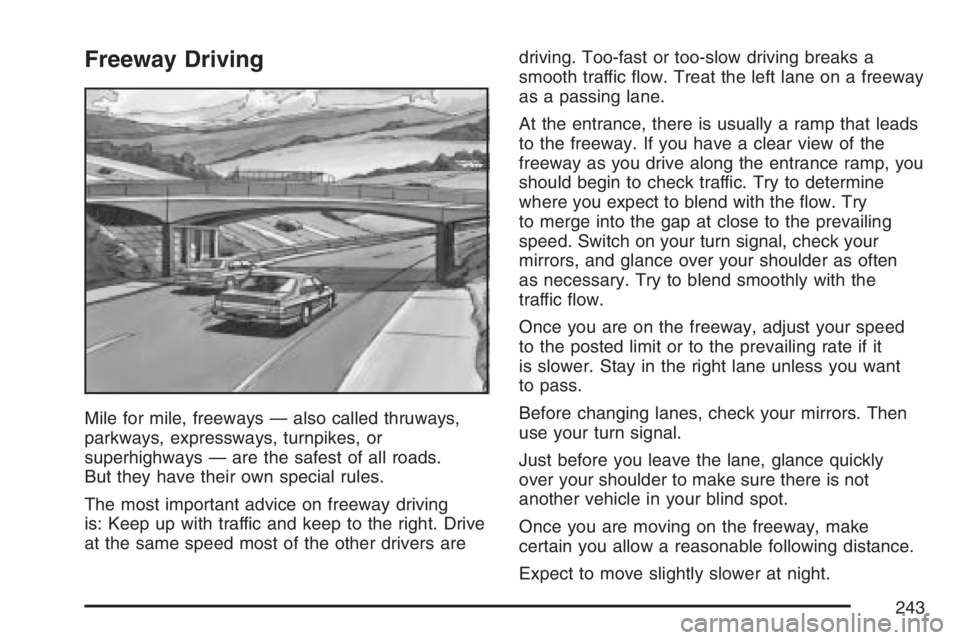
At the entrance, there is usually a ramp that leads
to the freeway. If you have a clear view of the
freeway as you drive along the entrance ramp, you
should begin to check traffic. Try to determine
where you expect to blend with the ow. Try
to merge into the gap at close to the prevailing
speed. Switch on your turn signal, check your
mirrors, and glance over your shoulder as often
as necessary. Try to blend smoothly with the
traffic ow.
Once you are on the freeway, adjust your speed
to the posted limit or to the prevailing rate if it
is slower. Stay in the right lane unless you want
to pass.
Before changing lanes, check your mirrors. Then
use your turn signal.
Just before you leave the lane, glance quickly
over your shoulder to make sure there is not
another vehicle in your blind spot.
Once you are moving on the freeway, make
certain you allow a reasonable following distance.
Expect to move slightly slower at night.
243
Page 245 of 432
Highway Hypnosis
Is there actually such a condition as highway
hypnosis? Or is it just plain falling asleep at the
wheel? Call it highway hypnosis, lack of
awareness, or whatever.
There is something about an easy stretch of road
with the same scenery, along with the hum of
the tires on the road, the drone of the engine, and
the rush of the wind against the vehicle that
can make you sleepy. Do not let it happen to you!
If it does, your vehicle can leave the road in
less than a second, and you could crash and
be injured.What can you do about highway hypnosis? First,
be aware that it can happen.
Then here are some tips:
Make sure your vehicle is well ventilated, with
a comfortably cool interior.
Keep your eyes moving. Scan the road ahead
and to the sides. Check your rearview mirrors
and your instruments frequently.
If you get sleepy, pull off the road into a rest,
service, or parking area and take a nap, get
some exercise, or both. For safety, treat
drowsiness on the highway as an emergency.
245
Page 265 of 432

Safety Chains
You should always attach chains between your
vehicle and your trailer. Cross the safety
chains under the tongue of the trailer so that the
tongue will not drop to the road if it becomes
separated from the hitch. Instructions about safety
chains may be provided by the hitch manufacturer
or by the trailer manufacturer. Follow the
manufacturer’s recommendation for attaching
safety chains and do not attach them to the
bumper. Always leave just enough slack so you
can turn with your rig. And, never allow safety
chains to drag on the ground.
Trailer Brakes
Does your trailer have its own brakes?
Be sure to read and follow the instructions for the
trailer brakes so you’ll be able to install, adjust
and maintain them properly. And, if you have
anti-lock brakes, do not try to tap into your
vehicle’s brake system. If you do, both systems
won’t work well, or at all.
Driving with a Trailer
Towing a trailer requires a certain amount of
experience. Before setting out for the open road,
you’ll want to get to know your rig. Acquaint
yourself with the feel of handling and braking with
the added weight of the trailer. And always
keep in mind that the vehicle you are driving is
now a good deal longer and not nearly as
responsive as your vehicle is by itself.
Before you start, check the trailer hitch, platform
and attachments, safety chains, electrical
connector, lamps, tires and mirror adjustment. If
the trailer has electric brakes, start your vehicle
and trailer moving and then apply the trailer brake
controller by hand to be sure the brakes are
working. This lets you check your electrical
connection at the same time.
During your trip, check occasionally to be sure
that the load is secure, and that the lamps and any
trailer brakes are still working.
265
Page 366 of 432
Fuses Usage
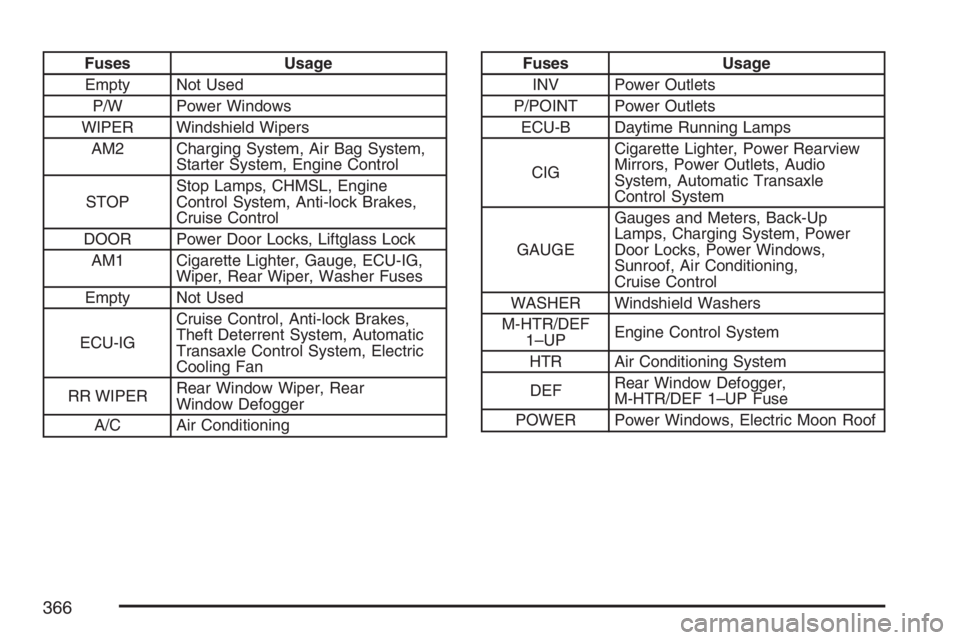
Empty Not Used
P/W Power Windows
WIPER Windshield Wipers
AM2 Charging System, Air Bag System,
Starter System, Engine Control
STOPStop Lamps, CHMSL, Engine
Control System, Anti-lock Brakes,
Cruise Control
DOOR Power Door Locks, Liftglass Lock
AM1 Cigarette Lighter, Gauge, ECU-IG,
Wiper, Rear Wiper, Washer Fuses
Empty Not Used
ECU-IGCruise Control, Anti-lock Brakes,
Theft Deterrent System, Automatic
Transaxle Control System, Electric
Cooling Fan
RR WIPERRear Window Wiper, Rear
Window Defogger
A/C Air ConditioningFuses Usage
INV Power Outlets
P/POINT Power Outlets
ECU-B Daytime Running Lamps
CIGCigarette Lighter, Power Rearview
Mirrors, Power Outlets, Audio
System, Automatic Transaxle
Control System
GAUGEGauges and Meters, Back-Up
Lamps, Charging System, Power
Door Locks, Power Windows,
Sunroof, Air Conditioning,
Cruise Control
WASHER Windshield Washers
M-HTR/DEF
1–UPEngine Control System
HTR Air Conditioning System
DEFRear Window Defogger,
M-HTR/DEF 1–UP Fuse
POWER Power Windows, Electric Moon Roof
366
Page 427 of 432
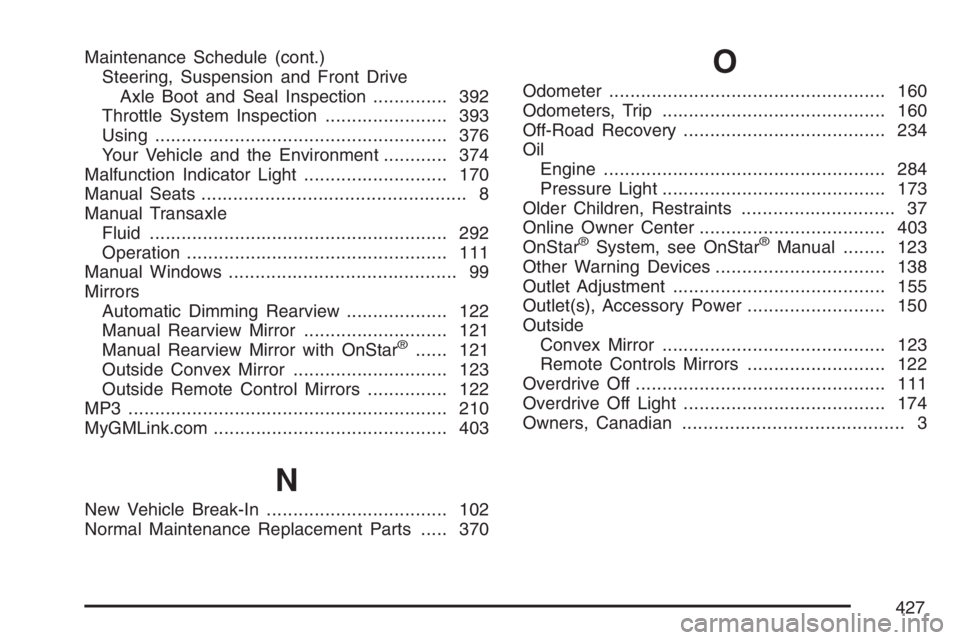
Maintenance Schedule (cont.)
Steering, Suspension and Front Drive
Axle Boot and Seal Inspection.............. 392
Throttle System Inspection....................... 393
Using....................................................... 376
Your Vehicle and the Environment............ 374
Malfunction Indicator Light........................... 170
Manual Seats.................................................. 8
Manual Transaxle
Fluid........................................................ 292
Operation................................................. 111
Manual Windows........................................... 99
Mirrors
Automatic Dimming Rearview................... 122
Manual Rearview Mirror........................... 121
Manual Rearview Mirror with OnStar
®...... 121
Outside Convex Mirror............................. 123
Outside Remote Control Mirrors............... 122
MP3 ............................................................ 210
MyGMLink.com............................................ 403
N
New Vehicle Break-In.................................. 102
Normal Maintenance Replacement Parts..... 370
O
Odometer.................................................... 160
Odometers, Trip.......................................... 160
Off-Road Recovery...................................... 234
Oil
Engine..................................................... 284
Pressure Light.......................................... 173
Older Children, Restraints............................. 37
Online Owner Center................................... 403
OnStar
®System, see OnStar®Manual........ 123
Other Warning Devices................................ 138
Outlet Adjustment........................................ 155
Outlet(s), Accessory Power.......................... 150
Outside
Convex Mirror.......................................... 123
Remote Controls Mirrors.......................... 122
Overdrive Off............................................... 111
Overdrive Off Light...................................... 174
Owners, Canadian.......................................... 3
427
Page 429 of 432
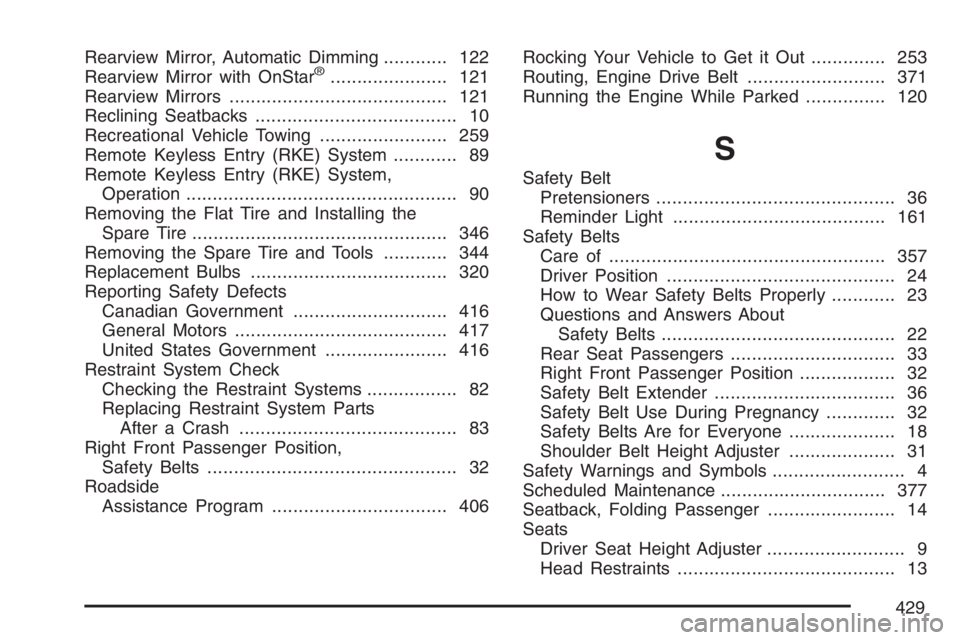
Rearview Mirror, Automatic Dimming............ 122
Rearview Mirror with OnStar®...................... 121
Rearview Mirrors......................................... 121
Reclining Seatbacks...................................... 10
Recreational Vehicle Towing........................ 259
Remote Keyless Entry (RKE) System............ 89
Remote Keyless Entry (RKE) System,
Operation................................................... 90
Removing the Flat Tire and Installing the
Spare Tire................................................ 346
Removing the Spare Tire and Tools............ 344
Replacement Bulbs..................................... 320
Reporting Safety Defects
Canadian Government............................. 416
General Motors........................................ 417
United States Government....................... 416
Restraint System Check
Checking the Restraint Systems................. 82
Replacing Restraint System Parts
After a Crash......................................... 83
Right Front Passenger Position,
Safety Belts............................................... 32
Roadside
Assistance Program................................. 406Rocking Your Vehicle to Get it Out.............. 253
Routing, Engine Drive Belt.......................... 371
Running the Engine While Parked............... 120
S
Safety Belt
Pretensioners............................................. 36
Reminder Light........................................ 161
Safety Belts
Care of.................................................... 357
Driver Position........................................... 24
How to Wear Safety Belts Properly............ 23
Questions and Answers About
Safety Belts............................................ 22
Rear Seat Passengers............................... 33
Right Front Passenger Position.................. 32
Safety Belt Extender.................................. 36
Safety Belt Use During Pregnancy............. 32
Safety Belts Are for Everyone.................... 18
Shoulder Belt Height Adjuster.................... 31
Safety Warnings and Symbols......................... 4
Scheduled Maintenance............................... 377
Seatback, Folding Passenger........................ 14
Seats
Driver Seat Height Adjuster.......................... 9
Head Restraints......................................... 13
429