mirror PONTIAC VIBE 2007 Owners Manual
[x] Cancel search | Manufacturer: PONTIAC, Model Year: 2007, Model line: VIBE, Model: PONTIAC VIBE 2007Pages: 432, PDF Size: 2.54 MB
Page 1 of 432
Seats and Restraint Systems
....................... 7
Front Seats
.............................................. 8
Rear Seats
............................................. 16
Safety Belts
............................................ 18
Child Restraints
...................................... 37
Airbag System
........................................ 63
Restraint System Check
......................... 82
Features and Controls
................................ 85
Keys
....................................................... 87
Doors and Locks
.................................... 92
Windows
................................................ 98
Theft-Deterrent Systems
....................... 100
Starting and Operating Your Vehicle
..... 102
Mirrors
.................................................. 121
OnStar
®System
................................... 123
Storage Areas
...................................... 127
Sunroof
................................................ 131Instrument Panel
....................................... 133
Instrument Panel Overview
................... 136
Climate Controls
................................... 152
Warning Lights, Gages, and
Indicators
.......................................... 158
Audio System(s)
................................... 177
Driving Your Vehicle
................................. 221
Your Driving, the Road, and
Your Vehicle
..................................... 222
Towing
................................................. 259
Service and Appearance Care
.................. 269
Service
................................................. 272
Fuel
...................................................... 274
Checking Things Under the Hood
......... 280
Bulb Replacement
................................ 315
Windshield Wiper Blade Replacement
... 321
2007 Pontiac Vibe Owner ManualM
1
Page 85 of 432
Keys.............................................................. 87
Remote Keyless Entry (RKE) System.......... 89
Remote Keyless Entry (RKE) System
Operation................................................. 90
Doors and Locks.......................................... 92
Door Locks................................................. 92
Power Door Locks....................................... 94
Rear Door Security Locks........................... 95
Liftgate/Liftglass........................................... 96
Windows....................................................... 98
Manual Windows......................................... 99
Power Windows.......................................... 99
Sun Visors.................................................. 99
Theft-Deterrent Systems............................. 100
Content Theft-Deterrent............................. 100
Starting and Operating Your Vehicle......... 102
New Vehicle Break-In................................ 102
Ignition Positions....................................... 103
Starting the Engine.................................... 104
Engine Coolant Heater.............................. 106Automatic Transaxle Operation.................. 108
Overdrive Off............................................. 111
Manual Transaxle Operation...................... 111
Parking Brake........................................... 114
Shifting Into Park (P)
(Automatic Transaxle)............................ 115
Shifting Out of Park (P)
(Automatic Transaxle)............................ 117
Parking Your Vehicle
(Manual Transaxle)................................ 118
Parking Over Things That Burn................. 118
Engine Exhaust......................................... 119
Running the Engine While Parked............. 120
Mirrors......................................................... 121
Manual Rearview Mirror............................. 121
Manual Rearview Mirror with OnStar
®....... 121
Automatic Dimming Rearview Mirror.......... 122
Outside Remote Control Mirrors................ 122
Outside Convex Mirror............................... 123
OnStar
®System.......................................... 123
Section 2 Features and Controls
85
Page 99 of 432
Manual Windows
Use the window crank to open and close each
window.
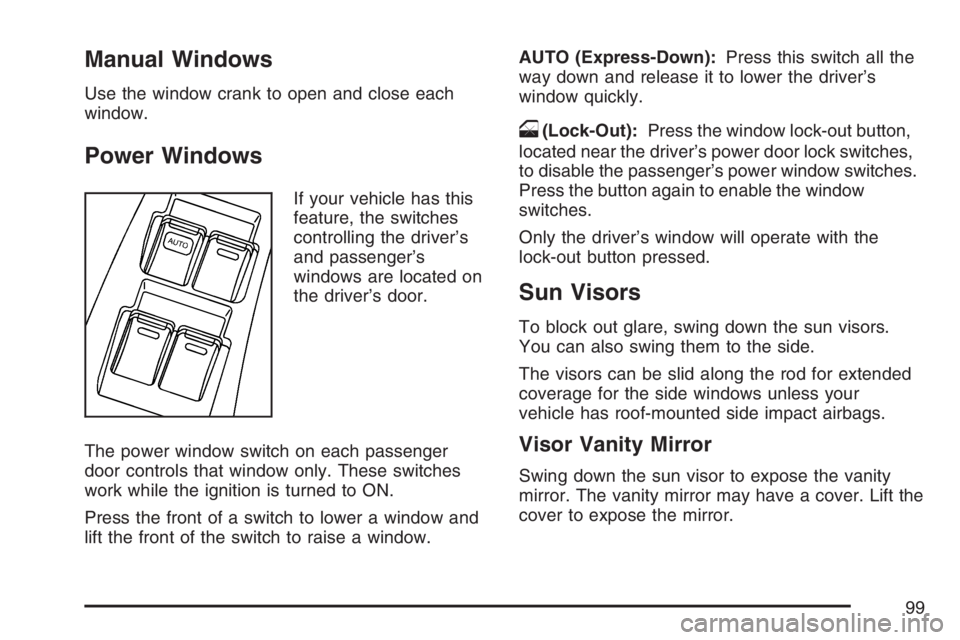
Power Windows
If your vehicle has this
feature, the switches
controlling the driver’s
and passenger’s
windows are located on
the driver’s door.
The power window switch on each passenger
door controls that window only. These switches
work while the ignition is turned to ON.
Press the front of a switch to lower a window and
lift the front of the switch to raise a window.AUTO (Express-Down):Press this switch all the
way down and release it to lower the driver’s
window quickly.
o(Lock-Out):Press the window lock-out button,
located near the driver’s power door lock switches,
to disable the passenger’s power window switches.
Press the button again to enable the window
switches.
Only the driver’s window will operate with the
lock-out button pressed.
Sun Visors
To block out glare, swing down the sun visors.
You can also swing them to the side.
The visors can be slid along the rod for extended
coverage for the side windows unless your
vehicle has roof-mounted side impact airbags.
Visor Vanity Mirror
Swing down the sun visor to expose the vanity
mirror. The vanity mirror may have a cover. Lift the
cover to expose the mirror.
99
Page 121 of 432
Mirrors
Manual Rearview Mirror
While sitting in a comfortable driving position,
adjust the mirror so you can see clearly behind
your vehicle. Move the mirror in the center to
move it up or down and side to side.
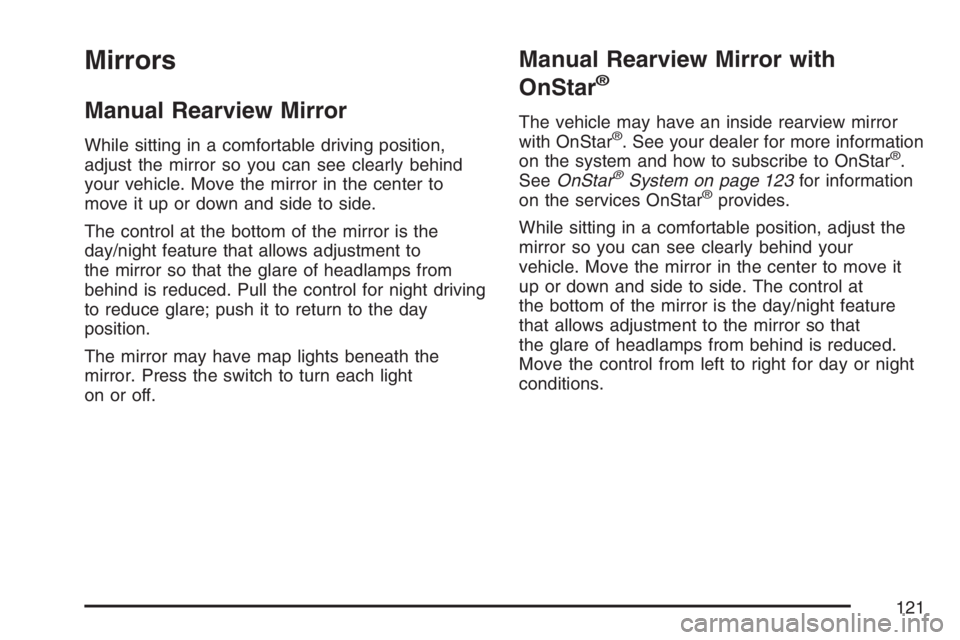
The control at the bottom of the mirror is the
day/night feature that allows adjustment to
the mirror so that the glare of headlamps from
behind is reduced. Pull the control for night driving
to reduce glare; push it to return to the day
position.
The mirror may have map lights beneath the
mirror. Press the switch to turn each light
on or off.
Manual Rearview Mirror with
OnStar
®
The vehicle may have an inside rearview mirror
with OnStar®. See your dealer for more information
on the system and how to subscribe to OnStar®.
SeeOnStar®System on page 123for information
on the services OnStar®provides.
While sitting in a comfortable position, adjust the
mirror so you can see clearly behind your
vehicle. Move the mirror in the center to move it
up or down and side to side. The control at
the bottom of the mirror is the day/night feature
that allows adjustment to the mirror so that
the glare of headlamps from behind is reduced.
Move the control from left to right for day or night
conditions.
121
Page 122 of 432
Automatic Dimming Rearview Mirror
While sitting in a comfortable driving position,
adjust the mirror so you can see clearly behind
your vehicle. Hold the mirror in the center to move
it up or down and side to side.
The mirror may have an automatic dimming
feature that darkens gradually to reduce the glare
of headlamps from behind. When the ignition
key is inserted and turned on, the inside rear view
mirror always turns on in the automatic function
mode. An indicator light located on the mirror
will come on to show you that the function is on.
When the inside air temperature is low, it may take
a little longer for the mirror to darken in response
to the detection of headlights. Press the button
in the center of the mirror to turn this feature
on or off.
One photocell on the front of the mirror senses
when it is becoming dark outside. Another
photocell, facing rearward, senses headlamps
behind you.
To keep the photocells operating well, occasionally
clean them with a cotton swab and glass cleaner.
Outside Remote Control Mirrors
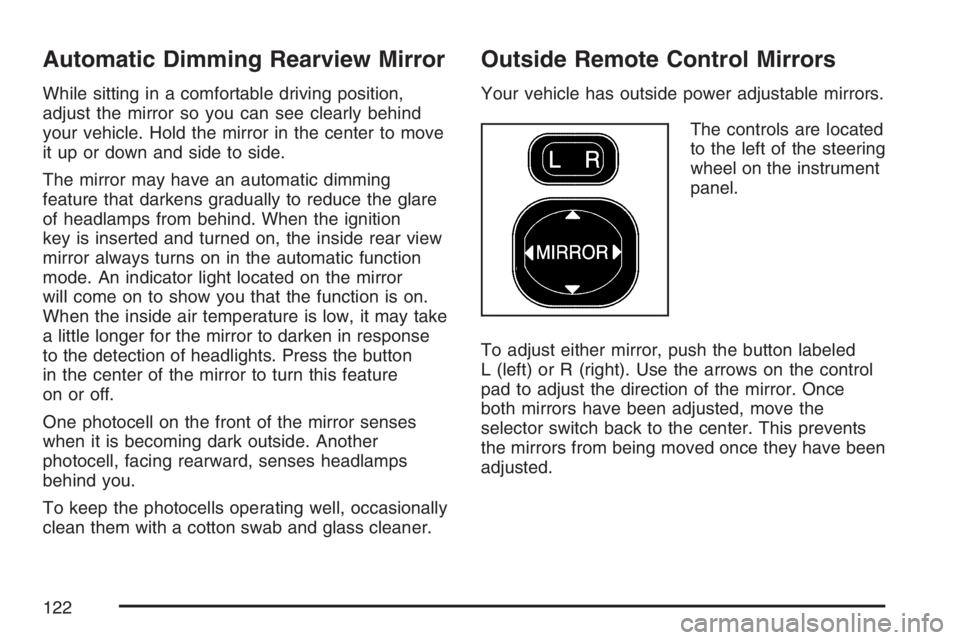
Your vehicle has outside power adjustable mirrors.
The controls are located
to the left of the steering
wheel on the instrument
panel.
To adjust either mirror, push the button labeled
L (left) or R (right). Use the arrows on the control
pad to adjust the direction of the mirror. Once
both mirrors have been adjusted, move the
selector switch back to the center. This prevents
the mirrors from being moved once they have been
adjusted.
122
Page 123 of 432
Outside Convex Mirror
{CAUTION:
A convex mirror can make things (like
other vehicles) look farther away than
they really are. If you cut too sharply into
the right lane, you could hit a vehicle on
your right. Check your inside mirror or
glance over your shoulder before
changing lanes.
The passenger’s side mirror is convex. A convex
mirror’s surface is curved so more can be
seen from the driver’s seat.
OnStar®System
OnStar®uses several innovative technologies and
live advisors to provide you with a wide range
of safety, security, information, and convenience
services. If your airbags deploy, the system is
designed to make an automatic call to OnStar
®
Emergency advisors who can request emergency
services be sent to your location. If you lock
your keys in the vehicle, call OnStar
®at
1-888-4-ONSTAR and they can send a signal to
unlock your doors. If you need roadside
assistance, press the OnStar
®button and they
can contact Roadside Service for you.
123
Page 137 of 432
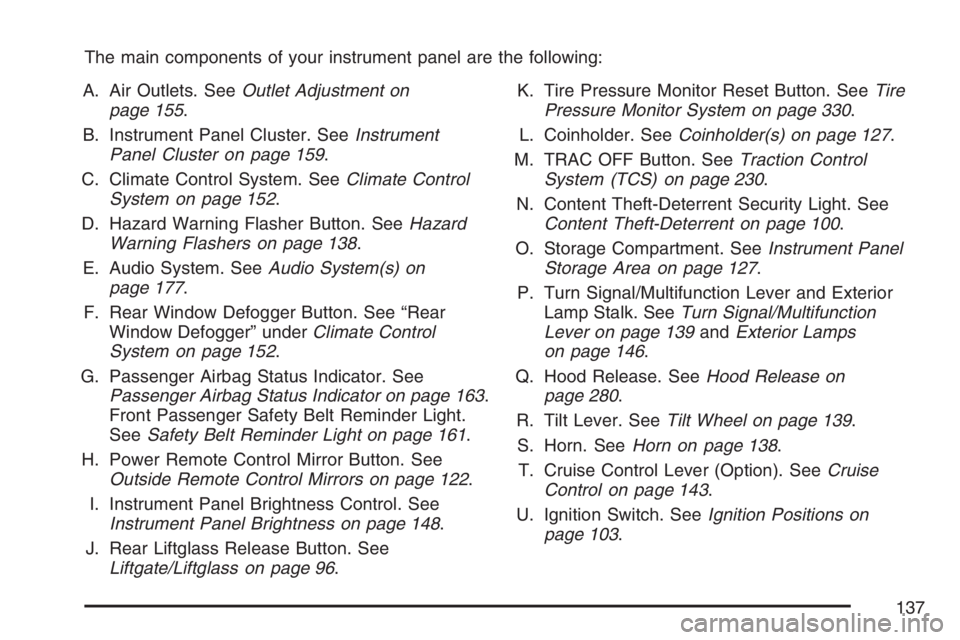
The main components of your instrument panel are the following:
A. Air Outlets. SeeOutlet Adjustment on
page 155.
B. Instrument Panel Cluster. SeeInstrument
Panel Cluster on page 159.
C. Climate Control System. SeeClimate Control
System on page 152.
D. Hazard Warning Flasher Button. SeeHazard
Warning Flashers on page 138.
E. Audio System. SeeAudio System(s) on
page 177.
F. Rear Window Defogger Button. See “Rear
Window Defogger” underClimate Control
System on page 152.
G. Passenger Airbag Status Indicator. See
Passenger Airbag Status Indicator on page 163.
Front Passenger Safety Belt Reminder Light.
SeeSafety Belt Reminder Light on page 161.
H. Power Remote Control Mirror Button. See
Outside Remote Control Mirrors on page 122.
I. Instrument Panel Brightness Control. See
Instrument Panel Brightness on page 148.
J. Rear Liftglass Release Button. See
Liftgate/Liftglass on page 96.K. Tire Pressure Monitor Reset Button. SeeTire
Pressure Monitor System on page 330.
L. Coinholder. SeeCoinholder(s) on page 127.
M. TRAC OFF Button. SeeTraction Control
System (TCS) on page 230.
N. Content Theft-Deterrent Security Light. See
Content Theft-Deterrent on page 100.
O. Storage Compartment. SeeInstrument Panel
Storage Area on page 127.
P. Turn Signal/Multifunction Lever and Exterior
Lamp Stalk. SeeTurn Signal/Multifunction
Lever on page 139andExterior Lamps
on page 146.
Q. Hood Release. SeeHood Release on
page 280.
R. Tilt Lever. SeeTilt Wheel on page 139.
S. Horn. SeeHorn on page 138.
T. Cruise Control Lever (Option). SeeCruise
Control on page 143.
U. Ignition Switch. SeeIgnition Positions on
page 103.
137
Page 150 of 432
Reading Lamps
If your vehicle has a sunroof, there will be a reading
lamp near the sunroof switch. Press the button to
turn the lamp on and press it again to turn it off.
If your vehicle does not have a sunroof, the
vehicle’s inside rearview mirror may have reading
lamps. If your vehicle has reading lamps, there
are two buttons located on the bottom of the
mirror. Press the buttons to turn the lamps on and
press them again to turn the lamps off.
Accessory Power Outlet(s)
With the accessory power outlet, you can plug in
auxiliary electrical equipment.
Your vehicle has an outlet under the climate
controls.
To use the outlet, the ignition must be in ON or
ACC. Pull down the small cover to access
the outlet.
Notice:Leaving electrical equipment on for
extended periods will drain the battery. Always
turn off electrical equipment when not in
use and do not plug in equipment that exceeds
the maximum amperage rating.This circuit is protected by a fuse and has a
maximum current level. Do not use equipment
exceeding the maximum amperage rating.
Certain power accessory plugs may not be
compatible to the power accessory outlet and could
result in blown vehicle or adapter fuses. If you
experience a problem see your dealer for additional
information on the power accessory plugs.
Notice:Adding any electrical equipment to
your vehicle may damage it or keep other
components from working as they should. The
repairs would not be covered by your warranty.
Do not use equipment exceeding maximum
amperage rating of 20 amperes. Check with
your dealer before adding electrical equipment.
When adding electrical equipment, be sure to
follow the proper installation instructions included
with the equipment.
Notice:Improper use of the power outlet can
cause damage not covered by your warranty.
Do not hang any type of accessory or
accessory bracket from the plug because the
power outlets are designed for accessory
power plugs only.
150
Page 236 of 432
When it looks like a chance to pass is coming
up, start to accelerate but stay in the right
lane and do not get too close. Time your move
so you will be increasing speed as the time
comes to move into the other lane. If the way
is clear to pass, you will have a running
start that more than makes up for the distance
you would lose by dropping back. And if
something happens to cause you to cancel
your pass, you need only slow down and drop
back again and wait for another opportunity.
If other vehicles are lined up to pass a slow
vehicle, wait your turn. But take care that
someone is not trying to pass you as you pull
out to pass the slow vehicle. Remember to
glance over your shoulder and check the
blind spot.
Check your vehicle’s mirrors, glance over your
shoulder, and start your left lane change
signal before moving out of the right lane to
pass. When you are far enough ahead of
the passed vehicle to see its front in
your vehicle’s inside mirror, activate the right
lane change signal and move back into
the right lane. Remember that your vehicle’s
passenger side outside mirror is convex.
The vehicle you just passed may seem to be
farther away from you than it really is.
Try not to pass more than one vehicle at a
time on two-lane roads. Reconsider before
passing the next vehicle.
Do not overtake a slowly moving vehicle too
rapidly. Even though the brake lamps are
not ashing, it may be slowing down or starting
to turn.
If you are being passed, make it easy for the
following driver to get ahead of you. Perhaps
you can ease a little to the right.
236
Page 237 of 432
Loss of Control
Let us review what driving experts say about what
happens when the three control systems — brakes,
steering, and acceleration — do not have enough
friction where the tires meet the road to do what the
driver has asked.
In any emergency, do not give up. Keep trying to
steer and constantly seek an escape route or
area of less danger.
Skidding
In a skid, a driver can lose control of the vehicle.
Defensive drivers avoid most skids by taking
reasonable care suited to existing conditions, and
by not overdriving those conditions. But skids
are always possible.
The three types of skids correspond to your
vehicle’s three control systems. In the braking skid,
your wheels are not rolling. In the steering or
cornering skid, too much speed or steering in a
curve causes tires to slip and lose cornering force.
And in the acceleration skid, too much throttle
causes the driving wheels to spin.A cornering skid and an acceleration skid are best
handled by easing your foot off the accelerator
pedal.
If your vehicle starts to slide, ease your foot off
the accelerator pedal and quickly steer the
way you want the vehicle to go. If you start
steering quickly enough, your vehicle may
straighten out. Always be ready for a second skid
if it occurs.
Of course, traction is reduced when water, snow,
ice, gravel, or other material is on the road.
For safety, you will want to slow down and adjust
your driving to these conditions. It is important
to slow down on slippery surfaces because
stopping distance will be longer and vehicle control
more limited.
While driving on a surface with reduced traction, try
your best to avoid sudden steering, acceleration, or
braking, including reducing vehicle speed by
shifting to a lower gear. Any sudden changes could
cause the tires to slide. You may not realize the
surface is slippery until your vehicle is skidding.
Learn to recognize warning clues — such as
enough water, ice, or packed snow on the road to
make a mirrored surface — and slow down when
you have any doubt.
237