size PONTIAC VIBE 2008 User Guide
[x] Cancel search | Manufacturer: PONTIAC, Model Year: 2008, Model line: VIBE, Model: PONTIAC VIBE 2008Pages: 368, PDF Size: 5.7 MB
Page 266 of 368
Tire Size
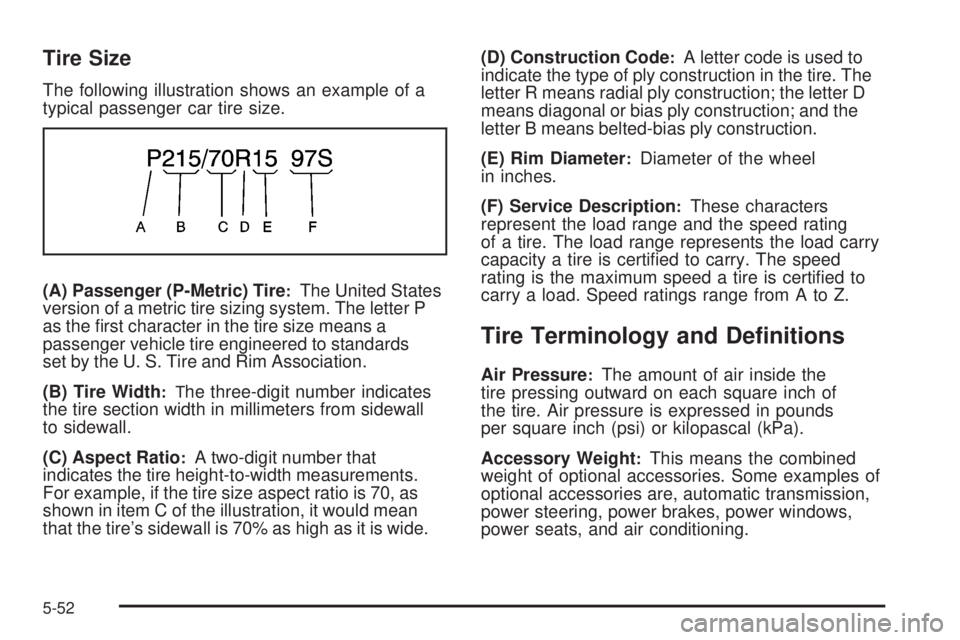
The following illustration shows an example of a
typical passenger car tire size.
(A) Passenger (P-Metric) Tire
:The United States
version of a metric tire sizing system. The letter P
as the rst character in the tire size means a
passenger vehicle tire engineered to standards
set by the U. S. Tire and Rim Association.
(B) Tire Width
:The three-digit number indicates
the tire section width in millimeters from sidewall
to sidewall.
(C) Aspect Ratio
:A two-digit number that
indicates the tire height-to-width measurements.
For example, if the tire size aspect ratio is 70, as
shown in item C of the illustration, it would mean
that the tire’s sidewall is 70% as high as it is wide.(D) Construction Code
:A letter code is used to
indicate the type of ply construction in the tire. The
letter R means radial ply construction; the letter D
means diagonal or bias ply construction; and the
letter B means belted-bias ply construction.
(E) Rim Diameter
:Diameter of the wheel
in inches.
(F) Service Description
:These characters
represent the load range and the speed rating
of a tire. The load range represents the load carry
capacity a tire is certied to carry. The speed
rating is the maximum speed a tire is certied to
carry a load. Speed ratings range from A to Z.
Tire Terminology and Denitions
Air Pressure:The amount of air inside the
tire pressing outward on each square inch of
the tire. Air pressure is expressed in pounds
per square inch (psi) or kilopascal (kPa).
Accessory Weight
:This means the combined
weight of optional accessories. Some examples of
optional accessories are, automatic transmission,
power steering, power brakes, power windows,
power seats, and air conditioning.
5-52
Page 269 of 368
UTQGS (Uniform Tire Quality Grading
Standards):A tire information system that
provides consumers with ratings for a tire’s
traction, temperature, and treadwear. Ratings
are determined by tire manufacturers using
government testing procedures. The ratings
are molded into the sidewall of the tire.
SeeUniform Tire Quality Grading on page 5-65.
Vehicle Capacity Weight
:The number of
designated seating positions multiplied by
150 lbs (68 kg) plus the rated cargo load.
SeeLoading Your Vehicle on page 4-19.
Vehicle Maximum Load on the Tire
:Load on
an individual tire due to curb weight, accessory
weight, occupant weight, and cargo weight.
Vehicle Placard
:A label permanently attached
to a vehicle showing the vehicle’s capacity
weight and the original equipment tire size
and recommended ination pressure. See
“Tire and Loading Information Label” under
Loading Your Vehicle on page 4-19.
Ination - Tire Pressure
Tires need the correct amount of air pressure
to operate effectively.
Notice:Do not let anyone tell you that
under-ination or over-ination is all right.
It is not. If your tires do not have enough air
(under-ination), you can get the following:
Too much exing
Too much heat
Tire overloading
Premature or irregular wear
Poor handling
Reduced fuel economy
If your tires have too much air (over-ination),
you can get the following:
Unusual wear
Poor handling
Rough ride
Needless damage from road hazards
5-55
Page 271 of 368
Tire Pressure Monitor System
The Tire Pressure Monitor System (TPMS) uses radio
and sensor technology to check tire pressure levels.
The TPMS sensors monitor the air pressure in
your vehicle’s tires and transmit tire pressure readings
to a receiver located in the vehicle.
Each tire, including the spare (if provided), should be
checked monthly when cold and inated to the ination
pressure recommended by the vehicle manufacturer
on the vehicle placard or tire ination pressure label.
(If your vehicle has tires of a different size than the
size indicated on the vehicle placard or tire ination
pressure label, you should determine the proper
tire ination pressure for those tires.)
As an added safety feature, your vehicle has been
equipped with a tire pressure monitoring system (TPMS)
that illuminates a low tire pressure telltale when one
or more of your tires is signicantly under-inated.
Accordingly, when the low tire pressure telltale
illuminates, you should stop and check your tires as
soon as possible, and inate them to the proper
pressure. Driving on a signicantly under-inated tire
causes the tire to overheat and can lead to tire failure.
Under-ination also reduces fuel efficiency and tire
tread life, and may affect the vehicle’s handling
and stopping ability.Please note that the TPMS is not a substitute for proper
tire maintenance, and it is the driver’s responsibility to
maintain correct tire pressure, even if under-ination
has not reached the level to trigger illumination of
the TPMS low tire pressure telltale.
Your vehicle has also been equipped with a TPMS
malfunction indicator to indicate when the system is
not operating properly. The TPMS malfunction indicator
is combined with the low tire pressure telltale. When
the system detects a malfunction, the telltale will
ash for approximately one minute and then remain
continuously illuminated. This sequence will continue
upon subsequent vehicle start-ups as long as the
malfunction exists.
When the malfunction indicator is illuminated, the
system may not be able to detect or signal low tire
pressure as intended. TPMS malfunctions may occur
for a variety of reasons, including the installation
of replacement or alternate tires or wheels on the
vehicle that prevent the TPMS from functioning properly.
Always check the TPMS malfunction telltale after
replacing one or more tires or wheels on your vehicle
to ensure that the replacement or alternate tires
and wheels allow the TPMS to continue to function
properly.
SeeTire Pressure Monitor Operation on page 5-58,
for additional information.
5-57
Page 273 of 368

This light also comes on for a few seconds and then
goes off when you turn the ignition to ON/RUN.
This indicates the TPMS is functioning properly.
If the low-tire pressure warning light comes on while
driving your vehicle, the system may have detected a
low-tire condition. You need to stop as soon as possible
and check the tires.
The low tire pressure warning light may come on in cool
weather when the vehicle is rst started, and then
turn off as you start to drive. This could be an early
indicator that the air pressure in the tire(s) are getting
low and need to be inated to the proper pressure.
A Tire and Loading Information label, attached to your
vehicle, shows the size of your vehicle’s original
equipment tires and the correct ination pressure for
your vehicle’s tires when they are cold. SeeLoading
Your Vehicle on page 4-19, for an example of the
Tire and Loading Information label and its location
on your vehicle. Also seeInflation - Tire Pressure
on page 5-55.
Your vehicle’s TPMS can warn you about a low tire
pressure condition but it does not replace normal
tire maintenance. SeeTire Inspection and Rotation
on page 5-61andTires on page 5-49.TPMS Malfunction Light
The TPMS will not function properly if one or more of
the TPMS sensors are missing or inoperable. When
the system detects a malfunction, the low tire warning
light ashes for about one minute and then stays
on for the remainder of the ignition cycle. The low tire
warning light comes on at each ignition cycle until
the problem is corrected. Some of the conditions that
can cause the malfunction light to come on are:
One of the road tires has been replaced with the
spare tire. The spare tire does not have a TPMS
sensor. The TPMS malfunction light and DIC
message should go off once you re-install the
road tire containing the TPMS sensor.
The initialization (reset) procedure was not
performed correctly after replacing or rotating tires
or wheels. See “TPMS Reset” later in this section.
One or more TPMS sensors are missing or
damaged. The DIC message and the TPMS
malfunction light should go off when the TPMS
sensors are installed and the sensor matching
process is performed successfully. See your
dealer/retailer for service.
5-59
Page 277 of 368
When It Is Time for New Tires
Various factors, such as maintenance, temperatures,
driving speeds, vehicle loading, and road conditions
inuence when you need new tires.
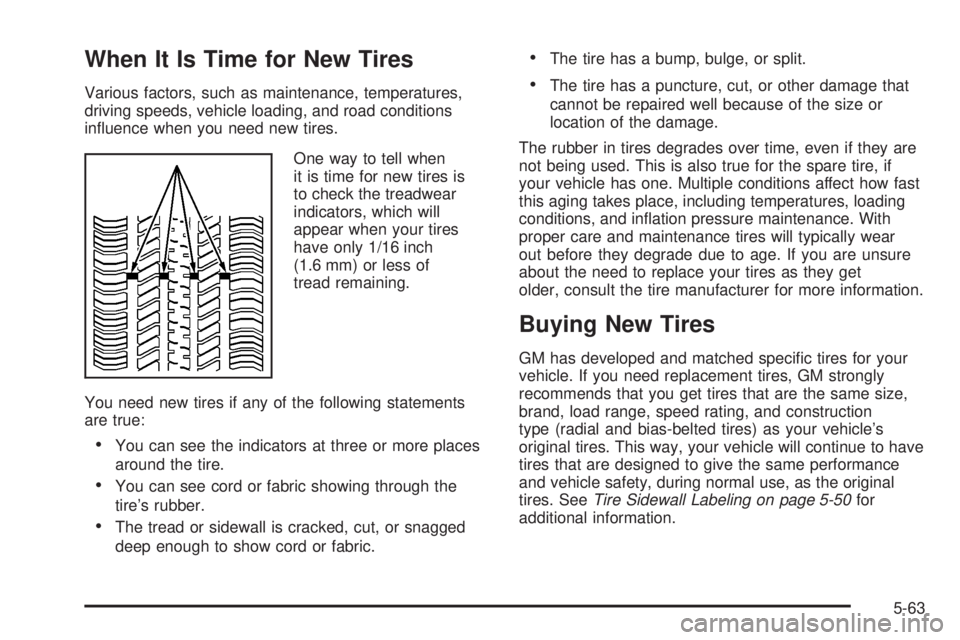
One way to tell when
it is time for new tires is
to check the treadwear
indicators, which will
appear when your tires
have only 1/16 inch
(1.6 mm) or less of
tread remaining.
You need new tires if any of the following statements
are true:
You can see the indicators at three or more places
around the tire.
You can see cord or fabric showing through the
tire’s rubber.
The tread or sidewall is cracked, cut, or snagged
deep enough to show cord or fabric.
The tire has a bump, bulge, or split.
The tire has a puncture, cut, or other damage that
cannot be repaired well because of the size or
location of the damage.
The rubber in tires degrades over time, even if they are
not being used. This is also true for the spare tire, if
your vehicle has one. Multiple conditions affect how fast
this aging takes place, including temperatures, loading
conditions, and ination pressure maintenance. With
proper care and maintenance tires will typically wear
out before they degrade due to age. If you are unsure
about the need to replace your tires as they get
older, consult the tire manufacturer for more information.
Buying New Tires
GM has developed and matched specic tires for your
vehicle. If you need replacement tires, GM strongly
recommends that you get tires that are the same size,
brand, load range, speed rating, and construction
type (radial and bias-belted tires) as your vehicle’s
original tires. This way, your vehicle will continue to have
tires that are designed to give the same performance
and vehicle safety, during normal use, as the original
tires. SeeTire Sidewall Labeling on page 5-50for
additional information.
5-63
Page 278 of 368
GM recommends replacing tires in sets of four.
This is because uniform tread depth on all tires will help
keep your vehicle performing most like it did when the
tires were new. Replacing less than a full set of tires can
affect the braking and handling performance of your
vehicle. SeeTire Inspection and Rotation on page 5-61.
{CAUTION:
Mixing tires could cause you to lose
control while driving. If you mix tires of
different sizes, brands, or types (radial
and bias-belted tires), the vehicle may not
handle properly, and you could have a
crash. Using tires of different sizes,
brands, or types may also cause damage
to your vehicle. Be sure to use the correct
size, brand, and type of tires on all
wheels. It is all right to drive with your
compact spare temporarily, as it was
developed for use on your vehicle. See
Compact Spare Tire on page 5-81.
{CAUTION:
If you use bias-ply tires on your vehicle,
the wheel rim anges could develop
cracks after many miles of driving. A tire
and/or wheel could fail suddenly, causing
a crash. Use only radial-ply tires with the
wheels on your vehicle.
Vehicles that have a tire pressure monitoring system
could give an inaccurate low-pressure warning if
tires not recommended for your vehicle are installed.
Tires that do not match the original equipment tires
could give a low-pressure warning that is higher or
lower than the proper warning level you would get with
original equipment tires. SeeTire Pressure Monitor
System on page 5-57.
Your vehicle’s original equipment tires are listed on
the Tire and Loading Information Label. SeeLoading
Your Vehicle on page 4-19, for more information
about the Tire and Loading Information label and its
location on your vehicle.
5-64
Page 279 of 368
Different Size Tires and Wheels
If you add wheels or tires that are a different size than
your original equipment wheels and tires, this may
affect the way your vehicle performs, including its
braking, ride and handling characteristics, stability,
and resistance to rollover. Additionally, if your vehicle
has electronic systems such as, anti-lock brakes,
traction control, and electronic stability control, the
performance of these systems can be affected.
{CAUTION:
If you add different sized wheels, your
vehicle may not provide an acceptable
level of performance and safety if tires not
recommended for those wheels are selected.
You may increase the chance that you will
crash and suffer serious injury. Only use
GM specic wheel and tire systems developed
for your vehicle, and have them properly
installed by a GM certied technician.
SeeBuying New Tires on page 5-63andAccessories
and Modifications on page 5-3for additional information.
Uniform Tire Quality Grading
Quality grades can be found where applicable
on the tire sidewall between tread shoulder
and maximum selection width. For example:
Treadwear 200 Traction AA Temperature A
The following information relates to the system
developed by the Unites States National
Highway Traffic Safety Administration (NHTSA),
which grades tires by treadwear, traction, and
temperature performance. This applies only
to vehicles sold in the United States. The grades
are molded on the sidewalls of most passenger
car tires. The Uniform Tire Quality Grading
(UTQG) system does not apply to deep tread,
winter-type snow tires, space-saver, or temporary
use spare tires, tires with nominal rim diameters
of 10 to 12 inches (25 to 30 cm), or to some
limited-production tires.
While the tires available on General Motors
passenger cars and light trucks may vary with
respect to these grades, they must also conform
to federal safety requirements.
5-65
Page 282 of 368
Used Replacement Wheels
{CAUTION:
Putting a used wheel on your vehicle is
dangerous. You cannot know how it has been
used or how far it has been driven. It could
fail suddenly and cause a crash. If you have
to replace a wheel, use a new GM original
equipment wheel.
Tire Chains
Notice:Use tire chains only where legal and only
when you must. Use only SAE Class “S” type
chains that are the proper size for your tires.
Install them on the front tires and tighten them as
tightly as possible with the ends securely fastened.
Drive slowly and follow the chain manufacturer’s
instructions. If you can hear the chains contacting
your vehicle, stop and retighten them. If the contact
continues, slow down until it stops. Driving too
fast or spinning the wheels with chains on will
damage your vehicle.
5-68
Page 295 of 368
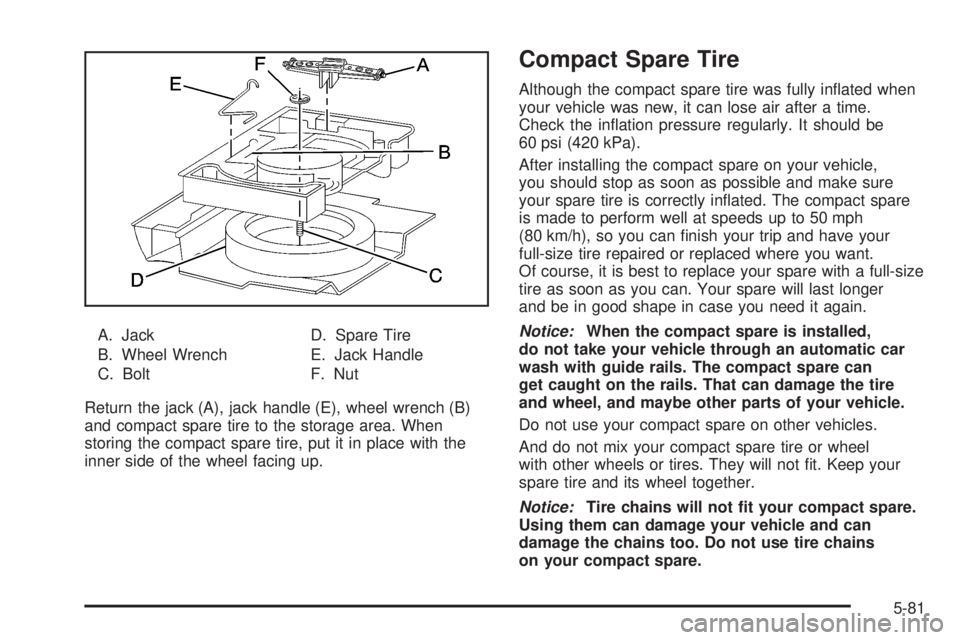
A. Jack
B. Wheel Wrench
C. BoltD. Spare Tire
E. Jack Handle
F. Nut
Return the jack (A), jack handle (E), wheel wrench (B)
and compact spare tire to the storage area. When
storing the compact spare tire, put it in place with the
inner side of the wheel facing up.
Compact Spare Tire
Although the compact spare tire was fully inated when
your vehicle was new, it can lose air after a time.
Check the ination pressure regularly. It should be
60 psi (420 kPa).
After installing the compact spare on your vehicle,
you should stop as soon as possible and make sure
your spare tire is correctly inated. The compact spare
is made to perform well at speeds up to 50 mph
(80 km/h), so you can nish your trip and have your
full-size tire repaired or replaced where you want.
Of course, it is best to replace your spare with a full-size
tire as soon as you can. Your spare will last longer
and be in good shape in case you need it again.
Notice:When the compact spare is installed,
do not take your vehicle through an automatic car
wash with guide rails. The compact spare can
get caught on the rails. That can damage the tire
and wheel, and maybe other parts of your vehicle.
Do not use your compact spare on other vehicles.
And do not mix your compact spare tire or wheel
with other wheels or tires. They will not t. Keep your
spare tire and its wheel together.
Notice:Tire chains will not t your compact spare.
Using them can damage your vehicle and can
damage the chains too. Do not use tire chains
on your compact spare.
5-81
Page 305 of 368
Headlamp Wiring
The headlamp wiring is protected by a circuit breaker.
An electrical overload will cause the lamps to go on
and off, or in some cases to remain off. If this happens,
have your headlamp wiring checked right away.
Windshield Wiper Fuses
The windshield wiper motor is protected by a circuit
breaker and a fuse. If the motor overheats due to heavy
snow or ice, the wiper will stop until the motor cools.
If the overload is caused by some electrical problem,
and not snow or ice, be sure to get it xed.
Power Windows and Other
Power Options
Circuit breakers in the fuse block protect the power
windows and other power accessories. When the
current load is too heavy, the circuit breaker opens
and closes, protecting the circuit until the problem is
xed or goes away.
Fuses and Circuit Breakers
The wiring circuits in your vehicle are protected from
short circuits by a combination of fuses, circuit breakers
and fusible thermal links. This greatly reduces the
chance of res caused by electrical problems.
Look at the silver-colored band inside the fuse. If the
band is broken or melted, replace the fuse. Be sure you
replace a bad fuse with a new one of the identical
size and rating.
If you ever have a problem on the road and don’t
have a spare fuse, you can borrow one that has the
same amperage. Just pick some feature of your
vehicle that you can get along without – like the radio
or cigarette lighter – and use its fuse, if it is the
correct amperage. Replace it as soon as you can.
5-91