tow PONTIAC VIBE 2008 User Guide
[x] Cancel search | Manufacturer: PONTIAC, Model Year: 2008, Model line: VIBE, Model: PONTIAC VIBE 2008Pages: 368, PDF Size: 5.7 MB
Page 95 of 368
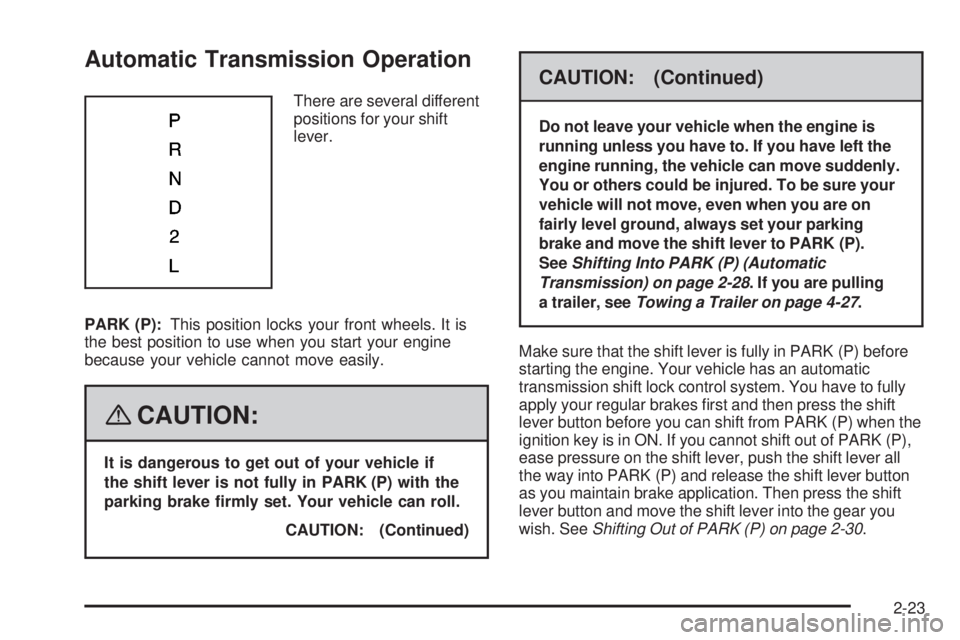
Automatic Transmission Operation
There are several different
positions for your shift
lever.
PARK (P):This position locks your front wheels. It is
the best position to use when you start your engine
because your vehicle cannot move easily.
{CAUTION:
It is dangerous to get out of your vehicle if
the shift lever is not fully in PARK (P) with the
parking brake rmly set. Your vehicle can roll.
CAUTION: (Continued)
CAUTION: (Continued)
Do not leave your vehicle when the engine is
running unless you have to. If you have left the
engine running, the vehicle can move suddenly.
You or others could be injured. To be sure your
vehicle will not move, even when you are on
fairly level ground, always set your parking
brake and move the shift lever to PARK (P).
SeeShifting Into PARK (P) (Automatic
Transmission) on page 2-28. If you are pulling
a trailer, seeTowing a Trailer on page 4-27.
Make sure that the shift lever is fully in PARK (P) before
starting the engine. Your vehicle has an automatic
transmission shift lock control system. You have to fully
apply your regular brakes rst and then press the shift
lever button before you can shift from PARK (P) when the
ignition key is in ON. If you cannot shift out of PARK (P),
ease pressure on the shift lever, push the shift lever all
the way into PARK (P) and release the shift lever button
as you maintain brake application. Then press the shift
lever button and move the shift lever into the gear you
wish. SeeShifting Out of PARK (P) on page 2-30.
2-23
Page 100 of 368
If you are towing a trailer, seeTowing a Trailer on
page 4-27.
Shifting Into PARK (P)
(Automatic Transmission)
{CAUTION:
It can be dangerous to get out of your vehicle
if the shift lever is not fully in PARK (P) with
the parking brake rmly set. Your vehicle can
roll. If you have left the engine running, the
vehicle can move suddenly. You or others
could be injured. To be sure your vehicle will
not move, even when you are on fairly level
ground, use the steps that follow. If you are
pulling a trailer, seeTowing a Trailer on
page 4-27.To shift into PARK (P), do the following:
1. Hold the brake pedal down with your right foot and
set the parking brake. SeeParking Brake on
page 2-27for more information.
2. Move the shift lever into PARK (P) by holding in the
button on the shift lever and pushing the lever all
the way toward the front of the vehicle.
3. Turn the ignition key to LOCK/OFF.
4. Remove the key and take it with you. If you can
leave your vehicle with the key in your hand, your
vehicle is in PARK (P).
2-28
Page 101 of 368
Leaving Your Vehicle With the Engine
Running (Automatic Transmission)
{CAUTION:
It can be dangerous to leave your vehicle with
the engine running. Your vehicle could move
suddenly if the shift lever is not fully in
PARK (P) with the parking brake rmly set.
And, if you leave the vehicle with the engine
running, it could overheat and even catch re.
You or others could be injured. Do not leave
your vehicle with the engine running.
If you have to leave your automatic transmission vehicle
with the engine running, be sure your vehicle is in
PARK (P) and your parking brake is rmly set before
you leave it. After you have moved the shift lever into
PARK (P), hold the regular brake pedal down. Then,
see if you can move the shift lever away from PARK (P)
without rst pulling it toward you. If you can, it means that
the shift lever was not fully locked into PARK (P).
Torque Lock (Automatic Transmission)
If you are parking on a hill and you do not shift into
PARK (P) properly, the weight of the vehicle may put too
much force on the parking pawl in the transmission. You
may nd it difficult to pull the shift lever out of PARK (P).
This is called “torque lock.” To prevent torque lock, set
the parking brake and then shift into PARK (P) properly
before you leave the driver’s seat. To nd out how, see
Shifting Into PARK (P) (Automatic Transmission) on
page 2-28.
When you are ready to drive, move the shift lever out of
PARK (P) before you release the parking brake.
If torque lock does occur, you may need to have another
vehicle push yours a little uphill to take some of the
pressure from the parking pawl in the transmission,
so you can pull the shift lever out of PARK (P).
2-29
Page 103 of 368
Parking Your Vehicle
(Manual Transmission)
Before you get out of your vehicle, move the shift lever
into REVERSE (R), and rmly apply the parking brake.
Once the shift lever has been placed into REVERSE (R)
with the clutch pedal pressed in, you can turn the ignition
key to LOCK, remove the key and release the clutch.
If you are parking on a hill, or if your vehicle is pulling a
trailer, seeTowing a Trailer on page 4-27.
Evaporation Pump
Your vehicle is equipped with a vacuum pump for the
vehicle’s fuel evaporation system. This pump performs a
fuel evaporation leakage test approximately ve hours
after the engine is turned off. You may hear a sound
coming from underneath the rear cargo compartment
for several minutes.
The noise is normal and does not signify a malfunction.
See your dealer/retailer with any questions.
Parking Over Things That Burn
{CAUTION:
Things that can burn could touch hot exhaust
parts under your vehicle and ignite. Do not
park over papers, leaves, dry grass, or other
things that can burn.
2-31
Page 105 of 368
{CAUTION:
It can be dangerous to get out of your vehicle
if the shift lever is not fully in PARK (P) with
the parking brake rmly set. Your vehicle can
roll. Do not leave your vehicle when the engine
is running unless you have to. If you have left
the engine running, the vehicle can move
suddenly. You or others could be injured.
To be sure your vehicle will not move, even
when you are on fairly level ground, always
set the parking brake and move the shift lever
to PARK (P).
Follow the proper steps to be sure your vehicle
will not move. SeeShifting Into PARK (P) (Automatic
Transmission) on page 2-28.
If you are parking on a hill and if you are pulling a
trailer, also seeTowing a Trailer on page 4-27.
Mirrors
Manual Rearview Mirror
When you are sitting in a comfortable driving position,
adjust the mirror so you can see clearly behind your
vehicle. Grip the mirror in the center to move it up
or down and side to side. The day/night adjustment
allows you to adjust the mirror to avoid glare from the
lamps behind you. Push the tab forward for daytime
use and pull it for nighttime use.
The mirror may have lights located on the bottom of
the mirror. Press the button next to each light to turn it
on or off.
Manual Rearview Mirror with
OnStar
®
When you are sitting in a comfortable driving position,
adjust the mirror so you can see clearly behind your
vehicle. Hold the mirror in the center to move it up or
down and side to side. The day/night adjustment allows
you to adjust the mirror to avoid glare from the lamps
behind you. Move the lever to the right for nighttime
use and to the left for daytime use.
There may also be three OnStar
®buttons located at the
bottom of the mirror face. See your dealer/retailer for
more information on the system and how to subscribe to
OnStar
®. SeeOnStar®System on page 2-35for more
information on the services OnStar®provides.
2-33
Page 111 of 368

Storage Areas
Glove Box
To open the glove box, lift up on the lever.
Cupholder(s)
There are two xed cupholders located in the console
area between the two front seats. There are also
two cupholders that fold out of the rear of the console
storage unit.
Coinholder(s)
Your instrument panel may have a coinholder located to
the left of the steering wheel and on the center console
near the parking brake.
Instrument Panel Storage
There are storage compartments located on the
instrument panel in two places. They are below the
interior/instrument panel brightness dial and below the
shift lever. Pull the top of the door toward you to open it
or for the compartment below the shift lever, push the
button to open it.
Center Console Storage
A storage area is located in the console between
the seats.
To access the storage area, pull up the lock release
lever while raising the lid.
Floor Mats
The driver’s side oor mat is held in place by
two locator hooks.
Be sure the driver’s side oor mat is properly placed
on the oor so that it does not block the movement of
the accelerator pedal.
2-39
Page 122 of 368
Y. Power Outlet. SeePower Outlet 115 Volt Alternating
Current on page 3-18.
Z. Parking Brake. SeeParking Brake on page 2-27.
AA. Center Console Storage Area. SeeCenter Console
Storage on page 2-39.
AB. Glove Box. SeeGlove Box on page 2-39.
Hazard Warning Flashers
The hazard warning ashers let you warn the police and
others that you have a problem. The front and rear
turn signal lamps will ash on and off.
The hazard warning
asher button is located
towards the center of
the instrument panel.
Press the button to make the front and rear turn signal
lamps ash on and off. Press the button again to
turn the ashers off.While the hazard warning ashers are on, the turn
signals do not work.
The hazard warning ashers work no matter what
position the key is in, and even if the key is not in
the ignition switch.
Other Warning Devices
If you carry reective triangles, you can set them up at
the side of the road about 300 feet (100 m) behind
your vehicle.
Horn
Press near or on the horn symbols on the steering
wheel pad to sound the horn.
3-6
Page 124 of 368

Turn and Lane-Change Signals
The turn signal has an upward (for right) and a
downward (for left) position. These positions allow
you to signal a turn or a lane change.
To signal a turn, move the lever all the way up or
down. When the turn is nished, the lever will return
automatically.
To signal a lane change, raise or lower the lever until
the arrow starts to ash. Hold it there until you complete
your lane change. The lever will return by itself when
you release it.
An arrow on the instrument
panel cluster will ash in
the direction of the turn or
lane change.
If you signal a turn or a lane change and notice the
arrow ashing rapidly, a signal bulb may be burned
out and other drivers will not see your turn signal.
If a bulb is burned out, have it replaced to help avoid an
accident. If the arrows do not go on at all when you signal
a turn, check for burned-out bulbs and then check the
fuse. SeeFuses and Circuit Breakers on page 5-91.
Headlamp High/Low-Beam Changer
The headlamps must be on for this feature to work.
For high beams, push the turn signal lever away
from you.
When the high beams
are on, this light on the
instrument panel cluster
also will be on.
It will go off when you switch to the low beams.
To switch back to low beams, pull the lever toward you.
Flash-to-Pass
With the lever in the low-beam position, pull the lever
toward you to momentarily switch to high beams
(to signal that you are going to pass). If you have the
headlamps on when you release the lever, they will
return to the low beams.
3-8
Page 126 of 368
Windshield Washer
Pull the lever toward you to spray washer uid on the
windshield. The spray will continue until you release the
lever. The wipers will run a few times. SeeWindshield
Washer Fluid on page 5-34.
The knob automatically returns from the position after
you release it.
{CAUTION:
In freezing weather, do not use your washer
until the windshield is warmed. Otherwise the
washer uid can form ice on the windshield,
blocking your vision.
Rear Window Wiper/Washer
Turn the knob up or down as far as it will go, to squirt
washer uid on the rear window. The knob automatically
returns from these positions after it is released.
The rear window washer uses the same uid bottle
as the windshield washer. However, the rear window
washer will run out of uid before the windshield washer.
If you can wash the windshield but not the rear
window, check the uid level.
{CAUTION:
In freezing weather, do not use your washer
until the windshield is warmed. Otherwise the
washer uid can form ice on the windshield,
blocking your vision.
3-10
Page 129 of 368
Reducing Speed While Using Cruise
Control
There are two ways to reduce your speed while using
cruise control:
Push and hold the lever to−SET until you reach the
lower speed desired, then release it.
To slow down in very small amounts, push the lever
down briey. Each time this is done, the vehicle will
go about 1 mph (1.6 km/h) slower.
Passing Another Vehicle While Using
Cruise Control
Use the accelerator pedal to increase the vehicle speed.
When you take your foot off the pedal, the vehicle
slows down to the cruise control speed you set earlier.
Using Cruise Control on Hills
How well the cruise control works on hills depends upon
the vehicle speed, load, and the steepness of the hills.
When going up steep hills, you might have to step on
the accelerator pedal to maintain the vehicle speed.When going downhill, you might have to brake or shift to
a lower gear to keep the vehicle speed down. Of course,
applying the brake or downshifting to SECOND (2) or
LOW (L) turns off the cruise control. Many drivers nd this
to be too much trouble and do not use cruise control on
steep hills.
Ending Cruise Control
There are several ways to turn off the cruise control:
Step lightly on the brake pedal or push the
clutch pedal, if you have a manual transaxle.
Press the ON-OFF button again.
Pull the cruise control lever toward you.
Erasing Speed Memory
When you turn off the cruise control or the ignition, the
cruise control set speed memory is erased.
3-13